Let's drop the bomb: It's time to get rid of nukes
The U.S. bishops issued their 1983 pastoral letter The Challenge of Peace without a total condemnation of nuclear arms but planned to revisit the issue after the Cold War. More than 25 years later, the question is still on the table.
(The results of the Sounding Board survey follow the article)
A native Texan, I was ordained a priest of the Diocese of Amarillo in 1946. For all but three of the following years my assignments as a priest were within 17 miles of the Pantex facility, located northeast of Amarillo.
Pantex, I learned in time, was the final assembly and disassembly plant for all nuclear warheads produced in the United States. The plant lies within the territory of St. Francis of Assisi Parish, where I was pastor from 1971 until 1980.
Generally supportive of President Dwight Eisenhower's "Atoms for Peace" concept, I was unconcerned about what was going on at Pantex. When parishioners approached me with qualms about the morality of working there, I tried to reassure them and referred them to the bishop of Amarillo.
On May 30, 1980, I became the bishop.
That summer Sister Regina Foppe, a Victory Noll Missionary Sister, challenged me to condemn the assembly of nuclear weapons in our own backyard as a theft from the poor. A resolution by the diocesan presbyteral council seconded her challenge.
Still, I hesitated. That Christmas I preached a bland sermon on peace and good will and urged an end to the Cold War between our country and the Soviet Union.
Then the year 1981 arrived with more wake-up calls, the first a subtle one as I was praying Psalm 33 in the liturgy of the hours: "A vain hope for safety is the horse; despite its power it cannot save." Something, someone-the Spirit of God?-tricked me. I found myself praying, "A vain hope for safety is the nuclear bomb; despite its power it cannot save."
I shook that off, but then a barrage of other voices followed. On February 15 Pope John Paul II visited the Peace Park in Hiroshima, Japan, the first city to experience the utter devastation of an atomic bomb.
"I bow my head," the pope said, "as I recall the memory of the thousands of men, women, and children who lost their lives in that one terrible moment, or who for long years carried in their bodies and minds those terrible seeds of death which inexorably pursued their process of destruction. . . . To remember Hiroshima is to abhor nuclear war. To remember Hiroshima is to commit oneself to peace."
That same February a story on the front page of Amarillo's newspaper reported how Oblate Father Larry Rosebaugh and five others had scaled the outer security fence around Pantex, been arrested, and were being held in the Potter County Detention Center to await trial. Stunned, I went to see him and found a saintly man.
After that, a permanent deacon and his wife came to see me, asking if it was morally acceptable for him to be working at Pantex.
In June Archbishop Raymond Hunthausen of Seattle denounced the Trident submarine base near Seattle as "the Auschwitz of Puget Sound." The nuclear warheads atop the submarines' intercontinental ballistic missiles were assembled at Pantex and delivered by train in heavily guarded, white, heat-reflecting railroad cars. If Hunthausen judged the possession of nuclear weapons immoral, what was my judgment to be about their assembly at Pantex?
Finally, in August the White House approved the assembly at Pantex of the enhanced radiation warhead, the so-called neutron bomb. The bomb was specifically designed for "enhanced" destruction of all biological life-including men, women, children, and infants in the womb-while leaving material infrastructure intact.
It was just one more step in the implementation of the immoral policy of "Mutual Assured Destruction," which the two superpowers had adopted to deter each other from launching a nuclear attack. The Cold War arms race between the United States and the Soviet Union resulted in each country possessing 25,000 nuclear warheads, more than enough to destroy the earth many times over. The policy, dubbed MAD, remains in force today.
Convinced at last that we had lost our moral moorings, I issued a statement urging workers engaged in the production, assembly, and deployment of nuclear weapons to consider the implications of what they were doing, to resign from such activities, and to seek employment in peaceful pursuits.
The call ignited controversy, condemnation, and praise, and it brought state, national, and international media to the Texas Panhandle. At their next meeting, the bishops of Texas unanimously expressed their support and issued a statement of their own condemning nuclear weapons.
This action of the Texas bishops was later credited by some with moving the National Conference of Catholic Bishops in its November 1981 general assembly to appoint a committee of five bishops, headed by the late Cardinal Joseph A. Bernardin, to undertake a nationwide consultation on the issue.
A year and a half later, in May 1983, the U.S. Catholic bishops met in Chicago to finalize the pastoral letter The Challenge of Peace: God's Promise and Our Response.
The debate was heated. Because nuclear bombs are so indiscriminately destructive and leave a legacy of radiation so sickening, the majority was convinced that we had no choice but to condemn them lock, stock, and barrel.
On the second day the majority voted in a provisional ballot for a total moral condemnation of nuclear weapons. In the final vote on the third day, however, to get in line with the more nuanced position of the Vatican, we voted--many of us reluctantly--for a strictly conditioned moral acceptance of nuclear weapons as a temporary deterrent to aggression.
We emphasized that such a policy could not be "a long-time basis for peace" and stipulated that the acceptance was to change to condemnation once the Cold War ended. We agreed to review the situation every five years.
But even though the Cold War ended in 1989, the issue has never been put back on the agenda of the bishops' general assembly.
Why have we not kept the promise we made? Why have we not issued an unconditional moral condemnation of the production, assembly, and deployment of nuclear weapons? Why have we not formally declared ourselves to be a church of peace, a full-fledged pro-life church?
"What can be said . . . about those governments which count on nuclear arms as a means of ensuring the security of their countries?" Pope Benedict XVI asked in his 2006 World Day of Peace message. His answer: "This point of view is not only baneful but also completely fallacious. In a nuclear war there would be no victors, only victims."
More than a quarter century after the peace pastoral, it is time for us bishops-and all U.S. Catholics-to act on this conviction, to speak out more forcefully, and take on a moral leadership role in the current efforts to completely eliminate nuclear weapons.
Despite disagreements on other issues, the pope has gone out of his way to praise President Barack Obama for actively pursuing nuclear disarmament, a significant departure from previous U.S. policy. Last September Obama convened and chaired a meeting of the United Nations Security Council that unanimously approved a resolution on nuclear disarmament that commits the international community "to work for a world without nuclear weapons."
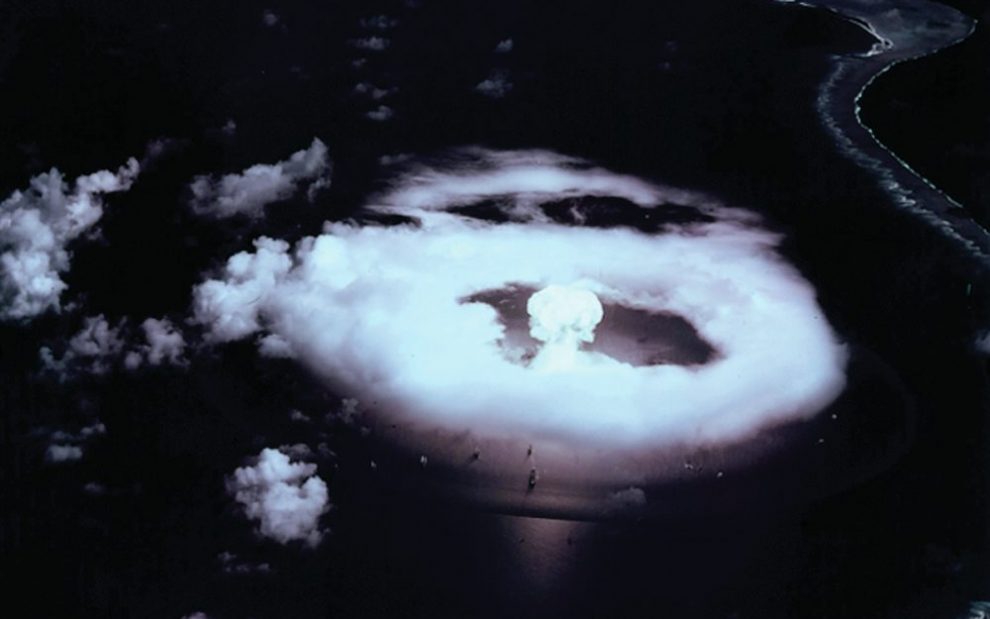
Sixty-five years after Hiroshima and Nagasaki, the specter of giant mushroom clouds rising in the skies above our crowded cities that leaves children, women, and men evaporated, cremated, and lifeless, haunts us as nuclear weapons continue to proliferate.
The hour of decision is here for the Catholic Church in the United States, led by our bishops, to join the growing secular and religious chorus of voices demanding the abolition of nuclear weapons.
If not now, when?
And the survey says...
Bishop Leroy Matthiesen is the retired bishop of the Diocese of Amarillo, Texas.
This article appeared in the April 2010 issue of U.S. Catholic (Vol. 75 no. 4, pages 27-31).
Nuclear weapons
By Al (not verified) on Tuesday, August 10, 2010Good article and the 2 comments are well said. Interestingly, both cities in Japan are in better shape today than Detroit, MI. During the cold war, neither party used nuclear weapons so having them, by itself, does not guarantee a nuclear attack. Today we face a problem with nuclear capabilty available to nations that have unstable leadership. That means that it would be neither safe nor prudent for us to get rid of our weapons as they do provide a deterrent. If one wants to rid the world of a threat of nuclear war (or any other war) we must find a way to rid ourselves of these unstable and immoral leaders. A bigger threat to America, at present, is the declining morality of our own society. As for the Obama administration, it is yet to be shown that their motives are either moral or in the best interests of this nation.
Nuclear Weapons
By The Truth (not verified) on Tuesday, March 23, 2010This was a good article and I respect your opinion and that of others. However, thinking that we could actually dismantle our nuclear arsenal is akin to saying that we should have pretty rainbows and 80 degree weather to look forward to every single day for the rest of our lives. It would be great to have, but it just isn't practical nor realistic.
Nuclear weapons are PEACE KEEPERS due to failsafe mechanisms. For those of you that don't know, China can't launch even a surprise nuclear attack against us because we have failsafe nuclear weapons hidden all over that will launch at different times at our attackers... it might be a week, it might be 10 years after the fact to ensure we give a maximum deterrent. Never to mind our Trident subs mentioned in this article and long range bombers acting as immediate deterrents. And if none of that is enough, a full blown nuclear war means we all freeze to death.
Even if we were to be foolish enough to get rid of our nuclear arsenal, does anyone really think that Iran or North Korea are going to simply join in the fray? Unfortunately, it is a pipe dream.
--"the Pope said... "To remember Hiroshima is to abhor nuclear war. To remember Hiroshima is to commit oneself to peace."
(cont...)
Nuclear Weapons (Part 2)
By The Truth (not verified) on Tuesday, March 23, 2010What exactly happened after the bombings on Hiroshima and Nagasaki? Just SIX DAYS after the bombing of Nagasaki, Japan surrendered and the war ended! They actually brought about PEACE because of their massive destructive potential. We had two world wars with a couple decade time span, but since Nagasaki, it's been over 6 decades since a world war because they are peace keepers.
In the meanwhile, we decided not to use nuclear weapons in Vietnam and instead used Agent Orange which killed FAR more people than Nagasaki and Hiroshima combined.
Like most things in life, we can see the glass half empty or half full. The half empty perspective is that many people died in the nuclear bombings. The half full perspective is that many other countless lives were saved by having the war end expeditiously as a result of the bombs.
--"Because nuclear bombs are so indiscriminately destructive and leave a legacy of radiation so sickening"
I'm sorry, but that radiation portion isn't fully accurate. Both Nagasaki and Hiroshima are thriving cities today... it's not like it is some radioactive wasteland. Moreover, people that survived the bombings and received lower dosages of the radiation are actually living LONGER than average. And when the WHO released their findings about Chernobyl a decade after the accident, there were only a total of 56 direct deaths associated with it with a decent percentage of those being firefighters on the scene.
Japan and Nukes
By Seeker (not verified) on Friday, August 5, 2011Interesting comments however the historical question left unanswered is "would Japan have surrendered had they been apraised of or seen a demonstration of nuclear weapons before they were actually dropped? Since no real offers were made, we can't know. Furthermore since that question that cannot be answered it's a little univocal to claim "only by dropping the bomb did we find peace".
Hiroshima and Nagasaki may be prosperous however I wonder if you bothered to speak to any of the survivors of the bomb blast? Frankly, I suspect you would hear a much different story. There are also questions about genetic mutation among survivors...
It's not about "rainbows"..its about saving the world from major destruction since the new historical situation contains nukes far more pervasive and more powerful than the two dropped in August 1945.
U.S. Catholic insists on a civil and respectful dialogue on our website, following our Comment policy. Comments should be charitable, on topic, and brief. U.S. Catholic reserves the right to delete comments deemed inappropriate. Links are not allowed and comments with them will be moderated or deleted. We encourage you to choose your words wisely.