Logo

The Difference God Makes

Monday, January 11, 2010
The Difference God Makes
ShareThis
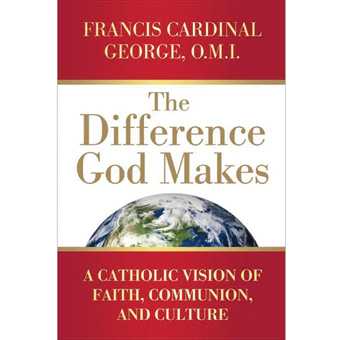
The Difference God Makes By Cardinal Francis George, O.M.I. (Herder and Herder, 2009)

Chicago’s Cardinal Francis George has a knack for delivering off-the-cuff comments that generate controversy. Once asked why the church will not ordain women as priests, he responded, “Have you ever seen a male prima ballerina?” But those inclined to label George a “conservative” should spend some time with his new book, subtitled A Catholic Vision of Faith, Communion, and Culture. In a country where “conservative” is often used to describe those committed to limited government, unfettered markets, and muscular foreign policy, the application of the term to George may obscure as much as it reveals.

The book is a collection of essays and addresses that George has attempted to weld into a unified whole. The first section deals with church’s mission to the world with particular attention to the challenges posed by secularism and globalization. A second section focuses on the church’s inner life. In the final section George takes a more philosophical turn, arguing that human beings only exist as persons in and through others.

The essays can be seen as a running argument about evangelization in cultures shaped by the Enlightenment. George is critical of the ways in which the mainstream culture of the United States in particular understands freedom as the ability of individuals to be free of communal constraints. He argues that understanding the human person as fundamentally a sovereign individual reveals an understanding of human beings as fundamentally distant from God and each other.

George poses fundamental questions about American culture that Catholics should ponder. Nevertheless, he might also consider that individualism’s roots lie not only in philosophy and theology but in the lived experience of those who suffered at the hands of both church and state. While radical individualism makes life in communion impossible, so does abuse of authority.                           

This review appeared in the February 2010 issue of U.S. Catholic ((Vol. 75, No. 2, page 42).

Comment viewing options

Select your preferred way to display the comments and click "Save settings" to activate your changes.

Nixon's comment on suffering

Nixon's comment on suffering at the hands of both chuch and state gets at something real in my lived experience. Because of his position George
has no real experience of that kind of suffering.
Regardless of how messy it is there is great value in "separation of church and state."

America was founded on

America was founded on individual liberty and local government no more than one day’s horseback ride from the governed. The 19th century Democrat was the staunch defender of state’s rights, which, under Federalists, Whigs and Republicans was assigned the role of slavery’s justifiers. The civil war cost us local government, the laws affecting behavior rising to the states and then the Federal government, way outside the one-day horseback distance rule that worked so well. The vigilante movements in the West and South were remnants of local home rule, where citizens concerned with the way they were governed took action to right the wrongs. The Tea Party Movement is another example of citizen participation against the governing elite centered far, far from the folks. It demonstrates the founding ideals of America are still the dominant tradition. The 20th century Democrats have declared war on Tea Parties as vigilantes and on America’s founding traditions, as cited in THE CHANGING FACE OF DEMOCRATS, Our Lost Libertarian Roots on claysamerica.com.

Comment viewing options

Select your preferred way to display the comments and click "Save settings" to activate your changes.
U.S. Catholic insists on a civil and respectful dialogue on our website, following our Comment policy. Comments should be charitable, on topic, and brief. U.S. Catholic reserves the right to delete comments deemed inappropriate. We encourage you to choose your words wisely.