No pain, no gain: Offering it up
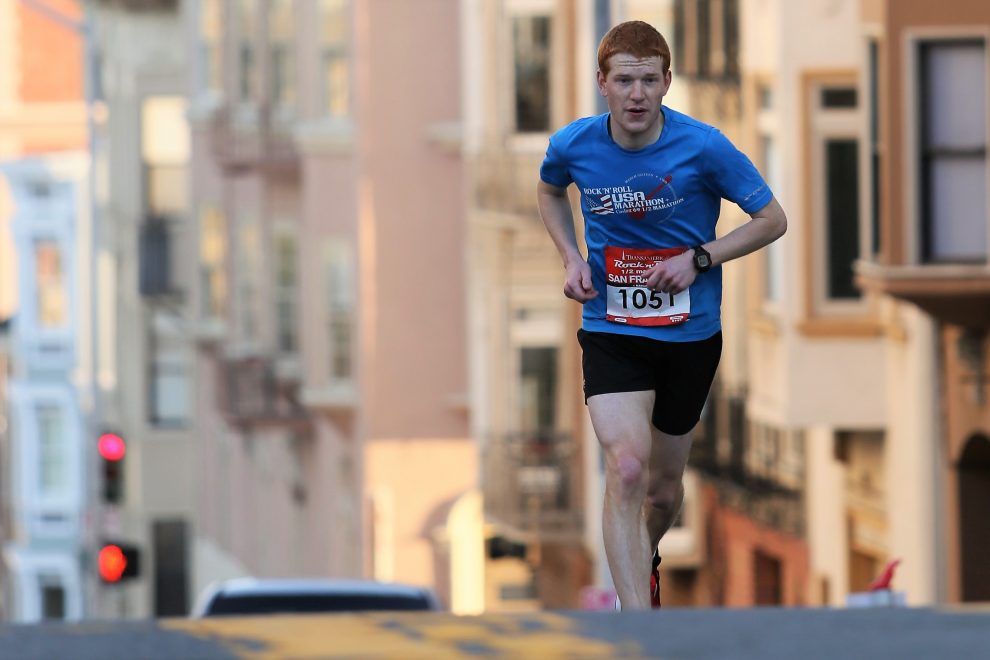
At about mile 22 I practically forgot the reason I was running-or at this point barely jogging-my second marathon in as many years. My feet were screaming at me to stop "offering it up" and lay my aching body down in the grass. It would feel so good to stretch out and soak up the Florida sunshine. A little voice asked, "Couldn't praying a rosary in the prone position be just as effective as pounding out 26.2 miles?"Sometimes the struggles we choose can unite us with those whose suffering comes unbidden.
The answer: not today. I had prayed many rosaries for Joseph, my great-nephew, since he was diagnosed with leukemia for the second time in his 11 years. That morning though, I was wrapping up several months of physical and emotional challenges as part of a different kind of prayer on his behalf. Despite my throbbing muscles, or even because of them, I continued to offer up the pain for him and others with this terrible blood cancer. I gritted my teeth, turned up my music player, and stumbled toward the finish line.
In my near-delirium during those last miles, I could almost hear a sweet Irish accent encouraging my schoolmates and me to "offer it up" when we had a headache or skinned knee many years ago. I do not remember a clear explanation of the concept. Maybe the sisters' intent was for me to feel there was a reason for pain, or that practicing this discipline could help me overcome my helplessness when things were bad. I forgot about this type of prayer for decades until I decided to train for and run marathons for a purpose beyond fitness.
Unfortunately, over Christian history some have presented "offering it up" as a way for the poor and suffering, even those in abusive relationships, to accept their lot in life as an expression of God's will. This unhealthy view forgets that, though suffering is a part of life, God offers us help in overcoming it. Christ indeed teaches us to take up our cross, follow him, and rely on his help in working through challenges. So while we may "offer up" our pain through difficult times, we should also offer up the prayer and work involved in overcoming them with God's help.
Where did the Catholic practice of offering up suffering for a cause come from? The Bible is full of sacrifices for others, with Jesus' death for our salvation as the greatest example. St. Paul teaches us in several of his letters the usefulness of putting up with pain for our own good and the good of others.
Many of my favorite saints have offered themselves up: St. Faustina of the Divine Mercy devotion, Thérèse of Lisieux through her Little Way, and Padre Pio are some of the more recent examples. I admire them as heroes of the "church militant" during their lives on earth who are now part of the "church triumphant" praying for us in heaven.
I made a personal decision to offer my time and effort for Joseph. A popular T-shirt worn by runners during marathons is, "If you think 26.2 miles is hard, try chemo." That says it all.
The first time he had leukemia, Joseph was 2 years old. He fought it off after a couple of years of treatment, and the doctors told us, reassuringly, that the odds of this terrible disease reoccurring were about 1 percent. Unfortunately, that long-shot chance was all the cancer needed to sneak back into his life before he began fifth grade.
When I heard Joseph was sick again, I knew I had to do something. I prayed, visited him in the hospital, and did some research. God answered me through an organization that raises funds for leukemia research through distance-running events worldwide.
During my four-month training, when I was in the right frame of mind and spirit, I learned to offer up my discomfort. I offered all sacrifices related to my efforts as prayers for those fighting this horrific disease.
As the mileage got longer, I would spend a few hours moving along at a steady pace and at times remembered to thank God for the gifts of life, my family, and the ability to run. Once I got warmed up, no matter how early or how long the distance, I enjoyed it.
The training could be grueling, but that was not the toughest part for me. I retired from the Marine Corps, and aching body parts come with the territory. The real challenge was the required fundraising. I had to swallow my pride and practice humility when I contacted friends for donations. Asking for money, even for such a compelling reason, was extremely tough, and through it I learned that offering up pain goes beyond the physical.
I now attempt to practice this type of prayer in some form every day. Sometimes I offer up a stiff knee with a smile instead of a groan or a walk up the stairs when I would rather take the elevator. These prayers may be for my parents' health, my daughter's test at school, or my wife to have a good day. When I have discomfort related to my physical training, I still try to offer it up for Joseph.
I have a long way to go but have on occasion even offered up a deep breath instead of seething impatience when stuck in traffic. Who knows, this may be even better for my blood pressure than running.
By Bill Harkins, a retired Marine officer and communications director of the Men of St. Joseph (menofstjoseph.com). This article appeared in the January 2010 issue of U.S. Catholic (Vol. 75, No. 1, page 47).

Some Insights (I hope)
By Kell Brigan (not verified) on Wednesday, January 13, 20103 of 3
available at the time. Instead, in the film, we're only shown St. Therese coughing up blood in secret, and not complaining or "bothering" anyone. Strange message, that. Why no scene showing St. Therese being treated by a physician? Why did this filmmaker think that showing reasonable medical care would somehow detract from her story?) Anyway, the only conclusion I keep coming to is that, yes, we should remain faithful in our belief that ultimately all is God's will and for the best, but I'll "patiently [deleted] endure" pain of any kind, or expect someone else to do so, when, and ONLY when, I'm absolutely certain there's nothing further that can be done to lessen or stop the pain in question. Anything less than that is cruelty.
Great insights
By Megan Sweas on Wednesday, January 13, 2010Hearing your perspective is really enlightening, Kell. Thanks for sharing with us here.
Truthfully, I always thought that the idea of "offering it up" was a little strange--and I know other editors agree with me. But Bill does have an interesting take/update on this pracitice. To his credit, he never says that his nephew should "offer up" his pain. There's a big difference between suffering and voluntarily taking on pain for others.
I'm reminded of a question I asked William Cavanaugh about torture. Though he is talking about victims of persecution, perhaps those of us without pain could hear this call and stand with and help to relieve the pain of the ill.
How does that relate to "taking up your cross"?
It all depends on how you understand it. It can be understood as masochism: "Catholics are masochists and God loves suffering. The more you suffer, the more you atone for your sins." I think that that's a misunderstanding.
What "Take up your cross and follow me" means to me is that if you take a stand on the side of the kingdom of God, you can expect persecution. It's not that persecution is a good thing or that you should seek it for its own sake. But if you line up on the side of the kingdom of God, you can expect resistance. And if you're not getting any, then you should probably ask why.
"Take up your cross and follow me" is a call to stand with the victims of this world and identify with them, to undo the mechanism of violence and not contribute to it.
Some Insights (I hope)
By Kell Brigan (not verified) on Wednesday, January 13, 20102 of 3
without ever once discussing charity or working to alleviate pain.)
Much of the time, people in pain (physical or otherwise) have to fight like hell to get the care or attention or environment they need -- either against fools who think that any pain (other than their own, of course) isn't real and that anyone claiming to be in pain is weak or egocentric or lying, or against a boondoggle of paperwork and dehumanizing bureaucracy that can make reasonable care impossible to get. I keep smelling a strange implication that someone who fights and stuggles and battles to get reasonable pallitive care, or who dares to ask whether or not any other options are available for alleviating their pain, is somehow "impatient" and less "heroic" or "devout" than someone who "patiently endures" without "bothering" anybody. (For instance, Leonardo Defilippis' biographical film of St. Therese bothers me a great deal. He does not have a single scene or discussion showing Therese seeking appropriate medical care at the onset of her illness. I checked a few sources, and this representation is unfair to St. Therese. She was not a masochist and absolutely did approach her Superior when her symptoms started. Her convent did provide for her the best known treatments
Some Insights (I hope)
By Kell Brigan (not verified) on Wednesday, January 13, 20101 of 2
Last comment on this, but I think I have a couple of insights, here.
1) Why can't someone "offer up" their pain for themselves? In particular, why can't the intention the pain is "offered" for be the cessation of that pain? It seems like it's somehow against the rules to pray for pain to stop, but when someone's peeling the skin off your scalp milimeter by milimeter, and clamping a vise around your skull and tightening it slowly and steadily, and driving red hot spikes into your cheeks and ears (you know, your average migraine), I can't see how it's reasonable to expect the person suffering to be capable of anything other than praying that the pain will stop. And, actually, isn't praying for the pain to STOP the FIRST thing they should be doing? In other words...
2) Why don't I ever see any emphasis, when talking about Redemptive Suffering, that FIRST and FOREMOST all reasonable efforts (and perhaps a few efforts above and beyond the call of duty, too) to STOP the suffering must be made, both by the person suffering on their own behalf, and also by anyone in that person's community who can pitch in on the effort, before anyone even thinks about the sufferer "offering up" that suffering? (To be fair, this article DOES specifically talk about providing appropriate care for people suffering involuntarily. Many Catholic discussions, however, talk about Redemptive Suffering
[ I deleted comment ]
By Eminem Relapse Refill Fan (not verified) on Thursday, March 4, 2010[ I deleted comment ]
I don't understand what
By Kell Brigan (not verified) on Wednesday, January 13, 2010I don't understand what "offered up her sufferings for the sins of humanity" MEANS. If Christ's sacrifice was sufficient to save us, how can DESTRUCTIVE suffering on our part do any good to ANYONE? How can one message from Christ's sacrifice -- that we are to identify with those who are suffering and who are sacrificed instead of with those in power who are pounding the nails in -- be reconciled with POINTLESS, DESTRUCTIVE suffering?
I DON'T UNDERSTAND HOW ONE HUMAN PERSON CAN "OFFER UP" POINTLESS, DESTRUCTIVE SUFFERING? HOW CAN POINTELSS, DESTRUCTIVE SUFFERING HAVE ANY VALUE WHEN IT RUINS AND POISONS EARTHLY LIFE, AND MAKES EVERYONE AROUND IT MORE LIKELY TO SIN AND ABANDON GOD? HOW CAN ANYONE "UNITE THEIR SUFFERING WITH CHRIST'S" WHEN CHRIST'S SUFFERING WAS ALREADY SUFFICIENT. I DON'T UNDERSTAND THE BUZZ WORDS AND KNEE-JERK PHRASES THAT NEVER NEVER NEVER GET EXPLAINED. I DON'T UNDERSTAND WHAT "OFFER IT UP" MEANS, SO PLEASE PLEASE PLEASE STOP REPEATING THE SAME FUZZY, SLOPPY, ILLOGCIAL BUZZ PHRASES WITH NO EXPLANATION. DOING SO IS UNFAIR AND INSULTING TO ME AND ANYONE ELSE WHO'S LIFE IS BEING RUINED BY CHRONIC ILLNESS. IF YOU CAN'T EXPLAIN CLEARLY WHAT "OFFER IT UP" MEANS IN CLEAR, PLAIN, NO BLARNEY LANGUAGE, THEN STOP PREACHING TO ME ABOUT SAINTS WHO DID SOME STRANGE THING CALLED "OFFERING IT UP" WHEN I HAVE ABSOLUTELY NO IDEA WHATSOEVER WHAT THE HELL THAT STRANGE, FUZZY, ILLOGICAL, INTERNALLY CONTRADICTORY PHRASE MEANS IN THE FIRST PLACE.
Reply to Kell Brigan
By David Phillips (not verified) on Wednesday, January 13, 2010I don't pretend to have all the answers, and I don't pretend to understand the pain and suffering you are going through. But I hope I can share some thoughts that might help answer your questions.
Christ, the Son of God, died for us on the Cross. The sufferings of His Passion and His death are the one Sacrifice of redemption. This Sacrifice is present until the end of time in the Mass. In a similar way, His sufferings continue in His Body, the Church, of which we are members of that Body, until His Second Coming,
We continue the mission of Christ in this world until His return. His death was not an instant case of "everything's magically all better in the world." The Church- us- has to pray, work, preach, teach, and yes, suffer. In the Bible we read of Our Lord Jesus saying we must take up our Cross and follow Him.
We also read in Scripture (Colossians Chapter 1): "Who now rejoice in my sufferings for you, and fill up those things that are wanting of the sufferings of Christ, in my flesh, for his body, which is the church."
Yes, in a sense- and we must say this carefully, there are actually things lacking and wanting in Christ's sufferings- (that is *our* cooperation with His sufferings in the here and now).
Part 2
By David Phillips (not verified) on Wednesday, January 13, 2010I also remember reading St. Anthony Mary Claret's writings about this subject.
He kind of put it like this: we all deserve punishments- even the punishment of hell- for our sins. When injustices, pains, and sufferings occur, we have 2 choices: We can either cry out and curse them, or we can accept them in the best way we possibly can, with the hope for a paradise of eternity with God after we die. Whether we curse them or accept them, they are still there.
Also....We know that the Church teaches that we can go to Purgatory when we die, either because of unforgiven venial sins, or because of temporal punishment still owing from forgiven mortal sins. But if we offer up our sufferings on earth, our purgatory can be reduced or even eliminated.
I hope this will help in some way.
Reply to Kell Brigan
By Anonymous (not verified) on Tuesday, January 12, 2010Maybe research and pray with St. Lydwine who suffered from headaches also. You are in my prayers!
This summary is from "Catholic Online; http://www.catholic.org/saints". She is the patroness of sickness. Lydwine of Schiedam was born at Schiedam, Holland, one of nine children of a working man. After an injury in her youth, she became bedridden and suffered the rest of her life from various illnesses and diseases. She experienced mystical gifts, including supernatural visions of heaven, hell, purgatory, apparitions of Christ, and the stigmata. Thomas a Kempis wrote a biography of her. She was canonized Pope Leo XIII in 1890. Lydwine suffered a fall while ice skating in 1396, when a friend collided with her and caused her to break a rib on the right side. From this injury, she never recovered. An abscess formed inside her body which later burst and caused Lydwine extreme suffering. Eventually, she was to suffer a series of mysterious illnesses which in retrospect seemed to be from the hands of God. Lydwine heroically accepted her plight as the will of God and offered up her sufferings for the sins of humanity. Some of the illnesses which affected Lydwine were headaches, vomiting, fever, thirst, bedsores, toothaches, spasms of the muscles, blindness, neuritis and the stigmata. Her feast day is April 14.
Sorry, But This DOESN'T HELP
By Kell Brigan (not verified) on Thursday, January 7, 2010In this author's case, his "pain" is a) voluntary and b) has positive results. My migraines have caused permanent brain lesions and movement disorders, and make it impossible for me to function normally. I have to be careful where I go because of triggers from fragrances, noise and crowds. My life span will likely be shortened to an unknown degree due to stroke. I pray daily that the migraines will STOP. How can I "offer up" something that is destructive? How can I "offer up" something that I don't want to exist at all? It just doesn't make any sense. I'm not getting donations out of this, or a certificate for having completed a marathon, or learning any useful life skills. If anything, my degree of disability and ability to cope are all getting worse over the years. Migraine and all the related disabilities (in my case, myoclonic jerking, falls, a disordered startle response, hypersensitive hearing, problems understanding speech, stuttering, dizziness, walking problems, etc. etc.) have cost me friendships and put my job at risk and interfere horribly with my life. No one has ever been able to explain this to me. What possible use could God have for something this pointless and destructive?