

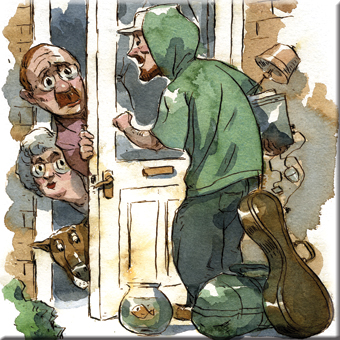
So your son graduated from college, can’t find a job, and needs a place to live—what’s a parent to do?
The first time Mark Bolich Jr. stayed out all night, he faced his not-too-happy parents the next morning.
"You could have called," they admonished him. "You could have sent us a text message. We were worried about you."
If Bolich were a high-school student, he would have expected such a reaction. But this time he was 22 and living at home after being away at college in another state for four years. He had forgotten what it was like to answer to someone regarding his whereabouts.
"That's when I realized I had to make some adjustments," said Bolich, now 23, of St. Petersburg, Florida. "What they were asking wasn't unreasonable. They weren't telling me what to do. They just wanted to know I was safe."

Bolich is a "boomerang kid"–a young adult who ends up moving back home after living independently. Some are returning to school; most are struggling with finances because they can't find work in a rocky economy, or their job doesn't pay the bills. Or a sudden lifestyle change, like a divorce or an addiction, could bring them home.
For parents, having a young adult back home poses some challenges: Do we charge rent? Will this arrangement harm or help our relationship? Do we set a timetable for moving out?
It can be an equally tough adjustment for their kids, from dating dilemmas to expectations about attending Mass. Their independence is not easily surrendered. If they choose to sleep with a partner outside of marriage or abandon religious practices, they now face scrutiny by the very people who once determined the rules of the house.
One thing for certain: They are not alone.
Prodigal children
In 2009 the Pew Research Center released some sobering statistics on the trend. About 20 million people ages 18 to 34 live with their parents, which is about 30 percent of that age group. Researchers put the blame squarely on the economy.
Welcoming back to the nest adult children who temporarily need some support may seem like the right thing to do. But it also comes at a time when the parents are dealing with diminished retirement and savings accounts or even a job loss. What starts off as a well-meaning gesture can disintegrate into a strained or simmering situation.
"This is a generation that is used to getting everything a lot faster than their parents did 50 years ago. First cars, first condos, first credit cards–all of that comes a lot younger these days," says Delis Alejandro, pastoral associate at St. Monica Parish in Santa Monica, California. "I don't think they've learned how to be good stewards of their lives. Practical common sense, like how to budget and setting realistic expectations, is not so prevalent. Immediate gratification is more the norm."
In her work with college students, Alejandro says the burden of school loans is the number one reason young people are getting into financial sinkholes. She also blames easy access to credit cards for giving this generation a false feeling of security.
Alejandro says she sees a lot of stressed-out kids these days: "It's heartbreaking." They are getting a big dose of the reality that living on their own is costly.
"They didn't have a plan in place. Things didn't turn out like they intended, so Mom and Dad become the safety net," Alejandro says. "There's nothing shameful in that, as long as a plan is put into place. If you approach this loosey-goosey, you're heading for trouble."
It wasn't an easy decision for Kelly Brown, 24, also of St. Petersburg. She was juggling a full load of college classes and working as a nanny when she took a break for a three-week mission trip to Ghana with the LifeTeen youth ministry program. The stress of keeping up with her studies, the demands of the job, and staying on top of her bills was getting to be too much.
After much prayer, she e-mailed her folks from the African country: Can I come home to live when I get back?
"I felt a little foolish about it at first," Brown admits. "There's a bit of a stigma attached to going back home at this age. But I felt I was being obedient to what God was moving in my heart. Given my circumstances, I knew it was the right thing to do."
Her parents also knew their daughter was under pressure and were happy to accommodate her. With their sons away, the house was "a little too quiet," says her father, Terry Brown. "You want to be there when your kids need help. And they're still your kids, even when they've grown up. We know she has goals and she works hard. One day she'll be gone again, so we're making the most of this time together."
Home economic slump
The recession that began in December 2007–just like the economic downturns in 1982 and 2001–is the main culprit for this societal change. And boomerang kids are bearing the brunt in this shift in cultural norms, says David Morrison, founder of Twentysomething Inc., a marketing and research firm.
"Young adults are the first to feel the brunt of a bad economy and the last to feel the benefits of a recovering economy," he told USA Today. "So the first way you hedge your bets is to minimize your expenses."
While moving back in with the folks may seem like the only solution, some experts urge young adults to explore other options first, such as finding roommates to share living expenses. If returning home is the only option, be prepared for some emotional fallout.
"Disillusionment is at the top of the list. You go to college to be a success, and get all built up for a bright future," says Theresa Thibodeaux, young adult ministry coordinator for the archdiocese of Los Angeles. "Then nothing pans out after school, and you're back home, right where you started, and you're thinking, ‘This is not the way it was supposed to go.'"
When Thibodeaux counsels adults in their 20s, she uses her own experience to show how moving home can feel like being in a time warp. After graduating from Loyola Marymount University in Los Angeles and taking a two-month trip to Europe, she came home with $2 in her pocket. She landed a job as a high school teacher, but the salary was rock-bottom. So she moved back home-right into her old bedroom, which she shared with her younger sister.
"She went to the same school where I was teaching. Now that was weird," recalls Thibodeaux.
Even though her parents gave her freedom to come and go as she pleased for the six months she lived there, nothing compares to being on your own. When she counsels boomerang kids, she tells them to be patient, be flexible, and expect a period of adjustment. Give your parents a chance to adapt to this new version of you.
"I know the economy is making this a more common occurrence these days. I just think we have to avoid this sense of entitlement that parents owe us and we're going to get a free ride from them," Thibodeaux said. "There are ramifications to returning to the nest."
Old habits die hard
It's not always easy for parents to see their children as adults when they're back living under their roof. And it is easy to regress to old habits and roles.
When Mark Bolich graduated last May from a small Christian college outside Milwaukee, he moved home and gave himself a six-month deadline to get his own apartment. But the recession was in full force, and the only job he could find was selling health insurance. He was liable for his own expenses and started getting in a financial hole.
Frustrated, little things started to bother him. He didn't get to pick what he wanted for dinner. He likes to eat and drink in his bedroom-a real no-no by his mother's standards. Make his bed? He doesn't see the point.
"I just don't want him treating our house like a hotel," says his mother, Kathy, a school nurse. "I won't clean his bathroom. I won't do his laundry."
With their other three children living out of house, she and her husband had adjusted to a more peaceful life as empty nesters.
But on the plus side of their son's return, the Boliches are enjoying an adult relationship with their son. He goes to Mass with them every Sunday. Dad gets help with yard projects. Dinner conversations can lead to lively discussions.
In February Mark started a better-paying job with good prospects for the future. While he says he appreciates his parents even more now, he's set another six-month deadline to move out. And when that happens, he hopes to start dating again.
"I can't afford it now, and it's too weird, telling a girl that I live with my folks," he says.
Some experts suggest creating a contract for rules and finances. Sharon and Mike Campbell of Tampa, Florida didn't feel it was necessary when their youngest child, Kelly, 22, moved back home after graduating from college. Although Kelly found a job within a month, it wasn't enough to make ends meet on her own. Her only financial obligations are her car insurance, cell phone, and social activities.
Sharon, who didn't go away to college, lived at home until she got married at 24. So having her daughter back home didn't seem unusual to her. "It's fun having her to talk to and hang out with."
When the kids were younger, weekly Mass was mandatory. Now Sharon goes solo, though she invites her daughter every week, just in case. Kelly usually politely declines.
"Mom laughs and calls me a heathen," Kelly says. "I know once I have kids, I'll start going back again. I'm just not into it right now."
Now that a year has passed, Sharon's only concern is that she may have been too lenient about a timetable. She frets that her daughter isn't putting enough away in savings, or making an effort to find a job with a better salary.
"As much as I love having her with us, I don't want this to be a crutch," Sharon says. "If we make it too easy on her to not move forward in her life, maybe we're not doing her any favors. I'm torn–if she moves out and is stretched so thin financially that she can't enjoy life, that isn't good, either."
Family ties
In some cultures, multi-generational living arrangements occur more by choice rather than necessity.
Even though old-world customs have eroded in modern American culture, moving home is still an admirable tradition for some.
"In the Hispanic Catholic culture, family always comes first," says Jacqueline Morales. When Morales' mother was diagnosed with Stage 4 lung cancer and given just months to live, her son Eddie quit his job in Jacksonville, Florida and came home to Tucson, Arizona to help out. He and his Nana had always been extremely close, so putting his own life on hold at age 28 didn't surprise Morales.
"It's not something I would have ever asked. But with my other son serving in Afghanistan and me working, Eddie knew things were difficult," she says.
Her son had been away from home for 10 years, also serving in both the Marines and Army. Though he was happily living in Florida with his best friend from high school, attending school, and working, he quickly shifted gears to a caregiver role in Arizona. All three lived in Jacqueline's five-bedroom house, just like they did when he was in high school. He shuttled his Nana to doctors' appointments, cooked meals, and prayed the rosary with her.
Because he and his mother were close friends, it felt "perfectly comfortable" to be back home in his old bedroom. His parents divorced years ago, and Eddie, his brother, and mom referred to each other as "the three musketeers," relying on the slogan, "all for one, one for all."
"My mom always showed respect for me. We just picked up where we left off," Eddie says.
He hadn't gone to church regularly in years. The experience of caring for his dying grandmother turned out to be a spiritual gift, he says. Being around her strengthened his beliefs and brought him closer to the religion that guided him through his youth and serving dangerous missions in Iraq.
"You could feel God's presence every time you walked into her room," he says. "She taught us so much about our faith, making it so real. I wouldn't have traded that time with her for anything."
His Nana died eight months later. Eddie stayed with his mother for another year, helping her adjust to the loss. He moved out at the beginning of 2010, though he makes frequent trips back home for visits and meals.
Eddie is back at work as an EMT and in the fire academy to complete his certification as a firefighter-paramedic.
Now it's Jacqueline's turn to adjust to living alone–something she has never done. But if circumstances ever put her sons in a situation where they need to come home, her door is always open.
"I told them to consider my house their runway," she says. "There are times in life when you need to stop and refuel, then take off again. My boys know this is their safe haven."
Strapped for cash
Sometimes the financial consequences of following a spiritual calling lands young adults back home. After graduating in 2006 from Marquette University in Milwaukee, Courtney Adams served in the Jesuit Volunteer Corps for two years, first in Seattle and then in a remote village in Alaska.
Earning just $80 a month, she faithfully followed Mahatma Gandhi's creed: Live simply so others may simply live. But that meant she was forced to defer her hefty student loan and was unable to save any money. When her stint was up, she had no choice but to return home to Springfield, Illinois, where she was warmly welcomed by her parents.
And it's a full house these days. With her sister back home after graduating from Saint Louis University last May and her brother still in high school, "it's the first time we've all been under the same roof in years," Adams says. Not that she spends much time there, as she juggles a full-time job with a nonprofit and two part-time gigs as a sales clerk and a babysitter.
Even bringing in three paychecks doesn't give her economic stability. By the time she makes her car payment and pays the bill for her insurance, that pesky student loan, and other living expenses, there's nothing left over to start saving for move–in costs, rent, and utilities.
Her parents don't charge rent. "But I don't feel like a freeloader," she says. "I make dinner, buy groceries, and I help my brother with his homework."
While she deals with the social issues other boomerang kids talk about, she also feels her faith journey has been somewhat slowed down. Living and working with her fellow Jesuit Volunteer Corps members, Adams' spiritual activities were part of the daily routine.
She's enjoying attending Mass at her home church in Springfield, where her parents are very active in the parish. But she hungers for something more. So now she's exploring opportunities for spiritual direction and attempting to reinvigorate her life in this area.
Adams is enjoying re-connecting with her clan after being away from home for six years. She knows she couldn't have followed her dream to serve in the Jesuit Volunteer Corps unless she had the safety net of her parents' help. She is grateful they made it possible for her to step out in the world-and step back into theirs until she can get on her own two feet again.
In the big picture, issues like sharing a crowded bathroom and calling in when she's going to be late seem minor.
"I feel very lucky to have parents who are supportive of me and the choices I've made in my life," Adams says.
This article appeared in the April 2010 issue of U.S. Catholic (Vol. 75, No. 4, pages 32-36).
Image: Darren Thompson








Add comment