Kym knows exactly what broke feels like.
A few months ago she was out of work and low on hope. When it looked as though she and her two children would be evicted from their California apartment, Kym-a Catholic with multiple sclerosis and no car to get her to her local parish-went online for help.
"Please pray for us," she wrote on a Catholic online bulletin board.
She found a quick and sympathetic response-some of it coming from other Catholics who have had their own close calls with too many bills, not enough cash.
In the seemingly affluent United States, out-of-control debt is sort of a quiet monster. Many churches don't talk about it, and those who've got it hiding in their homes don't want anyone to know about it.
It's sleeping in the suburbs, on the matching leather couches in the great rooms of families with unpaid-for SUVs in the garage.
It's nibbling at the feet of the young married couple who graduated from college with big student loans to pay off and a pile of credit card debt from too many new clothes and too many nights on the town-career folks just getting started but who already have a taste for nice things.
In the middle of the night, it's banging on the windows of the minimum-wage worker who can't make the rent and put food on the table, too. It's frightening the retirees whose savings aren't enough and who never imagined medicine could be this expensive.
How big a beast?
The monster of debt is scary already, and it keeps growing. Last year nearly 1.6 million non-business bankruptcy cases were filed, double the number of a decade ago. According to the Federal Reserve Board, both consumer credit and mortgage debt are at higher percentages than ever before. Household debt as a percentage of household assets (what someone owes versus what they're worth) is also at record levels.
Total consumer debt in the country-which includes credit cards and car loans, but not mortgages-now tops $2.12 trillion.
The New York Times reported last year that the typical American household has eight credit cards with $7,500 of debt on them. According to cardweb.com, which tracks consumer credit issues, about 185 million people in the U.S. have bank credit cards, and only about 70 million pay them off in full every month. People who roll their balances over month after month are known as "revolvers"-and there are tens of millions of them.
Debt that just keeps growing is first of all a money problem, but it can become a spiritual problem, too, as creditors call day after day, as stress eats away at peace of mind, as divorce or joblessness or health problems make people feel depressed and powerless, as some people feel compelled to hide a spending or gambling compulsion they don't want to admit and don't fully understand.
Debt can make people feel isolated, embarrassed, alone. "I couldn't sleep," says Kym, the single mother, who asked that her full name not be used. "Once you lose your job, your savings go quickly. I had to make a choice between medical bills and rent. It really becomes robbing Peter to pay Paul. What really saddened me was that a lot of my friends just totally abandoned me. I live in a very affluent area. I'm just working class. My friends didn't want to be around it."
When she trusted one friend with her troubles, that woman stopped calling. "It's almost like people are afraid it's contagious," Kym says. "I felt abandoned. I had nowhere to turn, because I don't have family except my own. I was left out there struggling with my faith."
Kym's faith has grown through her struggles with money; she says she feels God's presence with every step. Although she is going without the medicine she needs, so far her disease has been under control. She calls herself "extremely blessed" and said her experience has been "extremely humbling."
When she didn't know where else to turn, Kym asked for prayers online-and Catholics responded from all over the world. Within three weeks, she got a job offer, a car that runs, and a lead on a place to live. "The power of prayer-it's amazing what happens," Kym says, and she begins to cry.
But for the grace of God…
One of the most amazing things about America's growing difficulty with debt is what kind of people fall into the pit. Plainly put, it could be anybody.
Wendy Kelly, director of financial counseling for Catholic Charities in La Crosse, Wisconsin, is on the frontline of helping financially troubled families. "It affects professional people as much as it affects blue-collar people," she says. Sometimes people earning good wages just don't pay attention to what they're spending, and they have more credit available, so "it's just easier to dig a deeper hole," she adds.
"It could easily happen to you or me," she says. "A lot of us may be a paycheck or two away from some major catastrophe. Some folks feel pretty well insulated because they have savings and assets and other types of credit. But if they were to be severely injured or enter a nursing home, those things can be eaten up quickly. There but for the grace of God go you or I."
Philip Lenahan, a Catholic financial counselor from California who's written about consumerism and debt, says he sees no common thread among those who get into trouble, except "they're getting younger and younger," as financially naive college students are swamped with offers for credit cards. He's counseled people with six-figure incomes who end up filing for bankruptcy. People run up their credit cards month by month-"In the short run, there really isn't much pain," he says-until the interest rates and late fees hammer them, and suddenly the monthly payments don't even touch the principal.
Asked how often he encounters parishioners worried about finances, Father Timothy V. Vaverek of St. Joseph Catholic Church in Waco, Texas, answers: "A person just left my office."
Vaverek says the spiritual impact of debt is clear. "They're in trouble with money so they've got anxiety all the time," he says. People get exhausted working extra jobs or long hours trying to pay it off.
Then "a child gets sick, a mother gets pregnant, the roof gets a leak-things happen," Vaverek says. "If anyone has a propensity to depression, it will come out. If someone's prone to being sullen and angry, it comes out. And the relationships between husband and wife and parents and children tend to deteriorate, because everybody's under the gun.
"All this is a major spiritual problem. Plus it's pretty hard to pray when you're all stressed out."
For Laura Heilman and her husband, Mike, it all started with a $300 lawnmower. Young and married with their first house, they went to the store and bought the lawnmower and paid with a credit card. Then they needed more tools, and bought them with the credit card. There were problems with the contractor building their house, so they had to rent a place for a while.
"Before we knew it, we were $75,000 in debt," she says. "My husband is in a high-income bracket [he's a lawyer], so it wasn't like we were making $30,000 a year…. For us it didn't matter, we lived up to what we had."
Things changed for them when their oldest child was ready to start kindergarten. Laura was determined to send her children to Catholic school, but the Heilmans didn't have the tuition. So they started writing down their expenses and trying to figure out where all their money had gone.
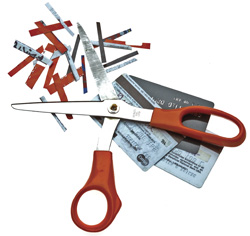
"I was shocked," Heilman said when she saw that list. "That night we sat down and cut up all our credit cards. That was such a freeing experience-it was like taking handcuffs off."
They started following the approach suggested by Dave Ramsey-a popular debt-reduction guru whose program is carried by radio stations all over the country-and paid off their debt in two years. Since then they've helped lead Dave Ramsey Financial Peace University classes at their parish, St. Richard in Jackson, Mississippi.
During the first class of the most recent session, "one of the men actually got up and cried," Heilman recalls. "He said, ‘I don't want to owe another man anything but love.'"
Heilman says eliminating debt can free people to do what many of them long to do-not to live in the fanciest house in town but to serve other people.
"That is the overwhelming sense I get in these classes," she says. "They feel like they can't help and give to other people or charities or the church because they have this overwhelming debt. They want to be givers, financial givers, not just of their other talents and treasures. They really want to help other people."
Why people buy
Some people get into debt because they lose their jobs or have strokes or car accidents. But others buy things they can't afford with money they don't have. Spiritual questions about overspending include why people do it, what need does shopping fulfill in them, and if they ever reach a point where they feel like they have enough.
"It's a huge spiritual issue. We keep spending, spending, spending," says Kristen Johnson Ingram, author of Devotions for Debtors (Galilee Trade). "I think it means we don't trust God. If we trust God, we don't need all that stuff."
Ingram says she's had her own financial temptations. "I can really run up a charge card, let me tell you." But she prayed, asking God to release her from always wanting more.
For starters, there are a zillion things to buy. Forget taking that old bedspread along for a picnic. Now you can buy a special tufted picnic blanket to color-coordinate with the picnic basket on wheels and the matching plastic plates and goblets, along with a bin to store them neatly in.
"Because some company decides to make something, we just feel we have to buy," Ingram says. "We're tempted and tempted and tempted."
Pope John Paul II, in a 1998 homily, described consumerism as a false antidote to spiritual emptiness. "Christ alone can free [us] from what enslaves [us] to evil and selfishness: from the frantic search for material possessions, from the thirst for power and control over others and over things, from the illusion of easy success, from the frenzy of consumerism and hedonism which ultimately destroy the human being," the late pope said.
Daniel Idzikowski, executive director of Catholic Charities of the Diocese of La Crosse in Wisconsin, says that "from a Catholic agency's point of view, consumerism can be an addiction. Your consumerism can consume you just as much as other pursuits can, and that's not helpful to your soul, much less your pocketbook."
Tom Beaudoin, professor of religious studies at Santa Clara University in California, has explored in his book Consuming Faith: Integrating Who We Are With What We Buy (Sheed & Ward) how one can intentionally tie decisions about what one buys with an awareness of what he calls "economic spirituality."
Beaudoin writes that Christians should understand that "the way we spend our money is an expression of our faith." Paying attention to globalization, to the working conditions under which the goods one purchases are produced, and asking hard questions about capitalism and inequities in the distribution of wealth, are all part of Christian responsibility and being part of the body of Christ.
"One of the things Jesus was very passionate about and interested in is the way your economic decisions indicate what you put your faith in," Beaudoin says. "There is a real curiosity among everyday Catholics about how to integrate a very personal sense of faith" with how they spend their money.
The love of money
Kelly of Catholic Charities talks to families about making distinctions between what they want and what they need. Sometimes getting out of debt means intentionally deciding not to define one's identity by what one owns.
"People buy in order to express who they are, in order to have a sense of well-being about being. This is really perverse," says Vaverek, a priest who has written and preached about asceticism.
"We live in a culture that has in many ways schooled us to feed that selfishness, especially through comfort. So it doesn't take a lot of effort to make a rock roll downhill. The church regrettably has all but completely failed to preach the gospel regarding the need for asceticism, the need for prayer, self-denial, and good works."
That's not to say that spending is inherently wrong, either-or that treating oneself to some nice things is always bad. But how much to buy depends in part on how much one can afford, and also on values.
"It's not wrong to go on a nice vacation," Lenehan says. "Not all discretionary spending is a problem. But certainly if you don't have it and you're trying to live like the family next door, that is a problem. It's amazing how content we can be living a very simple life."
The Bible speaks frequently about money and wealth-in the Old Testament about the oppression of the poor and the need for justice, and in the New Testament to say that "wealth and riches are subordinate to the reign of God," says Father Leslie Hoppe, O.F.M., a professor of Old Testament studies at Catholic Theological Union in Chicago.
"The New Testament has an apocalyptic worldview, that the end of the age is coming soon," Hoppe says. Many of Jesus' followers were fishermen or working men, but they're told to leave that behind and accept a kind of itinerancy and dependence on God.
"Because if the world is ending very soon, there's no point in amassing wealth," Hoppe says. "Jesus tells a parable about a man who had a very rich harvest and didn't have enough space in his barn. He takes down the barn and puts up bigger ones, and in the evening the man dies, showing the futility of it. The coming reign of God forces people to review their values."
Pass it on
At St. Edward Catholic Church in Pembroke Pines, Florida, Lee Menendez, an accountant, leads a 10-week Bible study from Crown Financial Ministries focused on reducing debt. "As we read through the scriptures, we realize that we're serving our lenders instead of being free to serve the Lord," Menendez says.
Catholics typically give an average of 1 percent of their income to the church, Protestants double that, Lenahan says. "Catholics tend to give out of what's left over," he adds, but in a consumer-driven society, "there's never anything left over."
Deacon Roberto Jimenez, director of development for the Diocese of Biloxi, Mississippi asks people to think theologically about giving and to consider the needs of others. "The reason people give to the things of God and to the things of the church is because they have faith," Jimenez says. "They give because they believe in God and trust in God."
Some of what he encounters amazes him-particularly the generosity of those who know from experience what being poor is like. Earlier this year, after Jimenez spoke at a church, a young woman approached him. She was divorced and had just started working at a Pizza Hut. She pulled out a brand-new checkbook and wrote to the church the first check she'd ever written in her life, giving $50 of her hard-earned pay.
"It just blew me away," Jimenez says. "She said at one time she got help from other people, so she felt compelled to help now."
Some Catholics who've dragged their way out of debt say not owing money gives them a sense of joy and freedom and gratitude to God. They live out their understanding that everything they have comes from God. With that understanding comes thankfulness and generosity toward those in need, a sense that God will provide in good times and bad, a lessening of a desire to have more and more.
Todd Conway, who works selling agricultural feed in southern Kentucky, first heard of Dave Ramsey while driving the backroads for his job, listening to the radio as the miles rolled by. "We weren't bad on credit cards, but we had a fair amount of consumer debt," Conway says.
Since then, he and his wife, Debbie, have paid off the debt, and he's helped introduce the Dave Ramsey approach at his parish, Holy Spirit in Bowling Green, teaching nuts-and-bolts skills such as setting a monthly budget, saving for college and retirement, and setting up an emergency fund.
During a presentation on stewardship during a Mass at Holy Spirit, Conway talked about the stress that's been taken off his marriage because he and Debbie agree in advance how their money should be spent. They live on a 30-acre farm, but they don't take annual vacations, they don't buy brand-new cars, they don't have a 52-inch TV.
Last fall, they took the whole family to Disney World-and paid in cash. "We think fun is going on vacation with no payments when we get home or buying a vehicle and not getting a payment book to go with it," Conway told the congregation.
He also told how he and Debbie decided to tithe, to set aside 10 percent of their income for the church and for charity as the very first line in their monthly budget.
"We truly should look at everything that we have, including our income, as God's, not ours," Conway told his parish. "When Debbie and I started to realize this, it suddenly became a lot easier to give and let us look at our spending less selfishly. I cannot think of a time when we gave money to the church or to a worthy charity and regretted it."
Can't Catholics talk money?
What Conway did is relatively unusual; it's not all that common for Catholic churches to say a word about money management, particularly from the pulpit, or to offer any guidance at all about responsible spending.
Some of the most popular Christian financial responsibility programs-including Dave Ramsey and Crown Financial Ministries-are viewed by some priests as perhaps too evangelical or "not Catholic enough."
But some Catholic parishes have tried them-often with booming results. In two sessions of Financial Peace University at Conway's church, 16 families paid off $122,000 of debt and put $42,000 into savings in just three months.
"Dave is evangelical in his beliefs, but it doesn't go against the Catholic faith," says Conway, who helped lead those classes. "The quotes he gives out of the Bible are in our Bible, too."
The Diocese of Baton Rouge has started collaborating with the local United Methodist Foundation to introduce parish leaders to the Good $ense Ministry Workshop, a six-hour financial planning program produced by the nondenominational Willow Creek Association, and to encourage parishes to offer it as a part of stewardship education.
Diocesan development director Mark Blanchard has plans for a much bigger program that will include financial counseling and programs to train more parishes in providing financial education.
"We're still in the wilderness as to what actual program to put in place," Blanchard says. He understands that some priests may be uncomfortable with using programs that weren't started by Catholics, but he doesn't think churches can afford to wait.
At last fall's International Catholic Stewardship Conference in New Orleans, Blanchard presented a workshop at 8 a.m. He expected no one to show up because it was so early.
By 7:30 a.m. the room was full.
He heard "story after story after story" of people devastated by debt, of churches that didn't know how to help them, of the need for parishes and Catholic schools to begin teaching about financial responsibility and stewardship.
So why are so many people having so much trouble with money?
Blanchard speaks of "financial illiteracy" and the blurred lines between what people want and what they really need.
Three common myths, according to Blanchard: "Things bring happiness. Debt is expected, not avoidable. And a little more money will solve your problems."
When Blanchard is out doing fundraising appeals in parishes and sees a parking lot filled with expensive late-model cars, "I know I'm in trouble."
"I drive a nine-year-old truck and I'm proud of it. My wife is embarrassed," but they believe in sending their children to Catholic schools and saving for college. So they don't have cable television ("My kids are the only two kids who know how to manipulate rabbit ears in Baton Rouge," Blanchard says).
He argues that Catholic churches need to start talking about values-based spending and "approaching families, specifically young families, and letting them know there is an alternative to the massive consumerism out there."
Nancy McGhee works at St. Richard Parish in Jackson, Mississippi and says it never occurred to her before she started following the Dave Ramsey program that someone could buy a car and not have a car loan.
Four years ago she and her husband, Chick, were in their late 50s, had $5,000 in debt, and were spending $800 a month to pay off one car and to lease another. Now the debt is gone and she's on her second "Dave Ramsey car," a used 2002 Honda she bought with cash.
"I had never budgeted," McGhee says. "I thought budgeting meant just kind of knowing where your money goes and paying your bills, which I always did. But what he teaches you is that you tell your money to go instead of wondering where it went. It really brings about peace and freedom."
Betsy Hewett and her husband, Terrill, are architects in their early 30s who left college with about $30,000 in debt-not student loans, but "just going to Macaroni Grill and buying supplies for school," she says, in her case using a credit card she doesn't even remember applying for. "We just really blew it, it's embarrassing to say."
Then, for two and a half years, the Hewetts worked a paper route together, along with working their other jobs, to whittle down the debt. They tithe 10 percent to St. Richard's. "To our friends, people in their 30s, the idea of giving $400 or $500 to the church every month blows them away," Betsy says. "To them, that's a car note-a really nice car note."
But "your money is not yours; it's the Lord's," she says. "When you put those glasses on, you really think differently. If you got a million dollars, what would you do with it? Would you buy a big house and a boat? Or would you give it to the poor?"
This article appeared in the September 2005 issue of U.S. Catholic (Vol. 70, No. 9, pages 12-17).
Image: Tom Wright