Far from being a threat to faith, modern science is an invitation to get better acquainted with the force behind the universe.
How can you believe in evolution?” a Christian woman accuses me. I explain that I don’t believe in evolution. I accept evolution as a scientific theory in the same way I accept the theory of gravity.
In 2006 National Geographic News reported that only 14 percent of Americans thought evolution is “definitely true.” Around 30 percent reject the idea entirely. Only people in Turkey have a lower rate of acceptance of Darwin’s discoveries.
Americans are becoming more and more scientifically illiterate. We often fail to distinguish between different kinds of knowledge. Scientific knowledge, by definition, is always revisable, but that does not mean it is untrue. All scientific knowledge is theoretical. A theory holds until someone comes along disproving the theory and offers a better explanation. Truth for science means “that which has not been disproven.” The “law of gravity” is “just a theory” in which we have a whole lot of confidence.
Those who resist science are not defending our faith. The bishops at the Second Vatican Council in Gaudium et Spes affirmed the “rightful independence of science,” warning against the attitude “that faith and science are mutually opposed.”
In just the past few decades we have learned more about the universe than all the humans who came before us. The 13.7-billion-year-old universe is expanding at an accelerating rate, and the fossil record demonstrates evolution. Without evolution the vaccines and pills so many take would be little more than snake oil. Without science, all our technological gadgets, from TVs to computers to cell phones, would not exist.
Evolution means humanity’s place in the universe may be more, not less, significant. We are the creatures most responsible for the care of life on this planet. We will save or destroy the earth.
Our global choices will determine the quality of life for future generations. Mere opinion, fuzzy beliefs, or rigid, uninformed ideologies are inadequate to meet such challenges. In the 21st century we need good, accurate scientific and theological knowledge. Any sane and responsible religious institution and its adherents should study and disseminate all kinds of knowledge.
The teachings of science do not contradict the truths of faith. Actually, scientific discoveries can bolster faith. Science tells us what and how; faith ponders why and what does it all mean.
The discoveries of physicists in the past century have been simply stunning. Albert Einstein took us beyond Sir Isaac Newton’s equations, revealing the centrality of the speed of light as an absolute by which we can understand the relationships of matter and energy (E=mc2). In 1927 Georges LemaÎtre, a Belgian Catholic priest, relied on Einstein’s insights to develop the big bang theory. Edwin Hubble demonstrated that the universe is expanding. Fritz Zwicky discovered that some 95 percent of the universe is made up of “dark matter” or “dark energy,” while only 5 percent of the universe is what we think of as ordinary matter.
In 1955 Hugh Everett articulated the many-worlds hypothesis, applying the quirky mysteries of quantum mechanics to large objects in the universe. Many physicists think our world is just one of countless others. In 1998 Saul Perlmutter and Robert P. Kirshner stunned us all by showing the universe isn’t just expanding, it’s accelerating. Sir Roger Penrose and Stephen Hawking formulated equations explaining the mysteries of singularities and black holes.
The disorienting notions of quantum mechanics show that physical reality is governed not so much by absolute laws, but by processes of predictable chance. A whole host of scientists (Heisenberg, Planck, Bohr, Schrödinger, Born) theorize that we cannot know for certain how matter and energy “are” at any given moment; we can only know the probability of something happening.
Scientists agree on these facts: The big bang occurred some 13.7 billion years ago, and 4.6 billion years ago our solar system formed. The moon is 240,000 miles from Earth. The sun is 93 million miles away. Light travels 186,281 miles per second and a light year is the distance light travels in a year.
The Milky Way is so big that at light speed (6 trillion miles per year) it takes 100,000 years to leap from rim to rim. The Andromeda galaxy, our closest neighbor, is 4.6 million light years away. The closest star to us is 26 trillion miles away. The stars within 220 light years of the sun encompass only 1 part in 10 million of the total number of stars in our Milky Way galaxy. There are more than 100 billion galaxies in the known universe.
Science yields even more curious revelations. The universe is incredibly calibrated and tuned. Had the big bang been an iota of a fraction stronger, nothing would have formed. A big bang a fraction of an iota weaker, and gravity would have collapsed, pulling everything back into a black hole. With just excruciatingly infinitesimal minor changes in creation, human persons would never have evolved, much less survived.
If we can imagine all of cosmic time compressed to one year, with the big bang as January 1, dinosaurs don’t show up until November 25. All of the recorded human history occurs in the last seconds of December 31.
We live in a vast, pulsating universe: trillions of stars, billions of galaxies. Scientific theories concerning black holes, string theory, and the multiverse radically reorient our comprehension of the majesty and mystery of the universe and thus our awareness of the awesomeness of God. Our imaginations expand as we learn what scientists know. Thus science affects our religious meanings and cultural truths because we are aware of realities unimaginable to those who came before us.
The whole notion of space-time as the context within which we exist and novel ideas about the meanings of past, present, and future marvelously open us to fascinating new conjectures about who God is and how God operates in and through physical realities. Teilhard de Chardin and John Haught contemplate a God who exists not so much in the past or the present but in the future, calling all forward in time to culmination.
We Catholics should rejoice in the astonishing realities science reveals, and we are called to relate other ways of knowing to the ways science knows. To know by love and faith are also legitimate ways of knowing. Remember: Science answers the questions “what” and “how”; the questions “why” and “what does it all mean” are above science’s pay grade.
One cannot “experiment” with 50 marriages and then pick one for 50 years. The joy and peace that come with 50 years of marriage are based on the logic of love, not science. By faith we know God, choose to be loyal and committed to the ultimate mysteries revealed in Jesus Christ, and live in communion with the community of disciples, the church.
As believers we want to know what science teaches and integrate that with theological approaches in order to explore the meanings of life and love. Science can tell me how Teresa evolved; scientists can’t explain why I fell in love with her and not Maria. A doctor can treat cancer. He or she cannot explain why your child died of leukemia while another child survived. Physicists can reveal a vast universe; they cannot explain why or how God created and keeps in existence all there is. Science cannot do an experiment to explain why God loves us.
Still, all these scientific discoveries portend bright promise for the future. For eons radio waves existed. It is only in the past hundred years or so we’ve been able to harness their power. Who knows what the conjectures of string theory may reveal and how those revelations may be placed at the service of humanity? Dynamite can be used to build dams and bridges; it can also be used to blow up Times Square. To answer questions of worth and value, good and evil, we need to go beyond science to philosophical and theological methods of knowing.
We exist. We are here and now, whatever “here” and “now” ultimately mean. Life is a gift, and gifts imply givers. Let us praise the giver. Deo gratias.
And the survey says…
1. I think religious faith and scientific knowledge are compatible ways to look at ourselves and the universe.
95% – Agree
3% – Disagree
2% – Other
2. Learning about scientific theories, such as the theory of evolution, can actually help us to learn more about God.
95% – Agree
3% – Disagree
2% – Other
3. Science has caused me to question my faith.
17% – Agree
69% – Disagree
14% – Other
4. I haven’t thought much about science since high school.
3% – Agree
94% – Disagree
3% – Other
5. I accept evolution as a legitimate scientific theory.
95% – Agree
3% – Disagree
2% – Other
6. I accept climate change as a legitimate scientific theory.
83% – Agree
5% – Disagree
12% – Other
7. Science classes in Catholic schools should include lessons on:
93% – Evolution.
40% – Intelligent design.
30% – Creationism.
20% – Other
Representative of “other”:
Only evolution should be taught as science. The other two may be taught as social phenomena.
8. In the dialogue between faith and the sciences, I am most bothered by:
57% – Catholics who represent their faith as being opposed to scientific knowledge.
46% – Fundamentalists who give faith a bad name.
35% – Militant atheists who abuse science to bash religion.
28% – Priests and other church leaders who do not bother to keep up with current developments in science.
14% – Other
This article appeared in the February 2010 issue of U.S. Catholic (Vol. 76, No. 2, pages 17-21).
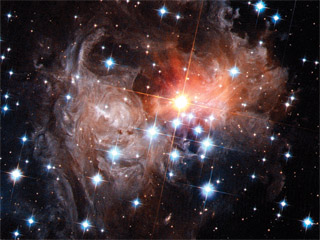
Image: NASA