Editors’ note: Sounding Board is one person’s take on a many-sided subject and does not necessarily reflect the opinions of U.S. Catholic, its editors, or the Claretians.
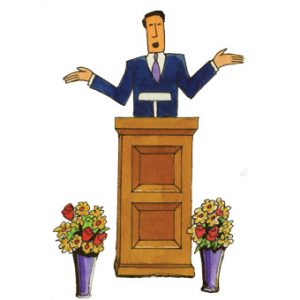 A Catholic funeral Mass is no place for a eulogy, says a Catholic pastor, but that doesn’t mean we can’t speak well of the dead.
I was spending a leisurely minute planning my funeral the other day–not a savory task, but a prudent one since I have pancreatic cancer.
A friend gave me advice, sharing her plans. One car per person; she wants to tie up traffic. Lots of tears. Everyone wears black. No gladiolas, just expensive tropical gingers and flamboyant birds of paradise. Lots of speeches about how endearing and unforgettable she was. Not helpful. Especially the speeches part.
Like all priests, I’ve squirmed through enough dreadful funeral orations to be very cautious about my own planning. One speaker will be enough. In my case it’s a dear friend at whose wedding I presided two decades ago; she has become my guide and my health care proxy on this journey of cancer. She is a parishioner, a member of my extended family now, and she’ll be able to speak from the heart, get a laugh or two out of everyone, say something about my faith journey, and sit down again.
It won’t be a eulogy, just some words after communion about my faith journey. In four minutes. Of course, the night before, at the vigil or wake, there will be a more raucous opportunity for general sharing on the topic of my life. I expect lots of tears and an unseemly dose of laughter. That may take more than a few minutes to unfold.
The commonplace “eulogy” is not part of our Catholic tradition, and it doesn’t belong in a Catholic funeral Mass. Eulogy is Greek for “word of praise,” and we come to bury Caesar and not to praise the wretch, as Shakespeare says, because the only one we praise in liturgy is Christ.
A local undertaker recently adopted a new obituary style, writing, “A Mass in honor of Bootsie will be celebrated at Holy Martyrs Church tomorrow.” No, Bootsie will just have to be patient with us, since we celebrate Mass in honor of Christ.
I don’t blame him for his mistake, because lately funerals have taken on the attributes of canonizations. Secular canonizations at that. Nary a word of faith, of a disciple’s life, is heard during the “words of remembrance,” that brief time after communion often set aside to remember the deceased Christian’s witness (rather than a list of accomplishments, or more often, embarrassing moments).
Indeed, you may be surprised that the Catholic Order of Christian Funerals (OCF) makes only one mention of a “eulogy”–and there it outright forbids them, even warning that homilies are to be kept free from the eulogistic style.
There are two purposes for the Christian funeral, according to the OCF: “The church through its funeral rites 1) commends the dead to God’s merciful love and 2) pleads for the forgiveness of their sins.” These values conflict with two cultural values in play: 1) to review the biography of the deceased and 2) to achieve “closure.”
The first need can be well addressed within the “vigil for the deceased,” frequently called “the wake.” The second need, for closure, is simply not a Catholic value. We believe that the bonds of affection that unite us in life do not unravel with death; it is merely hidden now in Christ but available to us in prayer and waiting for us in God’s future.
Nevertheless, the custom of having a “word of remembrance” at the funeral Mass has seized hold in the last 30 years or so, sometimes with the grudging approval of bishops in the particular law of the diocese. This adaptation normally happens after the communion prayer and before the final commendation. Where there are guidelines, they are often ignored.
Not long ago a priest in a Nearby parish was horrified to hear a beer can pop open in the pulpit as a tipsy cavalcade of grandchildren saluted their salubrious grandpa with a final Schlitz. Next they will be wielding champagne bottles against the casket like Mamie Eisenhower smacking the bow of an aircraft carrier.
I once squirmed through an extended story involving bad clams, diarrhea in a roadside forest, pursuing skunks, and home remedies that was a disgrace to the memory of a fine old Catholic gentleman.
That’s why I perk up in my presidential chair when I hear someone say, as a young man recently said at his mother’s funeral, “Preach the gospel at all times; if necessary, use words. This saying of St. Francis describes my mother’s life as a quiet yet staunch disciple of the Lord.”
Well, that’s more like it. In my parish, following the guidelines for the OCF in the Boston archdiocese, one speaker is permitted to offer a “word of remembrance of faith,” speaking for three to five minutes. The requirement of submitting a written text is often ignored, and sadly I’ve been ambushed a few times by wildly inappropriate repartee.
“Sorry, Father,” giggled one niece, “I guess I shouldn’t use language like that in church, tee hee.” The congregation at that moment looked like the audience at the opening night of Springtime for Hitler. In introducing the young woman, I set people up for “words of remembrance of faith.” Everyone knew that she had disrespectfully crossed a line.
There’s a real need, however, for remembrance. We should not use the language of denial, but rather find the right place in the sequence of rituals that constitute the OCF for such speech.
The Xaverian Brothers, to whom I belonged, had a custom of gathering as a community after the friends and relatives left the wake. We would gather in a circle, and a brother would lead off with a positive statement. No one could say anything at all until someone had something nice to say. Once, a particularly crotchety deceased brother engendered long silence, until one senior sighed and said, “Brother really knew how to enjoy a good cigar.” Then the floodgates opened, and hilarious stories ensued, almost all unsuitable for the Eucharistic liturgy the next morning.
There’s no reason this can’t be part of every vigil, either within or outside the vigil liturgy. Usually during a vigil liturgy I invite the assembly to share a word, a phrase, an attribute of the deceased they admired. I encourage them to say something about the faith of the deceased, and most of the time people rise to the occasion.
“She was a great cook, but she took all her recipes with her.” “He was generous to a fault and gave quietly to his favorite charities.” “He forgave me when I had done something unforgiveable as a kid.” “He was fair to his workers, and never said a bad word about anyone.” These insights help me enormously in planning my homily. I come to know the context for the funeral Mass.
Another time for prepared talks and reflections is at the “mercy meal” following the burial. We don’t expect the best man to give the toast at Mass, for crying out loud; there’s a right place for everything. The pastoral challenge is to point people to the right place, and earnestly hope for local tradition to take root.
The imagery of the OCF is strongly baptismal. The funeral Mass begins at the doors of the church, precisely where infant baptism or the catechumenal rites begin. We have the baptismal pall and the paschal candle.
I often tell the person chosen for the word of remembrance of faith that, in this context of baptism, his or her task is to give a kind of final report to the church. The church placed a candle into the deceased’s or godparent’s hand once, and said, “See to it that the flame of faith is still burning when the Lord comes.” How did this dear one carry that flickering flame into life, how did they nurture it, share it?
If a speaker can capture that in a few minutes, then I believe the core structure of the funeral liturgy is preserved, and the Eucharist can be the solid center of the many rituals and liturgies that make up the Order of Christian Funerals.
Bishops around the country are always thinking about putting the kibosh on any kind of funeral orations, whether words of remembrance or eulogies. I say, let them stay, but with clear guidelines, and with good resources to help the speakers make appropriate choices and to understand their proper role. A good reflection can help us cross the bridge from Eucharist to final commendation, and enrich the quality of farewell and solidarity in faith.
Let’s bring the stand-up comedy acts to an end in our pulpits, but let’s help people make a loving and respectful farewell to a dear one, and so commend him or her to the arms of our good and loving God.
“And the survey says… “
1. Eulogies are here to stay regardless of what church officials might like.
50% – Agree
36% – Disagree
14% – Other
2. The best place to remember the life of a deceased Catholic around the time of the funeral is:
49% – During the wake.
19% – At the “mercy meal” or gathering after the funeral.
18% – During the funeral Mass.
2% – In private conversations only.
12% – Other
3. I have given a eulogy or word of remembrance at a Catholic funeral.
34% – Yes
63% – No
3% – Other
4. Pastors and liturgists are too uptight about personal remembrances at funeral Masses.
28% – Agree
58% – Disagree
14% – Other
5. At a funeral I get more out of:
24% – A eulogy about the deceased.
48% – Hearing a homily about our belief in Christ and eternal life.
28% – Other
6. Parishes should require those who speak at funerals to:
86% – Be brief.
66% – Focus on the deceased’s faith.
43% – Submit a written text beforehand.
50% – Follow strict guidelines.
10% – Other
7. I’ve heard eulogies or remembrances that have been:
87% – A good tribute to the deceased.
57% – Boring and seemingly endless.
53% – Good for the family but not necessarily others.
45% – Inappropriate.
39% – Generic platitudes.
13% – Other
This article appeared in the November 2010 issue of U.S. Catholic (Vol. 75, No. 11, pages 29-33).
Results are based on survey responses from 251 USCatholic.org visitors.
Image: William Petersen