Could ending our adoration of oil be the key to a peaceful future?
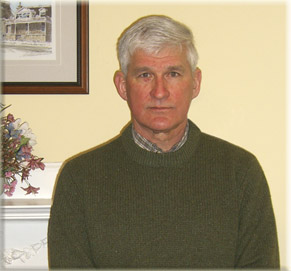
Has the idea of American exceptionalism finally run its historical course in the big muddy by the Euphrates? A persistent critic of the Iraq invasion and an ongoing skeptic of U.S. military adventures pretty much anywhere, Andrew Bacevich is too much a scholar of history to believe that Americans have permanently lost their taste for foreign entanglements.
Still, this conservative gadfly of neo-conservative policies entertains some hope that the United States might be ready now to devote more time to fixing problems at home than to creating new ones overseas.
A retired U.S. Army lieutenant colonel, Bacevich has been attacked from conservative corners since he first challenged the presumptions of the war on terror. He argues that his limits-to-power perspective most closely resembles true conservativism, although he's content to leave the labels behind.
"I'd like to see us have a politics of principled progressives and principled conservatives, arguing out the fundamental issues of public policy related to social justice, fiscal responsibility, and sensible foreign policies," he says.
"I think that creative tension could produce the kind of policies that actually might be in the long-term interests of the country."
You frequently criticize the notion of "American exceptionalism." Could you define that for us?
It's the idea that as a culture and a country we in the United States are different, that we have a God-given mission to the rest of the world. It's the presupposition that American values are indeed universal values.
The vast majority of Americans more or less unthinkingly subscribe to this belief. We know we are special. We know we are called upon to do great things.
This faith in our cultural exceptionalism is not unique to Americans. There are and have been other nations and societies that view themselves as the chosen people. But I think in our case that concept of chosenness, married to great power, makes American exceptionalism globally significant and dangerous. For all I know, the Finns think they're the chosen people, but they can think that all they want and most of the world wouldn't notice.
How did that faith in our national exceptionalism contribute to our experience in Iraq?
When George W. Bush became president, he did not in particular have a well-developed worldview or any particular principles related to foreign policy that he felt passionate about. He was kind of a soft realist. He talked about wanting to have a humble foreign policy. He was dismissive of nation-building.
But I think that he underwent a conversion experience on 9/11, and he came away as somebody who was converted to the Church of Woodrow Wilson. Bush now genuinely believed that as a nation we were called upon to remake the world in our own image. But unlike Wilson, he believed that the best way to achieve that was through unilateral action.
Now the idea of transforming and democratizing the greater Middle East as a national duty aligns neatly with the notion that a stable Middle East, dominated by American power, would be a place to reliably extract energy resources in order to sustain our way of life. But I don't think the decision to invade Iraq was necessarily cynical. I think Bush really believed invading Iraq was the right thing to do, and I think many of the people who supported his policies genuinely believed it.
Today that project has not fared too well, and I'm not sure too many people are willing to sign on to a crusade to democratize the Middle East any longer.
That doesn't mean that the idea of American exceptionalism is dead. I think it probably ebbs and flows, and it will no doubt come back because it is somewhere near the core of what makes Americans American. I say that with considerable regret.
Most Americans accept that our vast military capability is maintained for defensive purposes. Would you say that's a fair assessment?
The events of 9/11 alone suggest the extent to which defense as such doesn't figure as a priority for the so-called Department of Defense. The entire eastern seaboard was essentially left defenseless that morning because we had different priorities overseas.
The reality is we devote enormous energies into figuring out how to defend, let's say, Seoul, but nobody thought about defending Manhattan. So Manhattan was left naked to this very crude, primitive attack, which ended up causing so much devastation and destruction.
Indeed we've created an entirely different national security apparatus called the Department of Homeland Security that now assumes responsibility for the actual defense of the United States of America. So we have a department of defense that we don't call the Department of Defense, and this thing we call the Department of Defense, which should be called the Department of Power Projection.
This reflects a view that has evolved at least since the early days of the Cold War that advancing our vital national security interests is best accomplished by projecting American power "out there," and that's still the focus. Pentagon security strategists are far more concerned about what goes on in Baghdad or Kabul than they are about protecting Chicago or Los Angeles.
Why do we commit so much of our resources to conditions "out there" in the Middle East?
Oil, of course. Were it not for the existence of large reserves of oil and natural gas in that part of the world, we wouldn't care about it any more than we care about Uruguay.
The Middle East moved to the front rank of importance when it became evident decades ago that we no longer had the capacity to generate the oil necessary to sustain the American way of life as we have defined it. To this day the only way to sustain that way of life is to find a way to guarantee uninterrupted access to oil reserves abroad.
At the same time, our focus there is not completely about oil either. The Islamic revolution in Iran was tremendously significant. It deprived the United States of a valued ally, the Shah of Iran, who seemed to be a guarantor of regional stability. In his place it introduced a regime that was virulently anti-American, that had aspirations that were hostile to the status quo, and that challenged stability. Throw in the Soviet encroachment in Afghanistan, and the region begins to move up the list of strategic priorities.
Finally in 1980 President Jimmy Carter identified the Persian Gulf as a region that was vital to U.S. strategic interest and that if necessary we would use force to protect our interests there, what became known as the Carter Doctrine. Now we have a specific war planning responsibility focused on the region.
We create military exercises and begin to rotate U.S. forces into the region. We negotiate fly-over rights with regional powers. We build a massive military presence in staging areas like Diego Garcia in the Indian Ocean, and most significantly, beginning with Operation Desert Shield/Desert Storm in 1990-91, we launch large-scale military operations.
What you end up with is a pattern of increasing interventionism in the region with the expectation that this is going to produce stability. But it hasn't.
Why does our response to such challenges seem to rely so heavily, if not completely, on military force?
The perception in Washington is that "soft power" alternatives have too many significant limitations. For example many say that the problem of Islamic extremism really is a problem of underdevelopment; it's just poverty breeding resentment. So what we really need to do is to focus on development and economic assistance, and we can eliminate the factors that create alienation.
I'm personally very skeptical about that approach because it seems to me that it's a lot easier said than done. We have invested serious amounts of money in various parts of the world, and I think it's mostly been money down a rat hole. It has not produced significant improvements.
U.S. popular culture does have an allure, certainly, but that cuts both ways. It also is something that is viewed as blasphemous and profane. You don't necessarily win friends by sending Britney Spears on a tour of the Islamic world. And the American government doesn't control American culture. Soft power is hard to manage.
But even accepting soft power's weaknesses, why should military power become the preferred alternative?
After the conclusion of the Cold War, people in Washington came to believe that our military dominance was so great that the American military was basically unstoppable. Operation Desert Storm was an overwhelming success. Then with Operation Allied Force, we stopped ethnic cleansing in Kosovo without the loss of a single allied soldier. How much better can war get than that?
Pentagon brass believed that our high-tech approach made war efficient, effective, controllable, predictable. Force was no longer a blunt instrument, it was a precision tool, so war making had a much greater utility than it did back in the bad old days when nuclear weapons seemed to be the dominant expression of military power.
This was a deeply defective conception, but it had enormous influence in Washington and helps to explain why people like President Bush and his chief lieutenants could imagine that we could easily topple Saddam Hussein, establish American military supremacy, and acquire leverage that we could then use to transform the rest of the region.
Certainly events since 2003 have pretty much demolished that notion. I don't think too many people are still coming out of think tanks in Washington arguing that war can be a predictable undertaking.
Does the Catholic tradition offer any help in making foreign policy?
The just war tradition is tremendously useful, and it's too bad that in recent American policy making it appears to have been discarded. Force is supposed to be a last resort and only for defensive purposes. I'm afraid the Bush Doctrine of preventive war rendered those notions obsolete.
War should be a last resort: That's a useful moral notion, but it also makes a lot of political sense. History demonstrates time and again that war tends to be very unpredictable. It's hard to control. There are all kinds of unintended consequences.
I think that the whole concept of the seamless garment of life is tremendously useful because that becomes a way of thinking about self-interest in the broadest sense, to get to an enlightened definition of national self-interest.
When people talk about culture of life they're usually talking about abortion and end-of-life issues and capital punishment, but it seems to me that also raises environmental questions that are of vital interest to the United States of America. If the planet sustains terrible damage through climate change, then freedom as we know it is going to be compromised, and the well-being of future generations is going to be deeply damaged.
All issues that relate to energy-what kind we use, how we use it, and where we get it-if informed by that larger consideration of preserving the planet, would lead us to practical, specific near-term actions that would be different than those that we've pursued with regard to the Persian Gulf and the Middle East over the past 30 years.
Was there a moment in our political past where we might have made a different choice?
Jimmy Carter's infamous "national malaise" speech in 1979 is an illustrative moment. Carter was trying to define a new energy policy that would reduce our dependency on imported oil, but he also said: "This crisis is not simply about oil. It's about the meaning of freedom. We are at a crossroads and the choice is a fundamental one: How do we intend to organize American society?"
He was exactly right.
It was very clear what Carter was proposing in terms of national sacrifice and a new direction on energy policy. But in the next election Reagan was offering "morning in America." And we, the people-don't blame Washington-we, the people, made a choice. It was not the choice that Carter recommended, and we're living with the consequences.
We decided that freedom didn't mean freedom from dependency on Mideast oil, it meant driving a gas-guzzler at 85 miles per hour and living 50 miles from where you work. If we had made a different choice in the way we organize society and get our energy, it could have meant vast changes in what we're experiencing today.
But we keep electing people who give us what they think we want. And what do they think we want? They think we want a society that is built around a conception of freedom that emphasizes conspicuous consumption and self-indulgence. And that has meant embracing an increasingly militarized model of U.S. foreign policy. And the truth is, that's being done in response to a whole set of demands or expectations that we collectively have generated.
Do you think we're ready for the malaise speech now, that we're ready for the end of exceptionalism?
I doubt it. Politicians don't exactly want to engage in that kind of serious introspection. Near-term requirements essentially always trump long-term perspectives in American politics.
The accepted near-term requirement now is to get the economy going again, and in order to do that people have to consume again-a lot.
I'm a little skeptical when people identify the current economic crisis as another turning point. I would like it to be at least a cultural moment of introspection, a moment when we would as a people ask: "What does freedom really mean? What might I sacrifice for it?"
There are powerful forces that impede the kind of cultural examination of conscience that we deeply need.
How do you think the Obama administration is going to fare in confronting these issues?
Even if Obama gave sort of a "Malaise II" speech and combined it with a practical platform for change, I don't think he'd get a much better response than Carter did back in 1979.
I say that with regret.
As to the Obama administration's approach to war-making, it remains to be seen whether it will affirm the Bush Doctrine of preventive war or revive just war principles. I would hope for the latter. But the president's eagerness to deepen the U.S. military commitment to Afghanistan and his willingness to expand U.S. air attacks within Pakistan are not promising signs.
You don't believe that we should be engaged in the "long war," a broad conflict with the Islamic world.
Muslims are trying to find a way to reconcile their beliefs with modernity, the contemporary world of democracy, capitalism, and scientific inquiry. That is the environment from which Islamic radicals emerge.
The Bush administration thought that we could facilitate that reconciliation through transformation by force: We'll come in and we'll make them all into liberal democrats who worship Allah. That's not going to work.
We need to recognize that an Islamic reconciliation with modernity, if and when it happens, will happen because Muslims figure out how to do it-just as we Christians underwent a difficult, centuries-long process of reconciling Christianity with modernity. We more or less stumbled our way through that, and it was also a quite violent process.
The alternative to the "war on terror" rhetoric is to see the enemy realistically. Bush compared Al Qaeda to Nazi Germany. They are not Nazi Germany.
Terrorist entities like Al Qaeda pose a serious threat, but not an existential one. We should view that threat as akin to an international criminal conspiracy, like the Mafia informed by some religious convictions. As with the Mafia, the best response is a sustained and properly resourced international police effort-with the CIA and the FBI and other U.S. intelligence agencies working collaboratively with parallel enforcement entities in other nations.
That approach attempts to identify and root out these elements within the Islamic world that mean us harm. It does not require us to invade and occupy other countries. It does not require us to defeat this enemy in conventional military terms, but to contain a threat, just as we did so successfully with the Soviet Union.
That sounds a little more patient than we're used to in foreign policy.
Muslims are going to have to figure out their own path; we can't force them down one of our choosing. The best we can do is try to protect ourselves from the extremism that may emerge from that process, and that's why we need to reinvent the strategy of containment.
We don't do that by creating a new NATO. We do that by denying the extremists the resources they use to promote their cause. And we give them those resources every day by sending billions of dollars to oil-producing regimes. Some of that money gets siphoned off to the Islamic extremists.
In a real sense the key to a strategy of containment is a serious energy policy in this country. And a serious energy policy in this country is going to require us to make some important changes in the way we live.
This article appeared in the June 2009 issue of U.S. Catholic (Vol. 74, No. 7, page 24).