

Families separated. Millions left for dead. Do we share some of the blame?
Patrick Mwnyamahord knows where his father is buried because a neighbor showed him that small place. What he doesn't know is how his father got there, and there was no one he could safely ask, not then. Twelve years ago he and his family made one of a series of sudden escapes from the eastern Democratic Republic of the Congo (DRC) into nearby Burundi. On this particular exodus his father was too ill to travel and the family had to leave him.
"When we got back, he was dead," Patrick says, "and I don't know if he was killed by the enemy or by his illness. I don't know what happened to him." The "enemy" who may or may not have killed his father is a little hard to determine as well.
It could have been a gang of run-of-the-mill bandits taking advantage of the DRC's general craziness, or it could have been a group of Hutu irregulars fighting Tutsi rebels or government troops or both. It may even have been a neighbor of a different tribe who took offense at his father's ethnicity and advantage of his weakness. Members of Patrick's tribe are often set upon by larger groups in the chaotic killing field that has been the Congo's lot off and on-mostly on of late-since its 1960 independence.
The Democratic Republic of Congo, previously Zaire (its moniker under the despotic reign of Mobutu Sese Seko), straddles the equator in Central Africa. It is Africa's third largest country, the size of the entire United States east of the Mississippi. The country's 60 million people represent more than 250 distinct ethnic groups, and about half of the population is Catholic.

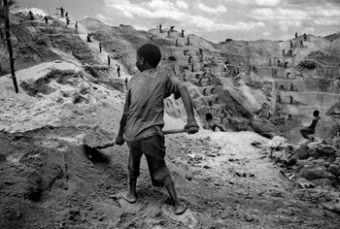
The thousands of refugees and mutilated survivors are testimony to the mindless brutality that has consumed this nation since a series of destabilizing conflicts began in 1996, when Tutsi pursuit of the Hutu perpetrators of the Rwandan genocide across the Congo's borders began a series of clashes that can be described as ethnic and political. But they also have roots in competition over the Congo's bountiful resources, particularly the precious metals that are currently helping to power the industrialized world's high-tech lifestyle even as their extraction delivers low-tech misery to the DRC.
According to the International Rescue Committee as many as 5.4 million people have died in this African holocaust since 1998, making it the world's deadliest documented conflict since World War II.
The suffering has gone largely unnoticed in the West. The United Nations has only recently achieved a fragile success in curtailing it. In January the Congolese government and 22 armed groups signed a cease-fire and peace agreement in the DRC city of Goma. The Congolese government set up a peace program for eastern Congo called the Amani Program and appointed Abbé Apollinaire Malu Malu, a Catholic priest, to organize the efforts.
All signatories to the Goma accord committed to stop any human rights abuses, but since the peace negotiations at least 86 civilians have disappeared or been executed, including some children, and at least 500 women and girls have been raped. Tutsi, Mai-Mai, and Hutu militias remain armed and ready to fight; child soldiers continue to be "recruited" in village conscription raids.
How often did Patrick and his family flee such "problems," his word for the violence that has assailed his community? Hands wave away the futility of trying to determine a specific figure. "Many, many times," say Francine and Serieux, Patrick's sister and brother, now sharing a couch in a Chicago apartment. "Many, many times," Patrick agrees.
Throughout their childhood, Patrick and his siblings were forced to fend for themselves as communal violence erupted, sometimes while they were at school.
"We would get a message: ‘It is not safe to go home,' " remembers Francine, and so the children would depart on foot for Burundi alone for a later rendezvous with their parents and other family members in a refugee camp.
Along the way, if they were lucky, they would be harassed by members of other tribes or robbed of what little they carried by armed men or soldiers at improvised checkpoints. If they were unlucky, they would not make it to the border alive.
Have they lost family members during such flights? It is a silly question. "Oh, many, many," the young refugees say, before leafing through a family photo album, emotionlessly pointing out the survivors, the wounded, and the dead.
Bordering nations that have been involved in the Congo's civil clashes have joined in on the plunder of the DRC's resources and, according to many, prolonged the conflict as a cover for the economic windfall. Primitive gold, copper, and coltan mining operations established and battled over by regional proxies or local warlords are often staffed by child soldiers or enslaved civilians.
Rudimentary operations connect to sophisticated global commercial networks that acquire the extracted metals for jewelry or computer or cell phone components.
While many U.S. consumers may have become aware of the phenomenon of blood diamonds, few are as familiar with these other conflict resources and hardly think of the technological marvels in their hands as "blood gadgets." But the explosion in cell phone use over the last decade and a half has fueled and intensified the violence in the Congo.
Anneke Van Woudenberg, senior researcher for New York-based Human Rights Watch, has tracked the interaction of Western commercial interests with the mayhem in the Congo.
"We live in a globalized world," Van Woudenberg says, "and we need to ask questions about the products we buy, such as gold, diamonds, or mobile phones. Where did the goods come from? Were they ethically sourced?" While a U.S. or European consumer can feel far removed from the Congo's turmoil, they are really only a cell phone keypad away. "It is our responsibility to ensure that we do not indirectly contribute to human rights abuses in far away places like the Congo."
After another outbreak of violence a few years ago, during which his family farm was looted and their many cattle, goats, and sheep stolen or slaughtered, Patrick and his family went on the road to Burundi and never looked back.
They endured a few years waiting in an increasingly insecure camp in Burundi (where a cousin was killed during a mortar attack) until they found sponsorship through Catholic Charities in the United States.
They finally landed in Chicago, on their feet for the most part, gainfully employed and trying to build a future. His younger siblings are in school; Patrick, now 26, plans to resume an education that had been frequently interrupted by violence. He hopes to become a biologist.
Would he return to the Congo someday? He shrugs, nods. "Yes, maybe. I would like to go back," he says.
"I would like to go back to our home," he says. "When there is peace."
Does he think that peace will come? Patrick shrugs.
"No," he says after a moment.





Add comment