

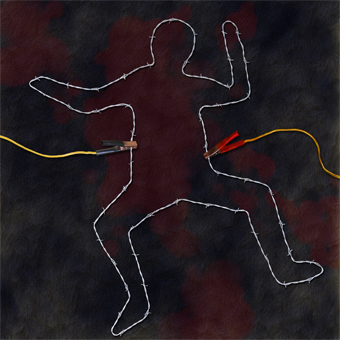
Our government's use of torture puts being both American and Catholic in serious conflict, says this theologian.
Theological research doesn't often include reading detailed accounts of torture, but it did for William Cavanaugh, now a professor of theology at the University of St. Thomas in St. Paul, Minnesota. There's also sleep deprivation, exposing people to freezing temperatures for long periods, bombarding them with rock music for hours, head slapping, sexual humiliation, and sensory deprivation such as blindfolding, among others.
Pope John Paul Hs 1993 encyclical Veritatis Splendor (On the Church's Moral Teaching) makes it quite clear that you cannot commit an act that is intrinsically evil for a greater good, and he lists torture as an intrinsic evil. Theological research doesn't often include reading detailed accounts of torture, but it did for William Cavanaugh, now a professor of theology at the University of St. Thomas in St. Paul, Minnesota.
"I read account after account of people's torture, and that's what I did all day," he says of his early work at the University of Notre Dame Center for Civil and Human Rights. "It was a grim time."
Cavanaugh didn't know then, however, that years later the war on terror would make his work on torture under Chile's General Augusto Pinochet relevant in the United States.

It hasn't been easy to get people to look at the way torture is perpetrated today. "You run smack up against a solid wall of affirmation," Cavanaugh says. "Nobody is going to say that torture is a good thing." But near-universal opposition has not prevented our government from doing it, he points out.
While confronting such a horrific and demoralizing practice can be daunting, Cavanaugh encourages religious people not to give up: "Otherwise, it becomes very depressing and lends itself to apathy and despair." He also suggests a good place to start: "The National Religious Coalition Against Torture (nrcat.org) has all kinds of information for parishes to raise awareness about torture," he says. "It's one of the most hopeful signs I've seen."
There's been a lot of debate lately about what acts count as torture. What qualifies?
The 1975 U.N. Convention on Torture defines torture as any pain or suffering, physical or mental, inflicted by public officials for various reasons, including punishment, interrogation, and intimidation.
Much of the recent debate has focused on the practice of waterboarding, a type of simulated drowning, which the United States until now has always treated as torture. It's a well-known technique used in South America during the era of military regimes in the 1970s and '80s. Then it was called "the submarine," and it certainly is torture.
What other forms of torture does the U.S government permit?
One common technique is stress positions, in which somebody's hands and feet are handcuffed together in something like a fetal position for hours. You know how it is when you're on an airplane and you can't move around. Imagine being put in a little box for 24 hours.
There's also sleep deprivation, exposing people to freezing temperatures for long periods, bombarding them with rock music for hours, head slapping, sexual humiliation, and sensory deprivation such as blindfolding, among others.
What is the effect of torture on its victims?
Torture is a deliberate, sustained assault on the integrity of the human person, and the effect of torture is the mental and physical disintegration of that person. The person's world is reduced to the body in pain. There is nothing else. Time doesn't exist. Emotional links are broken. People who have been tortured talk about this all the time.
Victims of torture find it very difficult to reestablish contact with other people because their basic sense of trust and personal integrity have been violated. They often find it difficult even to speak. Psychologists who work with victims say that a tortured person's voice has been taken away.
From a Catholic perspective, why is torture immoral?
Catholic teaching describes torture as an affront to basic human dignity. It is unquestionably immoral to take apart a person's physical and mental integrity by inflicting pain.
Some try to justify torture by acknowledging that, while it's an evil, it averts a greater evil. This has been ruled out in Catholic moral thinking. Pope John Paul Hs 1993 encyclical Veritatis Splendor (On the Church's Moral Teaching) makes it quite clear that you cannot commit an act that is intrinsically evil for a greater good, and he lists torture as an intrinsic evil. Once something has been labeled an intrinsic evil, there isn't any kind of calculus that can justify it.
Does Catholic tradition have more to say about torture than just, "Don't do it"?
On a deeper level our tradition tells us that doing violence is not our real nature. Genesis begins with the idea that good comes first and sin follows. When the Babylonians told their creation story, the universe was bad from the start, created out of a battle between the gods. The earth was created from the body of a dead goddess, and humans were created from the blood of one of her servants.
The first creation story in Genesis, which was written during the Babylonian exile, is in many ways a response to the Babylonian myth. It acknowledges the world is messed up not because it's supposed to be that way but because something has gone wrong. Violence and fear of the other are all deviations from the norm.
I think in many ways you can divide political discourse up into Hebrews and Babylonians. Dick Cheney is the Babylonian who is saying, "That's just the way it is. It's a dog-eat-dog world out there, and you've got to fight fire with fire." People who would otherwise think torture is wrong justify it because the world is evil.
How can we respond to that attitude?
We need to start telling a more hopeful story about what human nature really is and the possibility of reconciliation. In some ways we need to be more realistic than the realists.
Christians think that the creation story in Genesis is more real than the Babylonian one, but we've allowed the language of realism to be co-opted by those who don't tell the story of human beings as they really are, as children of God.
How does our government justify its use of torture?
One of the reasons Attorney General Michael Mukasey, in his confirmation hearing last October, didn't want to say that waterboarding is torture is that the president's Office of Legal Counsel defined torture as both intense and sustained over a long period of time. Part of the legal justification for waterboarding is that it may be intense, but it's not sustained over a long period of time.
If Mukasey were to admit that waterboarding is torture, then it would call into question other techniques that have been approved, such as hypothermia and stress positions.
A famous memo by White House Counsel John Yoo in 2002 defined torture as inflicting pain equal to organ failure, which is so extreme that it allows all kinds of things. The Justice Department withdrew that in 2004 but then issued secret memos under Alberto Gonzales in 2005 that basically reopened the door.
Any time there is an attempt to outlaw torture, such as John McCain's anti-torture legislation that passed in 2006, it is undermined. When he signed McCains bill into law, President Bush issued a signing statement that basically said, "But we can do it if we want to." As recently as March the president vetoed legislation outlawing the use of water-boarding by the CIA.
Is our use of torture something new?
It's new with regard to the legal justification. But the United States has been involved with torture for decades, at least through proxies.
In 1996 interrogation manuals from the School of Americas in Fort Benning, Georgia came to light, and they clearly showed that the United States had been teaching Latin American military and police officers torture techniques for decades. This charge had been raised for many years, and the Pentagon finally had to admit it. But it was swept under the rug very quickly.
But there is other documentation of CIA involvement in Latin America. A CIA officer named Dan Mitrione conducted torture classes using homeless people as subjects for the Brazilian military regime, which took over in 1964. The Brazilians later had a role in instructing the Chilean military regime that took over in 1973 under General Augusto Pinochet.
There was also Operation Phoenix in South Vietnam during the Vietnam War, which was fairly well documented in congressional investigations. At least 40,000 people were killed in detention centers by the South Vietnamese police, and many more were tortured. It's fairly clear that this was all done with the cooperation of the CIA.
That's one of the ironies about John McCain's opposition to torture. He says that when he was being held in Hanoi, one of the things that kept him going was the assurance that the United States would not do this to its enemies, that we're different and better than other countries. Of course, Operation Phoenix was going on while he was being held.
So is the United States for torture or against it?
There's this American exceptionalism on both sides of the issue. On the one hand we say, "We are America. We don't torture and we shouldn't." We're an exceptional country, a beacon of freedom and truth.
On the other hand the same logic is used for explaining why we need to torture. Former Attorney General Alberto Gonzales appealed to the unprecedented nature of the United States' role in this dangerous world. Of all of the nations, he claimed, we can be trusted to use "enhanced interrogation techniques" for everyone's benefit. So you have a dual argument going on: Because we're America, we don't torture, but because we're America, we must.
Ironically, there's also the adoption of the mantle of righteousness by the torturers. Torturers justify what they're doing by seeing their actions as a righteous sacrifice of their own principles for the greater good. The secret police in Chile during the Pinochet regime had an internal motto: "We will fight in the shadows so that our children can live in the sunlight."
What is the purpose of torture?
The biggest misconception about torture is that it has to do with information gathering. The classical debate about torture is whether it's OK if there's a terrorist who knows where the "ticking bomb" is. As far as I know, there's never actually been a case like that, and I've been studying torture for years.
I have interviewed torturers, people who were tortured, and psychologists in Chile and elsewhere, and they emphasize that information is seldom really at stake. Victims report that when they would finally relinquish a piece of information-their brother's political preference or whatever-the torturers would say, "We already knew."
One man said if the torturers wanted you to admit that you had seen José de San Martín, the 19th-century Argentine general and liberator of South America, on horseback the previous day, you would say it. You'd say anything.
Even now people in the CIA admit that we haven't really gained any actionable intelligence from torture. The Schlessinger Report after Abu Ghraib found that the people tortured there were not even intelligence targets. No information was being sought.
I'm not trying to deny that there was ever a case where serviceable intelligence was gained by means of torture. But the cases are few.
Then why do people do it?
There's a way in which torture creates the kind of enemies we need to imagine. In the Abu Ghraib photos, you see people dragged around on leashes, attacked by dogs, put in sexually humiliating positions, and made to howl. These images create the kind of deviant subhumans that we imagine terrorists to be.
Torture has a way of creating this unbridgeable gulf between "us" and "them." Chilean novelist Ariel Dorfman once said, "If we felt their pain, we couldn't go on living." So we pretend it's not happening. We say they must have done something to deserve it.
How can torture have this effect on our imaginations if it's happening behind closed doors?
I don't think it is all happening in secret. One misconception about torture is that there's a concerted attempt to keep it completely invisible.
There certainly is a dynamic of invisibility, but there's also this other dynamic of visibility. I call it "the striptease of power," which is an unfortunate metaphor but in some ways really works. There is this sense in which the state doesn't want its torturing to be known but at the same time wants it to be known to create the kind of fear and anxiety that's necessary.
In the United States torture is absolutely fundamental to the politics of fear connected to the war on terror. It's not fear of the government but of the enemies, the terrorists, against which only the government can protect us. September 11 has been used to justify everything from "enhanced interrogation techniques" to deficit spending.
The soldiers in Abu Ghraib clearly saw their acts as a kind of theater; the photographs were an integral part of what was going on. It was inevitable that those images would get out.
How do we avoid getting caught in that mindset of fear?
The first thing we need to do is tell the truth about who our enemies are, and why they are our enemies. But when the question is raised, "Why do they hate us?" we get answers like what President Bush said right after September 11: "They hate our freedoms."
There is a real amnesia about the history of the United States' dealings with the Muslim world. The truth is our foreign policy has made enemies for us. We have supported oppressive regimes, such as those in Saudi Arabia, Iran, Pakistan, and Indonesia, in exchange for access to oil. Our unconditional support for Israel against the Palestinians has also won us many enemies.
There was the coup in Iran in 1953, in which the United States and Great Britain colluded in the overthrow of a nationalist regime and reinstalled the Shah, who then ruled Iran for 26 more years through his brutal secret police organization that killed and tortured thousands.
We don't see any of that. All we see is that suddenly in 1979, these crazy people in Iran are on our TV screens, chanting, "Death to America!" And we think they've had some kind of strange religious experience or they've gotten a hold of this weird ideology, and the whole history is blotted out.
Why aren't Catholics more outspoken about these issues?
One of the things that I've been really troubled about over the last few years is the way the Catholic world reacted to the lead-up to the Iraq War in 2003.
Pope John Paul II, other Vatican officials, the U.S. bishops' conference, and virtually every other Christian body in the United States except the Southern Baptists expressed grave doubts about whether it was a just war. Then the war began, and Catholics went and fought it anyway with few exceptions.
I'm not talking about pacifism here, just taking the just war theory seriously. Most people claim to believe in the just war theory, but it always seems to justify war rather than forestall it.
If there is a war that's manifestly unjust, and our leaders are crying out against it, you should expect that at least some Catholics are going to take it seriously and say, "This is not a just war, and we're not going to fight it." That certainly should be the case when it comes to torture.
Why doesn't that happen?
Part of the problem is that the U.S. bishops squandered a lot of their moral authority in the sex-abuse crisis, and that is a terrible tragedy. But the essential problem is that we don't see enough friction between being Catholic and being American. We assume that they go together hand in glove.
I think that's something that needs to be questioned on a consistent basis. The idea that we're Christians first and Americans second ought to raise the possibility that there could be some serious conflicts.
But we've become good at separating public and private concerns. We're perfectly happy to hear the pope talk about peace or torture, but when it comes to actual political consequences, we shift to a different mode.
We need a real sense that we're a distinct community that is willing to act differently when it's called for. Too often the only thing that we think to do is write letters to our congressional representatives. Or the bishops' conference puts out statements and sends them over to the Pentagon. But letters and policy statements don't work unless you have people voting with their feet.
What is the significance of Jesus' Crucifixion for the issue of torture?
The cross is an instrument of torture. The fact that our Savior was tortured to death should never be far from Christian discussion about torture.
In the Crucifixion, God has absorbed the violence of the world and not given it back. God has taken on the position of the tortured in the world, the position of the victim. And if we don't see the whole world through those eyes, then we've missed something crucial about what it means to be Christian.
I think it was civil rights activist Dick Gregory who said that if Jesus had been around today, we'd all be wearing little electric chairs around our necks instead of crosses. We've just gotten so used to the cross that we often lose touch with its true significance. It was an instrument of torture reserved for common criminals in the Roman Empire.
How would our understanding of torture change if we took the cross more seriously?
I like the way literary critic René Girard describes how violence works and how Christianity undoes it. He argues that violence results from scapegoating, uniting against a common victim. Killing the scapegoat creates unity in the belief that the victim got what she or he deserved. And that's what passes for order in this world.
But in Christianity God makes it clear that the victim, Jesus, didn't deserve what he got. What passes for justice is really injustice.
I use Martin Luther King Jr. as an example. He made it clear that what passes for order is not really order at all. It's disorder. Once you have old African American ladies getting beaten up by big white policemen, it becomes dear to everybody whose side justice is on.
How does that relate to "taking up your cross"?
It all depends on how you understand it. It can be understood as masochism: "Catholics are masochists and God loves suffering. The more you suffer, the more you atone for your sins." I think that that's a misunderstanding.
What "Take up your cross and follow me" means to me is that if you take a stand on the side of the kingdom of God, you can expect persecution. It's not that persecution is a good thing or that you should seek it for its own sake. But if you line up on the side of the kingdom of God, you can expect resistance. And if you're not getting any, then you should probably ask why.
"Take up your cross and follow me" is a call to stand with the victims of this world and identify with them, to undo the mechanism of violence and not contribute to it.
This article appeared in the May 2008 issue of U.S. Catholic (Vol. 73, No. 5, pages 12-17).





Add comment