

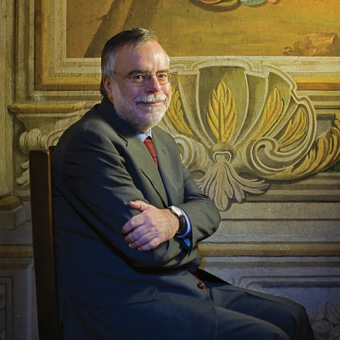
The founder of the international lay movement of the Sant’Egidio Community explains how his group has been able to build peace, one conflict at a time.
When Andrea Riccardi and his high school friends began to help Rome’s poorest 42 years ago, they did not intend to work beyond the city. But the movement they launched now has about 50,000 members in more than 70 countries.
Along the way Riccardi realized that to help the poor it was necessary to promote peace, as his Sant’Egidio Community has done effectively in Africa, Latin America, Asia, and the Balkans. “Promoting peace and helping the poor are related aspects of trying to respond to today’s needs by drawing inspiration from the gospel,” he explains.
Riccardi has a quiet, friendly manner, open and ready to laugh, but when he talks about his community, the passion comes through. The student unrest of 1968 convinced him that humankind had to make a fresh start, but, unlike many of his peers, he saw that something more than politics was needed.
He still sees religious renewal as the answer: “Our churches have to become warmly human, they have to be real communities, not closed in on themselves. Churchgoers need to be involved in social issues to help society be an expression of solidarity because globalization makes it urgent for us to find ways to live amicably despite our differences.”

When people come to the Sant’Egidio Community to find out what it’s all about, Riccardi says, “My answer is, ‘Come and pray with us.’ It’s reading the Word of God each day and meditating on it, which clarifies the meaning of our work.”
In elections earlier this year Italy’s center-left Democratic Party wanted you to run for governor of the region of Rome. Why weren’t you interested?
I’m convinced that I have to work in society and in the church, which is a broader field than engaging directly in politics and being involved with a party. I don’t disdain politics, but at the same time I don’t think it’s the be-all and end-all.
I didn’t even think so in 1968, when I was a student seeking what to do. Many of my companions chose political activity as the way to set the world right.
That was the year of student revolts in many countries, when young people demanded power to build a better world. Did you share this ambition?
We tended to be bold and confident at that time, whereas today many young people are uncertain because they are worried about the future.
After high school I felt the unrest and excitement because change was in the air. Like others at my school in central Rome, I wanted to change society. But the talk at that time, influenced by Marxism, was rather theoretical. I decided it was useless to change social structures without changing people, and dangerous to do so by using violence—in this I was influenced by reading the gospel.
Was this because of your Catholic family background?
I have a relative, a Benedictine monk, who was beatified in 1954, but my parents were not particularly Catholic. My father was a banker who joined the antifascist resistance movement during the Second World War. After the war he was opposed to the Christian Democratic Party because of the pressure in favor of the party exerted by some priests.
As a student I had doubts about religion. I didn’t much like my parish nor Catholic Action, which had become a breeding ground for Catholic politicians.
But I met a worker-priest who took me to the slums on Rome’s outskirts. The people living there were mostly migrants from southern Italy, laborers without steady jobs, women who served as maids in our homes. To me it was a shocking discovery: the Third World at our doorstep.
My group of school friends called it the New Frontier. I explored it on my Vespa motor scooter. We were seeking a way to live the gospel, and eventually we set up an after-school program to help dropouts return to regular schools.
That experience sparked discussions that persuaded me that I needed to know some theology as well as the gospels. I bought and read books by people such as French theologians Yves Congar, Henri de Lubac, and Marie-Dominique Chenu, and the German theologian Karl Rahner.
These discoveries—both of the marginalized people and of the theologians—were perhaps my most formative.
How much were you influenced by the Second Vatican Council, which had just concluded?
It was in the air, but the church seemed far away. However, two outstanding priests helped us in our work. Carlo Maria Martini, who at that time was not yet a cardinal but rector of the Gregorian University, worked with us in his spare time in the 1970s, while Vincenzo Paglia, now bishop of Terni, was the first priest to work with us in a stable fashion.
Then in 1974 Cardinal Ugo Poletti, the vicar for Rome, convoked a diocesan conference on the social problems in the city. It was a people’s assembly: All were entitled to speak, and we did so. Until then we had called ourselves simply “the community,” but, as we had to give ourselves a name to address the conference, we chose “the Community of Sant’Egidio.”
Here’s the reason: We had worked from places on the outskirts or places we rented in central Rome, but they were too expensive. When we heard that Carmelite nuns had abandoned a damp convent at the Sant’Egidio Church in the Trastevere district, we squatted there. Eventually, seeing the work we did, the owners—the state—allowed us to use it for a peppercorn rent. So we became the Sant’Egidio Community. [Sant’Egidio—or St. Giles—was a miracle-working hermit in seventh-century France.]
With the Rome diocesan conference the Second Vatican Council caught up with us. Although Pope Paul VI never visited us, Poletti did and he became interested in us.
Do members still live in the former convent?
No, it is used only for meetings and offices. The Sant’Egidio Church is now used for private prayer. Each evening at 8:30 the community celebrates vespers in the Basilica of Santa Maria in Trastevere. It is very beautiful with superb Byzantine-style mosaics, and each evening it is crowded with Sant’Egidio members and visitors from all over the world. A priest or lay member of the community leads a reading and meditation on scripture; and there is a brief homily and singing of the psalms.
Prayer holds the Sant’Egidio Community together. Groups are engaged in different activities—from caring for senior citizens, running a soup kitchen that feeds about a thousand a day, and providing schooling for migrants to preparing meetings such as the yearly international ecumenical and interreligious gathering, and maintaining contact with communities in many countries. But all come together to pray.
For the poor a carefully prepared liturgy is a feast in which there’s a respect for the People of God along with celebration of the glory of God. It goes to the heart. It frees us from the danger of losing ourselves in activities or discussions, but there is no break between the liturgy and serving the poor.
You also use the Santa Maria Basilica on other occasions, don’t you?
Yes, particularly for the annual Christmas luncheon for the homeless, Gypsies, HIV sufferers, and old people. On that day we feed about 500 at the basilica, thousands more in other places in Rome, and more than 120,000 all over the world. It is always done in a warm, personal way. I think that the Christmas meal of the poor over the past 25 years has become a model of the poor at home in the church, an image of the kingdom of God. We celebrate this meal now in more than 70 countries.
What has been your most rewarding experience?
To see healthy babies born from mothers who were suffering from HIV. For the past eight years, in many countries of sub-Saharan Africa, we’ve run an anti-AIDS program called DREAM, which stands for Drug Resource Enhancement against AIDS and Malnutrition.
It ranges from preventive measures to full antiretroviral treatment and monitoring of the infection through bio-molecular labs, exactly as happens in the richest countries. It also includes clean water, education, and nutritional therapy.
Full antiretroviral therapy reduces the risk of women transmitting HIV to their infants to 2 percent. At present we’re treating 80,000 people, 17,000 of whom are under 15. In all, a million have benefited. To see a healthy child born when it could have been condemned to disease is a huge blessing. It is the most effective free-of-charge sub-Saharan program and functions in 10 countries.
After treatment more than 90 percent of the adults live well; they are like people who have undergone resurrection. Women, freed from the stigma, become the backbone of a new society. But we are “condemned” by its success to look for more support all around the world, which is a real challenge.
Perhaps Sant’Egidio is best-known for its peace efforts in Mozambique and elsewhere. How did you get involved in these places, and when did you move from helping the poor to promoting peace?
Initially our horizon was simply Rome. We did not contemplate working beyond it. An outbreak of cholera in Naples in 1973, however, spurred us to send some of our people there. But we really were not convinced that we should start sending out “missionaries” in general.
However, people from other countries who had come to know our community in Rome began to set up Sant’Egidio communities in their own countries, first in Europe, then from the 1980s on in Africa, the Americas, Indonesia, and elsewhere.
Our work for peace is an extension of our work with the poor, not distinct from it. It is the same but without borders. War creates suffering, destruction, and poverty. We try to help those who are the victims of conflicts be heard and persuade people that armed conflicts are not inevitable.
That’s an admirable aim, but how does a group that began by helping school dropouts come to be called the “U.N. of Trastevere”?
That description was intended as a compliment, but I would say, go easy on imaginative descriptions.
We weren’t parachuted into Mozambique to broker negotiations between the government and rebels. Sant’Egidio groups were involved in development projects there for years but saw that development was impossible without peace, and peace was impossible unless the combatants could be brought together to talk to each other.
Because we were known and trusted, we managed to bring them together and, after 11 rounds of long, exhausting negotiations over 26 months and some relapses, peace was achieved.
A Mozambican archbishop was involved, as were the Italian government and other nations, including the United States. Sant’Egidio provided a nongovernmental setting where those involved could meet in Rome. It was often exasperating: We’d meet for hours, go to lunch, and resume our discussions with the awareness that, while we hammered out details, people were being killed.
But it is no good to do these things in an amateurish fashion. Good intentions have to be translated into treaty terms, which are detailed, clear, and binding. That sums up what has been called the Sant’Egidio method: winning the confidence of those concerned, respecting the different viewpoints, not imagining that we can do it all by ourselves but involving others with responsibility, patience, discretion, and competence.
Since Pope Benedict XV condemned the First World War, the Catholic Church has spoken out for peace in a way it did not before. However, Catholics should not leave it up to the pope and the Vatican but work for peace themselves. The Mozambique peace treaty made us realize that, although Sant’Egidio is a small group of people without borders, it can have an impact.
Recently Sant’Egidio has been invited to participate in the Council for Truth and Reconciliation in Burundi to heal the scars left by the horrendous ethnic conflict there. We had previously been part of the negotiations that had ended that conflict. Evidently the Burundians believe that the Sant’Egidio Community has the good of the country at heart.
The community has also been involved in the search for a settlement of the Darfur conflict since 2003. We have participated in the negotiations, and we are pleased that in February the Sudanese government and the major rebel group finally signed an agreement. It’s a meaningful step on the way to an overall agreement. Inclusion in it of a repeal of more than 100 death sentences, as requested by the Community of Sant’Egidio, was particularly satisfying.
Do you select certain areas for your peace efforts?
We study certain areas such as the Balkans—Serbia, Kosovo, Macedonia—and sub-Saharan Africa but act when there are opportunities because of our first-hand knowledge of the situation or because of requests for help.
Our first effort in the early 1980s was helping Christians in Lebanon. Then, after the Mozambique episode, we encouraged meetings between the Guatemalan president and the guerrilla commandants. That facilitated negotiations that ended a 35-year conflict.
You have been criticized for providing platforms for Islamist leaders such as Sudanese Sheik Hassan al-Turabi and Algerian guerrilla leader Anwar Haddam.
Sheik Turabi also met with Vatican officials. To try to stop violence you have to dirty your hands. If you want to shake only spotless hands, go to your golf club—although even the hands there might not always be so clean. As I mentioned, there has just been an accord between the Sudan government and the biggest guerrilla group, and we are proud that we helped to bring that about.
Our involvement in Algeria goes back to a request from Muslims, whom we had gotten to know during our Meetings of Religions and who in 1994 asked me for help from Sant’Egidio.
At the time an estimated 300 to 500 Algerians were being killed weekly. One could not be indifferent to such carnage. We brought the various guerrilla groups together with politicians who were opposed to the military, which had seized power after elections had gone in favor of the Islamist party.
In 1995 these consultations resulted in the “Platform,” a statement that spelled out the steps necessary to establish peace. Even some church leaders criticized us, and the Algerian government considered the initiative an interference in their internal affairs.
But because of the consultations many Algerians who did not know Sant’Egidio came to realize that dialogue rather than bloodshed was the way out of their tragedy.
The failure of these efforts was perhaps my biggest disappointment in this field. One basic problem was that in Algeria the church is still regarded as foreign, whereas in the Middle East it is a well-established local church as it is in much of sub-Saharan Africa.
Still, at that time the walls of Algiers were covered with messages of hope and thanks to Sant’Egidio, because our initiative seemed the only chance to stop the bloodshed. And the truce and amnesty that came years later under President Abdelaziz Bouteflika—unfortunately after thousands of additional victims—in a sense made the Platform, which had been signed at Sant’Egidio, a reality.
Is it possible to dialogue with Islam?
It’s a duty. It is difficult but a duty. What is the alternative—to fight? Islam is not a monolith, and it’s lazy to dismiss it as such.
Personally, I am moved by the place prayer has in Islam. We must find a way to coexist with Islam. The most important task we face today is to build a fraternal society despite religious, ethnic, and other differences. Dialogue with others is not a wishy-washy thing.
But it takes two to dialogue. Have not the high hopes that were placed in interreligious dialogue at Vatican II been followed by a letdown?
Part of the reason is that people forget what’s been achieved. Previously religions were often mixed up in conflict, but increasingly it’s recognized that this is an aberration, a deformation. In that regard there has been a very positive change of climate. Another aspect is that people are looking at this in terms of decades. That time frame is too restricted; this is an epochal affair.
That’s the historian speaking. In addition to your work with the Sant’Egidio Community, you also serve as a professor of contemporary history at Roma Tre University.
All Sant’Egidio members, except for our priests, are laypeople who pursue their working lives. By the time I graduated in law, I knew I was more interested in history and began to study it.
How has your study of history affected your understanding of faith?
I have been interested in St. Francis of Assisi and St. Benedict and his Rule for his community, which is still relevant for society today. I set out to develop an autonomous, gospel-based community “on the road,” meaning initially the Roman suburbs, that was to be composed of laypeople—just as monasticism was at its beginning. And I wanted our community members to deepen their spiritual lives without becoming self-absorbed, which is a great danger.
Reading Yves Congar got me interested in church history, and I went to Paris to meet him. I was impressed by his warning that “without history you’ll find yourselves like illiterates who can’t read the present.”
Does studying history help the poor?
Indirectly. It’s a search for truth or recovering complexity on issues that are oversimplified. For instance, St. Francis was not the saccharine figure so often represented.
History helps us to avoid oversimplifications, clichés, political correctness, and ideology.
Among other things a study of church history shows that the church is more than its parishes. There have been confraternities, lay organizations, and religious orders. The church is rich in energies and initiatives that ensure freedom of action.
You have continued the “Spirit of Assisi” that was sparked by the first interreligious meeting held there in 1986. Sant’Egidio helped organize that meeting, which was severely criticized by some Catholic leaders as a syncretic celebration that put shamans on the same level as the pope.
It was not syncretic. It didn’t propose some vague universal religion. The participants prayed alongside each other in their own way. They were not seeking some common lowest denominator, but they were all addressing the Creator. The walls between religions don’t reach all the way up to heaven.
What have the subsequent yearly meetings achieved.
They have maintained and developed the new attitudes of religions. For instance when we met in Kraków last year, I accompanied some Muslims to Auschwitz. They were stunned by what they saw. “So it’s all true!” they said.
The meeting in Romania, which has the largest Orthodox Church outside Russia, led to the first invitation from a country with an Orthodox majority for a papal visit. And I also remember the hug and request for forgiveness of the Lisbon Patriarch to the Jews in front of the Church of St. Dominic in Lisbon, a symbol of the Inquisition. I could recount many episodes like this.
For many U.S. Catholics abolition of the death penalty is not a top priority. Why has it been so important in Sant’Egidio’s activities?
I think it’s always wrong for us to kill another person. Moreover one is never absolutely certain of guilt. And the death penalty is never a deterrent, it always adds another killing to a killing. It disproportionately affects social, ethnic, and religious minorities, and legitimates a culture of death, while claiming to reinforce a culture of life. It makes society a killer.
I could continue. There are alternative instruments of justice. I was pleased to see that the U.S. Conference of Catholic Bishops has now made the campaign against the death penalty an educational priority.
How has the Sant’Egidio Community been able to win support from both liberals and conservatives?
We have our critics, and we realize we make mistakes. We also have many sympathizers because we try to be true to our understanding of the gospels and the church, and to meet the needs of others. You have to have an interior life but also serve others to avoid internal church squabbling.
The interview was conducted and translated by Desmond O’Grady, a freelance journalist and author based in Rome. It appeared in the July 2010 issue of U.S. Catholic (Vol. 75, No. 7, pages 28-32).



Add comment