Is the bishops’ work to empower the poor Catholic enough? An alliance of pro-life groups says it’s not.
It was the brainchild of a Chicago priest, Michael Dempsey, in the 1960s, and it has blossomed over the past 40 years into one of the most effective, sustained anti-poverty efforts ever attempted in the United States. In 2010 the Catholic Campaign for Human Development (CCHD) is funding some 250 groups in the United States, wrestling with issues such as education, jobs, health care, violence, economic development, and access to public services.
Unlike traditional direct help to the poor through Catholic Charities offices and St. Vincent DePaul societies, the Campaign is aimed at the systemic roots of poverty by helping the poor help themselves. At least half the board members of every CCHD-funded organization must be low-income residents of the community where the work is going on.
“Across our nation, CCHD is needed now more than ever in these difficult economic times when so many families are suffering and poverty is growing,” says Bishop Roger Morin, chairman of the U.S. bishops’ subcommittee on the CCHD.
But since last fall the Campaign has been under continuous public criticism.
An alliance of some 20 pro-life organizations called Reform CCHD Now (RCN) launched a barrage of specific charges and called for Catholics to boycott the Campaign’s 2009 November collection. CCHD has funded and continues to fund “groups that openly oppose the church’s teachings,” declared RCN, “including support for abortion rights, legalized prostitution, and gay marriage.”
The effort continues through publications, online articles and blogs, mailings to priests and bishops, and frequent appearances of spokespersons on radio, TV, and YouTube.
The persistence had an effect: Six U.S. bishops refused to allow the 2009 CCHD collection to be taken up in their dioceses. John Carr, executive director of Justice, Peace, and Human Development for the bishops’ conference, says he expects to see at least a 5 percent reduction in 2009 contributions, though he attributes it to a combination of the lingering effects of the recession as well as RCN activity. Still, the question of the long-range impact of the campaign against the Campaign remains.
The bishops’ charity
Dempsey, a Chicago pastor, had no idea such a controversy would ever arise when he conceived the idea for the Campaign. He had gone door to door in his poverty-stricken parish and asked the people how the church could best serve them. Many indicated that more than charity, they needed the skills, encouragement, and support to address the societal injustices they faced on a daily basis.
When he became an auxiliary bishop of Chicago in 1968, Dempsey brought his experience and his vision with him to the National Conference of Catholic Bishops. He called for a new national thrust to empower local self-help organizations to be funded by an annual nationwide collection. In the wake of the Second Vatican Council, with its call for the church to open its doors to “the joys and hopes, the griefs and anxieties” of the people of the world, “especially the poor,” Dempsey’s plan was adopted wholeheartedly by the bishops, and he was named the first director of the Campaign in 1970.
Though Dempsey died in 1974 at the age of 55, the Campaign from the start encountered a cheerful response from Catholic parishes. Today the yearly collection draws some of the largest contributions given to any Catholic collection, averaging more than $11 million a year, despite the recession. Seventy-five percent of the collection goes to the national office, which grants funds to applicants all over the county. The remaining 25 percent is given to dioceses to be distributed locally. All grants are screened at both the national and local level.
Many CCHD-funded organizations are in large metropolitan regions. For example, the Chinese Staff and Worker Association in New York City began receiving grants in the 1970s to assist badly paid immigrants laboring in Chinatown garment factories. Over the years the association has helped workers reclaim some $50 million in denied wages, created an independent restaurant workers union, and gained wage increases for all the state’s tipped employees.
Other Campaign recipients are in rural areas. Since the Statewide Organizing for Community eMpowerment (SOCM) in East Jackson, Tennessee received its first grant in 1974, the organization has won important battles to halt the spread of toxic waste from coal mining in the Cumberland Mountains.
On the offensive
The major members of the RCN alliance include the American Life League (ALL), an anti-abortion group founded in 1979, and Human Life International, created in 1981, both based in Virginia.
A newer voice is Texas-based Bellarmine Veritas Ministries, which calls itself a “Catholic grass-roots organizing ministry.” Its founder, Rob Gaspar, was largely responsible for compiling the battery of accusations against CCHD in 2009, which other groups are disseminating, adding their own grievances as well.
Besides accusing some Campaign recipients of themselves flouting church guidelines by promoting abortion, same-sex marriage, or birth control or openly taking partisan political positions, many more are charged with being “partners with” or “associated with” or being “members of” other organizations holding positions contrary to the Catholic faith.
Frequently mentioned amid the charges is ACORN, the large community action network and longtime Campaign recipient. It became notorious in 2008 when it faced charges of embezzlement and voter fraud. Though cleared of wrongdoing, ACORN was investigated by CCHD at the time and cut off from funding that year and since.
Following Reform CCHD Now accusations, Carr and his staff investigated all the Campaign-supported organizations charged, and at least five have been defunded. For example, the Preble Resource Center in Portland, Maine, which serves the homeless, was ordered to return a $17,400 Campaign grant because it urged voters to vote no on a ballot measure to overturn the state’s same-sex marriage law. Other organizations were exonerated of charges and a few are still undergoing scrutiny.
“We’re trying to lift up a Catholic expression of Jesus’ message to the world,” Carr says. “But this kind of institutional funding is a complex enterprise. And when we’ve made mistakes in the past, we correct them.”
These strong steps were welcomed by RCN, but they insist the guilty organizations represent only the tip of the iceberg. They identify 31 Campaign recipients that are publicly listed as members of the Center for Community Change, a Washington, D.C.-based organization that concentrates on poverty issues and provides training for community organizers. Though not funded by the Campaign, it was reported that the center had spoken favorably about reproduction rights and board members on its Generation Change project include advocates of gay rights or “radical” feminism.
Of special interest was the fact that Carr, the bishops’ top Campaign overseer, was formerly the board chairman of the Center for Community Change. Carr responded that he has had no relationship with the center since 2005 and that during his chairmanship, the center never took any advocacy positions contrary to church teaching. Nevertheless, critics saw in these links an indication of how far the church is straying into enemy territory.
Deal Hudson, director of outreach to Catholics for George W. Bush’s presidential campaigns, urged Belllarmine Veritas Ministries to call for the elimination of CCHD. “No amount of housecleaning is going to make this arm of the USCCB worthy of our donations,” he wrote on his blog.
Michael Hichborn, lead researcher for the ALL, says the critics really aren’t trying to bring down the Campaign. “We support the poor,” he says, “but we think the facts show the Campaign is violating its mission. If the mission of the church is the salvation of souls, how is it accomplishing this when it’s contributing to organizations acting in contradiction to the church? We’re asking for openness and transparency.”
The communications director for Human Life International and the RCN alliance, Stephen Phelan, says the relationship between CCHD recipients and secular organizations is undeniable. “It’s not hard to find the links,” he says. “We’ll keep this up until we get results.”
Guilt by association?
The Campaign for Human Development has responded to the charges mainly by denying that they are true.
It produced a document called For The Record: The Truth About CCHD Funding, which states, “All grant applicants are carefully screened and funds are provided only to projects with objectives and actions . . . fully in accord with the moral teaching of the Catholic Church.” It will not consider “applications from organizations which promote or support abortion, euthanasia, the death penalty, or any other affront to human life and dignity.” The document acknowledges that several accused groups have been defunded, that some have been examined and found worthy, while still others have had their grants placed on hold.
“In this age of the Internet, institutional charity can be misunderstood or misinterpreted,” says Carr. “So we’re constantly reevaluating the organizations we support.” He emphasized the Campaign’s fidelity to Catholic social teaching with its commitment to the preferential option for the poor, subsidiarity (allowing the people who are being helped to make major organizational decisions), and solidarity (cooperating with disparate groups that have a voice in planning and organizing).
The For the Record document did not explain one very important characteristic of the CCHD operation: Namely, from the beginning Campaign-funded groups were encouraged to organize and work not in isolation but, if possible, in collaboration with other community groups.
The essentials of this provision can be summarized in three sentences: CCHD funds only organizations whose projects are in conformity with official Catholic teaching. These organizations may join in coalitions with other organizations to work on projects that are mutually agreeable and do not violate Catholic principles. They can do this even though these other organizations may hold positions on other matters that are not in conformity with Catholic teaching.
For example, a Campaign-funded community organization could work with other groups to improve public housing, even though these other groups also advocate artificial birth control. The views of these other groups on birth control do not compromise the housing position of the Campaign-funded organization.
RCN, therefore, can easily find allegedly incriminating evidence of collusion between Campaign grantees and groups that oppose church teaching. It’s all right there on the Internet with terms such as “partners with” and “members of.” The terms of the partnership or membership, however, are rarely spelled out.
“It’s the nature of coalitions to work with groups that may not always pass the smell test or the Catholic Church test,” says Msgr. John Moretta, a Los Angeles pastor who has a great deal of experience with CCHD organizations working for the rights of farmworkers. “A cooperating group with one of our organizations here is the Church of Scientology, and you can hardly find anyone farther from the Catholic Church than them.”
Ralph McCloud, director of the national CCHD effort, defends such coalitions. “To effect change on a large-scale societal issue like immigration reform,” he says, “you have to have others in with you. You need to create a critical mass. If you try to do it alone, you isolate yourself from the world.” Through community organizing, he says, “We’re building bridges that get at the roots of poverty.”
McCloud mentions an exception to the coalition rule. If a high-profile, very visible priority of a coalition member is something vehemently opposed by the church, then a Campaign recipient ought not to be a part of that coalition. This would apply, says McCloud, to a coalition that included a member like Planned Parenthood.
Both Carr and McCloud cite the endorsements of the Campaign’s work from Pope John Paul II and from Pope Benedict XVI, who wrote in his encyclical Caritas in Veritate, “Every Christian is called to practice charity. . . . This is the institutional path, the political path of charity, no less excellent and effective that the kind of charity which encounters the neighbor directly.”
Fighting words
While such explanations of the Campaign’s methodology are persuasive and reasonable to some, RCN members aren’t convinced for several reasons.
First, there is ambiguity in what constitutes cooperation or support for a position contrary to church teaching.
For example, the CCHD-funded San Francisco Organizing Project (SFOP) became a major target of RCN groups when they learned that the project had actively promoted and cooperated in getting passed through the city council the Healthy Kids Program in 2006, which provided health insurance for children of families not otherwise covered. However, the program has links to the San Francisco Health Plan, which offers abortion coverage and birth control services. So, it was argued by RCN, SFOP was supporting both programs and should have opposed the Healthy Kids Program and the San Francisco Health Plan.
George Wesolek, director of CCHD operations for the San Francisco archdiocese, insists SFOP in no way endorsed abortion or birth control. “When you live in a diverse society,” he says, “how can you make people’s lives better if you’re so limited in the public arena? You do the best you can to achieve the greatest good possible.”
Even though funding for SFOP was ultimately upheld by Campaign officials and “strongly” endorsed by the archdiocese, ALL concluded in its analysis online that SFOP was “in direct violation of Catholic Church teaching and CCHD guidelines.”
Second, there is a yawning chasm between the psychology and theology of the two sides.
In the spirit of the Second Vatican Council, the Campaign is based on the possibilities of good people working together for a better world. Its proponents welcome ecumenical, interfaith, and non-believer cooperation in the work to be done. The challenge is to help bring the kingdom of God that Jesus talked about a little closer to fulfillment. The danger here can be overweening self-confidence and dismissal of criticism.
Reporting to his fellow bishops in November, Bishop Morin of the bishops’ CCHD subcommittee called the accusations “outrageous claims,” and said that CCHDs opponents “simply are not in favor of the church’s social teaching.”
The RCN alliance, meanwhile, has as its first and uncompromising priority absolute fidelity to church teaching, especially regarding abortion and same-sex marriage. Its proponents are alarmed at “the culture of death” and tend to view the world as the place where sinful people work out the salvation of their souls through prayer and endurance.
Direct charity to the poor is commendable but cooperation with secular entities is regarded as courting disaster from this perspective. The danger here is an almost fundamentalist narrowness of vision and a tendency to label all opposing views under the heading of “radical activism.” Judi Brown, president of ALL, for instance, called some speakers at the bishops’ Social Ministry Gathering this year, “enemies of the body of Christ.”
Third, the reform groups believe they are winning. They point to the handful of Campaign recipients that have been defunded, due in large part to their protests, and to others whose grants are on hold or under review pending a decision. They point to the bishops who refused to take up the CCHD collection in their dioceses last year and anticipate that more will join this year.
In an era when commentators like Glenn Beck urge those who belong to any church that speaks about “social justice” to get out immediately, and when Sarah Palin is applauded for lampooning community organizers, the RCN position can appear mainstream.
Campaign reform
In some dioceses CCHD guidelines are already being revamped. Msgr. William Burke, who oversees Campaign activity in the Baltimore archdiocese, says CCHD grantees there can participate in a coalition only if all the projects of the other members of the coalition conform to Catholic teaching. And should another coalition member unexpectedly take on a position that deviates from Catholicism, the Campaign grantee “must withdraw.”
At the national level, too, it appears that a tightening up is on the way. In May, Morin and other members of the CCHD subcommittee wrote to all the U.S. bishops about the efforts to “review and strengthen” the program.
They promised, among other things, to “be more clear on the Catholic in the Catholic Campaign for Human Development” by making funding guidelines, grant-making processes, and contracts “better reflect our Catholic principles,” to link CCHD activities to the bishops’ priorities, “specifically defending human life and dignity, strengthening family life, and reflecting the . . . diversity of our church and nation,” and to “consider a plan to give larger and fewer grants with the intent of improving CCHD’s monitoring capacity.”
Some Campaign veterans are uneasy about where all this is going. A seven-year member of the CCHD advisory board in Chicago, Karen Przypyszny, expresses concern about reported new directions for the kind of organizations that will be receiving local funds in the future. A movement toward encouraging right-to-life projects is underway, she says, as newly appointed members join the board and veteran members are sifted out.
“I’m absolutely supportive of start-of-life and end-of-life programs, but that’s not the focus of the Campaign for Human Development,” she says. “The Campaign is about the whole middle, about what happens in between. It’s about living in this world and working in community, about jobs and schools.” Przypyszny says she fears a shift could seriously cripple the Campaign’s historical reason for existence.
But Carr emphasizes that the core values of CCHD are intact and will remain so. “It would be a mistake to think the priority for the poor will be narrowed or shifted in another direction,” he says. “That’s not going to happen. What we want to do is reassure Catholic donors that their dollars are going where they’re supposed to go.” In fact, he says, with the new changes, the Campaign will be “more flexible and innovative.”
Risky business
Meanwhile, those on the front lines, the people working in communities with the help of Campaign funding, are somewhat on edge. Jeff Bartow, director of Southwest Organizing Project (SWOP) in Chicago, got e-mails and phone calls last year from both the local and national Campaign offices. He was asked to respond to RCN charges that his organization was “encouraging birth control through comprehensive sex education.”
SWOP, a 14-year-old community organization, joined forces in 2008 with a privately funded project called Elev8 to bring comprehensive health services into one of the neighborhood’s public middle schools. The intent of on-site care was to bring together parents, children, school personnel, and medical professionals. In its promotional literature, Elev8 noted that comprehensive, age-specific sex education would be available for all students. That was the red flag to RCN.
Bartow replied to the inquiries by telling CCHD officials that his organization included as supporting members a variety of institutions including churches, a hospital, a motherhouse of Catholic sisters, and five public schools in the area. Elev8 was offering the same sex education program that is mandatory in all Chicago’s public middle schools, he said. The program is required even in those public schools that are currently renting space from the archdiocese.
Bartow has not heard yet whether the Campaign was satisfied with his reply and would be funding SWOP in 2010, as it has for the previous five years. At risk is support for its work with immigration, housing foreclosures, predatory lending issues, and violence prevention, including the reduction of shootings in the area’s most violent precincts by 67 percent.
“What we’re doing here is extremely important work,” Bartow says. “I wouldn’t want to see it jeopardized.”
This article appeared in the July 2010 issue of U.S. Catholic (Vol. 75, No. 7, pages 12-17).
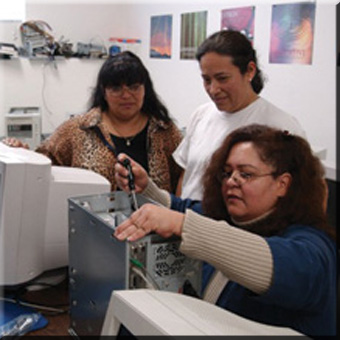
Image: CAMINOS San Francisco/Ken Touchton/©USCCB