

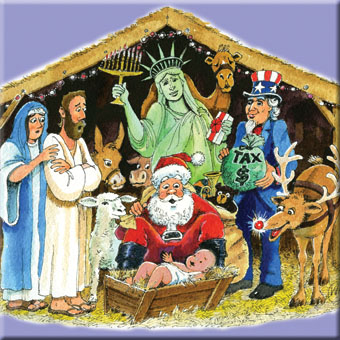
Let's keep Uncle Sam out of the nativity scene by reinforcing the wall between church and state.
Our varied beliefs can bring us together to feed the hungry and comfort the afflicted; to make peace where there is strife and rebuild what has broken; to lift up those who have fallen on hard times. This is not only our call as people of faith, but our duty as citizens of America, and it will be the purpose of the White House Office of Faith-Based and Neighborhood Partnerships."
With these words in February 2009, President Barack Obama signaled his continuation of a program George W. Bush placed at the heart of his 2000 compassionate conservatism campaign-taxpayer-funded faith-based initiatives. For many, Obama's action continued the erosion of the separation of church and state in the United States.
Indeed, the American constitutional principle of the separation of church and state has found many detractors of late, both in politics and religion. A spate of cases about the public display of the Ten Commandments got an Alabama judge removed from the bench, to the outrage of many believers. Every holiday season features another religious leader denouncing the "war on Christmas" and enlisting the faithful to tear down the "so-called wall of separation," which is contrary to the nation's "Judeo-Christian heritage."
It's true that the religion clauses of the First Amendment to the U.S. Constitution-"Congress shall make no law respecting an establishment of religion, or prohibiting the free exercise thereof"-do not include the language "a wall of separation." That metaphor comes from an 1802 letter from Thomas Jefferson to the Danbury Baptist Association, in which Jefferson asserts that, taken together, the two clauses "build a wall of separation between church and state."

But beyond the fact that the metaphor of "the wall" deftly summarizes a constitutional principle, it is also a natural fit for contemporary American Catholics. The reason: Separation most fully embodies Catholic teaching on faith and religious liberty, rooted in the dignity of the human person.
The Second Vatican Council's Dignitatis Humanae (Declaration on Religious Liberty) declares that "the human person has a right to religious freedom," meaning that "everyone should be immune from coercion by individuals, social groups, and every human power." The practice of religion consists of "voluntary and free internal acts by which human beings direct themselves to God." If civil authority "presumes to control or restrict religious activity, it must be judged to have exceeded the limits of its power."
In other words separation of church and state both respects the nature of religious faith and supports the maturation of religious liberty as described by the council. Religious institutions will breathe freer and thrive if government does nothing to entangle itself with religious ministries.
What does this separation mean on a practical level? Clearly, government cannot erect a state church. But from the point of view of the religious believer's best interest, to what extent should government promote and advance the ministry of religious institutions?
The most common point of contention on this issue relates to religious displays on public property, such as displays of nativity scenes or the Ten Commandments. While religious groups may initially be excited about seeing religious-themed artifacts erected with government support, there is a high price to pay.
The current legal criteria for evaluating whether such government-supported displays pass constitutional muster includes whether a fictitious so-called "reasonable observer" would understand the display as an endorsement of religion by the state.
And herein lies the rub: Anyone who sees life-size plastic models of Jesus in his manger, Mary, Joseph, an angel, shepherds, and some Wise Men standing alone on the town square will likely see an endorsement of religion.
So, what to do? Put up other holiday-themed figures: a plastic Santa Claus house and sleigh, flying reindeer, toy-building elves, candy canes, stuffed toys, Christmas trees, and colored lights. Line Jesus, Mary, and Joseph up with other holiday kitsch, and there is no longer any constitutional problem.
The reasonable observer's senses are sufficiently scrambled; she no longer sees a religious nativity scene but a secularized and commercialized holiday display. How is this a win for religious institutions?
A lesser-known issue, giving state employees Good Friday off with pay, should also worry people of faith. In order to pass constitutional muster, such a government practice would need a secular purpose. But unlike Thanksgiving and Christmas, which are no longer exclusively religious, few would argue that Good Friday is a secular holiday.
But wait! Isn't Good Friday but two days before Easter Sunday? And isn't Easter Sunday just chock full of secular aspects? The Seventh Circuit Court of Appeals is satisfied: "While there may be few secular aspects surrounding Good Friday, there are many secular aspects to Easter-the Easter bunny, Easter baskets, jelly beans, dyed eggs, and Easter-egg hunts. And [the state] has intrinsically tied the Good Friday holiday to the now-secularized Easter holiday." The "now-secularized" Easter robs Good Friday of its religious meaning. That's hardly a victory for the gospel.
Which brings us back to faith-based initiatives. What could be wrong with using tax money to further the ministry of churches? As with holidays, the cost to churches is the loss of the fundamentally religious dimension of the state-funded activity.
The most direct way for governments to fund church ministry is by channeling tax money toward the ministries of religious organizations. While a majority of the current U.S. Supreme Court may find no constitutional problems with government-funding schemes, that does not mean that religious believers should figure that it's good for religion, too.
The one who pays the piper calls the tune. Bush administration fact sheets presented the faith-based initiatives program as a "comprehensive effort to enlist, equip, enable, empower, and expand the work of faith-based" organizations to support the administration's partisan "compassion agenda."
President Obama sees his faith-based partnership office as a way to enlist support for the administration's interests in such areas as advising people with mortgage foreclosure issues and providing job-training. Government money coming into church coffers will mean that the priorities of partisan politicos will inevitably and insidiously nudge aside those of church members.
Obama's executive order in this area is clear: The federal government must ensure that any faith-based organizations receiving taxpayers' dollars be held accountable for their performance to ensure that they "achieve measurable results in furtherance of valid public purposes"-in other words, the purposes and policy priorities of the administration, not necessarily the first choices of religious communities.
At issue is the liberty and autonomy of religious institutions. The risk is that religious institutions will become beholden to governmental and political largesse, be enlisted in administration projects that may not be their own first choice of action, and retreat from engaging in a faith-driven ministerial imperative because it just doesn't bring in federal dollars.
And who will be willing to bite the hand that feeds it? A religious institution's prophetic voice, its ability to speak truth to power, will likely be self-censored when the power it needs to address is also the one holding the purse strings. Religious institutions will be more likely to curry favor with the politician du jour than challenge her on fundamental issues of justice. The ultimate result is a weakened religious community. So how is this a win for religion?
It isn't, and believers shouldn't fall for it. If we want to deliver services to those in need, let's do it not from public coffers but with our own alms, freely given, and according to our own evaluation of people's needs. If we want to take a Good Friday off work, we should, but not at the expense of the secularization of our faith's most solemn days. If we want to announce our faith with public displays, let's do it-in our homes and churches and private businesses.
And if we want to defend the integrity of our faith and promote the reign of God, our first line of defense is that principled "wall" of separation, which our constitution and Catholic teaching wisely support.
And the Survey Says…
1.) A strict wall of separation between church and state creates a stronger church.
Agree – 53%
Disagree – 35%
Other – 10%
2.) I support:
Prayer at civic events, such as meetings, public school graduations, and inaugurations – 56%
Public displays containing religious imagery – 50%
Government funding of faith-based ministries and service providers – 35%
Daily prayer in public school – 34%
A paid day off for government employees on Good Friday – 23%
None of the above – 25%
Other – 11%
3.) At the holidays, my local municipality publicly displays:
Secular Christmas displays – 61%
A nativity scene – 29%
A menorah – 20%
I don't know – 19%
Kwanza candles – 9%
Nothing – 7%
A sign from atheists – 1%
Other – 6%
4.) The Founding Fathers never intended a "wall" of separation between church and state.
Agree – 47%
Disagree – 36%
Other 17%
Representative of Other:
"They intended a separation, but not such a rigid boundary as a wall."
5.) The United State of America is a Christian country.
Agree – 38%
Disagree – 37%
Other – 25%
Representative of Other:
"The United States is a religious country but not specifically Christian. We welcome many different religions."
6.) I'd be willing to offer Catholic charitable groups more donations in order for them to operate without government funding.
Agree – 54%
Disagree – 25%
Other – 21%
Representative of Other:
"Most Catholic groups I know of don't receive government funds."
Feedback
The ideal relationship between church and state would be . . .
The Catholic model (Catholic Charities, hospitals). It has worked effectively without organizations losing their Catholic identity. The Second Vatican Council set the church on a course of engagement with the world. We should not turn back.
State protection of the right of all Americans to freedom of religious expression and to worship as they chose, from Roman Catholics to Wiccans.
Government should support churches but not dictate what they can do.
Separation, but the opinions and votes of elected officials might reflect their religious ethics. One should be able to vote his or her conscience.
To acknowledge that they work together every day-always have and always will.
A creative tension. The state needs to be reminded that there are other priorities. The church has to realize that the state has a legitimate function and should be allowed to do its job.
Religion should be included in all government functions. The Constitution only forbids the government from establishing a state religion (though they already have: atheism).
The best thing religion does for society as a whole is that it . . .
Makes us look at how we treat others, no matter what our faith tradition is.
Fills a void that society cannot get from any other institution. It brings morals, beliefs, and holiness to people.
Establishes moral principles for lawmakers and judges to use.
Operates educational institutions and hospitals, and meets the needs of the poor.
Gives us peace of mind in a crazy world.
Gives old cranky people something to do.
Serves as a reminder that we're all in this together.
The church-state relationship that makes me most uncomfortable is . . .
Public officials being sworn in to office on a Bible. Why not on the Constitution?
When I hear people insist that this is a Christian country. I don't believe it is or should be. This country should welcome people of all religions or no religion.
The president or other public officials expressing their religious beliefs and especially saying "God bless America" in public statements.
Overtly Christian prayer at public gatherings, and government funding that restricts the faith expression of the recipient organization.
The church-versus-state struggle about health care and human reproduction.
The teaching of creation alongside evolution in public schools. I believe we are living in a created universe, but I do not think a science teacher should have to teach religious views at a public school. I prefer to keep catechesis in the hands of parents and the parish.
School vouchers. I believe in public education, so if I want additional education for my child in a religious setting, I should be responsible for it myself.
Forcing citizens to financially support legislation or government activities that are contrary to one's religious principles.
I don't like to see churches take a stand on politics with only one issue in mind while neglecting other important factors.
When I see a religious display on public property, my reaction is . . .
Interest and curiosity. If it is a Christian display, I take in its message. If not, I look for commonalities to our religious symbols and try to see its message.
Hopeful that it is inspiring more people to do good and be more religious.
Discomfort. It is our mission as church to express the Christian faith, not the government's job. Christian displays on public property imply that those who do not hold those beliefs are outsiders here.
Patriotic. It's an example of our freedom of religion and expression. That's America.
Cynicism. I wonder how much of my tax money was wasted putting it up and taking it down and storing it for next year.
Hesitation. I wonder how people of other faiths feel about it.
Enthusiasm. We should put displays of different religions all together to express peace in diversity. Peace on Earth!
General Comments
John Adams said: "Our Constitution was made only for a moral and religious people. It is wholly inadequate to the government of any other." Society without religion will destroy itself from within.
We have a great system. The state does not interfere with nor support the institutional churches. That freedom gives us an environment in which religion can thrive.
Government funding for faith-based charities can go a long way but too often stifles the spiritual aspects of those missions. Are we really benefiting our brother when we feed his body and ignore his soul?
When President Bush started the "faith-based initiatives," I felt that he was trying to pass off onto churches the responsibility of the government to care for the poor. Churches can help a few people, but they should never try to take the place of government, and government should take its responsibility seriously.
If you go to the Nordic countries, all of the churches are beautifully maintained by the state but their pews are empty. State funding of churches is like striking a bargain with the devil: It may seem to provide benefits at first, but ultimately one side always ends up losing.
The further we get from God and his Commandments, the more corrupt our society becomes. God bless America-we need all the help we can get.
This article appeared in the December 2009 issue of U.S. Catholic (Vol. 74, No. 12, page 31).





Add comment