How violence takes a toll on our kids.
As a firefighter and a police officer, Annette Nance-Holt and her ex-husband, Ronald Holt, knew the dangers of the city and took every precaution they could to protect their son, Blair. "He wasn't the kind of teenager that didn't listen," says Nance-Holt. "He was an outstanding young person."
When another teen opened fire on a public bus after school on May 10, 2007, Blair, 16, showed himself to be a hero, throwing his body over a girl and taking the gunshot that would kill him.
Blair became one of 32 Chicago Public School students killed that school year, and also emerged as a symbol for the victims of youth violence.
"All the time we tell our children to go to school and do the right thing, and he was doing the right thing, along with the other people who were on the bus," Nance-Holt says, noting that four fellow Julian High School students were shot and injured in the incident.
Homicide is the second leading cause of death among 15- to 24-year-olds throughout the country and the primary cause of death among African Americans of that age group, according to the Centers for Disease Control and Prevention (CDC). In 2006 emergency rooms treated more than 720,000 violence-related injuries in youth ages 10 to 24.
The U.S. Surgeon General declared youth violence a national epidemic in a 2001 report: "No community, whether affluent or poor, urban, suburban, or rural, is immune from its devastating effects. . . . This epidemic has left lasting scars on victims, perpetrators, and their families and friends. It also has wounded entire communities and, in ways not yet fully understood, the United States as a whole."
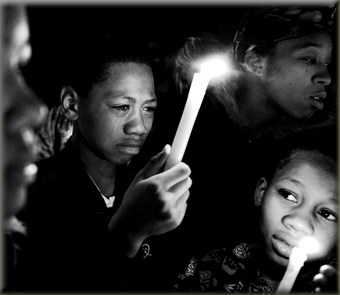
With 36 Chicago Public Schools students killed during the 2008-2009 school year, Chicago is at the epicenter of this epidemic. Still, the stories and photos from Chicago illustrate the crippling toll violence can take on children anywhere.
Unhealthy nation
As a first-responder to emergency calls, Nance-Holt says that violence is a much larger problem than most people ever see, with most non-fatal shootings never making the news.
When the surgeon general declared youth violence a national epidemic, homicide rates had actually fallen from a 1993 high. Rates have risen slightly since 2001, but as is the nature of epidemics, there are frequent outbreaks. "Much work is still needed to help develop a society where all youth live fulfilling lives, safe from hurt and harm," says CDC's Jeff Hall, a behavioral scientist with the Division of Violence Prevention.
Violence may be focused in certain neighborhoods, but it's everyone's problem, says Father Bruce Wellems, the Claretian pastor of Holy Cross/Immaculate Heart of Mary Parish in Chicago's Back of the Yards neighborhood. "We're all the Body of Christ, so if you have cancer in your left hand, why should you care? The thing is, it's going to spread."
With the gang lifestyle glamorized in pop culture, "wannabes" emulating gang activity are a problem in suburban Chicago, reports Tom Sedor, principal of Infant Jesus of Prague School in Flossmoor, southwest of Chicago. "You can't put your head in the sand and say that will never happen here," Sedor says.
Homicide in one community is a threat to the entire nation, Hall says, because "it actually compromises our society's ability to reproduce itself. It removes from our present individuals who could possibly have large contributions to our future."
Father Michael Pfleger, an outspoken advocate for victims of violence and the Holts' pastor at St. Sabina Parish in Chicago, echoes Hall's analysis, categorizing youth violence as a life issue. Abortion, he says, is "whatever keeps life from its God-given potential. We're aborting in the womb, yes. We're also aborting in the streets."
"It has a whole ripple effect on young people," Pfleger adds. "If a child is living in fear, it affects their ability to learn, to grow, to dream."
Child's play
When Elisabeth was 11, her 15-year-old brother became involved with two gangs. When both gangs started coming after him, the family sent him off to live with an aunt, but gang members would continue to confront Elisabeth, following her after school and asking where he was.
"In school I didn't really listen that much," says Elisabeth, now an eighth-grader at St. Agnes School in Chicago's Little Village neighborhood, a Hispanic immigrant community. Instead, Elisabeth worried about her brother's future and her own safety.
Her parents transferred her to St. Agnes to protect her from those harassing her and now drive her to school. "Right now I'm just afraid of being alone," she says, adding that her focus has improved at the new school.
Studies show that children exposed to violence often have increased levels of anxiety and depression, and can exhibit symptoms of post-traumatic stress disorder or general distress disorder, leading to poor academic performance, Hall says.
"You just can't expect somebody to walk past a murder scene every day and sit down in Algebra 1 class and pay attention," says Chicago Sun-Times education reporter Rosalind Rossi, who compiled a survey of more than 250 fifth- through eighth-graders at three public schools. The study found that half knew at least one friend or relative who had been shot at and nearly three-quarters had heard gunshots in their neighborhood.
Though gang lines lie a block from St. Agnes, Elisabeth's story is especially dramatic, Principal Matthew Banach says. Most students are like fifth-grader Giovanni, whose dad and grandpa walk him to school every day. His parents let him play only in the house or yard because not even a park two blocks away is safe, he says. The last time Giovanni played soccer at the park, gangbangers started shooting. {C}
"Usually our parents are very good about keeping their kids inside the house and safe," Banach says. Staying inside the house, however, does not allow for socialization and physical activity, both important to a child's development.
When a child doesn't feel secure, it also can show in his or her behavior. Banach tells of a fourth-grader who lived next door to a house with gang activity. He couldn't sleep and showed signs of attention-deficit disorder. "He was very much hypersensitive, looking around, very active, and taking those emotions and stress and acting out in different ways."
Discipline can both curb violent behavior and mitigate the stress caused by violence. "If you have uncertainty on the outside," Banach explains, "at least you know in this environment, here are the regulations."
Another tactic offered by Catholic schools serving kids in violent neighborhoods is to focus on the future and encourage them to use their education to improve their community.
"We don't want violence to define who they are and what they can achieve," Banach says.
Dodging bullets
When asked if school is safe, 10 teenage boys in a mentor group at Holy Cross/Immaculate Heart of Mary Parish answer, "Hell, no!"
These are the "bad kids," says youth worker Claudio Rivera, who grew up in the parish. "They get labeled this way, and they get recognized as a group instead of as individuals."
In the absence of a safe, encouraging environment, violence can take on a cyclical nature, causing fear and insecurity, which leads kids to perpetuate more violence.
As the group discusses how to represent the third station, "Jesus falls for the first time," for a neighborhood Way of the Cross this spring, it becomes clear that the teens have experienced more than their fair share of falling. Of the 10 boys, ages 14 to 16, four report being shot at and one says he had been shot. Just a few weeks before, Rivera says, Jaime spent a few nights in juvenile detention after being caught with a gun.
Jaime says he turns to family and the church when he falls. Still he's not sure about participating in the Good Friday Way of the Cross. "They told me to stay off the street," he says, worried that he could get in more trouble, either with the cops or the gangs. Rivera reassures him quietly after others chide him for being scared.
You simply don't admit you're scared in this neighborhood, the kids say. Rivera, who starts a Ph.D. program in psychology at DePaul University this fall, explains that fear is exactly what leads kids into destructive behavior.
"Some of them deal with this fear in kind of an external manner where it shows in their aggressive or belligerent behavior," Rivera says. "Others internalize it, and you can't see it as readily. It shows itself in their lack of success in school or attempt to even go to school, in self-medicating, in joining the gang."
Wellems says violence often starts at home, with a parent missing or both parents working and unable to provide proper attention or guidance to their children. "One of the fundamental rights of a child is to be cared for and to be loved, and if that doesn't happen, then there's a violent reaction."
At 11 or 12, Wellems says, a kid is looking for protection and might become loosely associated with a gang, walking to school with other neighborhood kids. Young teens want to take risks and gain approval, while gang members in their late teens feel responsible for protecting the neighborhood.
Gangs actually have positive values of fraternity and loyalty, Wellems notes, "but what's messed up about it is that there's no adult guidance." After some guys in their 20s rammed vans into each other in a gang war, for example, Wellems saw 15-year-olds ramming their bicycles into each other.
Looking at violence as an epidemic allows us to see that the problem is with a learned behavior, says Gary Slutkin, a public health expert and founder of Ceasefire, a violence prevention program.
A "bad" kid is merely formed by "a bunch of infectious influences that predictably result in a certain set of behaviors.
"The enemy or the agent is the thought that ‘I'm supposed to do this or people will think I'm weak.' There's actually an information and skill gap," says Slutkin. Most don't realize they are under peer pressure.
Once teens are caught up in the cycle of violence, it's hard to escape. Violence has debilitated the youth in or coming out of juvenile delinquent centers, says Father Dave Kelly of Precious Blood Ministry of Reconciliation, an anti-violence ministry of the Missionaries of the Precious Blood in Chicago.
"When you talk about goals or dreams, they really look at you as if that were a silly question or a non-question because they don't see themselves living beyond 21 years of age," he says. "It causes them to live for the moment and not be willing to set aside instant gratification."
No dead ends
Jermaine Winfield was running high on adrenaline after his basketball team at North Lawndale College Prep beat ACT Charter on January 20, 2009. Waiting for a ride home from his coach, he and a few teammates saw some friends surrounded by other boys.
The teammates went over to defend their friends, but after they thought the fight was over, the other group came back with a gun. Jermaine and his teammates started running and heard four or five shots. He felt a pain in his leg, but it wasn't until they got back to the locker room that he realized he had been shot in the thigh.
Jermaine, then a junior, spent the night in the hospital and learned that he could have been killed or paralyzed if the bullet had hit farther up.
"I try not to think about it. I just moved on," says Jermaine, who still has the bullet in his leg. "Once the doctor told me I would still be able to play basketball, that was the only thing I was thinking about. I was just focused." Jermaine wants to work with computers if he doesn't play professional basketball. "I'm not going to let it be my downfall," he says, demonstrating incredible, and necessary, fortitude.
"This stuff happens unfortunately-maybe when you're poor it happens more often-but you keep taking care of business and then you do your work on your own personal resilience," says John Horan, director of expansion at North Lawndale College Prep and a former priest. The school doesn't use metal detectors and deals with violence through prevention and counseling. Their strategy is to "overwhelm the kids with caring, mindful, attentive adults," Horan says.
Studies "suggest that the act of being victimized compromises your ability to see yourself as a person [who] can determine your own fate," says the CDC's Hall. This can lead to anger and anti-social behavior, but adults can help motivate kids to transcend their surroundings.
Flag football games and camping trips attract at-risk youth to Holy Cross, but Rivera says it's the relationships that are key. "From my perspective, kids are going to seek out adults for guidance and that's going to be whether they seek out the adult who is going to guide them in the right direction . . . or the adult who's going to guide them in the other direction."
When Jaime got in trouble for carrying a gun-it's common for older gang members to hide their weapons on younger kids-Rivera reminded him of a wilderness trip the mentor group had taken. Jaime had been the one always concerned that his friends were warm enough and had enough to eat. "You're a caring kid. That's going to take you a long way," Rivera says he told him. Jaime has recently taken steps in the right direction, focusing on his education and future opportunities.
"You celebrate the successes of each kid just as you go after each kid who's failing," Wellems says. While holding kids responsible, adults must give them another chance. "It's always giving them a light at the end of the tunnel, never cutting them off completely."
It takes the whole community-parents, park workers, teachers, police, and church leaders-to help at-risk kids find hope for their future. Rivera knows this from experience. "I felt the support that I received from my family, these groups, from various adults is what helped me get by," he says.
At St. Sabina, Pfleger rails against gun manufacturers, but he also tells parishioners not to tolerate violence-to turn in both guns and murderers.
"The effective way to change norms is to use multiple messengers," Ceasefire's Slutkin says. "Faith leaders are part of the community's ability to provide a unified message that we don't want this here anymore."
Faith influences individuals, communities, and also civil society. Slutkin notes that gaining the support of Chicago's Cardinal Francis George, president of the U.S. Conference of Catholic Bishops, was a turning point for Ceasefire, which has become a national model adopted by smaller cities affected by violence. The cardinal has been involved at all levels-from raising awareness of the issue and securing funding to negotiating conflicts with gang leaders.
As a public health expert, Slutkin approaches violence scientifically, but when George first met with Slutkin and heard about his program, the cardinal also recognized that violence is a spiritual problem.
"This is about transformation, isn't it?" the cardinal said.
This article appeared in the June 2009 issue of U.S. Catholic (Vol. 74, No. 7, page 12).