Logo

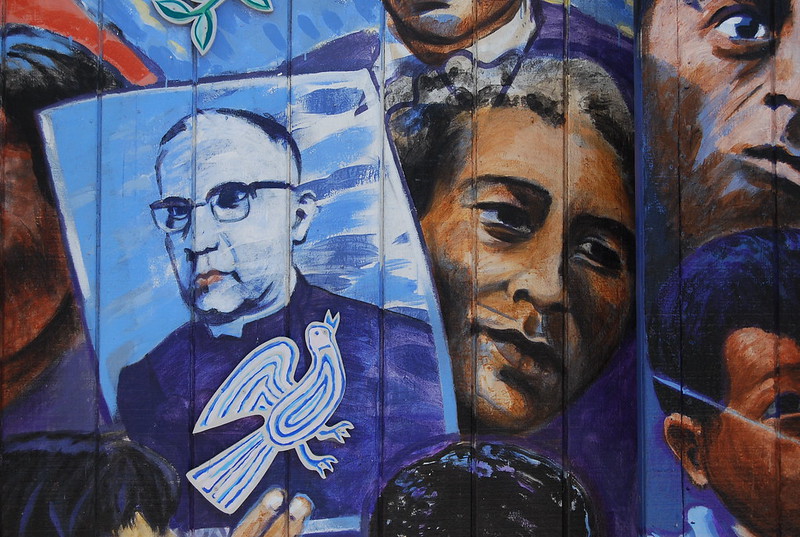
Oscar Romero: Bishop of the Poor

Wednesday, February 25, 2009
Oscar Romero: Bishop of the Poor

In 1980, in the midst of a U.S. funded war the UN Truth Commission called genocidal, the soon-to-be-assassinated Archbishop Oscar Romero promised history that life, not death, would have the last word. "I do not believe in death without resurrection," he said. "If they kill me, I will be resurrected in the Salvadoran people."

On this 29th anniversary of his death, the people will march through the streets carrying that promise printed on thousands of banners. Mothers will make pupusas (thick tortillas with beans) at 5 a.m., pack them, and prepare the children for a two-to-four hour ride or walk to the city to remember the gentle man they called Monseñor.

Oscar Romero gave his last homily on March 24. Moments before a sharpshooter felled him, reflecting on scripture, he said, "One must not love oneself so much, as to avoid getting involved in the risks of life that history demands of us, and those that fend off danger will lose their lives." The homily, however, that sealed his fate took place the day before when he took the terrifying step of publicly confronting the military.

Romero begged for international intervention. He was alone. The people were alone. In 1980 the war claimed the lives of 3,000 per month, with cadavers clogging the streams, and tortured bodies thrown in garbage dumps and the streets of the capitol weekly. With one exception, all the Salvadoran bishops turned their backs on him, going so far as to send a secret document to Rome reporting him, accusing him of being "politicized" and of seeking popularity.

Unlike them, Romero had refused to ever attend a government function until the repression of the people was stopped. He kept that promise winning him the enmity of the government and military, and an astonishing love of the poor majority.

Romero was a surprise in history. The poor never expected him to take their side and the elites of church and state felt betrayed. He was a compromise candidate elected to head the bishop's episcopacy by conservative fellow bishops. He was predictable, an orthodox, pious bookworm who was known to criticize the progressive liberation theology clergy so aligned with the impoverished farmers seeking land reform. But an event would take place within three weeks of his election that would transform the ascetic and timid Romero.

The new archbishop's first priest, Rutilio Grande, was ambushed and killed along with two parishioners. Grande was a target because he defended the peasant's rights to organize farm cooperatives. He said that the dogs of the big landowners ate better food than the campesino children whose fathers worked their fields.

The night Romero drove out of the capitol to Paisnal to view Grande's body and the old man and seven year old who were killed with him, marked his change. In a packed country church Romero encountered the silent endurance of peasants who were facing rising terror. Their eyes asked the question only he could answer: Will you stand with us as Rutilio did? Romero's "yes" was in deeds. The peasants had asked for a good shepherd and that night they received one.

Romero already understood the church is more than the hierarchy, Rome, theologians or clerics—more than an institution—but that night he experienced the people as church. "God needs the people themselves," he said, "to save the world . . . The world of the poor teaches us that liberation will arrive only when the poor are not simply on the receiving end of hand-outs from governments or from the churches, but when they themselves are the masters and protagonists of their own struggle for liberation."

Romero's great helplessness was that he could not stop the violence. Within the next year some 200 catechists and farmers who watched him walk into that country church were killed. Over 75,00 Salvadorans would be killed, one million would flee the country, another million left homeless, constantly on the run from the army—and this in a country of only 5.5 million. All Romero had to offer the people were weekly homilies broadcast throughout the country, his voice assuring them, not that atrocities would cease, but that the church of the poor, themselves, would live on.

"If some day they take away the radio station from us . . . if they don't let us speak, if they kill all the priests and the bishop too, and you are left a people without priests, each one of you must become God's microphone, each one of you must become a prophet."

By 1980, amidst overarching violence, Romero wrote to President Jimmy Carter pleading with him to cease sending military aid because he wrote, "it is being used to repress my people." The U.S. sent $1.5 million in aid every day for 12 years. His letter went unheeded. Two months later he would be assassinated.

On March 23 Romero walked into the fire. He openly challenged an army of peasants, whose high command feared and hated his reputation. Ending a long homily broadcast throughout the country, his voice rose to breaking, "Brothers, you are from the same people; you kill your fellow peasant . . . No soldier is obliged to obey an order that is contrary to the will of God . . . "

There was thunderous applause; he was inviting the army to mutiny. Then his voice burst, "In the name of God then, in the name of this suffering people I ask you, I beg you, I command you in the name of God: stop the repression."

Romero's murder was a savage warning. Even some who attended Romero's funeral were shot down in front of the cathedral by army sharpshooters on rooftops. To this day no investigation has revealed Romero's killers. What endures is Romero's promise.

Days before his murder he told a reporter, "You can tell the people that if they succeed in killing me, that I forgive and bless those who do it. Hopefully, they will realize they are wasting their time. A bishop will die, but the church of God, which is the people, will never perish."

The twentieth century has been the bloodiest century in history. In what Jose Marti called the "hour of the furnaces," Oscar Romero, Nelson Mandela, Desmond Tutu, Martin Luther King, Fannie Lou Hamer, Dom Helder Camara, Maura Clark, Dorothy Kazel, Ita Ford, Jeann Donovan, and Ella Baker accompanied those who were in the sights of the men with guns. They burned brighter.

Renny Golden is co-author with Scott Wright and Marie Dennis of Oscar Romero: Reflections of His Life and Writings, available through Orbis Books (914-941-7636) and The Hour of the Furnaces, Minn: Mid-List Press, a social history/poetry of the war years in El Salvador.

Comments (11)

Comment viewing options

Select your preferred way to display the comments and click "Save settings" to activate your changes.

Oscar Romero

I had heard of Bishop Romero but didn't know the whole story. His courage in the face of such violence is exemplary. He did truly walk Christ's path. Most of us don't have that much courage. I doubt his name will be forgotten and he is a saint where it truly counts - in heaven.

Understanding

Oscar Romero is a hero to me! To see the transformation in his life was nothing short of a Paul-like miracle. The real question to me is not what others did or didn't do it should be what are we doing or willing to do? If we don't face this question head on we miss the point of his life and death.

One wonders why the delay in acclaiming Monsignor Romero as a Sa

if One takes the view that lived Christianity is an outer expression of an interior reality; then surely Monsignor Romero's vivid emample to us all through the implementation of the teachings of Christ would suggest that by his own actions and his solidarity with the meek and pure of heart that he is indeed sitting at the right hand of the Father. Along with all who die in the Grace of God I believe he is a Saint, however I wonder why the Vatican has put the brakes on publicaly acclaiming him so? We live in ever more dangerous times and it is appropriate that a role model of Romero's stature be held up for the leaders of the world to see.

Eminem Relapse Refill Fan's picture

Canonization of Archbishop Romero

There may be some hesitation on the part of the Vatican, because Romero is associated with "liberation theology," which is controversial.  Some ideas termed liberation theology have been condemned by the Vatican.

Although I don't doubt that some forms of liberation theology fell into error, I also would propose that Romero is the model of a TRUE liberation theology, one which is in total accord with authentic Church teaching, yet at the same time radically challenges the status quo, seeks real renewal in the Church and in society, and works to liberate the poor and oppressed. 

I feel quite certain that eventually, Archbishop Romero will be canonized.

Oscar Romero

I concur with Philip that Monsignor Romero will be acclaimed by the Vatican as a saint in due course. Yes Liberation theology did in extremes veer in to marxist political action but that must be balanced against the drift towards fascism which occurred with many of the leaders of the institutional church. It was interesting to note that while the JP 2 Papacy warned priests to stay out of politics (OR ELSE)it became probably the most politicised papacy in history (which was a good thing as evidenced by the liberation from political tyranny which JP 2 brought about across Eastern Europe)
Jesus came to free us from ourselves and Romero himself is a striking example of liberation theology in action in that he was the first to admit that he was blind for many years but through the suffering of his flock who became for him Alter Christos; he came to see the the path to which we are each called as Christians and took it despite the all too predictable consequences.

Forgiveness

"You can tell the people that if they succeed in killing me, that I forgive and bless those who do it.

The "Romero" prayer

The beautiful prayer ending "We are prophets of a future not our own" was actually composed by Bishop Ken Untener of Michigan, who wrote it for Bishop Reardon to speak at a funeral of priests. Bishop Untener was a holy man with a commitment to his people very much like that of Archbishop Romero. He died five years ago today. May his soul and the souls of all the blessed departed rest in peace.

Prophets of a future not our own

It helps now and then to step back and take the long view.
The Kingdom is not only beyond our efforts, it is beyond our vision.
We accomplish in our lifetime only a tiny fraction of the magnificent enterprise that is God's work.
Nothing we do is complete, which is another way of saying that the Kingdom always lies beyond us.
No statement says all that could be said. No prayer fully expreses our faith. No confession brings perfection. No pastoral visit brings wholeness. No program accomplishes the Church's mission. No set of goals and objectives includes everything.
That is what we are about: We plant seeds that one day will grow. We water seeds already planted, knowing that they hold future promise.
We lay foundations that will need further development. We provide yeast that produces effects beyond our capabilities.
We cannot do everything, and there is a sense of liberation in realizing that. This enables us to do something, and to do it very well.
It may be incomplete, but it is a beginning, a step along the way, an opportunity for God's grace to enter and do the rest.
We may never see the end results, but that is the difference between the master builder and the worker.
We are workers, not Master Builders, ministers, not Messiahs. We are prophets of a future not our own.
- Bishop Ken Untener

The above prayer is often reffered to as the "Romero Prayer" in honor of Bishop Oscar Romero of San Salvador.

Why did the bishops of El

Why did the bishops of El Salvador not in support of the actions of ArchBishop Romero?
What was the reaction of late Pope John Paul1 and what course of action did he take on the assissanation of ArchBishop Romero?
It is terribly sad that President Carter also a stauch christian did not respond postively to the demands of Archbishop Romero to stop military aid to the military regime of El Salvador which were used to repress the freedom movement of the poor and marginalised.
Will the current government of El Salvador conduct and enquiry into the assassination the late Archbishop even at this late stage and punish the murderers?
Long live Archbishop Romero. May his soul rest in peace

I just wonder why we should

I just wonder why we should believe that Carter is a "staunch Christian." Just because he and other U.S. leaders say they are Christian does not mean we should believe them. Their actions show otherwise.

Comment viewing options

Select your preferred way to display the comments and click "Save settings" to activate your changes.

Post new comment

The content of this field is kept private and will not be shown publicly.
Comments are limited to a maximum of 1500 characters.
  • Web page addresses and e-mail addresses turn into links automatically.
  • Allowed HTML tags: <a> <em> <strong> <cite> <code> <ul> <ol> <li> <dl> <dt> <dd>
  • Lines and paragraphs break automatically.
  • Filtered words will be replaced with the filtered version of the word.

More information about formatting options

CAPTCHA
Answer this question to prove you are a human visitor and prevent automated spam submissions.