A Catholic view of the market just may be what’s needed to rescue our economy from its moral recession.
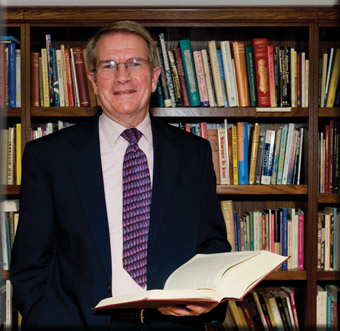
The editors interview Daniel Finn
If anything good comes out of the current economic crisis, it might be a more urgent discussion of morality in the marketplace, theologian and economist Daniel Finn says.
Finn, a professor at St. John’s University in Collegeville, Minnesota and president of the Society of Christian Ethics, has attended separate meetings of theologians and economists on back-to-back weekends for 30 years.
This incongruous experience has left him with a goal. “I’ve constantly been struck by how differently people think about these issues,” Finn says. “Both within economics and Christian ethics, people on the left and right often don’t talk to each other. They just think the other side is wrong.”
Finn wants to bring all sides to the same table to discuss morality’s role in the market. Even in exclusively Catholic circles, though, solutions won’t be easy to come by. “You shouldn’t say, ‘What’s Catholic social teaching’s recipe for fixing this crisis?’ There are several options within the general Catholic frame,” says Finn, who also co-directs The True Wealth of Nations research project studying the relation of economics and Catholic social teaching.
Still, the discussion is worthwhile for religious folk. “There needs to be a sense that we’re in this together as a church and as a society, even if we don’t agree with each other,” Finn says. “This way we’d live a fuller, more integrated spiritual life.”
What brought about the current economic crisis?
There are several contributing causes, but the reigning philosophy that led to this crisis is the ideology of the free market. It says that people know their own interests better than anyone else and therefore are the best situated to act on those interests and decide what risks they’re going to take.
Housing was a big part of the problem. Interest rates on mortgages were lowered so low-income families could afford to own a house, but many middle-income individuals also bought a second or third house to rent out. Everyone expected home values to keep rising. Even if a family fell on hard times, they could always sell the home for a profit, though now this is no longer the case.
At the same time, new financial instruments were invented that gave investors more confidence to take financial risks. The investments weren’t based on real underlying assets like homes or factories but were derived from other financial instruments, hence the name derivative.
These new instruments were not subject to the usual financial regulation, and they got so complicated that nobody really knew what would happen if investments on which they were based were to fail.
London’s Financial Times estimates there were $3 trillion to $4 trillion worth of bonds with real assets behind them and between $30 and $50 trillion worth of these derived instruments. So when something went wrong in the world of real assets, such as people being unable to keep up their mortgage payments, the effect in the financial markets was magnified by 10. That’s what has made the current crisis so catastrophic.
How does Catholicism respond to free-market philosophy?
One of the biggest things Catholicism says about the economy is that it should be oriented toward the common good. Virgil Michel, a long-deceased Benedictine who taught at St. John’s University, had one of the best definitions of the common good. He said it had two aspects: the common conditions of social life and the attainment of the good life by all.
Common conditions are the things that we all depend on but that no one person generates: schools, museums, parks, police forces, peace, and so forth. The good life means that there should be a minimum quality of life for everyone. It doesn’t mean economic equality, but it does mean nobody can be left out. If you want plastic surgery and can afford it, I’m not going to stop you, but first everyone else has to have basic health and dental care.
For The True Wealth of Nations research project I co-direct, we’ve made the bold statement that if a country were to implement what Catholic social thought recommends, it would be on the path to sustainable prosperity for all. In essence that’s the Catholic view of where we have to be going.
Our current system has been devised without much concern for the common good or with the naive presumption that a free market would somehow serve the common good, but it doesn’t work that way. When you leave economic life to the free market, some people get left out. Our culture’s views of the market and of the human person are quite constrictive.
How so?
Economists understand the human person as a rational individual trying to maximize his or her own interests. You have certain things you enjoy and value in life, and everything you do is to obtain those goals.
This model was thought to be accurate back in the 1830s. Psychologists have dismissed it for 140 years, but it has been kept in economics for mathematical reasons. It is useful within limits, but it doesn’t explain everything.
Economists have used this model to explain the actions of both a felon stealing from folks in Calcutta and Mother Teresa helping them. She had a different set of interests, but according to an economic perspective, they both were pursuing their self-interest. In a moral conversation, however, you want to distinguish between Mother Teresa and the thief.
There has been a disciplinary decision in economics to avoid moral judgments. I think this perspective has an impact on how businesspeople, politicians, and ordinary people think about the world.
What might be a better point of view?
The Catholic point of view says that even though markets are essential, individuals don’t operate just to maximize their own personal well-being. The point of economics, like everything in life, is to serve a higher goal. That goal is ultimately union with God. There ought to be an orderliness to our economic decisions, our consumption decisions, and our institutional decisions that brings us closer to God, or we’re going in the wrong direction.
What would an economy based on Catholic social teaching look like?
Stefano Zamagni, an Italian economist, has researched the history of markets. He proposes that the Franciscans of the 13th, 14th, and 15th centuries set up the basic institutions of the market (such as banks and corporations), but it was what he calls a “civil market,” where the common good was vibrant. You didn’t press for the best possible deal or charge the highest possible price; you negotiated a fair price.
According to this analysis, our problem today is not that we have markets, but that we have the capitalist version of markets. He calls for creating a civil market for the 21st century.
Was a “civil market” possible because markets back then were smaller?
There were some sizable cities in the 13th century, but nothing like today. Most people lived in a much smaller context and knew each other.
Economies of scale are efficient. The best way to produce chairs is not for one guy in his workshop to do it all; it’s for factories to produce them. So we move into larger cities, and all of a sudden we don’t know each other like we used to.
It’s hard to take a step that’s going to harm others when you know them. Psychic distance is much greater these days. It’s easier to consume something made unjustly 10,000 miles away or decide to close down the factory when you’ve never met any of the workers.
Can we create a just market?
I’ve found that we approach this question the wrong way. We usually ask, “Are markets just?” The problem is that nobody judges a market all by itself. Everybody judges the market within its ecology.
What do you mean by “ecology”?
All markets exist in some context, what I have called their moral ecology. There are four parts to it.
First is the construction of markets. Markets cannot exist without laws that forbid certain abusive activities. But within the rules of the market, you are legally free to make whatever deals you wish, based on whatever values or goals you have.
Every nation has a market—even the old Soviet Union had one, though the government had many restrictions on what Russians could do with their rubles. No market is completely free either. Libertarians often say they want a “free” market, but they still want the government to prohibit abuses such as murder, force, and fraud.
The second component of the moral ecology of markets is the provision of essential goods and services. These are the things that should be guaranteed to everyone, even to those who cannot afford to pay for them.
The third component is individual and group morality. Law can forbid the worst abuses, but for a thriving economy, people need to be far more honest, industrious, truthful, generous, and kind than the law could ever require. Many corporations spend large sums of money to develop a “corporate culture,” encouraging such traits.
The last component is civil society—groups larger than the family but smaller than the government: religious organizations, unions, political parties, chambers of commerce, non-governmental agencies, the press, and so on. They help hold the government and market accountable.
We take civil society for granted in the United States, but it is especially important for development in Third World countries. From a Catholic point of view, people join such groups in order to work for the common good of the community and not only for their own self-interest.
What does Catholic social teaching have to say about these components of the market?
The principles are general ones. They do not tell Congress or individual citizens exactly what to do, but they are still helpful. Catholic concepts such as solidarity and subsidiarity are good examples.
Solidarity requires actions and policies that benefit the poor and all who need assistance. For example, it was wrong for last year’s government stimulus checks to go to taxpayers but not to those too poor to pay taxes. Not only are the poor worthy of our help, but they spend all their income and would have spent all their stimulus check. Most folks saved some of the check, so it stimulated the economy less than if the poor had gotten the money.
Subsidiarity requires that problems be addressed at the lowest organizational level possible. For example, local communities control public schools. We move to larger organizations and higher levels of government when necessary, such as to establish national anti-discrimination laws when some states refused to grant equal status to African Americans.
Such teaching excludes both state control and free-market economics. But because it is a set of general principles, Catholic social teaching needs to be interpreted and applied to particular situations.
That’s going to mean disagreement among sincere Catholics about issues such as environmental laws or what kind of bailout the government should initiate in the current financial crisis.
What essential goods does Catholic social teaching say we should have?
The church says we have economic rights, including the right to food, housing, health care, and education. Health care is a good example because it’s basic to human dignity, and we’re the only industrialized country that doesn’t provide it to everyone.
The talk of rights, an invention of the modern world, works well with the Catholic point of view. Pope John Paul II explained our rights using what he called “the universal destination of goods.”
This comes from Thomas Aquinas’ doctrine of property, which says that God’s intention in creating the goods of the earth was to meet everybody’s needs. If I own things, I’m not the absolute owner. If I have more than I need and you have less than you need, I have an obligation to share from my surplus to help meet your needs.
Rights are claims. The right to food means a starving person has a claim on my food. The Catholic Church adopted this language, even though we realize rights are rooted in God’s work, your dignity as an individual person, and the nature of the goods.
Obviously many secular people don’t have God in this at all. Somehow they think we just have rights because we have rights.
How can people access their right to food, shelter, and so on?
There’s no one answer about how—whether it’s through the government, Catholic Charities, or family support.
In an agricultural economy, people needed access to land to meet their human needs. Now the ordinary way to meet your needs is to get a job, get paid, go to your local grocery store, and buy what you need. The same doctrine of the earth meeting human needs leads to what the popes have called the right to employment. If you aren’t employed, you don’t have access to the goods of the earth.
Is it possible for everyone to be employed?
Free market supporters worry that the right to employment means the government should hire everybody. The church is not saying this but that everyone needs and deserves a job in a market society. That’s very difficult to implement.
Government policies should favor employment rather than discourage it, but you have to be careful there. Technological change sometimes costs jobs, but in the long run it raises prosperity and creates jobs.
Another concern is even if a person is employed, do they earn enough to support themselves and their family?
Can’t we just legislate a just wage?
Part of the simplicity of the just wage theory was the presumption that all families had one earner and that the worker’s spouse was at home taking care of the kids. Today, should someone who is supporting a spouse get paid more than a similar worker whose spouse also works?
The just wage and laws to make markets more humane also were possible when there was not much international competition. Countries with lower wage, labor, and environmental standards can produce goods more cheaply than we can. To insist that everybody is paid $11.50 or $13.50 an hour may doom a corporation.
In a market economy, we have to find new ways to implement the values protected by the just wage doctrine.
What effect do an individual’s moral choices have on the economy?
To their credit neo-conservatives such as theologian Michael Novak talk a lot about individual morality, which often gets overlooked as one element that can make a just market.
But they too often say that personal morality is the answer. You can’t ignore the other three components of a moral economy. If you don’t talk about all four parts of the economy, you don’t even understand your own position.
Isn’t the idea that individuals could be virtuous all the time opposed to a Catholic worldview?
All of human life is touched by sin; the Catholic approach is not to withdraw from a sinful world but to work to transform it.
Wealth itself is not evil, as long as it is directed to our higher goal of life with others and God. Pope John Paul II’s 1991 encyclical Centesimus Annus on the 100th anniversary of the first social encyclical, Rerum Novarum (On the Rights and Duties of Capital and Labor), analyzed and encouraged wealth creation.
The neo-conservatives are right that too many people talk about re-distributing wealth with no attention to the work of creating it, whether by ordinary laborers or by entrepreneurs.
These Catholics also do a great service to claim that businesses and Catholics who run them ought to be much more attentive to morality. How do you treat your workers? What do you do during a recession?
There’s a firm in Minneapolis that doesn’t lay off its workers during a recession but instead cuts back everybody’s hours, including white collar workers. Everyone gets paid less but all keep their jobs. That is a dramatic example, but there are a lot of responsible ways of running a business.
Can we blame the current crisis on greed?
I think we have to be very careful not to say that self-interest itself is wrong. It’s not always against the common good. The fact that somebody gets out of bed early in the morning and goes to work every day of the week to send their kids to school is, in a sense, the self-interest of the parents. Or somebody in the slums of Rio de Janeiro starts a little business, sells a service to the poor, and hires two people. Neither of these is bad.
But greed is going over the line and trying to seek more for yourself than you ought to, and there is a lot of greed in the economy. The problem we face as a culture and as a church is that greed is seen as legitimate. It’s the false invisible-hand story—that self-interest and even greed will automatically contribute to the common good.
Where do you draw the line? What we’re finding now is that even free marketers are more likely to want some government regulation to prevent these terrible catastrophes from happening. We may now see that derivatives will be regulated and made less attractive.
What can Catholics do to make the market more just?
Individuals are responsible for living their own lives more responsibly. I encourage my students to think about what they are going to do with their lives, what kind of career they are aiming for. How do you live your faith in your work? How can you set an example for others?
We all have opportunities to work with local community organizations to make the world a bit more just.
Of course there are the consumption decisions we make. Do we really need all this stuff we buy? How much do we contribute to good causes?
I once had a professor who contributed to some worthwhile cause an amount equal to the cost of every vacation he and his wife took. There’s no one answer that fits everyone or every situation, but each of us needs to find some way to live responsibly.
What would our lives look like if we lived in a society that is shaped by Catholic social teaching?
It wouldn’t be completely different, but there would be things that we could count on that we can’t count on now. We could live with assurance that everyone, including the poor and unemployed, has health care, and that poor kids’ schools were as good as wealthy kids’ schools.
I think it would really make a difference for our own spirituality. We’d understand ourselves in this broader context of the economy as a whole, as well as in our personal relationships with family, friends, community, and God. All those relationships, even the personal ones, would be enriched by knowing we’re not complicit in an unjust system.
Still, no matter how far we get we’re never going to reach the kingdom on earth.
This article originally appeared in the March 2009 issue of U.S. Catholic (Vol. 74, No. 3, page 12).