

She is fighting to regain her composure and she is losing. Her narrative halts in midsentence, stalled in a sob, and Lourdes Solorzano's previously calm, confident face disintegrates into a portrait of plain heartache. Her red T-shirt is rhinestoned with the American flag, and she raises it over her mouth in an awkward, embarrassed effort to hide her pain.
Her baby was just two months old, Solorzano finally says, the last time she saw her. That baby, raised by Solorzano's parents, is a 16-year-old young woman now. In all those long years of telephone calls and re-reading letters from home, watching a daughter grow up at a distance in the changing faces and poses of school portraits or Christmas snapshots, why had she never returned to her native Honduras to see her? "Tengo miedo," Solorzano says, brushing two quickly falling tears away with the back of her hand. "I was afraid I wouldn't be able to get back in."
Solorzano's is a tiny, tragic fragment of the United States' immigrant "problem." The painful separation she has endured has been repeated by countless other immigrant families. After struggling to find a way in, they cannot go back, and without the right documentation, they cannot move forward to a full life in the United States.
Though still below historic highs in terms of total population percentage, in sheer numbers America's foreign-born population has exploded in recent years-from 8 million in 1990 to almost 36 million in 2004. Of that figure as many as 13 million are living in the U.S. illegally, in violation of their visas or work permits, or just sin papeles, without any documentation at all.

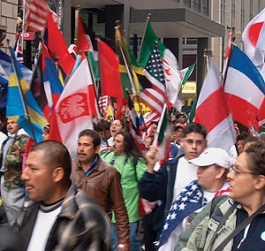
In recent months, many in the community of undocumented people have come out of the shadows in marches seeking a rational transition to legal residency and citizenship. They have long been supported by the U.S. Catholic Church, which describes the current immigration system as "broken" and calls on legislators to create more generous immigration policies so families can be reunited and people living for years in legal limbo-fearful to seek redress of wrongs, press employers for just wages, even to seek medical care when they need it-can become full participants in American society.
But efforts on behalf of the rights and dignity of undocumented migrants into the U.S. have produced a backlash. Many Americans have responded to the newfound assertiveness among undocumented people by calling for more punitive measures against them and those who support them. Many propose tighter immigration controls, including a larger military presence and more imposing physical barriers along the U.S. border with Mexico, where almost 60 percent of the undocumented migrants originate.
But they don't all come from Mexico. In the Flatrock neighborhood of South Nashville, where Native Americans once met for parleys with English settlers-the pesky, undocumented immigrants of their time-Catholic Charities' Latino Services office is a veritable United Nations. Here is a Colombian, there a Panamanian, an Argentine, all crowded into this small office seeking help getting a driver's license, negotiating a lease, fighting for back wages, and, for almost all of them, some kind of path to citizenship.
That's what brought Solorzano here today carrying her newborn son, drowsing in a car seat. She tells how she and her husband left Honduras to escape its life-draining poverty and a criminal gang that had taken over their village, how they came to the U.S. to build a better life for themselves and their children, as so many immigrants like them will tell you. The Solorzanos are part of a mass migration of Latinos to a region that just a few years ago could have corralled a good percentage of its immigrant population into a downtown honky tonk.
Tennessee's foreign-born residents, mirroring the national trend, jumped from just over 59,000 in 1990 to more than 217,000 last year. David Lubell, director of the Tennessee Immigrant and Refugee Rights Coalition (TIRRC), says most Tennesseans have handled the multicultural transition gracefully. It has only been since recent coverage of immigrant marches that he has seen any serious flare-ups between undocumented residents and the native born, a change he attributes to the overheated rhetoric of local politicians and talk-radio blowhards.
"These people wouldn't be here if we didn't need them," says Lubell. "There have been challenges that local governments are still trying to address, but they are no different from the challenges the nation faced when my ancestors came to this country."
Alien nation
Some people come to America on boats, some on 747s. Some cross a river or climb over a fence. One of Jessica Vasquez' earliest memories is as a 6-year-old ducking out of sight in the backseat of a car as she and her family crossed the border from Tijuana in 1980. Somewhere near the Illinois border, with a driver exhausted and strung out on who knows what, their car flipped and rolled, her 4-year-old brother completely thrown from the vehicle, somehow uninjured.
But when the dust had settled, the man who was transporting them had more things on his mind than her brother's miraculous escape. He hurried the family away before police arrived at the wreck. Discovery at the accident scene would have meant deportation for them all.
It was the beginning of a double life that persists to this day as Vasquez, now 27, prepares to graduate from Chicago State College. "I haven't even told some of my closest friends that I'm an ‘illegal,' " she says. "I'm embarrassed. People have so many ideas about who undocumented people are. You know, usually a landscaper or somebody working in a field. They don't think of us as students or anything else, but really we're everywhere."
Vasquez doesn't remember life in Mexico and has no close family ties there. The idea that she could be deported there is astonishing to her. "My parents brought me here when I was so little, I don't know anything about Mexico. My home is the United States, yet I'm not welcome here."
She has no credit cards, no identification. She has an I.R.S. number to pay her taxes but no Social Security number for benefits or tax credits she might be eligible to receive. When her friends were getting their driver's licenses, she was making excuses about why she couldn't be bothered. When they were applying for student loans, the National Honor Society student told them she didn't want to deal with the paperwork.
Vasquez has had to attend scattered city college classes as she could afford to pay for them out of pocket. That eight-year educational odyssey will end soon, but "when I graduate, I don't know what comes next," she says.
Her youngest sister, U.S.-born Yolanda, attends the University of Notre Dame and will not face the same struggles Jessica has endured. "I'm so proud of her," Vasquez says, "but at the same time I look at her and I can't help but think that could have been me or my brother or my other sister. I tell her take advantage of it. Don't take it for granted."
Vasquez' peculiar situation is the same one faced by at least 2 million other undocumented residents who came to the U.S. as children, who have never known a different culture, but have never been eligible for legal residency. Almost 14 million people live in "mixed families" with some immediate members, typically U.S.-born children, having citizenship or legal residency but with a parent or spouse who doesn't. These families face difficult choices and at worst a harrowing separation in the event of the arrest of an undocumented family member.
Vasquez is cautiously optimistic that recent immigration reform proposals will offer some escape from the purgatory she inhabits. Until then she will persist in this odd life, living underground in plain sight.
"I'm trying to live by the rules," she says. "I hope someday to become a teacher and eventually get my master's in public health. I want to be able to buy a house and have a fulfilling career. I want to offer my daughter a better life. You know, I want the American dream."
Nine little numbers
Eddie Reynosa spends a lot of time pondering those nine little numbers that stop him at almost every turn, the numbers most American residents treat as an afterthought, the numbers printed on their Social Security cards. "It's hard. You have a lot of things that you want to do. It's a line that stops you from bettering your life, getting an education. I'm human; I'm a person. I offer the same things that a guy who has papers can offer."
Eight years ago at 18, Reynosa came to the U.S. from Mexico to earn a little money to help pay for college and work on his English. He would still like to go to college and move beyond the laborer jobs he has been able to take, but now he would like to build his future north of the border. "My hopes and dreams are to go to school here and learn about computers. . . . I plan to be married one day and have children here. One of my dreams is to have children go to college here," Reynosa says. "It's the best country, the U.S.A."
Reynosa is startled into silence by the suggestion that he return to Mexico and wait in line legally before returning to the U.S. "I can't go back," he says, finally. "I can't. I would lose everything. I can't go back after eight years here. I am not the same person.
The little-noted reality is that for poor people without a trade, a college degree, or special expertise, men like Reynosa could literally spend a lifetime waiting for a chance to enter legally.
"People ask: Why don't they come legally? Why don't they wait in line?" Jeffrey S. Passel, a demographer at the Pew Hispanic Center, a research organization in Washington, said in The New York Times. "For most Mexicans, there is no line to get in."
According to the Pew Center, the U.S. offers 5,000 permanent visas worldwide each year for unskilled laborers. Last year two of them went to Mexican legal immigrants. In the same year about 500,000 unskilled Mexican workers crossed the border without the paperwork, and most of them, like Reynosa, found jobs.
"Most of us just want a better life, and we are young people, people who can contribute, people who have heart and have brains, good prospects for good citizens," says Reynosa. "But if you don't have the Social Security number then the government loses a good doctor or a good teacher, people who could change something."
Todos somos Americanos
The men congregate in the small office as early as 6 a.m., watching Spanish-language TV and waiting for contractors to drop in after early morning shopping sprees across the parking lot at the Home Depot. The office supervisor helps these laborers negotiate the terms of their day work, making sure that everyone understands what's expected and how much they're going to get paid-never less than $8 an hour, typically more than $10-watching out that these mostly undocumented workers get a fair deal from the local contractors who hire them. This morning about 30 men are waiting like the world's least glamorous beauty pageant for the contractors to arrive. On a good day, by noon, they will all have departed for job sites around the city.
Burbank, California's Temporary Skilled Worker Program, run by the Archdiocese of Los Angeles' Catholic Charities, has been the focus of controversy since its doors first opened in February. Demonstrators regularly picket outside, demanding the job placement site be shut down.
"Their position," says Steve Leonetti, a program coordinator at Catholic Charities' Glendale Community Center, "is that our work aids and abets criminals because they're entering the country illegally."
His take is slightly different. "They're here now," says Leonetti, "and we need to address the issue of them being here. It is our obligation as Catholic Charities to take care of the most vulnerable in our community."
Alex Martinez, 26, is one of the informal leaders of the day-labor men. He has been in the U.S. for five years, leaving behind his wife and son in Honduras. Of course that separation is "muy duro," he'll tell you, very hard on him and harder on his wife.
"I miss Christmas, Holy Week, family events, everything," he says. "But what can you do? If I was in Honduras, I wouldn't have any money, I wouldn't have a future, and my son would have nothing. At least this way I can send some money back home." In a good month, that means $600 to $700 back to his family, a life-changing sum in a nation where the per capita income in 2005 was just $1,035 and the poorest often work for less than $3 a day.
To have come legally to the United States would have been, practically speaking, impossible, he says. "To get a visa you have to have a good bank account, a good car, and a nice house. It's too expensive," Martinez says. "They never give it to people like me who really need it.
"Here you have to work hard to make a living-nothing is free-but there is better opportunity," Martinez says. "It doesn't make any sense to put people down for coming here to work. People come here to better themselves." All the talk about people being illegal or breaking laws by crossing borders is "illogical," says Martinez, when men like him are sacrificing-and offering-so much. He's not even sure why any borderline should matter so much in the first place. After all, Martinez says, "Todos somos Americanos." We're all Americans.
Who is my neighbor?
Last year the TIRRC had to fight off 20 pieces of state legislation that David Lubell argues were aimed merely at making life more difficult for Tennessee's undocumented residents. Lubell sees such campaigns as so much wasted energy when state legislators and advocates like him could be working on positive efforts such as creating more English classes for migrants.
"These folks are trying to integrate; they're trying to learn English and pay taxes," he says. "Focusing on integration [instead of punitive legislation] would be the best thing we could do.
"Every generation gets its new immigrant group who becomes the focus of ire . . . because they're ‘undermining' a certain culture of the country. First you had the Irish, then the Germans, then the Italians, the Japanese, and the Chinese. All of these groups were once a threat to American culture, and now it's the Latinos' turn."
But who exactly gets to define what America is, Leonetti asks. "This is a culture in constant flux. Because it is an immigrant culture, it's constantly changing. Every one of these groups has added something to the culture, not taken away from it."
"I guess it comes down to the old question," says Terry Horgan, the director of the Catholic Charities office in Nashville where Lourdes Solorzano has come to puzzle over her residency options. "Who is my neighbor?"
Lourdes and her husband make a neat embodiment of the contradictions and heartaches inherent in America's current immigration system: They are the steady hard workers who pay their taxes. They have done modestly well and have born a son in their adopted homeland, an American citizen outright who will never have to live in dread of paperwork or a traffic stop.
But their immigrant story has its dark side as well, driven by the peculiarities and uncertainties of their legal status. In addition to the daughter they've lost to time and distance in Honduras, not too long ago the couple lost another child, here in Tennessee-this one a victim of bureaucratic indifference or perhaps, as Solorzano says, of "racismo."
Late in that pregnancy, she began bleeding and felt the child within her in distress. When she went for help at a Nashville emergency room, she was turned away. As an undocumented resident, she could not produce a "TennCare" card for treatment. The fetus died and the following week she delivered it stillborn.
Despite such a bitter experience, Solorzano is determined to stay in the U.S. if she can, but she would like to end the uncertainty that surrounds her future. "I have a foot here and a foot in Honduras," Solorzano says with a bemused smile. It is hard to plan a life that way. What would she do if she could formalize her status? Solorzano's response is quick on the heels of the translation's end. "Get my daughter and have a better life," she says.
In this hoped-for "legalized" life, Solorzano could buy a home, open a checking account, get a loan, get a driver's license-most of all possess that magical Social Security number that would transform her life. With "papers" she could do all those small things American citizens can do. But there's one she would probably never do-take it all for granted.



Add comment