

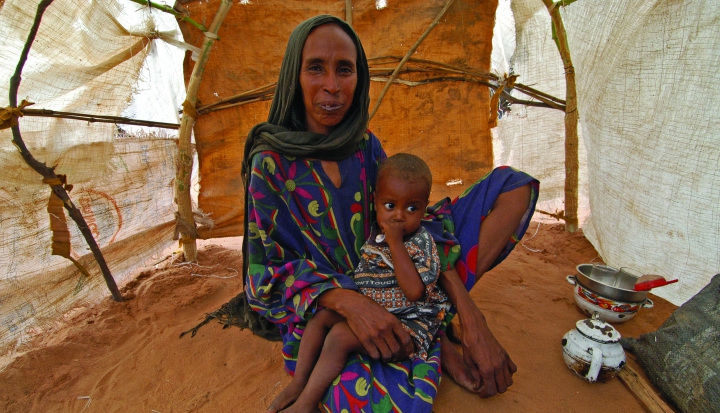
While much of the world has closed its eyes to the genocide in Darfur, Catholics are helping refugees and spreading the word about the tragedy.
Along with his sister and her children, Ousman Adam Abdullah now shares the dusty confines of his tent in eastern Chad with the ghosts of his past. Thinking back on the attack that forced him to flee Darfur and separated him from his family members-including a son and three daughters whose fate he does not know-Abdullah recalls much of the ordeal as if it were a dream he can only process in simple sentences.
"They started from the south. There were at least 1,500 soldiers," Abdullah says of the day in 2004. "They had guns and bombs. They even used knives to slaughter people."
More than five years since it began, the conflict in the Darfur region of western Sudan continues unabated. Though its battlefields are often marked only by charred villages, the fighting in Sudan-the largest country in Africa-is conflict on a grand scale, having claimed more than 200,000 lives and displaced as many as 2.5 million people since 2003. Inside of Darfur the conflict has brought fear and terror to a generation of Darfurians, while around the world it has sparked a campaign of fundraising concerts, heated protests, and high-level debate.
But awareness alone has done little to stop the violence in Darfur, which the United Nations has labeled the worst humanitarian crisis in the world today. At its heart a conflict of ideology, ethnicity, and competition for resources, the crisis in Darfur is one of the most widely recognized-but perhaps least understood-conflicts in the world.

History of hatred
With the arrival in the mid-seventh century of Arabs from the Middle East, Northern Sudan—compromised then entirely of black Africans following traditional religions—gradually began adopting Arabic language and culture, including Islam, from its neighbors across the Red Sea. By the time of Sudan's independence from Britain and Egypt in 1956, Arabs comprised the largest single ethnic group in Sudan and have dominated the country's politics since.
Through the 1960s and '70s, an ideology of Arab supremacy swept across North Africa. When the Sudanese government in Khartoum imposed Sharia law in 1983, Christian and animist rebel groups in the South rose up in what became one of the longest and bloodiest wars in Africa. Nearly 2 million people were killed and 4 million displaced before a peace agreement ended the war in January 2005.
The war between the North and the South, at least in part a religious struggle, has caused confusion over the fighting in Darfur, which is predominately ethnic. Traditionally nomadic pastoralists, the Muslim Arabs of the North have moved south in recent decades, attracted by more arable land and better rainfall as the Sahel-a vast belt of arid land stretching across Northern Africa-grows drier each year and wind-driven sand claims grazing land. Their migration has brought them increasingly into conflict with Muslim, non-Arab tribal groups, such as the Fur (Darfur means "Land of the Fur").
Marginalized both politically and economically by Sudan's Arab government, these western regions became fertile ground for rebel groups. The two most prominent to emerge beginning in 2002 were the Justice and Equality Movement and the Sudanese Liberation Army. In response the government of Sudan unleashed the Janjaweed militia-units composed largely of Arab herders, estimated to comprise as many as 20,000 combatants.
Armed, trained, and in many cases directly supported on military operations by government forces, the Janjaweed (which translates roughly as "devils on horseback") have committed atrocities of rape and murder across Darfur. Their leader, Ali Mohammed Ali, has been indicted by the International Criminal Court for war crimes. The government of Sudan has consistently denied supporting the Janjaweed.
Though the rebel groups of Darfur clash with government soldiers and militia units in an ongoing low-intensity conflict, the fighting in Darfur is not a civil war. The vast majority of those killed are non-combatants, targeted first with intimidation, then with rapes and killings. The aim is to drive all non-Arabs from Darfur-an act that meets the definition of genocide.
"Some Janjaweed came and asked if I had sent my sons to fight with the rebels," said Fatoma Ahmed from the Msleete tribe. "They brought their camels to eat my crops." Harassment and threats from the Janjaweed forced everyone in her village of 200 homes to flee. Ahmed moved to a camp in West Darfur and sells firewood to earn money for food.
Unlike the common image of Janjaweed as ghost soldiers who appear from nowhere, militia members are sometimes familiar to their victims, having lived near or traded with some of the villages they now attack. Promised both land and resources by the Sudanese government, many Arabs are easily recruited. As Arabs, they see themselves as superior to the black-African Muslims of Darfur, the displaced often say.
"The Janjaweed kill us because they want to take our land," says Ahmed Adam Ali. "They said, ‘We don't like black people in Darfur. Sudan is for Arabs, not Africans.'" Of his village's 2,000 people, Ali says, the Janjaweed killed 400, including his brother, and bombers pursuing them on their multiple-week trek-mostly on foot-to a camp in eastern Chad killed 100 more.
It is a complex and multi-layered conflict says Scott LeFevre, regional representative for the Horn of Africa for Catholic Relief Services. "It's important to resist the temptation [to think] that it's a simple solution, and all we need to do is X, Y, or Z and it'll solve the problem," he says.
The conflict in Darfur is having broader regional implications as well. In December 2005 the government of neighboring Chad declared a state of war with Sudan, accusing Khartoum of supporting rebel groups within Chad who seek to overthrow the government. There are about 220,000 refugees from Darfur in eastern Chad, and the United Nations World Food Program (WFP) reported that it provided 66,000 emergency food rations in 2006 to Chadians displaced by fighting in the east. This increases tensions between the two countries and further taxes the strained resources of the U.N. The conflict between Chad and Sudan also has begun to destabilize the neighboring Central African Republic, threatening still more conflict in the region.
On the ground
For humanitarian agencies working in Darfur, the challenges are immense. Darfur is about the size of Texas and the region is connected only by a basic road network, susceptible to the seasonal rains that pound western Sudan between June and September. Many of these roads are unable to support the heavy truck traffic required to move emergency food and supplies. The WFP had to airlift much of the 400,000 tons of food it distributed in Darfur in 2006. Darfur is the U.N. agency's largest emergency operation anywhere in the world with nearly 2 million people completely dependent on food aid for their survival.
For CRS, which has 120 staff members in Darfur, insecurity remains the chief impediment to its operations, which reach 150,000 people each month with food and items such as soap, plastic sheets, and cooking supplies. "We can't travel by road because they are too dangerous," says LeFevre.
The agency must rely on the U.N. to shuttle staff by helicopter to distant villages, where they train local community groups to distribute food and supplies. Relief items are transported on rented trucks by local drivers familiar with the routes and security issues.
"It's extremely difficult to plan, execute, monitor, and evaluate the whole cycle," LeFevre says. "Often we get halfway through things and we get caught in the crossfire. Then we have to go back in, and that's extremely inefficient."
CRS and other agencies have been attacked on several occasions, though as Darfur grows increasingly lawless it is difficult for anyone to identify who exactly is conducting such attacks. According to the U.N., more than 400 U.N. and aid agency staff were evacuated from Darfur in 31 separate incidents during the last six months of 2006 alone. Insecurity also forces the people of Darfur to continuously move, increasing their food insecurity and compounding the difficulties faced by humanitarian agencies in reaching those most in need.
Steps by the international community to end the conflict, often fragmented and inconsistent, have been met with continued resistance by the government of Sudan, led by President Omar al-Bashir. A small, under-resourced, and largely ineffective peacekeeping force of 7,000 African Union (A.U.) soldiers has been in Darfur since 2003. Al-Bashir agreed to a deployment in January 2008 of more than 20,000 A.U. and U.N. peacekeeping forces to protect the civilian population. But promises of cooperation by the government of Sudan have often gone unmet, says Dave Mozersky, Horn of Africa project director for the International Crisis Group, an analysis and advocacy organization.
"It's important to remember this is something the government of Sudan agreed to in November [2006] and has been dragging its feet on," Mozersky says. "The regime is still pursuing a military strategy in Darfur, and a bolstered U.N.-A.U. force will challenge that strategy."
Both Russia and China have used the threat of their veto power in the U.N. Security Council to block tougher resolutions against Sudan, and "that shut down the Security Council in any meaningful role," says Mozersky. Not only is China a major consumer of Sudanese oil-Sudan exports as much as 70 percent of its oil there-but China is also a major supplier of arms to the Sudanese government.
Moral mandate
Then-U.S. Secretary of State Colin Powell labeled the conflict in Darfur genocide before the U.S. Senate in September 2004—a term repeated consistently by the Bush administration, an outspoken critic of the Sudanese government. The United States has placed sanctions against Sudan, but as of June 2007, the United States is also $569 million in arrears to the U.N. for peacekeeping efforts. Critics, among them many church officials, have been vocal in condemning what they see as politicking at a time when lives are being lost daily.
"There is no easy solution, but there is a clear moral mandate for the U.S. to contribute to an international solution that will stop the killing and bring a just peace through political negotiations," says Stephen Colecchi, director of the Office of International Justice and Peace for the United States Conference of Catholic Bishops.
At press time the future of Darfur peace talks remained uncertain. And as the international community crawls toward a resolution of the Darfur crisis, little has changed for the millions displaced within Darfur, like Ousman Adam Abdullah, Fatomah Ahmed, and Ahmed Adam Ali. Their stories remain unfinished. They, like most in Darfur, have been swallowed up by the enormity of the events surrounding them.
Back in his tent, baked by the mid-morning sun, Ousman Adam Abdullah was using his time in camp as best he could when I met him in 2004. Studious and energetic, with the air of a professor, he was writing reports of the events that forced him and thousands of others from their homeland and sending them to the United Nations through camp representatives-a litany of rape, murder, and brutality. His motives, he said, were simple. "We want help from the world."
This article appeared in the January 2008 issue of U.S. Catholic (Vol. 79, No. 1, pages 30-35).
Images: Photos courtesy of Catholic Relief Services






Add comment