

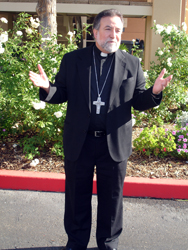
In the midst of a heated debate on immigration and a crackdown on undocumented immigrants, Bishop Jaime Soto lays out the church's agenda.
Although born in Los Angeles, Bishop Jaime Soto has been stopped several times at airport security. During one such occasion the officer did not want to believe that he was a bishop until he opened his briefcase. He was carrying a Bible and a bottle of whiskey.
The grandson of Mexican immigrants, the newly appointed coadjutor bishop of Sacramento, California is one of the church's most prominent spokespersons on immigration. Last year, while still serving in the Diocese of Orange, Soto asked all Catholics there to support immigration reform through fasting and prayer.
Countering the continuing heated election-year rhetoric that targets the "illegal alien invasion problem," Soto has been a voice of reason trying to rally the Catholic community to actively support our immigrant brothers and sisters in need as well as to advocate for comprehensive immigration reform.
Now appointed to the capital of California, Soto will have plenty of opportunities to lobby for immigration reform and other Catholic social concerns. He knows, though, that it is important for a pastor or bishop to "speak with integrity and clarity. It is not enough to be prophetic. One must also be persuasive. That's not an easy task. It has never been."

The Catholic Church has taken a prominent role in the debate about immigration reform, and … (Laughing) I would say we've taken a beating.
True. So why did the church get so publicly involved in this particular debate?
Historically, caring for immigrants has been a hallmark of American Catholicism, and so for us to enter into the immigration debate was not just theoretical or theological. It came out of our own experience about what works best and what we have learned. Through many periods of our history different groups of immigrants have been despised, rejected, marginalized, and we've always been the institution that has stood by them.
Have all bishops been comfortable with the church's lead role in the public immigration debate?
Obviously some of us have taken more of a lead, but I would say that there is a general consensus among the bishops on the importance of advocacy for immigrants. Thus when we California bishops have been vocal on this issue, I often hear from a bishop, for example, in the deep South, who says, "I really liked what you said on TV the other night. Could you send me your materials so we can do the same thing here?"
Many of us who otherwise might be a little camera-shy have been willing to put our foot down on this issue to state publicly and strongly that it's not right how immigrants in this country are being treated, especially how they're being portrayed as criminals.
What for you is the faith dimension of this social issue?
One of the key tenets of both the Jewish and Christian scriptures is the call to hospitality. That is intimately woven into our historical and religious memory. The Jewish scriptures repeatedly tell us, "You must take care of the alien in your land…. You must take care of the stranger."
There's a beautiful passage in the Letter to the Hebrews that calls us to extend hospitality, for in doing so, we may be "entertaining angels" (13:2). So there is a direct connection between being open to God's grace, to God coming into our midst, and welcoming the stranger.
Of course, in Matthew 25, it is made very clear that whoever welcomes a stranger, one of the least of our brothers and sisters, receives Christ. So there are plenty of clear biblical mandates for us, and to some extent those passages have to haunt us, knowing that we will be judged for how we treat the alien, the stranger.
Is a pro-immigrant stance a "nonnegotiable" for Catholics?
The part that is nonnegotiable is the respect and the openness to the immigrant that is so sorely lacking in much of the current national discourse.
What is obviously open to negotiation is how best to do that. That should be part of a healthy national debate. As Catholic bishops we've taken a strong position against what we see as very harsh and punitive measures against immigrants. These measures, such as the recent raids and deportations, we believe, are actually counterproductive in terms of making America safer and stronger.
So how should we deal with illegal immigration?
First of all, the bishops would agree with the general sentiment that the U.S. immigration system is broken. Often people think that somehow we are encouraging undocumented immigration, but nothing could be further from the truth.
We're very aware of the negative consequences of people entering this country illegally. Most of all it's bad for the undocumented immigrant, who really bears the brunt of this status. But it's also not good for any society to have such a significant population living on the margins.
So the real question is: What is the most reasonable way to resolve this situation? That's why we have been trying to advocate for an earned legalization program that will provide undocumented immigrants with a path to permanent residency and eventually citizenship.
We also support the creation of a temporary worker program that would allow immigrants to come into the country when there is a labor demand. That's perfectly legitimate and can be a step toward providing a long-term solution to the problem of a large undocumented population.
Another thing that drives the large numbers of people entering the country illegally is the lengthy period of time it takes for family members of legal immigrants to join them in this country. That backlog has been created by the insufficient U.S. quotas for family members of immigrants from certain countries, which in turn have led to unreasonably long waiting periods.
You often hear people complain that undocumented immigrants "should get in line and wait like everybody else." But immigrants from European countries, for example, do not have to face the long waiting periods for family reunification that those from Mexico, Central America, India, China, or the Philippines do.
Mexican and Asian families sometimes have to wait for 10 years or longer. These are the countries from which most of the undocumented populations come. If we can find a way to reasonably reduce the waiting period for family quotas, we will also then provide a remedy to people entering the country without permission.
One of the most common arguments against providing undocumented immigrants with a path to legalization is that we shouldn't reward people who have broken the law.
Of course we agree that it's important to have a good legal system. But we also believe that laws should work. They should further the common good and the welfare of people.
In other areas we've seen the government change laws from, for example, the heavy regulation of certain industries to deregulation when it's believed to cause an undue burden on the market. So the government frequently decides to create certain laws and then later to change them when they don't work.
Similarly in immigration we have a system that doesn't work. We have laws that don't really serve the needs of the country, so we're simply advocating for laws that work. {C}
Since the proposals for comprehensive immigration reform collapsed last year, we seem to have entered a phase of harsh measures aimed at undocumented immigrants. What's your take on that?
It's hard to divine what the Bush administration has been attempting to do recently by more severely applying the law. Some have speculated that the administration may be doing that to demonstrate its ability to apply the law, so that it would then create a greater openness for reform. This is politicking with human lives.
I am concerned, for example, about the raids that have been going on, and how disruptive they are to families and whole communities.
Take the case of the child who comes out of school and the parent isn't there to pick her up because the parent has been deported. What does that child need to know to be prepared for that traumatic experience?
Have these raids and deportations led to a greater climate of fear?
Yes, right now there's a great deal of fear in the immigrant community. We've been creating materials and holding workshops here in Southern California and other parts of the country to educate immigrants about how to respond and what to do in those circumstances. They draw a huge attendance, because there is this nagging fear, "This could happen to me."
Of course, these harsh enforcement measures don't look particularly good on TV. It's been interesting to listen to those who support a harsh immigration policy trying to justify the very ugly images. They try to give them a positive spin, that the crackdown will mean, "Oh, they're all going to go home now." But it doesn't look very American to pull people out of workplaces or to drag kids out of school.
What about the border fence? Is expanding it a part of the solution to illegal immigration?
You constantly hear people saying that we haven't done anything in border enforcement. But since 1986 U.S. border policies have gotten increasingly more aggressive, harsh, and punitive. And yet they have had no or little impact on the flow of migrants.
So there's a certain lunacy to the assumption that if we just keep doing the same thing, it will get us a better result. It just doesn't work.
And by making it more dangerous and more difficult to cross the border, we have created a market for organized crime. We've made it very profitable to ship people into the United States in the same way that other contraband such as drugs are being brought in. U.S. policies have become enablers of a cruel and ugly criminal system in Mexico and Central America.
Have Catholics bought into the anti-immigrant rhetoric as well?
I do think that many Catholics, in general, are persuaded by some of the prevalent media messages. So there are many Catholics who have bought into the jingle of pro-choice and that it's the American thing to do, without necessarily understanding all the implications of that expression.
Similarly many Catholics have been duped by this drumbeat that all immigrants are criminals, without necessarily understanding what drives people to come here. They don't understand the tremendous risks immigrants take to work, to take care of their families, and to become productive members of society. Many of the anti-immigrant groups are very well-organized and have packaged a powerful media message that has duped a lot of people, including a lot of good, thinking Catholic people.
How do you counteract that?
We have to get our message out, and nothing persuades as much as success.
We often say, "Practice what you preach." But it's also true that we should preach what we practice. We should talk more about our historical experience of immigrants building strong communities and of becoming dedicated and hard-working Americans. We Catholics have done that well over the centuries. And we're doing it now with current immigrant communities that are coming into our churches.
So we need to tout our success stories more. We have a strong message that says to the rest of society that it can work. Our multicultural communities today are a testament to what is possible, not only in the church but in society.
It is kind of a nagging problem for us as pastors that we don't speak out forcefully enough about the church's social teaching, whether that be in regards to abortion or euthanasia or on issues like immigration or the Iraq war. I see this as a failure on our part as pastors to be more compelling and more forceful about what are the social demands of the gospel.
Is part of the reason why many non-Hispanic Catholics are anti-immigrant a continuing racism that still sees fellow Catholics who are Hispanic as "the other"?
I wouldn't necessarily put all the burden on the Anglo community. In some cases we also have to convince the Hispanic community that there's a lot more to the church than just them. We have these huge Hispanic parishes, and they sometimes get into a mindset that they're the only ones.
All of us Catholics have to assume a sense of responsibility and obligation for our church that transcends our own group identity. We need to see the diversity of our church not as a threat but as a strength. We have to preach about that not only to the Anglo community but to the Hispanic community as well.
If, as you say, many people have been duped by the anti-immigrant forces, what are the most important things you want every Catholic to understand about immigration?
I would want everyone to know that the church's active involvement in the legalization program in 1987 and 1988 was a great success.
We not only provided permanent-residence status and a path to citizenship for many immigrants, we helped create more business owners and more engaged citizens for American society. We helped families establish themselves. We have nothing to fear and much to gain from having that kind of a program again.
It will not make America weaker, it will make America stronger. That's the message that I'd want to keep hammering home to people. We are all stronger when we are together.
The other thing people need to know is that nobody wants to be an immigrant. They would much rather stay in their homeland and be able to prosper in the towns and villages in the lands of their ancestors. So there always is a certain amount of duress that propels people to leave their country.
Unfortunately the situation in Mexico is still very dire. Despite some significant reforms that have happened in Mexico since the defeat in 2000 of the PRI [the Institutional Revolutionary Party, which ruled Mexico for 71 years], Mexico in many ways is still ruled by an oligarchy. There still is little political will to break through that and create a more dynamic economic environment that would be good for Mexico's working and middle classes.
How well are Catholic parishes and organizations currently serving the needs of immigrants?
I've had the good fortune of serving on the board of the organization CLINIC, the Catholic Legal Immigration Network. We oversee the network of legal immigration services provided throughout Catholic dioceses here in the United States.
When I go to their meetings and see the dedication of people working not only in California, Miami, or Texas, but also in places like Nashville and Knoxville and Kansas City and other places where there are migrants and refugees, I'm always amazed. They work hard not only to care for and look after immigrants and refugees. They help them become part of American society.
Many of our parishes are serving very effectively, having become what sociologists have called "mediating structures" in our society-places for people not only to worship but also to socialize, to organize, to develop their skills, and to learn how to participate in American society politically, socially, and economically.
Parishes are vital anchors in their communities. In many immigrant neighborhoods the ringing of the church bells gives people a sense of hope and a sense of grounding. When we hold religious processions-as pious as they may seem to some-in immigrant neighborhoods, we help people to understand who they are and that there is some sense and purpose to their lives.
At its best, the parish is both a public sign of hope to the community and also a sign of protest against the difficult, demeaning realities people are facing.
Can you give us an example of a parish that does this well?
I served for 13 years at our Lady of Guadalupe Parish in a neighborhood of Santa Ana, California called Delhi, one of the oldest and most densely Hispanic neighborhoods in Orange County.
Our Lady of Guadalupe Delhi is a small church. Since its beginnings it has served the migrant community. Initially it served agricultural migrants. Now it serves immigrants working in the service economy or the industrial sector.
Immigrants arrived at our church door. For them Our Lady of Guadalupe Delhi was their first stop. It was moving to witness the immigrant who comes here and finally gets a job and then brings his first paycheck to offer it to the church. Many immigrants make that amazing offering just to thank God for what they've received.
Recently a young woman came to see me to ask me to preside at her wedding. She told me that the reason she asked me was because I had helped her get legalized back in 1987. Today she is a grade-school teacher, working with immigrant kids and trying to help them find their way, the same way we did for her when she was just a kid in the active youth group we had in that parish.
Many of the kids in that same youth group were unaccompanied minors or young adults who had come up to the United States. For them the church, and especially our youth program, was really their surrogate parent. So it has been rewarding for me to see these young people get married, have their own children, and raise their families here. I still get together with some of them. They continue to be very active in the church.






Add comment