

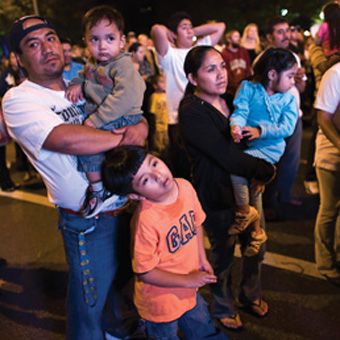
New state laws and the failure of immigration reform are taking a heavy toll on children and families.
Carlos Rodriguez has been receiving letters and brochures from colleges and universities from across the country encouraging him to apply because of his outstanding grades in an Alabama high school. He dreams of the day he can start college next year.
But Rodriguez has two problems. For starters, he is an undocumented student, which limits his college options because he does not qualify for federal and state financial aid. And Rodriguez’ family is considering leaving Alabama for good—either relocating to another state or even going back to Costa Rica, where he and his parents were born.
The family agreed to be interviewed over the phone on the condition their real names weren’t used. They also asked not to reveal the name of the town where they live for fear the police or the immigration authorities might come to their house to arrest them.
Thousands of undocumented immigrants have left Alabama since the state enacted the toughest immigration law in the country in late September 2011. Arizona, Georgia, Utah, South Carolina, and Indiana have passed their own immigration laws, but none included provisions as harsh as those approved in Alabama. Among the most controversial aspects of the law is a provision requiring schools to check students’ immigration status.
In October a federal judge temporarily blocked the school requirement and another provision of the law, but upheld others—including the one that requires police to check the immigration status of suspected undocumented immigrants during routine traffic stops.
Another judge had previously blocked another controversial provision that had led to a lawsuit by a coalition of Alabama church leaders. That section of the law, the churches argued, would make it illegal to celebrate the sacraments with or provide social services for undocumented immigrants.
In an August 19 statement explaining why he had joined the lawsuit, Arch-bishop Thomas Rodi of Mobile said, “Once immigrants are in our midst, the church has a moral obligation, intrinsic to the living out of our faith, to be Christ-like to everyone. . . . This new law prevents us as believers from exercising our life of faith as commanded by the Lord Jesus.”
Rodriguez’ family has lived in a town near Montgomery for nearly 15 years. His parents, Ignacio and Delia, emigrated from Costa Rica with Carlos and his younger brother, Luis, looking for a better life. They overstayed on their tourist visas and have lived in the same town since they arrived. The couple has worked in factories and cleaned houses. They also have a 13-year-old son, Arturo, who is a U.S. citizen born in Alabama.
The Rodriguezes say that many of their neighbors have already left because of the fear of being stopped by police and deported. Luis, their second son, plays soccer in school and says that many Latino players have stopped showing up because their families are afraid to drive or have left town.
“Our sons have lived in Alabama practically all their lives,” Delia says, explaining why they haven’t left yet. “They consider themselves from here. They don’t know any other place.”
The couple still hopes that the new law will be blocked completely and that next year Congress will pass an immigration reform bill that would allow them to stay in the country.
“Now we live in fear—hoping the police don’t stop us while driving our kids to school or going to work,” says Ignacio.
According to many news reports, Alabama farmers have complained that their harvests have rotted and they now face business failures because not enough American workers are willing to work in the fields.
“For us, it’s all about survival. That’s just the bottom line, folks. Without a viable labor source, we cannot survive,” Jeremy Calvert, a vegetable farmer, was quoted on the PBS NewsHour last October.
For the Rodriguezes there are other severe social repercussions. They say that immigrants do not trust the police anymore, and immigrant kids face suspicion and derogatory comments at school.
“The law is having a terrible impact on people’s lives,” Delia says.
Under pressure
The failure of federal immigration reform efforts has prompted many states to address the controversial issue of illegal immigration on their own terms. In 2009, 1,500 immigration bills were considered. Arizona, Georgia, Utah, South Carolina, and Indiana have taken a harsh approach to dealing with the estimated 11 million undocumented immigrants who live in the United Sates.
Meanwhile, the Obama administration has deported nearly 1 million undocumented immigrants. In October Immigration and Customs Enforcement (ICE) announced that in fiscal year 2011 (which ended in September) a record 396,906 people had been deported, nearly 25 percent more than the Bush administration deported in 2007.
As a result, thousands of immigrant families have been torn apart. Enforcement-alone policies have spread fear and mistrust in immigrant communities across the country.
On Dec. 12, 2011, the feast day of Our Lady of Guadalupe, the patron saint of Mexico and the Americas, the nation’s 33 Hispanic Catholic bishops released a “letter to immigrants” that asks Americans to recognize the contributions of undocumented immigrants. It was not the first time the U.S. Catholic bishops have come out in support of comprehensive immigration reform and a path to citizenship for undocumented immigrants.
“We are well aware of the great sacrifice you make for your families’ well-being,” the letter says. “Despite your contributions to . . . our country, instead of receiving our thanks, you are often treated as criminals because you have violated current immigration laws.” In the letter the bishops tell undocumented immigrants: “You are not alone, or forgotten. . . . We open our arms and hearts to you, and we receive you as members of our Catholic family.”
Caught in the web
Time ran out for Army Spec. Hector Nuñez, his wife, Rosa, and their two small children. Rosa’s one-year humanitarian visa expired on Dec. 19, 2011. Their lawyer has applied for an extension. According to the U.S. Citizenship and Immigration Service, a humanitarian visa can only be extended for one year at a time.
Nuñez, a combat engineer with the National Guard, served six months in Kuwait in 2007. Rosa, 27, came to Chicago with her family illegally when she was a child. Some of her siblings have since become citizens or legal residents, but she did not qualify.
“My wife grew up as an American,” Nuñez says. “She should be allowed to stay in the country she calls home with her husband and kids.”
Rosa and Hector have been married for six years. She delivered their second son at the end of November.
In 2010, following the bad advice of a lawyer, the couple traveled to Ciudad Juárez for an interview at the U.S. Consulate to resolve Rosa’s legal status, as she was married to a U.S. citizen. Instead, she was barred for 10 years from returning.
Nuñez, who at the time was going to be deployed to Afghanistan, was desperate and sought the assistance of Rep. Luis Gutierrez (D-Illinois), who obtained a one-year humanitarian visa for Rosa on Dec. 20, 2010.
Last July the couple and their son attended a rally in Chicago to urge President Barack Obama to stop deporting noncriminal immigrants through the controversial federal program Secure Communities. Although designed to identify and remove undocumented immigrants who are “the most serious criminal offenders,” the program had instead primarily led to the deportation of people who had committed minor offenses such as traffic violations.
Holding their son in his arms and standing next to Rosa, Nuñez told the crowd of several hundred that their case was an example of how a broken immigration system separates families.
The following month the Obama administration announced new guidelines to unclog the immigration courts by prioritizing the deportations of convicted immigrant offenders according to the gravity of their offense and allowing low-priority offenders to remain in the country and apply for a work permit. That decision followed mounting criticism of the Secure Communities program, with Illinois, New York, and Massachusetts pulling out of it.
In a Sept. 29, 2011 letter to Homeland Security Secretary Janet Napolitano, Archbishop José H. Gomez of Los Angeles applauded the administration’s new guidelines for “low-priority” deportation cases. Gomez, the chairman of the bishops’ Committee on Migration, specifically urged stays of deportation, among others, for children who were brought to the United States at a young age and for “those with long-term presence in the United States and other equities, such as U.S. citizen children or spouses.”
“My wife has been in the United States most of her life and she has never been in trouble with the law,” says Nuñez. “But she is being treated worse than a criminal. There are people who actually commit crimes, and they are slapped on the wrist. I just don’t think that she is being treated fairly.”
Nuñez explains that it was very hard when his wife had to stay in Mexico for six months and that he cannot imagine her being away for 10 years.
“It would be devastating for our family,” says Nuñez. “We don’t want to think of the possibility of our kids growing up without their mother.”
In January the Obama administration announced its intention to change another immigration rule that would help the Nuñezes and many other American citizens with undocumented immigrant spouses and children. The change would allow them to stay in the United States while applying for hardship waivers, the first step in their applications for legal residency. With such a waiver Rosa would not have been barred from reentering the country for 10 years.
Separation anxiety
Josefina Sanchez and Clara Figueroa’s story is part of an alarming new trend: thousands of children placed in foster care because their parents have been either detained or deported. Sanchez and Figueroa (not their real names) are sisters who were detained in the summer of 2010 at their trailer home in a small town in New Mexico when the authorities responded to a false drug-trafficking tip.
The authorities did not find any drugs but arrested both sisters because they were undocumented immigrants. Child Protective Services (CPS) took custody of the three young children who lived with them.
During the four months that they were in ICE custody, Sanchez and Figueroa did not know where their children were. In December 2010 both sisters were deported to Mexico while their kids remained in foster care.
A year after being deported, Sanchez expressed her distress during a phone interview from Mexico. She and her sister did not want to talk directly to the media but related their story through a representative of the Applied Research Center, a think tank based in New York that has documented their story.
“I didn’t know where my child was. I didn’t do anything wrong to have my child taken away from me,” said Sanchez, whose baby was only 9 months old when she was arrested. Figueroa’s children were 1 and 6 years old at the time she was detained and deported.
According to the Applied Research Center’s recent report Shattered Families, the federal government removed more than 46,000 mothers and fathers of U.S.-citizen children in the first six months of 2011. The center estimates that there are 5,100 children in foster care whose parents have been either detained or deported. There are approximately 5.5 million children in the country who have an undocumented parent, and about 4.5 million of those children were born in the United States.
In their pastoral letter to immigrants the Latino U.S. bishops say of the impact of family separation due to deportation: “This situation cries out to God for a worthy and humane solution.”
For a year Figueroa and Sanchez feared their parental rights would be terminated. In September the Mexican consulate in New Mexico phoned the sisters in Michoacán and told them to go to the airport the next day. There Mexican officials escorted the three children off the plane. After 14 months apart, the sisters were finally reunited with their children.
“Though child welfare departments are required by law to try to reunify children with their parents—and research shows that children fare better with their families—that principle is often ignored when a border stands in the way,” says Seth Wessler, senior research associate with the Applied Research Center.
Wessler adds that deportation too often leads to the termination of parental rights. In jurisdictions around the country, child welfare departments and children’s attorneys argue that it is in a child’s best interest to remain in the United States rather than join their parents in another country.
According to Wessler, counties near the border with Mexico are working to stop the separation of families. In San Diego County, California and El Paso County, Texas, the child welfare departments work with the Mexican consulate and the Mexican child welfare department to place children with their families in Mexico.
Dare to DREAM
The cases of the “dreamers,” children whose undocumented parents brought them to the United States when they were children, provide a compelling argument for immigration reform.
One of those “dreamers” has become a national symbol in the movement to pass a federal DREAM (Development, Relief, and Education for Alien Minors) Act. Arianna Salgado sat between Illinois Gov. Pat Quinn and Chicago Mayor Rahm Emanuel at the signing ceremony of the Illinois DREAM Act on Aug. 1, 2011.
In her remarks that day, Salgado, a petite 18-year-old undocumented student, electrified the crowd in the auditorium at Benito Juarez High School on the South Side of Chicago.
Salgado spoke of her dream of getting a college education. When she was a junior in high school, a school adviser told her she was not going to be able to attend college because her immigration status did not allow her to get federal financial aid. But now the Illinois DREAM Act will help students like her to go to college.
“Today we make history as Illinois sends a message across our great nation that every student deserves to strive regardless of their immigration status,” said Salgado.
The “dreamers” have grown up speaking English and consider themselves American. Salgado came to the United States from Morelos, Mexico with her mother when she was 6 years old.
“When I was a kid, I listened to my relatives talking about immigration and that we should never tell anybody about our status,” recalled Salgado. “My mother and I wished things were different, but we tried to live as normal a life as possible.”
The Illinois DREAM Act created a privately funded scholarship program for undocumented students. The Illinois law, similar to California’s, was signed months after broader federal legislation, passed by the House in December 2010, died in the Senate because it failed to get the 60 votes necessary to bring it to the floor.
The federal DREAM Act would have provided permanent residency to the estimated 65,000 undocumented students who graduate from high school each year, having arrived in the United States as minors, and have lived in the country for at least five years. Since first introduced in 2001, the bill has faced an uphill battle for approval in Congress. It was reintroduced in the Senate last May, but again died before reaching the floor.
In a June 28, 2011 letter to the Senate Judiciary Committee, the U.S. Catholic bishops applauded the re-introduction of the DREAM Act in the Senate as an important intermediate step. “In the absence of comprehensive immigration reform, DREAM Act-eligible children are among the most vulnerable of the unauthorized population in the United States today,” Archbishop Gomez wrote on behalf of the bishops’ conference. “We have a choice as a nation: either to ensure that these capable and patriotic long-term members of U.S. society fulfill their promise and serve our country or to separate them from their families and communities and return them to nations they do not know. It is morally incumbent upon us as a nation to choose the former, not the latter.”
Salgado and her fellow “dreamers” were disappointed when the federal DREAM Act was defeated. They had organized an impressive nationwide campaign in support of the legislation, effectively using the Internet and social media, staging public demonstrations, and visiting legislators.
Later Salgado joined a national campaign of “dreamers” to publicly acknowledge that they are here illegally. They held public rallies to proclaim they are “undocumented, unafraid, and unapologetic.”
“People need to put a face on this issue,” Salgado explains. “Yes, I am undocumented, but I am also a daughter and a student.”
Salgado is now a freshman at Dominican University in River Forest, Illinois, where she received a scholarship to study social work. She says she will continue to work toward an overhaul of the immigration system.
“We must continue fighting for the dreams and the education of undocumented students so they can realize their potential,” Salgado says.
This article appeared in the March 2012 issue of U.S. Catholic (Vol. 77, No. 3, pages 22-26).
Image: Wes Frazer







Add comment