Armed with soil and seeds, Catholics in blighted cities are taking social justice into their own hands.
In Camden, New Jersey a jumble of railroad tracks, freeways, and abandoned factories lace through the Waterfront South area on the Delaware River just across from Philadelphia. During heavy rains, a nearby wastewater treatment plant frequently leaks raw sewage onto the streets.
An urban exodus from Camden has left 4,000 empty lots in a 10-square-mile area; half of the houses have been abandoned. This makes the city a prime place for people to dump stuff they don’t know what to do with. One day an old speedboat ended up on Broadway, one of the city’s main streets. Two weeks before, a huge abandoned factory caught fire and burned to the ground.
Camden, once a thriving manufacturing center, is today better known for its crime, corruption, poverty, and urban dysfunction. It also must contend with the consequences of the industrial era: high concentrations of polluting facilities, diesel emissions, and contaminated Superfund sites (highly polluted locations the E.P.A. designates for cleanup).
Parishioners at Sacred Heart Church have been trying for years to turn things around in their neighborhood, and most recently they have focused on food.
“Food is the most basic justice issue,” says Andrea Ferich, director of sustainability at the parish’s Center for Environmental Transformation. “If you don’t have it, what justice is that?”
Ferich and her neighbors are hoping that the plants sprouting in their city garden will bring new life to Camden. Before the land was turned into a vegetable garden, it was a trash heap amid boarded-up rowhouses. Now it features lush green growth on raised beds, a greenhouse, and a farmers market.
To turn the tide of urban decay in cities like Camden, residents across the country have invested in backyard, community, and school gardens in order to provide themselves with good, healthy food. Catholics are among those creating, promoting, and volunteering in this effort as they attempt to meet Jesus’ call in Matthew’s gospel to feed the hungry and welcome the stranger. What they are finding is that feeding people enhances dignity among the poor, promotes justice, builds community, and offers healing.
How does your garden grow?
Detroit is one of the most economically devastated cities in the country. Although the downtown area boasts beautiful skyscrapers and new economic development, other sections of the Motor City feature hollowed-out factory buildings, boarded-up storefronts, and neighborhoods where only a few houses still stand among acres upon acres of vacant land. The city has lost more than half of its 1950 population of 2 million, as mostly white people headed for the suburbs and left 25 percent of Detroit’s 139 square miles vacant.
Five supermarket chains served the city, but by the 1990s they were all gone, too, leaving a “food desert,” a phenomenon that affects low-income neighborhoods in many American cities. Retail executives began pulling supermarkets out of mixed-income neighborhoods after the civil disturbances of the late 1960s.
Prejudice against the poor, people of color, or ethnic minorities also plays a role. A 2010 report by PolicyLink (New York) and The Food Trust (Philadelphia) reviewed more than 132 studies, discovering that low-income zip codes have 25 percent fewer chain supermarkets and 1.3 times as many convenience stores compared with middle-income zip codes. Zip codes with primarily African American residents have about half the number of chain supermarkets than do areas with primarily white populations; predominantly Latino areas have only a third as many.
Without grocery stores, people buy their food in convenience stores, gas stations, and fast-food restaurants, says Capuchin Franciscan Brother Jerry Smith, executive director of the Capuchin Soup Kitchen in Detroit.
“They eat a lot of fast foods, and kids think Coke and chips is a meal,” he says.
The combination of processed and fast foods and the lack of fresh produce is having a negative impact on people’s health. According to FeedingAmerica.org, 49 million Americans are hungry, including 17 million children. Meanwhile, one out of three American children is overweight, and childhood diabetes has reached epidemic proportions.
Capuchin Franciscan Brother Rick Samyn decided to grow a vegetable garden for the Capuchin Soup Kitchen in 1997. He started out with two lots, and today Earthworks Farm covers several vacant lots in a residential neighborhood on the east side of Detroit with vegetables, fruit trees, herbs, and beehives.
Earthworks supplies food for the soup kitchen, which provides 2,000 meals a day, and also sells produce through the Grown In Detroit Co-op as well as to several health clinics and the Gleaners Food Bank. A 1,300-square-foot greenhouse on the soup kitchen parking lot produces more than 100,000 vegetable seedlings that are distributed free to community gardeners.
Magic beans not required
The desire to feed the poor also led Mike Zimmerman, a second-year law student at Fordham University in New York City, to plant a garden 14 stories up at St. Paul the Apostle Parish.
Zimmerman had been volunteering at the church’s Loaves and Fishes Soup Kitchen when he got the idea of supplying the poor with healthy, organic food by growing it himself. He contacted Paulist Father Gil Martinez, the pastor, who suggested the church’s rooftop as the site for the garden. Zimmerman recruited several fellow law students to help with the garden and solicited donations for soil and seeds.
Zimmerman, who plans to specialize in agricultural law, wanted others to understand the connection between food and justice. At the soup kitchen Zimmerman saw this contradiction in the processed food the poor were typically served, supplied by a global agricultural system that is intent on producing quantity and profits, and that relies on expensive pesticides, herbicides, insecticides, and fertilizers.
“Our garden is not going to feed all these people,” says Zimmerman, “but through local action, we’re showing what we can do to change this food system. This is just the first step toward fixing an unjust system and learning the skills required to grow fresh, organic food on a larger, more practical scale.”
The garden delights neighbors in the 42-story condo building that overlooks it, Martinez says, but it also delights the people who eat the food.
“They know that the food is grown just for them,” says Martinez, “and they say our soup kitchen is the best in Manhattan because of that.”
Zimmerman’s project wasn’t just altruistic. The native Vermonter missed the lush greenery of home and believed that a garden could help re-energize himself—and maybe others—in the Big Apple. Martinez, a son of migrant farmworkers, agrees.
“There’s a sense of touching creation and participating in it through the garden,” he says.
Although Zimmerman is Jewish, he and Martinez are united in the common spiritual tradition of stewardship of the earth, as described in Genesis.
Having dominion over creation “is about taking care of the world that God has so graciously given us,” says Zimmerman. “And what’s so poignant here is that there is not a lot of open space [in New York City] for us to see God’s creation.”
Urban restoration
St. Paul’s garden may be a bright green spot in a sea of concrete in Manhattan, but in Camden, gardens are helping to transform the city itself.
“Camden is a place much like Nazareth, where people wondered if any good could come out of it,” says Ferich of the Sacred Heart Church’s Center for Environmental Transformation.
In 2005 a number of parishioners went to New Orleans to assist survivors of Hurricane Katrina. They returned inspired by the idea that change only happens when people help themselves and that the neighborhood is the best place to advocate for environmental justice. They established the center, which acts as a model for sustainable living and provides a space where people of all faiths can gather to reflect on their responsibility to the environment, learn to reduce their impact, and advocate action.
As a part of this effort, the center started a garden and built a greenhouse that provides fresh vegetables at their local farmers market. It also holds classes for neighborhood residents to learn how to cook. A Junior Farmers program teaches conservation by enlisting local youth to make brightly-colored rain barrels that collect water for plants, which save families 1,300 gallons of water in the summer.
The center also holds retreats on environmental justice in its renovated convent; participants study how systemic problems create ugly and polluted places like Camden, where residents have unusually high rates of respiratory diseases and elevated rates of cancer of the lung, esophagus, stomach, liver, kidney, and pancreas.
Detroit, too, has seen much change in its landscape: The grassroots efforts have so far transformed 300 acres of vacant land into more than 1,500 productive urban gardens. And it is leading the nation in urban agriculture, says Ashley Atkinson, director of Urban Agriculture and Openspace at nonprofit resource agency The Greening of Detroit. The gardens vary in size and shape, but they are neatly cultivated areas in which adults and children are working together.
In 2006, for example, Riet Schumack and her husband bought a small brick home in Brightmoor, one of the most blighted neighborhoods in the city. She wanted to live a simple life and teach area youth the business of organic farming, urban style.
Schumack’s house overlooks a gently sloping flood plain leading to the Rouge River, a quiet spot despite its proximity to U.S. 24, a main artery of the city. When she proposed starting a community garden, neighbors pitched in to help her clear much of the shared space leading to the river and to plant water-tolerant trees and groundcover.
Schumack then found funding that permitted neighborhood kids to earn $100 or more per month working on the garden. They also receive a $15 stipend for attending a weekly financial literacy program taught by a social studies teacher in the neighborhood.
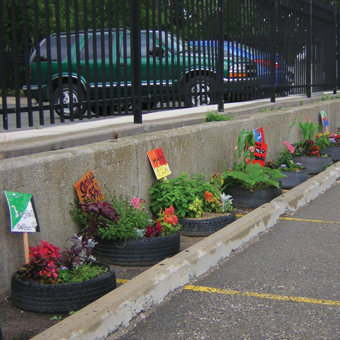
The youngsters till and weed the soil and take great pains to beautify the land with borders of tires and wooden posts. They plant a variety of greens, tomatoes, beans, and carrots, selling them during the summer at the Northwest Detroit Farmers’ Market.
“I don’t know what it is about me getting along with 14-year-old African American boys, but I do,” says Schumack, who has also purchased orange team shirts for the young farmers, which they proudly wear during the annual agricultural tour of Detroit’s gardens.
The success of Detroit’s gardens is more than just food production and marketing. It’s about connecting people and restoring their confidence so that they can rebuild their neighborhoods.
“We build relationships before we do soil tests,” says Atkinson.
Some place like home
Lay Htoo is a member of the Karen people of Myanmar who escaped persecution and fled to Thailand with her husband and four children. They lived in a refugee camp for 10 years before applying for resettlement in the United States. They ended up in Rockford, Illinois, where after five months, they were still without work. Lay Htoo heard from another refugee friend that there were jobs and gardens in Kansas City, so the family moved there.
While her husband and son found work in a slaughterhouse, New Roots for Refugees, a program of Catholic Charities of Northeast Kansas, gave Htoo some land, seeds, tools, and water to get her farm started.
“My first season working with the New Roots for Refugees program was in 2010,” says Htoo. “I worked in the garden, and everything went well. This past October, when things at the garden slowed down, I started going to school to learn English. I kept going to meetings for the garden during the winter, learning about many topics.”
The refugee women tend an 8-acre farm located in the middle of a public housing project in this metropolitan area of 2.3 million. Each farmer has a quarter-acre plot where she grows whatever she wants—including familiar vegetables of her homeland. Because the plots are contiguous, the farmers are able to interact and help each other. Htoo became a member of a community with 16 other refugee farmers from Myanmar, Somalia, and Bhutan who provide each other with a social and emotional support system.
Although Kansas City might not seem to require the drastic transformation of Detroit or Camden, its urban gardens are nonetheless bringing people together in similar ways.
“There is a lot of memory and story around agriculture for refugees,” says Rachel Pollock, director of New Roots for Refugees, which began in 2007. “It is where they belong. This entrepreneurial effort impacts the refugees’ lives because they are able to take charge of their own futures.”
New Roots also has an economic impact in Kansas City. Last year 12 farmers sold $60,000 worth of fruits and vegetables, with $12,000 of that going to low-income food-stamp customers. This year, with five more farmers, expectations are high that business will grow considerably.
One of the best parts of the program is that Kansas City residents interact with the refugees at one of the city’s eight weekly farmers markets, says Pollack. Relations between the refugees and the American-born residents have been fraught with tension because of language and cultural differences. The gardens and farmers markets, however, are changing that.
“It may start out where they learn each other’s names,” says Pollock. “Then they make friends, meet their families, and learn to cook their ethnic dishes.”
Growing green thumbs
Megan Kohn was watering the neighborhood garden in Romanowski Park in Detroit when 8-year-old Saba and her friend Alea came by to see what was going on. After the girls asked to help, Kohn directed them to get trowels out of her red truck parked 11 raised garden beds away.
“I love gardening,” says Saba. “You can get your hands dirty without getting yelled at. You get to plant things, and when they grow, you pick them.”
Such interaction between kids and adults is one reason that Kohn, an urban agriculture apprentice for The Greening of Detroit, is encouraging families in the neighborhood to come to the garden to work, visit, and harvest fresh produce.
Gardens also have a special effect on children, says Dominican Sister Nancyann Turner, manager of the youth program at the Capuchin Soup Kitchen. “Children were amazed at the 8-foot-high sunflowers they planted from seeds. Even the toughest kids derive a sense of pleasure and accomplishment by growing plants. They are less violent and there is less crime.”
Gardening provides them with “active entertainment” where children build and create something out of nothing and then feed themselves psychologically and spiritually, says Turner. It is an alternative to the “passive entertainment” of television and video games. Gardens also provide a kind of healing and a beacon of hope, especially for the inner-city poor.
“They are broken people, and one of the most healing things for them is the garden,” says Ferich from Camden. “This means that they are doing something with their bodies, for their bodies.”
Ferich, a Mennonite who converted to Catholicism last year, grew up gardening with her mother. She also learned the value of peacemaking, especially among the “forgotten people”—the poor, minorities, prostitutes, and addicts—of which Camden has many.
One night Ferich noticed a frail woman in oversized clothes shivering in the rain. She invited her in and gave her some food. As they talked, Ferich learned the woman was a prostitute. She asked her what she wanted, and the woman said she liked the garden. So the next day, the two gardened together. The garden was later named for the woman and now is called Eve’s Garden.
“The real vision in the Book of Revelation is Jesus returning to the city where a garden lies beside a river next to trees that heal,” she says. “I hold on to this narrative as I sit in our garden and love my neighbors.”
This article appeared in the October 2011 issue of U.S. Catholic (Vol. 76, No. 10, pages 12-17).
Image: Catholic Charities Foundation of Northeast Kansas