Logo

Midnight in Paris

Wednesday, June 8, 2011
Midnight in Paris
ShareThis
Midnight in Paris
Directed by Woody Allen (Sony Pictures, 2011)
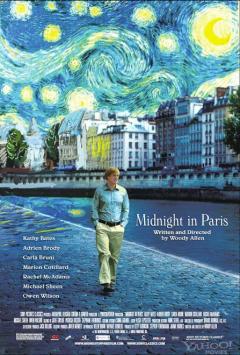
When I was a doctoral student in Paris in the late 1980’s and early 1990’s, I used to fantasize about the Paris of the 13th century, when my hero, Thomas Aquinas, was composing his theological masterpieces and when the cathedral of Notre Dame and the Sainte Chapelle were being brought to completion. From the perspective of late 20th-century Paris, when a bored skepticism held sway in much of the high culture, that time when ardent faith and high intellectual achievement went hand in hand seemed to me a golden age indeed. It is just this tendency to hanker nostalgically after a beautiful lost epoch that Woody Allen affectionately mocks in his witty new film, Midnight in Paris.

The story centers around Gil Pender, a writer of third-rate Hollywood movies who longs to compose a great novel, like those of Hemingway, Gertrude Stein, and F. Scott Fitzgerald. Gil finds himself with his fiancée in modern-day Paris, but the present interests him much less than the roaring-20s when his heroes strode the cultural stage in the city of lights.

Tired after a late night stroll through the city, Gil reclines on a set of stairs and considers his sad condition. Suddenly, a car from the 1920’s pulls up, and a group of revelers beckon him to join them. They deliver him to a rollicking gathering where he meets a young woman, in full flapper mode, who introduces herself as “Zelda,” and her husband, who blandly presents himself as “Scott Fitzgerald.”  While Gil tries to make sense of what can only be an elaborate prank, he spies Cole Porter at the piano, singing one of his most fetching lyrics, and then, to his utter astonishment, a dashing, black-mustachioed young man enters the room and is greeted as “Hemingway.” Gil realizes that he has indeed passed through a sort of time warp into the Paris of the 1920’s.

In the course of three or four visits to this new/old world, Gil manages to meet most of the major cultural players of the period. Besides Hemingway, Porter, and Fitzgerald, he runs into Picasso, Dali, Man Ray, Luis Bunuel, and T.S. Eliot—and everyone acts precisely according to type. Hemingway speaks in the clear, chiseled prose of his novels and is always angling for a fight; Dali is both charming and bizarre; Picasso is all stormy intensity; Cole Porter is unfailingly witty and urbane. I was, at first, put off by what I took to be a rather cartoonish evocation of these figures, but I then surmised that Woody Allen is exposing (and mocking) precisely our romanticizing predilection to paint the past in primary colors.

At Gertrude Stein’s salon, Gil meets a young woman, who is currently the mistress of Picasso and who had also had flings with Modigliani and Braques (why not?). As he shares with her his boundless enthusiasm for the Paris of the 1920’s, she registers a certain boredom and sadness. How much better than the present, she says, was the Paris of the belle époque, when Toulouse-Lautrec, Gauguin, Degas, and Van Gogh dominated the artistic scene and when Maxim’s glowed in all of its splendor.  Someone from inside Gil’s fantasy world exhibits, in short, the same tendency to denigrate the present and romanticize the past, to live somewhere other than in the now.

In a sort of dream-within-a-dream sequence, Gil and his girlfriend are transported from the '20s back to the Maxim’s of the belle époque where they meet Toulouse-Lautrec and Gauguin, who wax nostalgically about Renaissance! The grass, it seems, is always greener on the other side of the temporal divide between now and “back then.”

The point seems to be that fantasizing about the past is, psychologically and spiritually, a non-starter, for the only time that is fully real is the present. And in this, Woody Allen makes common cause with many of the great spiritual teachers, who have warned about the dangers of living so thoroughly in the past (or the future) that we miss the opportunity to sink into the dense texture of the here and the now.

His gentle mocking of Gil and his girlfriend is meant as a kind of spiritual exercise:  Don’t create fantasies about the past. Realize that the same Hemingway who wrote splendid, crystalline prose was also a tortured man who eventually took his life; realize that the same Scott Fitzgerald who composed some of the most beautiful sentences of the 20th century was also a hopeless alcoholic who died penniless; realize that the same Picasso who was the best painter since Rembrandt was also a shameless abuser of women.

This exercise is not meant to sully the memories of these people; it is meant to remind us that the past was every bit as grubby and ambiguous as the present. Therefore, we should live now; create now; love now; follow the will of God now. For this time, with all of its complexity and darkness, is the time that we have.

At the end of the film, Gil reveals that he got this message. Paris, he says, is always most beautiful in the rain.

Father Robert Barron is the founder of the global ministry, Word on Fire, and the Francis Cardinal George Professor of Faith and Culture at University of St. Mary of the Lake in Mundelein. He is the creator and host of a new ten episode documentary series called "Catholicism" and hosts programs on Relevant Radio, EWTN and at  WordOnFire.org.

Comment viewing options

Select your preferred way to display the comments and click "Save settings" to activate your changes.

Art and life

I enjoyed the movie, mostly because of the beautiful scenes of Paris that were depicted. It is difficult to think about Woody Allen and the things he has done with out repulsion. I think he knows that people despise him, but he still wants to be loved. So, he goes into the past and finds Gertrude Stein to say that he can write a good novel(since he is clearly Gil in the film). He is also accepted by his idols- the writers and artists of the 1920's- which should make him feel good. Then, he (as Gil) gets to talk about the portrait that Picasso painted of his mistress- because of his secret knowlege, and one-ups the intellectual snob that his girlfriend (Inez) fell in love with. Then, at the end, he finds another girl who understands him, and he might be able to live with in the present. I'm afraid, it's all about Woody.

Truth and Beauty

A friend reminded me this past week that whatever in this world is "true and beautiful" is Catholic because it is from God, who made the Church His earthly dwelling.

What a grace it is to see God in seemingly "godless" people! I just wonder their reaction to someone who points this out to them- to be a fly on the wall...

Boycott Info and Support for Victims

Some information that's far more important than any movie.

"He's my father married to my sister. That makes me his son and his brother-in-law. That is such a moral transgression." Ronan Farrow, in Life Magazine.

List of Polanski supporters -- http://www.indiewire.com/article/over_100_in_film_community_sign_polansk...

News coverage of SNAPs call for a boycott of Polanski and his supporters, and similar criminals in the arts -- http://www.youtube.com/watch?v=tyc1KNGDeWs

Rape, Abuse and Incest National Network --
http://www.google.com/url?sa=t&source=web&cd=1&ved=0CDoQFjAA&url=http%3A...

People are free to boycott anything they want

It's their money. But boycotts usually backfire especially with films. They create publicity and sell more tickets. A review of past movie boycotts confirms it.

Anonymous, you make some good

Anonymous, you make some good points.

I remember when I was young, my mother refused to go to an Liz Taylor movies because she had, what 5, 6, 7 husbands, none at the same time, serial marriages.

I never understood that, and still don't. Liz Taylor was a great actress. Whose business is it how many husbands she had. And why should her quality as an artist/actor be judged by how many husbands you have had?

a slight correction

I absolutely loved the movie, and I think you articulate well what it was saying. But I'd take issue with one sentence:

"This exercise is not meant to sully the memories of these people...we should live now; create now; love now; follow the will of God now"

The movie was teaching a lesson about living now and creating now, not explicitly about following the will of God now. Woody Allen is an atheist, and the movie talked about how art distracts us from the meaninglessness of life.

The irony is, it depicted about the artist's duty of distracting us from life's meaninglessness as something noble and meaningful.

How Can a Rotting Zombie Make a Movie?

Woody who? Didn't he die in a mysterious puff of noxious gray-green smoke some time in 1992, right after every single print of every movie he ever made vanished from the earth? And the same thing goes for Polanski. The need to appropriately SHUN and SHAME misogynists is a matter of far greater importance than mere movies. And please don't talk to me about forgiveness; shaming criminals and perverts is a cultural function. Hey, I'd rather put him in jail, but this is the only option for censure we've got. And, Woody  is throwing [deleted] in women's faces on a regular basis, i.e. going on in disgusting terms about his "parental" marriage in People Magazine a year or so ago. He's showing nothing resembling repentance, so I'll let God worry about his soul. My concern is with his reputation.

[This comment has been edited by the online editor. Please review our comment policy.]

You get him girl!

Wow, and I thought I was tough on woody. My sister raved about this movie (athiest) and kept telling me how I "just had to see it." I said "if you can guarantee that I won't get one fleeting glimpse of that creep maybe I'll see it when it comes out on home view." Yuck! Don't worry I've confessed this issue (harshness and negative speech) and Fr. said sometimes we need to say it. Harsh criticism is often earned and warranted.

Thanks

Thanks for saying what I was thinking. There is so much good art out there that we don't have to rely on perverts to bring it to us. I'm not judging Allen's soul, that is for God. But I won't spend my money on a movie by a guy who chases little girls around and gets the blessing of his colleagues. Someone needs to speak up and I am glad you did.

Don't see their movies if you don't want to

While you're at it don't look at the paintings of great artists who were also screwed up individutals including great religious art. Woody Allen and Roman Polanski are great filmmakers. I wonder if you ever liked any of their films. I suppose not. No matter, you don't have to. Your premise that we need to shame artists who do bad things might have some merit but extending it to a prohibition on viewing their art sounds like McCarthyism, facism, communism and other isms that impose censorship on what art a person may and may not look at. It also sounds a lot like the old Church list of banned books and movies I remember from my youth. A friend who also grew up Catholic chose which films to see from the list of banned ones. If they were banned he knew they were good. It is not to excuse Allen's and Polanski's wrongs but artists are often tremendously talented tremendously troubled people capable of great art, great wrongs and astounding self destruction. Your calling Woody Allen a rotting zombie is dehumanizing, un-Christian and sophmoric. I wonder if you appreciate art at all. If you do please tell me what artists you appreciate and I'll tell you some publicly known immoralities they committed. I'm glad that people like you don't control what I watch, read and listen to. James Joyce's Ulysess is considered one of the greatest novels in the world and was banned for years not only in this country but in Joyce's own Ireland. To those who would ban art I say no. To artistic freedom I say under the gray Moorish walls "Yes, Yes, Yes!"

Comment viewing options

Select your preferred way to display the comments and click "Save settings" to activate your changes.

U.S. Catholic insists on a civil and respectful dialogue on our website, following our Comment policy. Comments should be charitable, on topic, and brief. U.S. Catholic reserves the right to delete comments deemed inappropriate. Links are not allowed and comments with them will be moderated or deleted. We encourage you to choose your words wisely.