Logo

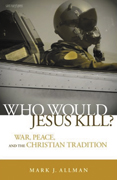
Who Would Jesus Kill? War, Peace, and the Christian Tradition

Sunday, March 15, 2009
Who Would Jesus Kill? War, Peace, and the Christian Tradition
ShareThis By Mark J. Allman (St. Mary’s Press, 2008)

“Who would Jesus kill?” asks author Mark Allman in this introduction to Christian thought on the ideal of peace and the morality of warfare. The answer is easy: No one! The unmarried, childless, propertyless, non-political Jesus of the canonical gospels kills no one.

Many of those baptized into the life, death, and Resurrection of Jesus, however, as well as others who look to Jesus as a moral example, have engaged in warfare and killing with regularity. WWJK? presents a variety of positions, rationales, and critiques that disciples of Jesus have used throughout history to justify their personal and communal conduct that seems in such clear opposition to the words and example of Jesus.

This book seems to be intended for college classrooms, adult education programs, and thoughtful readers. A challenging teacher, Allman presents a great deal of information but does not do all the work for the reader. In addition to the reflection questions that close every chapter, Allman leaves open to discussion why the various moral theories presented early in the book exist. Also unexplained (because it is possibly unexplainable) is why various prayerful, thoughtful, sincere Christians might hold such different positions on issues so important—the matters of killing and the destruction of lives, cultures, and property that is of the essence of warfare.

There are places in the text where Allman leaves it to the reader to figure out the kind of pacifist, just warrior, or holy war he is discussing—but no one who reads WWJK? will ever want use the words “pacifism,” “just war,” or “holy war” again. Allman does not allow simplistic understandings of these complicated ideas to stand without critique.

WWJK? is a useful introduction to Christian positions on the objective morality of war and peacemaking. Those forming and reforming their consciences on matters of war and peace will profit from Allman’s thought-provoking explanation.

Comment viewing options

Select your preferred way to display the comments and click "Save settings" to activate your changes.

WWJK?

The question of who would Jesus kill has obvious implications that since Jesus spent his life on earth as non-violent person who allowed himself to be crucified that this must be our model under the WWJD? principle.

I beleive scripture makes it clear that Jesus's mission on earth was to save, not condemn. However, Jesus's life on earth was a mere 33 years compared to eternity and he makes it clear in Matthew 25 that he will be the judge casting people into a lake of fire. Jesus said to fear eternal death much more than our physical death on earth. I trust in the mercy of Jesus, but according to scripture Jesus is going to be killing a lot of people in a way worse than just shooting them.

WWJK?

I've thought a lot about this because when you break it all down, it does seem hypocritical.

The best thing that I can come up with is this:

- we hold life as our most precious gift from God
- we react violently towards people that prey on others or who attempt to take the gift away
- evil (or call it sin) exists in the world
- the new covenants are love God above all else and love your neighbor as yourself
- we are imperfect humans and when the "rubber meets the road," we choose to preserve ourselves, our loved ones and our way of life rather than willingly submit ourselves to die
- there is a difference between murder and killing
- killing should be a last option if someone violates a convenant

There was a great example of this dilemna in a story out of Indianapolis where a dad woke up to his daughter screaming. When he entered the room, he found a naked guy with a mask on, a knife and some rope. A struggle ensues, the naked guy dies. Heart attack? Choked out? Does it matter? What would you do in the heat of the moment if that was your child? You decide.

Matthew 22:36-40, "Love the Lord your God with all your heart and with all your soul and with all your mind.' This is the first and greatest commandment. And the second is like it: 'Love your neighbor as yourself.' All the Law and the Prophets hang on these two commandments."

Romans 13:8-10, "Owe no one anything except to love one another, for he who loves another has fulfilled the law. For the commandments, "You shall not commit adultery," "You shall not murder," "You shall not steal," "You shall not bear false witness," "You shall not covet," and if there is any other commandment, are all summed up in this saying, namely, "You shall love your neighbor as yourself." Love does no harm to a neighbor; therefore love is the fulfillment of the law."

Bye bye Jesus! Hello

Bye bye Jesus! Hello Catechism of the Catholic Church

On Just War:
The Catechism of the Catholic Church reads:

Avoiding war

2307 The fifth commandment forbids the intentional destruction of human life. Because of the evils and injustices that accompany all war, the Church insistently urges everyone to prayer and to action so that the divine Goodness may free us from the ancient bondage of war.

2308 All citizens and all governments are obliged to work for the avoidance of war.

However, "as long as the danger of war persists and there is no international authority with the necessary competence and power, governments cannot be denied the right of lawful self-defense, once all peace efforts have failed."

2309 The strict conditions for legitimate defense by military force require rigorous consideration. The gravity of such a decision makes it subject to rigorous conditions of moral legitimacy. At one and the same time:

- the damage inflicted by the aggressor on the nation or community of nations must be lasting, grave, and certain;

- all other means of putting an end to it must have been shown to be impractical or ineffective;

- there must be serious prospects of success;

- the use of arms must not produce evils and disorders graver than the evil to be eliminated. The power of modem means of destruction weighs very heavily in evaluating this condition.

These are the traditional elements enumerated in what is called the "just war" doctrine.

The evaluation of these conditions for moral legitimacy belongs to the prudential judgment of those who have responsibility for the common good.

End of Story
Phobos and Deimos

Readers interested in War

Readers interested in War and Peace may also find some of the works by Ronald G Musto interesting, such as:

1. The Catholic Peace Tradition. Maryknoll, NY: Orbis Books, 1986; reprint New York: Peace Books, 2002.

2.The Peace Tradition in the Catholic Church. An Annotated Bibliography. New York: Garland Publishing, 1987.

3.Catholic Peacemakers: A Documentary History. 2 vols.
Vol. 1: From the Bible to the Crusades. New York: Garland Publishing, 1993.
Vol. 2: From the Renaissance to the Twentieth Century. New York: Garland Publishing, 1996.

3.Liberation Theologies: A Research Guide. New York: Garland Publishing, 1991.

4.“Just Wars and Evil Empires: Erasmus and the Turks,” in John Monfasani and Ronald G. Musto, eds., Renaissance Society and Culture: Essays in Honor of Eugene F. Rice, Jr. New York: Italica Press, 1991, pp. 197–216.

Ron Musto holds a B.A. from Fordham University and an M.A. and Ph.D. in medieval and Renaissance History from Columbia University. He specialized in fourteenth-century Italian religious history and taught on the college level for several years. He is a fellow of the American Academy in Rome and the winner of NEH (1978) and Mellon Foundation (1980) fellowships and of the Best Book Award from the Catholic Press Association (1986) for his The Catholic Peace Tradition.

Peace,
M. Francis

Who Would Jesus Kill

Albeit there seems to be an undertone of bitterness and disillusionment (perhaps well-justified), the posting by "Anonymous" makes several interesting points.
Catholic theology certainly does not allow a decoupling of the Trinity, yet that fact in no way innures to its position that God the Father is indistinct from God the Son, nor from God the Holy Spirit. The Trinity is at core an irresolvable mystery of Faith .. not of Aristotelean logic. And to assert that our human, finite minds can comprehend the infinity of God seems, well, just that: Human!
Said less abstractly, when John the Baptist baptised Jesus Christ and the Holy Spirit descended in the form of a dove, it was NOT Jesus Christ descending upon Jesus Christ, who was actually God the Father being baptised. And so it goes throughout the Old (Hebrew)Testament and the New Testament.
Notwithstanding my comments, "Anonymous" points to a difficult issue: the continued slaughter of ever so many. I hope that this helps, and that Jesus Christ can be viewed as Love; not violence.

Who Would Jesus Kill?

Well, if you accept the Biblical account of things together with the idea of the Trinity, then Jesus actually has killed a whole lot of folks--indeed, as part of the Trinity Jesus would have wiped out all human, animal, and plant life on earth druing the great flood other than those in Noah's Ark ... Jesus also killed the first-born of Egypt during the Exodus period, the army of Pharoah when the parted Red Sea closed over them, as well as the various people killed while Moses kept his arms upraised (according to God's, and hence Jesus', command) during the years in the desert ... more wars followed, of course, once the Israelites had established their kingdom--wars won with God's help ... so unless you plan to decouplke jesus from the god of the Old Testament--which Jesus himself did not do--it's really hard to argue that Jesus was nonviolent or a pacifist.

Thank-you. Jesus said it not

Thank-you. Jesus said it not once, but three times.."I come not to change the Law, but to fullful the Law". Jesus is the blood sacrifice for our way to God..."I am the true and living way: no one comes to the Father but by me." Jesus even exhibits all acts of God(from the Old Testiment)during his presence here on Earth...even lossing his temper and punishment..even killing. So it is my believe that nothing changes from the Torah. All the Laws that God gave man still stands.

The writings of Eugen

The writings of Eugen Dewermann address some of the questiona raised.

"Drewermann's primary intuition is that Christianity has done violence to people by using fear as the primary motive for faith-fear of hell, fear of exclusion, fear of God. At the heart of Drewermann's nonviolent interpretation of key Christian beliefs is his analysis of a violent image of God that characterises traditional interpretations of sin and the cross. It is this God image, opposed to human desires and self-realisation, that sanctified the killings of millions of peoples in wars declared to be 'just' and legitimated the violent exploitation of nonhuman nature and the aggressive economic exploitation of non-Christian cultures."

An Introduction to the Work of Eugen Drewermann
Matthias Beier
ISBN: 0826415849
Publisher: Continuum

Theologian and psychotherapist Eugen Drewermann is probably the best-selling religious writer in Europe over the past quarter century. The sheer enormity of his principal books - The Cleric (900 pp.), The Structure of Evil (1969 pp.), Faith in Freedom: Depth Psychology and Dogmatics (720pp), Depth Psychology and Exegesis (2 vols.), and Psychoanalysis and Moral Theology (2 vols.) - has thwarted publication of his works in English translation to date. Drewermann's scathing attack on the clerical mentality, ideology, and culture (The Cleric), based on his psychotherapeutic work with clergy, led to his being silenced by Roman Catholic authorities in 1991 and suspended from the priesthood in 1992.

Comment viewing options

Select your preferred way to display the comments and click "Save settings" to activate your changes.

U.S. Catholic insists on a civil and respectful dialogue on our website, following our Comment policy. Comments should be charitable, on topic, and brief. U.S. Catholic reserves the right to delete comments deemed inappropriate. Links are not allowed and comments with them will be moderated or deleted. We encourage you to choose your words wisely.