
Marriage of convenience: Changing wedding traditions
Catholics should find a way to welcome couples whose paths to the altar don't go straight down the center aisle.
Full disclosure: I hate weddings. Don't get me wrong. I think marriage is great, but the actual celebration for me is generally a nails-on-chalkboard experience. Whether it's the cast of color-coordinated thousands, the infants (and pets) in wagons as flower children, or the fiscal black hole of the bridal-industrial complex, I find it all a bit much.
The latest nuptial innovation, courtesy of a St. Paul, Minnesota couple, featured the wedding party boogying down the aisle to a hip-hop ballad. With 20 million-and-counting hits on its YouTube video, I think we may have a liturgical catastrophe on our hands. I may never go to a wedding again.
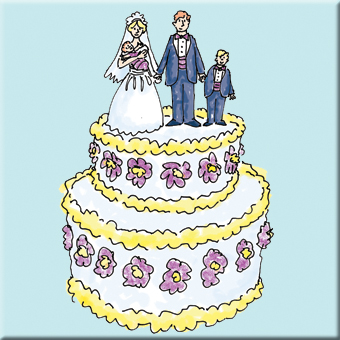
If that wasn't enough, the Church of England has issued an official ritual for a single-service wedding and Baptisms of the couple's children-a sacrament combo platter. Turns out that 20 percent of the couples coming to the Anglican church to marry already have children, either together or from a previous relationship. Britain's Office of National Statistics has noted that having children, not getting married, is now often the first major milestone of adult life.
On second thought, the Anglican move seems refreshingly reality-based. "Patterns of relationship and marriage within society are presenting new opportunities for the church," Bishop Stephen Platten, who chairs the Church of England's liturgical commission, told CNN. He hopes more unmarried parents will go ahead and tie the knot.

Not every Anglican was so excited about formalizing what had been a pastoral adaptation. Stephen Robinson of the Anglican group Forward in Faith called the plan "bonkers," according to the U.K. Mail. "We are following the methods of the supermarkets: Buy one, get one free. I don't know why they don't do a bumper deal and offer all seven sacraments in one service." Others suggested that the wedding/Baptism twofer will encourage sex before marriage (as if there were need of such encouragement).
It is true that baptizing children at the wedding acknowledges the obvious premarital sexual relationship. But before we lament the destruction of the family, we should remember that until the last century or so, children (or at least pregnancy) often preceded marriage and still does in many parts of the world, so this is well-traveled ground.
And like it or not, the courtship-marriage-sex-children pattern is fading. U.S. statistics from 2007 show unmarried women accounted for nearly 40 percent of births. More than 13 million unmarried heterosexual couples live together, according to 2008 U.S. census data, and more than half of couples who eventually marry live together first.
It's also worth noting that the parents seeking to marry are realizing that they want and need the church, and so are coming with their children to the sacraments. No matter what path brought them to the altar, they ended up where Christian tradition wants them to be, in (one hopes) permanent sacramental relationships. With blended families, weddings are often not only about the couple but about their children as well. Making the wedding a time of commitment for everyone is a great way to support such families, whether that means Baptism or something else.
We in the Catholic Church will have to make our own choices about this issue eventually, but it is more than a merely liturgical question. It's first about how we respond to couples whose personal histories don't follow the moral norm the church presumes but who come seeking Christian marriage anyway. Whether an official Catholic rite that includes Matrimony and Baptism will ever exist is up for grabs. What isn't is the fact that the realities of modern family life have changed dramatically.
We could, on the one hand, continue to insist that cohabiting couples separate and that divorced Catholics unable to obtain an annulment forgo marriage-and watch as more and more Catholic couples and their children walk out the church door. Or we could skip the finger-wagging and find new ways to promote the ideals of fidelity, love, and permanence embodied in marriage, while accepting the plain fact that not everyone will take the same path to reach them.
I, for one, will root for the latter-as long as we all agree to keep the liturgical boogying to a minimum.This article appeared in the October 2009 issue (Vol. 74, No. 10, pg. 8) of U.S. Catholic magazine.
Homosexuality is DEATH, I choose LIFE!
By Anonymous John (not verified) on Tuesday, May 25, 2010What a dispicable thing to say that God made them to be gay (sodomite)! You obviously and billigerantly ignore the bible teachings on this.
The average lifespan of homosexuals is no more 51 yrs of age... Imagine the child not having their parent around after 9 or 13 yrs of age or less! DON'T ANY OF U LIBERALS EVEN CARE ABOUT THE COUNTLESS STD'S, THE HIGHER RATES OF SUICIDE AND DEPRESSION???????????
HOMOSEXUALITY IS DEATH...I CHOOSE LIFE!!!
OK...If homosexuality is a
By Anonymous (not verified) on Saturday, September 18, 2010OK...If homosexuality is a choice then you too have interest in the same sex but choose to be with the opposite sex. If a gay man marries a women but likes men is he still a homosexual? And God, who is perfect and beautiful in every way, created ALL life as they are, not who you want them to be. We shall pray for forgiveness everyday to the Holy Father as he has more grace in his heart than sin in the world. But the individual, our brother or sister in life under God, has to make the choice to be be with God. And we should be there to help them not to punish or name call. Judgement is up to God our Father. No one else.
I will also pray for you, that you find tolerance and peace. Though it may be hard for a man/woman to offer forgiveness, but God lives in us and he can forgive.
Please understand that there are many "Heterosexual" persons who die at early ages for many reasons. Homosexuality is never the reason, but the sins of man that cause death, illness and aloneness. Please reach out and help one another and do not destroy another of Gods children because it makes you feel better about yourself. Open your heart and mind and you will find God! We are not just people, we are Gods children loved with the purest of hearts.
Peace be with you, brother!
Weddings some of the most
By donna (not verified) on Thursday, February 18, 2010Weddings some of the most important events of our lives, this is one of the reason why they are intensely celebrated and filled with traditions that vary around the planet. It's not the wedding that's important, it's the marriage. If you're not fully committed into marriage then that marriage doesn't stand a chance and sooner or later you'll have to deal with marriage retreat problem. It really is all up to us.
Catholica wedding ceremony includes baptisms.
By adavis (not verified) on Thursday, November 12, 2009Folks:
Get over it. The Holy Roman Catholic Church already has a wedding mass ceremony that includes baptising adult children and infants.
So what is the argument about ?
The last time I was in OAXACA (wa-HA-ka), Mexico, I attended one in a small church just off the main square.
Would love to hear more about that...
By Bryan Cones on Tuesday, November 24, 2009I imagine what you experienced was a "mash up," much like the baptism of infants at Sunday Mass. But I imagine it's a fairly common occurrence in priest-poor parts of the world, such as Oaxaca.
Bryan Cones
I wish this article would
By Alison (not verified) on Tuesday, November 10, 2009I wish this article would have included more concrete ideas rather than just saying "We Catholics need to be more accommodating". I don't really think this was a useful article at all for that reason. We already have con-validation classes that many people take advantage of. I would really like to hear the authors thoughts on what else we're lacking.
And more importantly, there are reasons you can't give a couple who can't get an annulment another sacrament of marriage...because they already have one! We cannot cheapen what these sacraments mean because they are not ours to cheapen.
I guess the best "we Catholics" can do is have a better education of those attending mass beforehand.
i was never for tradition!
By cherylhiggins (not verified) on Monday, November 9, 2009i was never for tradition! lol!
Yes, let's all just ignore
By GA Catholic (not verified) on Thursday, October 8, 2009Yes, let's all just ignore the Catholic Faith because it doesn't fit in with the values of our society. After all, that's what the first Catholics did, right?
Or wait... didn't they actually prefer to be ripped to shreds in an arena by wild animals rather than compromise their faith by pouring some wine on the ground?
Hmmm. Maybe compromise isn't the best policy.
Weddings
By Becky (not verified) on Tuesday, September 29, 2009A local parish has at least once taken an innovative tack to the sacrament of marriage. This parish is in a poor, mostly immigrant area of town where couple often delay marriage indefinitely due to the cost of a wedding and other practical factors. The parish's solution? A group wedding, where numerous couples who had been living together for some time each had an opportunity to profess vows and become married both legally and sacramentally. The cost of the celebration was spread out throughout the parish and did not fall on the shoulders of any single couple.
I think that if marriage were truly viewed by Catholics today as a sacrament taking place within the community of the parish, then its state would be improved. A wedding shouldn't cost an arm and a leg, and it shouldn't be viewed as something that one must "save up for." It is a part of life of the community and should be supported by it. This would mean both more modest weddings and more practical support for married couples, in my opinion.
Cool!
By Bryan Cones on Monday, November 9, 2009Glad to hear some parishes are responding in a positive way to situations like this one--and especially like the community focus of this one. What a way to "support marriage" without having to be negative.
Bryan Cones