Can we reinvent Catholic schools?
Theresa Muniz remembers the nuns in her elementary school as strict, vigorously inspecting her appearance and demanding straight-laced behavior. But in her working-class Chicago neighborhood, her parish school offered what her parents wanted: a good education and reinforcement of the values they held dear.
"My parents wanted me to keep my legs crossed and my mouth shut," she says laughing.
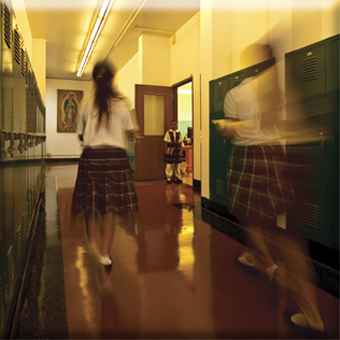
Today the halls of her old school are empty, its doors shuttered a decade ago-a victim, like so many other Catholic schools, of population shifts and new cultural and economic realities.
Muniz' story and a survey of her neighborhood paint the picture of what has been happening all over the country. As more affluent second and third generations of Latino and European immigrant groups move up in the world, they've moved out of the parish and urban environments of their parents and grandparents, leaving behind working poor or new immigrant families who can't support parish schools and the increasing costs of their lay teaching staffs.
During the last few decades, the same story has settled like a shroud over Catholic school systems across America. Since 2000, nearly 30 percent of Catholic schools in cities have shut down and 20 percent of suburban schools. According to a 2008 report from the Thomas B. Fordham Institute, an education-issues think tank based in Washington, more than 1,300 Catholic schools have shut down since 1990. Most of the school closures were in urban areas.
Nationally Catholic schools recorded another 3.5 percent decline in enrollment for the 2008-2009 school year, and another 162 schools closed, according to the National Catholic Educational Association (NCEA). There are now 6,028 elementary or middle schools and 1,220 secondary schools, enrolling 2,192,531 students in the United States.
Enrollment declined in all regions of the country, but the largest decreases were centered in large urban areas that were populated by high concentrations of Catholic immigrants in the late 19th and 20th centuries.
But the news is not all bad. Last year 31 new schools opened, and in recent years a few new Catholic schools have opened with innovative funding models that take the financial burden off parents. Experiments have also begun with charter school conversions of old Catholic schools, giving parents disgruntled with traditional public schools more options.
While Karen Ristau, executive director of NCEA, worries the recession may contribute to a new cycle of school closings, a new spirit of creativity and willingness to make tough decisions may also be emerging.
Some are making these moves within the confines of the current system, looking to new funding sources and finding new methods to support existing schools. Others have taken bolder steps: This year New York will be joining Washington in controversial conversions of Catholic schools to public charter schools, as one-time parish institutions shed their religious character in exchange for stable funding.
Still others are doing both. The always controversial voucher programs once held out the faint hope of a new platform of support for Catholic schools. But vouchers seem to have fallen out of favor with the Obama administration's Department of Education, which is declining to continue a Washington voucher experiment.
Greg Naleski, vice president for development in the NativityMiguel School Network, a network of Catholic and faith-based middle schools, insists that may prove short-sighted. Washington needs to take notice of what is happening with Catholic schools, he says. Despite closing schools and declining enrollment, some 2.1 million students still attend Catholic schools.
"What would happen if all the faith-based schools said, ‘We're done' and sent our students to the public schools?" he asks. "The public schools couldn't absorb them. These schools serve a purpose and have a proven model of success."
According to the Fordham Institute, some 300,000 students have been displaced because of Catholic-school closings since 1990. U.S. taxpayers have been on the hook for upwards of $20 billion to pay for public schooling for students left behind by vanishing Catholic schools.
Resurrection models
The decline of Catholic education is certainly not the result of disinterest among families in low-income communities. In many U.S. neighborhoods, parents are desperate for opportunities to send their children to good, safe, values-driven schools, Naleski says. The NativityMiguel School Network, which includes 64 schools in 27 states across the country, helps fill that void.
By focusing on middle school, the founders believe they can change the path of students. "By high school it is too late," Naleski says.
But Naleski says it is not just the strong academics that parents want out of his schools. They're attracted to the strong values that a Catholic school offers. "We provide an urban Catholic education to those who couldn't afford it otherwise. We bring a school to them."
Every day Naleski gets calls from parents and community groups wanting to know how to open a NativityMiguel in their town. But the network is careful about where they put the schools. Before the doors open on a new school, they need to raise about $14,000 a year per student. Only about 5 percent of that cost comes from parents as tuition, though some costs are covered by the volunteer efforts of NativityMiguel parents. The remaining funds come from individual donors.
One key is that each school is its own not-for-profit and has its own board of directors, Naleski says. These board members help fundraise and are instrumental to the schools staying open and viable.
The Cristo Rey Schools Network is another organization serving working class families who can't afford hefty tuition for a Catholic education. Cristo Rey schools rely heavily on fundraising, but they are unique in several ways.
The schools enroll mainstream students, not academic superstars. There is no academic admission test. In fact, if applicants to a Cristo Rey school are already performing at a high academic level, administrators will often refer them to a college prep school.
And school staff do not look just for Catholic students.
"We are doing it because we are Catholic, not because they are Catholic," Robert Birdsell, president of the network, says. "We are doing it to serve the less fortunate, to break the cycle of poverty."
But the schools do have high expectations, telling students on day one that they are the class of the year they will graduate high school, as well as the year they will graduate college. Students also dress in business attire.
But perhaps the most singular element of a Cristo Rey education is that the students themselves help pay the bills.
Cristo Rey students are out on a job site every week, and in return local businesses and corporations support the school. It costs about $10,000 a year per student, and families make a contribution of $1,600 toward the cost of tuition. The remainder is covered by the students' wages.
"We realized that we couldn't be sustainable on just tuition and fundraising," Birdsell says. "We looked to the other side of the ledger, our students."
Cristo Rey schools also raise money through traditional fundraisers and apply for grants from foundations. Each school requires a site plus two years of operating costs, about $2 million. Rather than rely on parishes, Cristo Rey schools are supported by 27 religious orders.
The Cristo Rey student employment model is not easy to emulate, especially in this economy. In June Birdsell says he was still trying to find more than 400 jobs for his students.
Rafael Jaquez's daughter Nicole graduated from a Cristo Rey school in New York City. He says he would have had trouble paying for a Catholic high school for his daughter. As a child he attended Catholic schools, but these days the city's Catholic high schools charge on average $15,000 a year-far more than he could afford on his social worker's salary.
But affordability is not the only reason he became deeply committed to Cristo Rey. "They seemed like a no-nonsense school," he says. "I really like the approach and that it was high-spirited with the focus on college."
He says his daughter became well integrated in the law firm she worked with for four years. On her last day, they threw her a party. The work experience taught her to be responsible and committed. In fact, if students have an unexcused absence they have to pay $100-something that never happened to Nicole.
"I always tell her, ‘You paid your way through school,' " he says.
Biding our tithe
While some new networks and individual schools are trying different approaches to serve working class communities, innovations inside dioceses are happening, too.
The Archdiocese of Washington changed the way it provides a funding cushion for schools and hopes to keep more schools open. In the past it provided emergency funds for schools as they confronted budget deficits. Now the archdiocese offers tuition aid directly to students, encouraging schools to get as many bodies in seats and collect as much from families as possible.
Susan Gibbs, a spokesperson for the archdiocese, says a recent assessment of all Washington schools looked at the strength of their relationships with parishes. Some parishes commit a lot of money to their schools; others over time have lost their connection.
Making sure that the relationship between a school and its parish is strong has been the key to keeping the schools up and running in the Diocese of Wichita, Kansas. Wichita Catholic schools have been recognized as one of the most successful systems in the nation.
Bob Voboril, superintendent of Wichita Catholic schools, says the most important element in making his schools successful is the strong support of parishes. Enrollment-at 10,800 students in both rural Kansas communities and inner-city neighborhoods-has been increasing, and the academics are competitive with the best, most costly private schools in the state. In the past 10 years, the diocese has not closed any schools.
That may be because the diocese's 38 schools are tuition-free to Catholic students and affordable to non-Catholic kids. The Wichita difference? Its ability to persuade Catholic families to actively tithe in support of local schools.
In a wealthy Wichita parish that level of support can generate $100,000 a week for Wichita schools, but even in the poorest parishes, tens of thousands of dollars in weekly fundraising is not uncommon. Parish members can also contribute through their skills and time in school landscaping efforts, building repairs, or as members of schools' coaching staffs.
"If people believe everything they have is a gift from God and they come to church each Sunday and they are active in their parish, [then] they are generous," Voboril says.
This relationship between parishes and their schools is built on the philosophy that education is a vital ministry of the church. Catholic identity is deeply embedded within the schools. That is not to say that Wichita Catholic schools don't serve non-Catholics. In fact, Voboril says the support that schools get from their parishes allows them to take in more low-income students because the overall tuition stays affordable.
Relying on the parish community also frees schools from relying on outside donors who have particular interests, like a good football team or maintaining a college-prep track. "It becomes a challenge," he says. "[In other states] there are a lot of principals who feel trapped and beholden to those who hold the money."
Another sign of life has been the overall strength of the Catholic schools of the Diocese of Phoenix, which has opened six schools over the last 10 years and has plans for five more. Superintendent MaryBeth Mueller told The Arizona Republic that the success of local Catholic schools has partly to do with the Arizona school tax credit.
Individual donors and parents can claim tax credits for contributions to public and private schools. Contributions made to the Catholic Tuition Organization of the Diocese of Phoenix benefit students attending local Catholic schools. Funds generated through the tax credit have helped families afford to send their children to Catholic schools. About 50 percent of students in the diocese receive some kind of financial help through the tax credit and other tuition assistance.
Chartering a new course
Making Catholic education affordable and renewing the church's educational mission to the poor will require new thinking and better data analysis according to the Fordham Institute's report, "Who Will Save America's Urban Catholic Schools?"
Its authors suggest that rather than push for a restoration of federal vouchers, Catholic schools should devise better strategies for claiming a share of existing government programs, such as getting Title I money and joining school lunch programs.
"A lot depends on the imagination and ingenuity of the school leaders," the NCEA's Ristau says.
New ideas are at a premium. Despite Cristo Rey's success, Birdsell says the Cristo Rey model is not the answer everywhere. "We need to think creatively," he says.
He also says schools need to market themselves better, dialing up the expectations by proving to people that they offer the best. Ristau says the NCEA sees the new immigrants in the cities as both a challenge and an opportunity for Catholic education broadly. Latino students, she says, should be in Catholic schools. After all, many come from devout Catholic families.
Many immigrant Latino families, however, don't see Catholic schools as a place for them. "In their countries, the Catholic schools are for the wealthy," she says. To counter this mindset, Ristau says urban schools are reaching out to immigrant families, encouraging the families of current students to evangelize the families they know.
A sudden charter school conversion is another controversial idea. Susan Gibbs of the Washington archdiocese is quick to defend last year's decision to convert seven of its schools into publically funded charter schools, which do not have to follow all public school regulations but must meet performance goals outlined in their "charters." Gibbs says the archdiocese spent $6 million a year for 10 years on the schools that were converted and couldn't defend continuing that level of support. It had only two choices: Close the schools or change them into charters.
According to Gibbs, the new charters were able to keep all their old staff and most of their students. The few families that took their children out so they could go to a "real" Catholic school were quickly replaced by neighborhood children who otherwise wouldn't have been able to afford the parish school.
Gibbs notes that 71 percent of the students in the converted schools were not Catholic in the first place. She says that the parishes that house the schools now get paid rent, which they can use toward after-school and religious education. Charter schools in Washington also spend $11,000 per child, more than Catholic schools can afford to spend.
But others note the danger in Catholic schools embracing charter conversions as a fix for the ongoing crisis. In a 2007 report, Ronald Nuzzi, director of the Alliance for Catholic Education Leadership Program at the University of Notre Dame, wrote that charter schools are "one of the biggest threats to Catholic schools in the inner city, hands down."
The charter schools teach value-based education but cannot use religion as its basis. Charter schools' competition with parochial schools is especially severe because many of the best charter schools take inspiration from Catholic school practices, which have a strong record in educating disadvantaged students and preparing them for college.
"It would be tragic and absurd to help drive Catholic schools out of business by publicly funding student attendance to both public and charter schools but not to private schools," Fordham's Matthew Ladner wrote.
Ladner, who studied Arizona's tax credit program as a model for the Journal of Catholic Education recommends tax credits and school vouchers to offset the "double payment penalty" phenomenon and to preserve Catholic education in the inner city.
The NCEA is against Catholic schools becoming charters. "To my way of thinking it is very sad," Ristau says. Ristau is quick to note, however, that she understands the dilemma. "The D.C. public schools are very poor," she says. "It is just an awful system. Were I a parent, I couldn't send my children there."
Gibbs agrees the Catholic-schools-turned-charter have lost a big piece of themselves. "Losing the religious education is big," she says.
Marketing 101
Yet keeping schools open sometimes means tough sacrifices. In 2007 in Rochester, New York the superintendent of Catholic schools made the hard decision to close 14 of the system's 48 schools. A task force outlined the circular issues faced by the schools in the working class community: enrollment had dropped so tuition was rising. The rising tuition was forcing families out, and the schools were facing a $1 million deficit that was projected to grow.
At the time Bishop Matthew Clark told the families: "By acting now, we can free the system of potentially crippling financial woes and ensure our overall Catholic school program will not just survive but thrive in the future." He lowered the tuition of the surviving schools and gave families a $500 credit toward tuition at new schools.
As the 14 schools closed, the Rochester diocese lost some 400 students. All of the other students transferred from a closing school to one that remained open. One reason parents had the option of staying with a Catholic school is that New York provides busing for any child within 15 miles of a school.
Rochester Superintendent Anne Willkens Leach started her job in the summer of 2008. She says she thinks she represents a fresh start for the school district. Leach says her major goal this year is to not have to close any Catholic schools. The recession is making her work extra hard to accomplish that goal, but she thinks Rochester schools are in good shape for the coming school year.
One lesson learned in Rochester is that the Catholic schools have to aggressively market themselves. Leach says they have been running ads in newspapers and on television as well as reaching out to reporters for coverage whenever something happens that might be of interest. They've also told parishes that every Sunday in the church bulletin there should be at least one mention of the school.
Leach has been following the national discussion about converting Catholic schools into charters, but she says that is not a move she would like to make. Providing values and faith-based education is important and it is something she wouldn't want to lose.
In 2001 Leach worked for a public school system. She said she tried to give school administrators and teachers advice about what to say in response to the tragedy of September 11.
But, being a devout Catholic herself, she could not give them the piece of advice that she thought was most important. "I would have liked to have told them to pray," she says.