The issue of women priests may be a settled matter, but that doesn’t mean a woman can’t serve the church as a deacon.
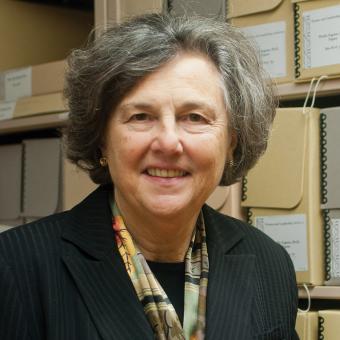
Celebrating the opening of the archives of her work on women in the diaconate at Loyola University Chicago’s Gannon Center for Women and Leadership, scholar Phyllis Zagano minced no words about the topic that has been her life’s project: “Women as deacons is not a concept for the future. Women as deacons is a concept for the present, for today.”
With women’s ordination being a sensitive topic in Catholic circles, Zagano carefully lays out her argument for restoring what for many centuries was an official role of women in the ancient church, rejecting a “slippery slope” argument that claims women deacons would mean eventual women priests. “We have this misunderstanding that the diaconate is only a step on the way to priesthood,” she says. “The diaconate is a separate vocation, and one doesn’t imply the other.”
Despite her advocacy Zagano doesn’t think every bishop needs to ordain women as deacons tomorrow, noting that some dioceses still don’t ordain men to the permanent diaconate. “One bishop may feel he needs women deacons; another bishop may feel he doesn’t,” she says. “But if the archbishop of Chicago thought he needed women as deacons, why would he not be allowed to have them?”
If anything, Zagano says, women deacons are worth a try. “As I said to [New York] Cardinal John O’Connor 20 years ago, ‘I’ll give you my life as an experiment. Just see what happens.’ ”
What obstacles are there in current church teaching or law that would prevent the ordination of a woman as a deacon?
The principal obstacle is that women have not been ordained as deacons in the Western church for at least 800 years. In current canon law women cannot be ordained as anything. It’s as simple as that.
There is a collision between the tradition of the church and the law of the church on this question. What is admitted by all sides—both those for and against it—is that it’s an open question.
I’m confident in saying that because the most recent discussion coming from the Vatican about this topic is a 72-page study document by the International Theological Commission, which had one conclusion: It’s up to the magisterium, the teaching authority of the church, to decide.
In New York in the late 1980s I was at a meeting with then-Cardinal Joseph Ratzinger and discussed the issue with him briefly. He said, “It’s under study.”
To my mind the study has just gone on too long. So I think the biggest obstacle is inertia, and perhaps a misunderstanding of the diaconate and how women in the diaconate could further the objective need for greater evangelization.
Some say that if women can’t be ordained priests, they can’t be ordained deacons. What’s the connection between those two?
What used to be called the “progression of orders”—deacon, priest, and bishop—developed late in the history of the church, and it isn’t helpful today. It’s better to understand the deacon as one of the arms of the bishop; the other arm is the priest. They are separate orders in the church.
One doesn’t imply the other. When you ordain a man a permanent deacon today, there’s no expectation that he would become a priest. A deacon is not a priest. The diaconate is a separate vocation, one that was lived by men and women in the ancient church, and is lived today by men.
But isn’t there a fear that if you ordained a woman as a deacon, you could ordain her a priest, too?
I wrote a book called Holy Saturday: An Argument for the Restoration of the Female Diaconate (Crossroad) at the request of my old boss, Cardinal John O’Connor of New York. I brought my outline to him, and I think I had six points.
He said, “Phyllis, if you’ve proved a woman can be ordained a deacon, you’ve proved she can be ordained a priest.” I said, “Eminence, I’m not allowed to talk about women priests. Why are you bringing that up?” He said, “Oh, that’s very good. Make that point three.”
The cardinal was very clear in that discussion that the slippery slope was a fear of Rome. I simply say ordaining women as priests is just not the teaching of our church. But that doesn’t mean a woman isn’t ordainable.
To say that a woman is not ordainable and cannot serve in persona Christi—as a deacon, in the person of Christ the servant—is to argue against the incarnation. The important thing is not that Christ became male. It’s that Christ became human. If we say that a woman cannot live in persona Christi, I think we’re making a terribly negative comment about the female gender.
That is the so-called iconic argument against women in the priesthood: You have to be male to represent Jesus. That argument is no longer used. The argument church teaching uses today is the argument from authority, which is that Christ called forth only men as apostles.
That is what Pope John Paul II said in 1994, that the church does not have the authority to ordain a woman as a priest, because Christ did not choose women for membership among the Twelve.
And that doesn’t apply to women deacons?
The argument from authority doesn’t hold for women deacons because in Acts the first seven who are generally understood as the first deacons were called forth by the apostles, not by Christ. They were put forward by the people of the church and received a laying on of hands from the apostles. Further, the only person in all of scripture who has the job title “deacon” is Phoebe, a woman.
The argument from authority against ordaining women as priests is actually an argument for ordaining women as deacons. I don’t think you can accept one and not the other.
How do bishops respond when you suggest ordaining women as deacons?
When I ask them to ordain me, they always say they want to keep their jobs. That’s a change in the response. It used to be, “That can’t happen.”
I think it’s more important to look through the eyes of the bishop as he looks at the needs of the diocese and how they are being fulfilled by whatever cadre of ordained or other ministers he calls forth. That, to me, is the bottom line on the need for women to be ordained: the needs of the church.
We have in the United States 35,000 lay ecclesial ministers, of whom something like 80 or 85 percent are women. We have in the United States about 16,500 permanent deacons, most of whom are married men.
But of the women who minister in the church, none has the particular relationship between herself and her ministry and the bishop. So she’s not exactly an arm of the bishop. She’s literally at arm’s length from the bishop as a lay ecclesial minister.
Many dioceses have wonderful programs of certifying lay ecclesial ministers. But with the diaconate, there’s a specific progression of formation—the spiritual, the human, the intellectual, and the pastoral—that is under the control of the bishop. So if a woman is then trained by the bishop in his program and is formed spiritually, humanly, intellectually, and pastorally, then in ordaining her the bishop is certifying, in a way, that he trusts her.
What are some more specific needs that a female deacon might meet?
A bishop may find that he needs women to provide for the charity of the church. A need of the church—and an ancient task of the woman deacon—was to be the intermediary between the women of the church and the bishop. She would bring the needs of the women to the bishop. Alternatively, she would bring the teachings of the bishop to women.
When a Syrian bishop was writing in the fourth century about needing women deacons, he used an interesting verb to explain why. He said it was unseemly for women to uncover, divulge, or disclose themselves before men.
You can take that to mean it’s unseemly for women to undress at baptism before men, and women deacons did assist in the baptism of women. But it could also mean that it’s unseemly for women to expose themselves personally to men in certain situations.
I think of women as spiritual directors and counselors, as well as in hospital and prison ministry. In those situations a woman deacon would bring the pastoral concern of the bishop directly to the women in need.
In addition, there are many women who are judges on marriage tribunals. If a layperson is a judge on a marriage tribunal, for example, that layperson can have a vote. But a layperson who writes an individual judgment in a church proceeding cannot sign it. She has to run down the hall and get a cleric to sign it. The same applies to diocesan chancellors. But if those women were deacons, they would be clerics, able to act on their own.
Can’t any layperson do most of this ministry?
A layperson can lead a communion service in a nursing home. But there is a distinction, and the reason we have ordination is because the bishop is ordering the individual to stand in on his behalf.
I don’t think it’s a difference in the actual ministry. There’s a difference in the minister. And to my mind a great deal of it is in formation and training.
Think of rural areas. If you’re going to send somebody out in rural North Dakota, that person is going to go out with only the training he or she received. If the bishop were deciding whom to send, I think he’d rather send somebody he has trained and ordained, because he can remove that person’s faculties, too.
It’s also sacramental. In the parish you have people who are being prepared for marriage. It’s usually the priest who is going to preside at the wedding, but many times the marriage intake is done by a lay ecclesial minister who cannot be the church’s official witness at the wedding. But a deacon is an ordinary minister of the sacrament of marriage, and a female deacon could preside at the wedding.
How would a woman deacon change the Catholic experience of Sunday Mass?
An ordained person is a public minister of the church. When I go to my parish, there’s a huge rotation of lay ecclesial ministers and volunteers, altar servers, acolytes, lectors, ministers of the Eucharist. There’s no direct symbolism to that.
A deacon is vested in the dalmatic and is a stable personality in the parish. And so there’s the symbolic understanding or a symbolic representation of a woman up there on the altar as a recognized, trained, ordained minister. I think that there’s a real difference.
The deacon is also charged to live a life of prayer and, as a cleric, is required to celebrate morning and evening prayer, to make an annual retreat, to have a spiritual director, to have a confessor. There’s a whole different way that the personality is formed, and that’s the spiritual formation. It’s not just a function. It’s an identity rooted in prayer.
I think there can be a qualitative distinction in the personality who is a public figure in the parish, is publicly available, has given her life to the people of God, and is approachable. I can’t see myself approaching any of the lectors or lay ecclesial ministers I have with a question about God or the church.
But why not just continue to expand lay ministry?
I think we might be confusing status with office. There are people who have the office or the job of pastoral associate who are laypeople. Those laypeople work for the pastor. Typically they are trained and formed as lay ecclesial ministers. They cannot function ceremonially at the altar except as lectors and acolytes and leaders of music.
To my mind, it would be another step if the pastoral associate who’s been running the soup kitchen all week long can wear the vestments of a deacon, proclaim the gospel, and preach about helping the poor. It connects the dots.
How might the ordination of a woman as a deacon happen?
All a bishop has to do is ask for derogation from the law, as recommended in a 1995 document of the Canon Law Society of America, which parsed how it could happen. You need derogation from the law to install a woman as an acolyte, derogation from the law to install a woman as a lector, and derogation from the law to ordain a woman as a deacon.
I think that bishops could ask for a regional permission in the United States or even a sub-regional permission—for certain dioceses or archdioceses—to train women and then ordain them as deacons.
I think we could experiment. We could see how it works. If it works in your region, maybe other regions will adopt it. If it doesn’t work in your region, maybe other regions won’t adopt it.
Are there any more official developments on this issue?
There’s a lot of discussion in the Orthodox churches in the United States and stretching to Constantinople. His All Holiness Patriarch Bartholomew of Constantinople has said he thinks that the Orthodox churches could return to this ancient tradition of ordaining women as deacons.
The Armenian Apostolic Church and the Orthodox Church of Greece can ordain women as deacons. And the Holy See recognizes the validity of the sacraments and orders of those churches.
In the United States there are discussions in dioceses where several women are in touch with their bishops and formation directors discussing this matter, asking to be considered as candidates even though they can’t be officially considered. Some of them are mirroring the deacon formation programs by attending Catholic master of divinity programs. And two in particular I can think of are in touch with their bishops and the deacon formation people, and have spiritual directors from the deacon formation list, and they are going forward.
These are professional women between the ages of 35 and 50 with children, supportive husbands, some of them working in Catholic ministries or locations, and some of them volunteering in their churches, being put forth by their parishes in one case.
Would ordaining women as deacons make a statement about the equality of women?
I think the world outside the church is asking, “What exactly is your problem?”
In 1995 I was a guest of the Archdiocese of New York on what is called a shooters’ platform for photographers in Central Park at the papal Mass. That made me the closest woman to the pope. All around was a sea of priests waiting to give out communion. I thought: This is ridiculous. What does this look like?
When you see a papal Mass on television, it supports, to my mind, a mentality that argues women shouldn’t be seen or heard. In some countries that is true—the very countries where the gospel is most necessary, where the new evangelization could help raise women to a greater dignity. It is in those countries, when they see this picture of only men, that their concept of women is reinforced. I think it’s a negative image, and it’s one that has to change.
Do you think the current pope is at all open to the possibility of women deacons?
In March 2006, when Pope Benedict XVI was speaking to the priests of the diocese of Rome, a priest asked him about women in governance and ministry. The pope said it was proper to ask if the church could offer “more positions of responsibility” to women. And I believe he indicated he thought it would be a good thing to have more women in governance and ministry.
Governance and ministry, technically, can only be performed by the ordained. To me, he was clearly speaking about the possibility of women deacons.
The principal issue this question circles on is simply: Is a woman made in the image and likeness of God? Well, I’m here to tell you, this is what Jesus looks like. They need to understand that and they need to represent that on the altar.
Until a woman deacon is standing at the altar with the pope, proclaiming the gospel, it’s not going to be heard. It’s not so much that we need new evangelization; we need new evangelizers. The message is lost because of the messengers.
This article appeared in the January 2012 issue of U.S. Catholic (Vol. 77, No. 1, pages 18-21).
Image: Photo of Phyllis Zagano by Meghan Murphy-Gill