

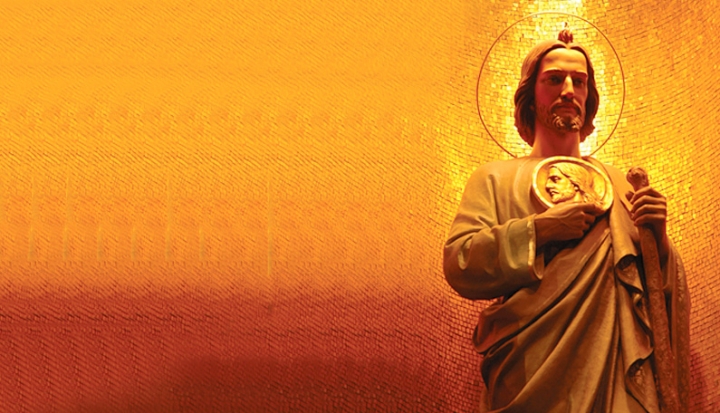
In the late 1980s, when Robert Orsi had just begun his work studying devotion to St. Jude, he had dinner with a prominent liturgist who had spent years promoting liturgical change after Vatican 11.
As Orsi began to describe his research on St. Jude devotees, he noticed the liturgist becoming more and more agitated. “Suddenly he pushed himself back from the table,” writes Orsi, “and said loudly and furiously as he got to his feet something along the lines of ‘You are trying to bring back everything we worked so hard to do away with.’ Then he walked out.”
Orsi would beg to differ. He is most certainly not, he says, trying to bring back the devotions he has spent his life documenting. But, he says, Catholics would do well to examine why almost any mention of these traditions produces such extreme reactions among some. We need a “disciplined attentiveness” to these practices, he insists, “particularly those we find alien or objectionable.”
How did you end up researching the devotional life of American Catholics before Vatican II?
It’s always seemed to me one of the richer moments of American Catholicism. I was drawn to the 1920s, ’30s, and ’40s as a historian, and I have to say I’m fascinated by the saints and the relationships people form with them. From the beginning I wanted to study religion not as it was doctrinally presented but religion as it was lived, the stuff of everyday life.

You go to great pains to say that religion is about relationships, but that in this context “relationship” is not a friendly, fuzzy word.
In communities that practice religion, you have aunts, uncles, fathers, mothers, siblings, but these people very often live in networks that also include sacred figures or demons or ancestors or ghosts or spirits, and people are in very complicated and intense relationships with them.
My grandmother’s favorite saint, for example, was St. Gemma Galgane of Italy. Gemma’s story is a story of pain and suffering and sacrifice. Her intimacy with Jesus is never free of pain and victimization. When I hold this life up in relationship to my grandmother’s life, where also love and pain and victimization were very connected, it seems to me that it wasn’t an accident that this was my grandmother’s favorite saint because their lives so thoroughly resonated with each other. But in many ways this was a tragic intersection. Gemma’s life was not exactly a good model for my grandmother.
There’s a tragedy about religion, I think. We live in a culture in which religion is thought to make life better. But it doesn’t always do that. There’s a realness to life with religion. It doesn’t necessarily make life worse, but it can. And it certainly doesn’t always make life better.
How should we in the 21st century look at the devotional practices of Catholics before Vatican II?
We need a disciplined attentiveness to the practices of people, particularly those practices we find alien or objectionable.
I am always coming up against people who ask me, “Why are you studying these superstitious practices?” Often it’s women’s devotions, by the way, or children’s devotions, that are deemed superstitious. Usually superstition means anything that white men in power do not do.
Let’s take the devotion to the infant of Prague. I mean, to a post-Vatican II Catholic, what is more troubling than a bunch of women sitting in a church basement sewing sequins on a statue’s nightgown? But for the women involved in that devotion it was an important form of friendship. We may not like it. I’m not calling for a return to Infant of Prague devotions. But the challenge is not to be so terrified by the preconciliar past, not to dismiss it and say nothing went on back there. Not to say, “That was the moment of Catholic infancy in America.” What hubris. Let’s pay attention to devotions in a way that withholds judgment and actually asks people, “What were you doing?”
Not long ago I read a new, admirable American Catholic encyclopedia, a great book. Yet in this supposedly authoritative view there is no reference to St. Jude, no reference to Sacred Heart devotions, no reference to rosaries. How could there be an effort to talk about American Catholic life and history with no mention of these devotions?
What are people who try to wipe this out of the Catholic past afraid of?
Before the Second Vatican Council, American Catholicism was a culture with many opportunities to have direct experiences of the holy. Not simply you and the host at Mass, but lots of other opportunities to have powerful encounters with sacred presence. Today sacred presence is not tolerated in the modern world. This is true everywhere modernity has landed. I think that because a certain experience of presence became threatening in the modern world, liberal Catholics thought a firewall had to be drawn against those experiences.
Do you think that fear was completely misplaced? What about excesses, like claiming to see the face of Mother Teresa in a cinnamon roll?
Whether or not they are theologically appropriate is somebody else’s question, it’s not mine. As a historian, I want to know the world in which these things happened, why they happened, and what they meant to the people who were involved.
I’ve been trying to draw this line for 20 years, and sometimes people suspect that I’m speaking out of a certain bad faith. It is true that I find many of the things that I’ve worked on compelling and powerful. It’s also the case that I have been trying to argue for 20 years that whether or not we find these things personally compelling, they are there in the Catholic past and therefore we need to think about them historically and culturally. Even Mother Teresa in a cinnamon roll-I think that’s a phenomenon worth attending to.
If the pre-Vatican II faith was all about presence, what replaced that?
The general trajectory of the modern world is to deny divine presence as a physical reality in the mundane world of everyday life.
Such as saying Jesus didn’t really rise from the dead, but rather the apostles just felt his presence?
Right. I’m not saying, by the way, that presence disappears from the modern world. I personally think that presence endures, that the Catholic imagination is oriented toward it and that it endures. But in the modern world presence becomes an embarrassment.
What do you make of the fact that 30 years later, we’re saying that not enough Catholics believe in the Real Presence in the Eucharist?
The “believing” notion of presence is not a good thing. If I were going to design a religion, I would not want to throw my money on people believing in something. The whole part of my research on growing up Catholic is that Catholic children didn’t “believe in” presence, but rather they were oriented toward the “reality of presence” by everything in their world.
Can you explain that?
If you ask Catholics who grew up before Vatican II about their First Communion, the first thing they remember is being taught never to touch the host. The nuns needed to get home to these children that this is really God. That’s an incredible cognitive task.
How else was presence made real for children back then?
There was a real sense that childrenboth saintly children and children in general-could have direct experiences of sacred presence. Speaking only for myself, I know I certainly was constantly waiting for a miracle.
Here’s a story to illustrate the Catholic imagination in a typical child from the 1950s. I remember once in about fifth grade, in my parish in the Bronx, I was standing in front of a portrait of Pope John XXIII. He may have just died. All of a sudden a red button skidded across the floor. I didn’t know where it came from. I quickly checked out all possibilities. I picked up the red button, and it seemed to me that it looked just like the buttons on the pope’s robe. And I thought, “Aha, could this be it? Is this my moment?”
The point of the story is that I was really prepared emotionally, intellectually, and cognitively to experience a miracle. If a culture prepares children for this experience, they’ll have this experience.
What is at stake for adults in passing on the faith to their children?
The challenge of that century of American Catholicism was breathtaking. You have schools packed with all these kids, you have a relatively small number of teaching sisters, you have an emphasis on presence being really real, and you have to get this through to the kids.
That was a big responsibility. Stand back for a second and think what might have happened if they had not been able to control these kids. Total pandemonium: kids shooting spitballs and misbehaving in church, which would have been very destructive of the realness of the real. So for adults, too, the stakes were high.
The real just doesn’t happen. Whole cultures have to act it out and perform it and engage it, and one of the ways that all cultures do it is in relationships between adults and children. This is one reason why children’s dissent or questions or doubts are so threatening.
How did absence replace the sense of sacred presence?
A modern person goes to an art museum and sees a statue. They look at the statue and admire its form. They don’t think, “I could kiss this statue and this statue will help me in some way because this statue is the real being.” That’s what I mean. The modern world invited us to think about sacred presence and to reframe it in terms of myth and symbol.
Somebody recently found that Catholics in the United States today are thinking in symbolic terms about the Eucharist, using symbolic language. That was not what the nuns were talking about. They weren’t talking symbol, they were talking really real, and to speak of a symbol is a significant shift.
Could the church make these devotions contemporary again?
I’m really not arguing that these devotions should be recovered. What I’m calling for is attentiveness to these practices, even the ones that we find embarrassing. Especially in the context of a modern world that says, “You are an immature, probably socially useless human being if you really believe that Mary appears in little grottos.”
Who says those people are socially useless?
One good example is the “stages of faith” model proposed by James Fowler. There are six stages and ideally you’re supposed to progress from one to the next. In this model, where are people who believe that Mary appears in a grotto? Stage 2.
You have an enormous hierarchy of faith in which the lowest are people who believe in real sacred beings, and the highest are people who appreciate the symbolic, ethical dimensions of religion. Most mid-20th century Catholics would come in at about 2.5. Unitarians would be ranked at about 6.
Does this hierarchy of belief lurk somewhere in the code language of “I’m spiritual but I’m not religious”?
“Religious” is the world I’ve been talking about, in which individuals are formed in particular religions where there are strong authorities-which, by the way, are not uncontested.
When someone says, “I am spiritual but not religious,” it means, “I have freely chosen, I am not shaped by authority. No one tells me what to do. I believe what I want to believe and what seems true to me.” I always tell my students to be most suspicious, most attentive to the presence of authority in those contexts in which everybody assures you there’s no authority or power present. It’s probably in those environments that authority is operating at its most powerful: People actually think they’re doing only what they want to do.
Are you saying that the people who claim to be only spiritual are kidding themselves that they’re not under some authority?
Indeed.
They feel better about it, though.
They do. They’re the ones that operate completely independently, right? And the rest of us can supposedly only admire them.
Why was there no resistance when devotions were closed down almost overnight?
The priests who implemented these reforms were raised in the most intensely clerical culture in the history of American Catholicism. I can’t imagine a priest who had come up in the ’40s and ’50s saying to his parishioners, “We have some decisions to make about our church.”
I can’t tell you the number of stories I’ve collected of people saying, “One day I went to church and the statues were gone.” Even if they hated the reforms, these priests, without talking to anybody, just said, “OK, folks, new world.”
Another example: It was very common at wakes, before the council, to say a rosary. It was a source of tremendous comfort. But I remember showing up at a wake shortly after the changes, and that was it: no more rosary. We were going to have a scripture reading instead. To change a community’s death rituals is a big deal. This needed a certain amount of sensitivity.
I think that period left a scar on American Catholicism. Maybe it will go away over time; maybe in 100 years this will all seem silly and people will forget it, but right now there’s a scar.
Can you imagine another way it could have been done?
Catholics could have said, “We cherish and value our past, but this is not our spirituality anymore and we recognize this. On the other hand, we’re not going to draw a firewall against it. In cases where there are lingering pockets of these devotions, because of age or ethnic culture, we’re going to honor those. We’re going to appreciate the devotions of people at different stages of their lives and we’re going to move toward something else.” But that’s not what happened.
For me the shocking thing is the firewall. I think whenever communities build this firewall against the past, the past can only then come back and haunt them.
This article appeared in the November 2005 issue of U.S. Catholic (Vol. 70, No. 11, page 24-28).
Read more about the enduring practice of devotions to St. Jude.
Image: The National Shrine of St. Jude





Add comment