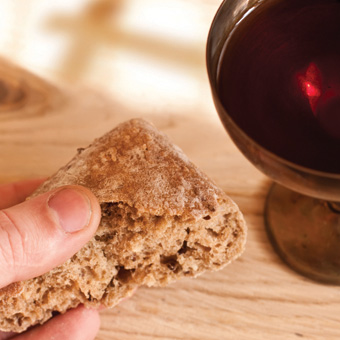
Why isn't transubstantiation in the creed?
When considering the Catholic Church, perhaps nothing stands out so obviously as the Mass.
Eucharist, according to the Second Vatican Council, is both the “source and summit” of Christian life. Using bread and wine, at Mass we celebrate a communal sharing of the true presence of the risen Christ in these elements, which change from bread and wine into this sacrament of Christ. This is known as transubstantiation, a theological term used by Latin (Western) Christians, and it is a central belief of the Roman Catholic Church. So why does the creed make no mention of it?
The creedal formula we normally profess on Sunday is known to theologians as the Nicene-Constantinopolitan Creed, because it is derived from two fourth-century councils. The greater part of this statement of faith is dedicated to the trinitarian nature of God because this was the raging debate of the day.
At this time the eucharistic presence of Christ was not a source of contention. Several centuries were needed before the church would ask whether this presence could be seen with the eyes in our head or only with the eyes of faith.
Although belief in Christ’s presence was an ancient doctrine, the particular terminology of transubstantiation had not yet been created. Early creedal debates took place in Greek and were centered mostly in the East while the later debates over the Eucharist occurred in Latin and took place in the West.
It was not until the Fourth Lateran Council in 1215 that the Roman church adopted “transubstantiation.” Even still, Eastern Christians do not use the term (though they share in belief that the eucharistic elements change to become the sacrament of Christ’s body and blood during the Mass). Transubstantiation was re-emphasized by the Council of Trent in the 16th century, but the council said it was doing so without prejudice to the theology of the East. Likewise, since both Eastern and Western Christians have the creed in common, to unilaterally change it to include transubstantiation would threaten an important bond between the two.
As with all human language, there are limits to how well the word describes the transcendent reality to which it refers. For example, the term substance suggests something physical, leading to the regrettable idea that bread and wine are changed into the physical body and blood of Christ. This is a misrepresentation. Real is not the same as physical.
In his book on the Eucharist Pope Benedict XVI reminds us that there is more to reality than the physical. “What has always mattered to the church,” he insists, “is that a real transformation takes place. . . . There is something new there that was not before.”
By John Switzer, assistant professor of theology at Spring Hill College in Mobile, Alabama.
This article appeared in the August 2011 issue of U.S. Catholic (Vol. 76., No. 8, page 46).
God is in control
By Michael McCormick (not verified) on Wednesday, July 27, 2011No wonder so many people want nothing to do with church. God's will is at work here. Our God is not limited to your understanding or mine of how he can express himself to us. My God is patient and kind but ever present. One man may recognize God's presence in his life. While another's understanding of the same event may be drastically different, yet no less God. There is a spiritual change in the room, in the community and in me at communion. The Eucharist, for me contains the presence of God. Does it matter if the experience for an individual is understood as a spiritual presence of God or a physical presence of God? Regardless of that understanding, God is still in control not any of us.
Reply to Michael McCormick
By Bad Meets Evil (not verified) on Monday, August 8, 2011I haven't been on here in awhile, and just read the above comment from Mr. McCormick.
His intentions may be good, and his comment may sound good at first read.
But here is what we have to consider... If God Himself has revealed to us that the Eucharist is truly His Flesh and Blood, doesn't that mean that He wanted us to acknowledge this fact ?
Isn't what Mr. McCormick is saying sort of like saying God is patient: for one man the Bible may be God's book, for another the Koran may be His book, for another the Bhagavad Gita may be His book? It doesn't really matter... as long as a spiritual awakening takes place in the individual?
Or, isn't it like saying: Does it really matter whether or not Christ is God's Son? For one individual, Jesus is the Second Person of the Trinity... for another, Jesus is a nice man who called Himself "Son" figuratively in a way to apply equally to all of us.... it doesn't really matter, as long as we love Jesus?
This kind of thinking places the subjective and the individual conscience/mind above the objective and God's will.
God is in control, yes. He revealed the truth of transubstantiation to us, via Scripture, as well as via the repeated and infallible teaching of the Magisterium of His Holy Church.
The Council of Trent's teaching about the change in the physical substance is infallible, true, and applies to all Catholics. There is no way around it.
And why does transubstantiation really matter?
By Bad Meets Evil (not verified) on Monday, August 8, 2011Please understand, this is not about technical words and unimportant technical details .... this is at the heart of our Faith. Why?
If the substance changes, you no longer have bread and wine. You have Jesus Christ Himself physically present. Therefore, the Blessed Sacrament (Jesus) is to be worshipped in the exact same way in our churches as the 3 wise men worshipped Him in Bethelehem. The Eucharist is completely Our Lord Jesus Christ Himself, and is to be loved, adored, and worshipped accordingly.
But if the Eucharist is somehow only half-Jesus (consubstantiation), or if it is only a symbolic presence... this vagues and lowers down the intensity of the real God-given miracle that takes place at Mass and that remains after Mass... and it would only fit that less worship, less adoration, less love would be shown to such a non-substantial presence. We are left with warm community fuzzies and spiritual transformations... things that are surely important, but incomplete, and a denial of the great act of love that Jesus gives us via the Blessed Sacrament until the end of time.
Real Presence
By Fr. Michel Holland, OSB (not verified) on Wednesday, July 27, 2011Many thanks to Mr. Switzer for his edifying clarifications on what happens during Mass. As evidenced by the tenor of many uninformed conservative Catholics, the real work of Vatican II--the education of the People of God--has yet to be achieved. We are in a situation where we have Catholic fundamentalists on one side and the 19 to 29 year olds who believe that the Church by and large has nothing to offer them but the same old theology from within a worldview that no longer exists.
As a Catholic priest who believes with his whole heart in the miraculous Presence of Jesus in the Eucharist but who does not subscribe to the transubstantiation theory (any more than I accept any other of Aristotle's suppostions) I would hope that the Catholic Church would begin to crack open the wise teachings of Vatican II and reverse the course the institution is now taking. The Church has room for more than one interpretation, as evidenced in the centuries prior to Boniface VIII.
I'm sorry Father Holland...
By Bad Meets Evil (not verified) on Wednesday, July 27, 2011... but you are no longer a Catholic.
I love you, I pray for you, and I don't judge you. You may be a saint in your heart.
But, you are objectively wrong. Your bishop or superior, if he is truly Catholic, should silence you immediately and remove you from active ministry.
Your masses may not even be valid if you don't have the intention to do what the Church does.
Transubstantiation is not a theory.
It is a dogma. It must be accepted. It has been officially taught by the Church's most solemn form of the Magisterium repeatedly. It is a matter of faith (not one of discipline) and the Council of Trent taught:
"And because that Christ, our Redeemer, declared that which He offered under the species of bread to be truly His own body, therefore has it ever been a firm belief in the Church of God, and this holy Synod doth now declare it anew, that, by the consecration of the bread and of the wine, a conversion is made of the whole substance of the bread into the substance of the body of Christ our Lord, and of the whole substance of the wine into the substance of His blood; which conversion is, by the holy Catholic Church, suitably and properly called Transubstantiation."
And Jesus said: "[56] For my flesh is meat indeed: and my blood is drink indeed. [57] He that eateth my flesh, and drinketh my blood, abideth in me, and I in him. [58] As the living Father hath sent me, and I live by the Father; so he that eateth me, the same also shall live by me."
This is why I couldn't be a part of any of my local parishes, even if the New Mass is valid, even if Benedict is a valid pope (I'm not sure of either)... I can't trust the priests to actually believe what the Council of Trent taught infallibly about a matter of faith.
What Catholics believe:
By Bad Meets Evil (not verified) on Wednesday, July 27, 2011From the Council of Trent
CANON I.-If any one denieth, that, in the sacrament of the most holy Eucharist, are contained truly, really, and substantially, the body and blood together with the soul and divinity of our Lord Jesus Christ, and consequently the whole Christ; but saith that He is only therein as in a sign, or in figure, or virtue; let him be anathema.
CANON lI.-If any one saith, that, in the sacred and holy sacrament of the Eucharist, the substance of the bread and wine remains conjointly with the body and blood of our Lord Jesus Christ, and denieth that wonderful and singular conversion of the whole substance of the bread into the Body, and of the whole substance of the wine into the Blood-the species Only of the bread and wine remaining-which conversion indeed the Catholic Church most aptly calls Transubstantiation; let him be anathema.
CANON IV.-If any one saith, that, after the consecration is completed, the body and blood of our Lord Jesus Christ are not in the admirable sacrament of the Eucharist, but (are there) only during the use, whilst it is being taken, and not either before or after; and that, in the hosts, or consecrated particles, which are reserved or which remain after communion, the true Body of the Lord remaineth not; let him be anathema.
CANON VI.-If any one saith, that, in the holy sacrament of the Eucharist, Christ, the only-begotten Son of God, is not to be adored with the worship, even external of latria; and is, consequently, neither to be venerated with a special festive solemnity, nor to be solemnly borne about in processions, according to the laudable and universal rite and custom of holy church; or, is not to be proposed publicly to the people to be adored, and that the adorers thereof are idolators; let him be anathema.
Johnny, Johnny, Johnny.
By Anonymous (not verified) on Thursday, July 21, 2011I once knew a John Switzer. He owned a tractor dealership. But I'm pretty sure you're not him.
That being said, where indeed did you get your misinformation regarding the Real Presence of Christ in the Eucharist?! Hopefully, you didn't attend classes at one of the many heterodoxical institutions we've had to suffer with in this country for the last few decades.
What makes it worse is that you claim to be teaching others this heterodoxy at a Catholic college! I looked it up and I think I understand. Spring Hill College has Jesuit roots. Jesuits used to be the "Marines" of the Church. You'd send 'em in to Catholicize an area. Now, with some notable exceptions, they are, for the most part, a troubled group.
Into the physical body and blood of Christ
By Bad Meets Evil (not verified) on Thursday, July 21, 2011Like "Adeodatus" above, I was alarmed at reading the following sentence that Mr. Switzer wrote:
"For example, the term substance suggests something physical, leading to the regrettable idea that bread and wine are changed into the physical body and blood of Christ."
In fact, the physical substance of the bread and wine *do* change. This is a part of the great miracle that occurs at each Mass.
The physical substance is in fact, after the Consecration occurs, the physical body and blood of Christ. The appearance and other "accidents" of bread and wine do remain, but in fact that which one eats, drinks, touches are no longer bread nor wine in any sense of the word.
(Some special Eucharistic miracles have occurred where the accidents no longer remained... and the Eucharistic host actually appeared as actual flesh, the contents of the chalice as actual blood, to the human eye.)
Mr. Switzer is correct that "real" can mean more than the "physical." Angels are "real" but they have no physical bodies. However, the Real Presence does in fact include the physical.
If Ratzinger-Benedict does not assent to this (I hope and pray this is not the case), then he is unfortunately a heretic and would not be a valid pope. Already, some of his possibly Modernist and pseudo-Teilhardian "cosmic" quotes make him suspect, to say the least. Are these writings and speeches of Benedict's really as philosophically "deep" as they appear... or are they just more Modernist mumbo-jumbo that defy linear reasoning?
REAL, PHYSICAL
By Adeodatus (not verified) on Thursday, July 21, 2011"Body, Blood, Soul and Divinity of Christ"
"[T]he regrettable idea that bread and wine are changed into the physical body and blood of Christ. This is a misrepresentation."
Your theology about the Eucharist is all wrong. Yes, the physical bread and wine become (though our physical eyes decieve us) the Body, Blood, Soul and Divinity of Jesus Chris, Our Lord. The substance of the real, physical bread and wine changes. I honestly don't understand how the editors at a "catholic" publication let your article slip through the cracks.
If you don't believe me, read:
The Catechism of the Catholic Church
United States Catholic Catechism for Adults
or
Blessings.
U.S. Catholic insists on a civil and respectful dialogue on our website, following our Comment policy. Comments should be charitable, on topic, and brief. U.S. Catholic reserves the right to delete comments deemed inappropriate. Links are not allowed and comments with them will be moderated or deleted. We encourage you to choose your words wisely.