

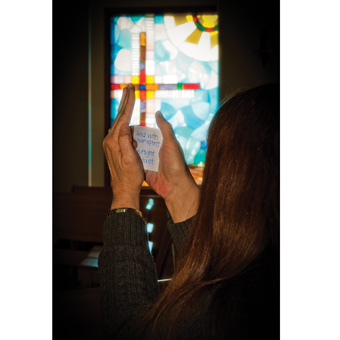
It’s dress rehearsal time as parishes prepare for the new Mass.
It was last Advent season when Andy Hentz first heard his pastor talk about the new Latin-to-English translations coming to the Mass. But it wasn’t until Hentz, a mail carrier who reads Catholic magazines and listens to Catholic radio, read excerpts of the new texts on the Internet earlier this year that he realized how dramatic the changes will be.
The 33-year-old married father of three says his parish, St. Elizabeth Catholic Church, has not yet done much to prepare parishioners for what is coming. When the new texts are implemented across the nation this fall, Hentz thinks some Catholics could be caught off guard.
“I haven’t heard much about this, considering it’s going to change the central thing that we do as Catholics,” says Hentz of Granite City, Illinois, a St. Louis suburb. “That’s kind of surprising.”
Diocesan and parish officials across the country say they have worked hard to make sure that won’t be the case when the new translations are introduced at Mass on November 27, the first Sunday of Advent. Last year the U.S. Conference of Catholic Bishops presented the new texts at 22 regional workshops for diocesan and parish leaders. More than 4,200 people participated from all but six dioceses, says Father Richard Hilgartner, associate director of the USCCB’s Secretariat for Divine Worship. Many dioceses that weren’t home sites sent teams of priests, who would return home and lead training sessions in their parishes.

The church has more than ignorance to overcome. Critics charge that the new texts clash too awkwardly with English, and they resent the “top-down” way in which they are coming to American parishes from Rome.
“Many people will at first be concerned about making changes to prayers and responses we know by heart, but the hope is that the new texts will be helpful in leading to a deeper understanding of what we celebrate in the liturgy,” Hilgartner says. “Parishes are being encouraged to plan for catechesis about not only the changes in the texts but the bigger picture—the nature and meaning of the Mass—as well.”
Ready or not
Father Paul Turner, pastor of St. Munchin Parish in Cameron, Missouri, has been giving presentations to a few dozen dioceses in the United States, Canada, New Zealand, and Australia. He will go to England and Scotland later this year.
“I’ve been trying to respond to requests from dioceses intermittently over the past couple of years, and there is more intense interest now,” Turner says. “I think it’s going well, but I’m finding what you would expect. Some priests are very hesitant about the changes coming, and some are very excited about it.”
Turner says some dioceses have done “quite a lot” to prepare; others have done “quite little by comparison.”
The Archdiocese of Dubuque, Iowa hopes a gradual approach will have its faithful ready by late November. Starting in February it began publishing one-paragraph installments in the Sunday bulletin, describing the reason for the changes and including short excerpts, says Peggy Lovrien, director of Dubuque’s Office of Worship.
The first 15-part series covered the introduction to the Mass and the liturgy of the word. This fall a second 15-part series will focus on the liturgy of the Eucharist and the dismissal.
In February the archdiocese also gathered more than 200 musicians to practice singing the new translations and some new music proposed by Catholic publishers. Early this fall Dubuque plans to reconvene the group.
Lovrien says she has enjoyed working with the musicians. “Through all of this I’m real impressed with the deep love of the church that people have,” she says.
She is not worried that many Catholics will be caught off guard come Advent. “Nothing is perfect in terms of communications,” she notes. “The church, from Rome to the Sunday liturgy in parishes, has been communicating over and over that these changes are coming. If there are those who are surprised by it, I think the numbers will be small.”
Turner says it’s hard to say whether he’s comfortable with the level of preparation thus far. “It’s like asking me as a pastor if I’m comfortable with the level of preparation an engaged couple has received so far before marrying,” he says. “You can never have too much.”
Great divide
Turner has no doubt that the new texts will be implemented on schedule, but some critics say the change will be so unpopular, it should not be forced on Catholics all at once. Father Michael G. Ryan, pastor at St. James Cathedral in Seattle, last year proposed a pilot project “What If We Just Said Wait?” in which the new texts would be introduced in some carefully selected parishes throughout the English-speaking world to be evaluated after a year. Ryan has since discontinued the campaign.
“There is no chance that will happen,” Turner says. “It’s impractical. What would you do [at such a pilot parish] for weddings and funerals when you have a large number of people who have not had the catechesis? And what would you do at the end of that year, go back to the original texts?”
While he disagrees with the critics, Turner likes their passion for the issue. “It’s a sign of how deeply people care about the Eucharist. Behind that is a desire that the people’s voice be heard in some way. It’s a good desire. These changes are going to affect every Catholic in the pews.”
Alexandra Besore, a 25-year-old singer and actress in Los Angeles who attends Mass daily, is among those who are excited about the changes. She says she has grown increasingly frustrated with how area churches have become too “modernized and Protestantized,” citing more tolerance for homosexuality and contraception.
Besore doesn’t necessarily want to revert to an all-Latin Mass but says she is “thrilled” that the “fabulous” new translations will bring a more literal translation of the Mass from the original Latin and a step toward the traditional.
“The closer you get to the original, the closer you get to when Christ was on the Earth, so any move in that direction is a positive thing,” Besore says.
Father Anthony Ruff, a Benedictine priest and nationally known liturgist, says he typically shares Besore’s conservative approach, but he could not disagree more with her support for the new translations. Ruff teaches liturgy and Gregorian chant at St. John’s University in Collegeville, Minnesota. He calls the new texts a “train wreck.”
“They are going to alienate people and be divisive,” Ruff says. “Priests weren’t asking for this, they weren’t consulted, and their viewpoints have been ignored. The vast majority of liturgical and musical directors are against this change and are dreading it. They are doing it against their will, but they’re trying to make the best of it.”
Ruff says he has sympathy for the goal of creating texts that are more faithful to the Latin. But he says the new translation guidelines issued in the 2001 document Liturgiam authenticam, will never produce “good English.”
Hentz, the mail carrier, agrees. Hentz’ favorite part of the Mass always has been at the end of the eucharistic prayer when the priest says, “through him, with him, in him, in the unity of the Holy Spirit . . .” In the new translation, that part will be changed to, “through him, and with him, and in him . . .” It might sound like a minute change, but Hentz says it’s the one he’ll have the most difficulty with.
“The Trinity to me is very present there,” he says. “Christ is in the Eucharist, brought there through the Holy Spirit, offered in sacrifice to the Father. [The ‘ands’] kind of break up that connection in my head.”
Another change that struck him as odd is saying “and with your spirit” instead of “and also with you,” in response to the priest’s, “The Lord be with you.”
“My wife was saying, [‘and also with you’] is just kind of a part of our culture. ‘And with your spirit’ seems strange. It’s not the way we talk in our everyday language. But I also see that there’s a different meaning there, and I guess they’re trying to illuminate that.”
The new texts are “overreacting to our current texts, which are too loose and unfaithful,” Ruff says, “but [they] twist the Engish language to fit Latin grammar and word order, and that will not give you good, poetic English, which we need in the liturgy.”
Ruff is urging opponents of the new translations to “make our voices be heard from now until Advent.”
“It’s a long shot . . . but it still will send the right kind of signal for the future, and it will make it clear to the Roman authorities that we need better guidelines and a better process.”
Ruff has felt ramifications from speaking out against the texts, he says. In November he was terminated from the International Commission on English in the Liturgy (ICEL), for which he had chaired a committee that set all of the music for the new texts in the new Roman Missal.
“I know Rome has read my blog. That’s why I was terminated. ICEL told me Rome did not want anyone critical of Rome involved in the work,” Ruff says. “It’s sad that this is the way our church operates. I don’t feel that bad for myself. I’m glad I was a part of this important work. I’m not hurting at all. I’ve moved beyond that to [see] how can I help the church reform itself.”
Change will do you good
Ken Canedo, composer in residence at Holy Trinity Catholic Church in Beaverton, Oregon, and a widely published liturgical music composer, has traveled the country giving presentations on the new texts.
“People have been very receptive. There always are some pockets of resistance. People don’t like change, of course. It’s human nature, especially with something as intimate as the Mass.”
There is a lot of misunderstanding about the new translation, Canedo says, especially if people are getting their information only from news sound bites, rumors, and blogs.
“Catholics need to receive information about their sacred liturgy from authoritative church sources,” Canedo says. “We also need to appreciate that the Mass has a resonance that goes beyond only what we remember of it from our own lifetime.”
Canedo says he has been able to diffuse some of the controversy by putting the changes in historical context. “What I try to do in my workshops is to quote church sources: Liturgiam authenticam and the United States Catholic bishops,” Canedo says. “I also give people a brief history of the Mass from the Council of Trent in 1545, onward through the Second Vatican Council, and up to our day. There were a lot of changes in the liturgy during that long period of time, and knowledge of that helps people to view the upcoming changes in a better light.”
Even those opposed to the changes have told him how an understanding of the history of the Mass has helped them to be more open.
Views from the pews
One person who has enjoyed learning from Canedo is Betty Drilling, a Holy Trinity parishioner. Drilling sings in the choir that Canedo leads.
Drilling says she first read about the changes in the parish bulletin and was struck by how familiar they were. “When I read them, I said to my husband, ‘I don’t know what the big deal is. I remember this,’ ” Drilling recalls.
Drilling, 71, still clearly remembers when the Mass was said in Latin, before the Second Vatican Council, which was implemented in 1970.
In January her parish discussed the new texts at a conference attended by about 200 people, including representatives of the parish’s eucharistic, homebound, greeters, and choir ministries.
“Ken spoke for an hour and 15 minutes, he explained things, and we had question-and-answer time,” she says. The participants then broke into discussion groups and shared their thoughts and feelings about the new texts.
Drilling says she was concerned that the more traditional language would be accompanied by a return to the pre-Vatican II emphasis on kneeling in the pew, something her knees can’t handle. She also wanted to know whether people will still shake hands while sharing the sign of peace and hold hands while praying the Our Father. “Those are things that bring fellowship, even among those people who are new to our parish. My concerns were allayed because none of these things will change.”
“It’s the priest who has to learn so many different things. I don’t understand why people are so upset. It’s going back to what our Bible says and going back to our history. It’s not an awful lot of change.”
Larry Merkel couldn’t disagree more. “I don’t see the point in doing it,” says Merkel, a 43-year-old married father of three, whose family attends Mass each Sunday at St. John Neumann Church in Austin, Texas. “The new translations seem kind of stilted. The ones we have been using have a nice flow to them. They kind of go along in a melodious way, but these don’t seem to do that.”
Merkel, a patent agent, compares the new texts to patent applications that have been translated word-for-word from Japanese or Chinese to English. They are difficult to understand, he says. It is much easier to read applications that have been translated by consultants who account for the nuances of both languages.
“When they’ve been reflowed a bit, they don’t change the meaning; they’ve just been massaged a little bit, and they read much more smoothly.”
Merkel says he probably will quietly say the current responses even after the new texts are implemented but will encourage his children—ages 13, 11, and 8—to make their own decision. He has yet to hear his pastor say anything to prepare people for the changes.
Hentz finds himself somewhere in between the enthusiastic and the oppositional. “It will take some getting used to, but I guess they’re doing it to stay true to the original Latin to make the meaning a little deeper, maybe. I guess that’s a good thing.”
This article appeared in the May 2011 issue of U.S. Catholic (Vol. 76, No. 5, pages 12-17).
Image: Tom Wright


Add comment