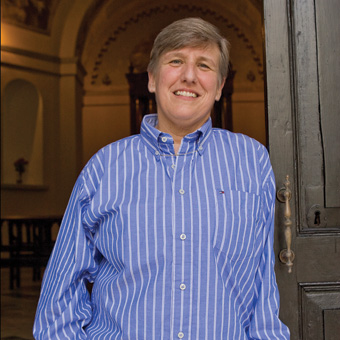
Who’s the norm, and who’s the diversity? So wonders this Latina theologian, who suggests that tensions in a parish may not be such bad thing after all.
Asked to introduce herself at a Hispanic ministry meeting a few years ago, Carmen Nanko-Fernández gave her name and then added, tongue firmly planted in cheek, “I’m a theologian, and my preferred theological method is pastoral hostility.”
It was mixed company, Nanko-Fernández recalls. “The folks who were not Latinos started to laugh. The Latinos didn’t laugh. They came up to me later and asked me, ‘Can you explain more about this hostilidad pastoral?’ ” They immediately appropriated it into Spanish and adopted it as “the oxymoron that best suited the reality of our ministries,” she says.
While obviously called to pastoral care, Nanko-Fernández says those who minister in the church today find that “our ability to care may at times be compromised by frustration, loss, fear, and even anger.” Faced with societal issues such as injustice, discrimination, and cycles of poverty and violence, and church problems such as parish closings, resource cutbacks, and abuse scandals, pastoral workers face an uphill struggle that can seem overwhelming. So she calls for pastoral “hostility” as a way to recover the prophetic role of naming and fighting injustice.
Nanko-Fernández describes the growing body of U.S. teologías latinas as “theologies dreamed in Spanish, articulated in English, and lived in Spanglish.” In her own theological work, she places great emphasis on taking daily lived experience—lo cotidiano—more seriously.
You’ve been concerned about the way the Catholic Church defines and deals with diversity. What’s wrong with it?
I’m always intrigued that we want to start things with unity because there’s somehow an impression that if there’s not unity, then there must be division. Being a “hybrid” causes me to look first not at unity but at points of intersection.
Properly understood, diversity is the condition of the United States, it’s the condition of the church, it’s the condition of creation.
There are two common approaches to diversity. In the first approach people highlight differences, but the critique is that we never get to a point of understanding.
The other one starts with commonality, but my fear is that, especially in our churches, it’s usually a synonym for assimilation to what is seen as “normal.” In that approach diversity is used to describe those who are different from an unspoken normative understanding of the church. So then the question becomes: Who’s the norm, and who’s the diversity?
You could ask: If Latino/as today are already the largest population in the U.S. Catholic Church, the “big dog” in the house, how come we aren’t considered the norm in the church today? Why isn’t everybody else coming along and doing things latinamente (in a Latino/a way)?
But as in the recent restructuring of the bishops’ conference, diversity tends to get used to lump together the ever-increasing presence of so-called minorities and immigrant populations. In that approach the differences of generations of immigrants from across Europe—with their own linguistic, cultural, economic, and ethnic particularities—are homogenized and seen as the norm, while the African American, Hispanic, and Native American communities, who actually predate the majority of the European presence in the United States, are categorized as the “new” diverse face of the church.
How would you define and approach diversity instead?
I prefer to approach diversity from what some have called our “multiple belongings.” In Latino/a theologies that has often been expressed by the term mestizaje. I prefer terms like hybridity. We look at our diversity as these points of intersection that we then need to navigate and negotiate.
Truth be told, that navigation and negotiation is often tense and involves misunderstandings. Sometimes we end up doing things that could be culturally offensive because we didn’t know. But part of coming to a truer unity is being able to humanly deal with those tensions, negotiate and navigate, and apologize when we need to.
One place where that negotiation and navigation occurs and often leads to tension and conflict is in parishes. What feeds those tensions?
I think it is often fear that sparks tension—fear of someone we don’t know, which happens on both sides. Then there is often a good deal of stereotyping and ignorance about each other. In the United States sometimes it’s the notion that “my people” had to lose their language and had to assimilate, so now it’s “your people’s” turn.
In the parish in the Bronx where I grew up it was actually the reverse from how it usually happens. Our parish had been predominantly Italian, and the fights were between the Italian majority and the minority of English-speaking Irish Catholics. Still the fight was a familiar one over resources: Who celebrates Mass in the church, and who is put in the basement?
Sometimes it’s a fight over time—a misunderstanding of how other people see time. In some parishes Mass is built around parking lot times. There’s a reason that the Mass has to be out by no later than 11:30 because we have a big group coming in for the next Mass.
That makes sense, but the Koreans, the Latinos, or the Poles will linger because they want to talk. After Mass is their catch-up time, and church is the social space for that.
So the older English-speaking community is accusing the Polish community of being insensitive to the fact that the next Mass is starting, and the Polish community is accusing the English-speaking community of not caring about the relationships that are also part of being a community.
What might parishes gain if they work through rather than avoid these kinds of conflicts?
Tensions make us nervous because we don’t really want to think that we don’t like each other. It takes time and space and getting to know each other. We Americans like things fixed, and we like to move on and all be together, whether it’s under one flag or one church.
Maybe the value of tensions is that they cause us to pay attention to our relationships. They can slow us down and help us to find ways to talk with each other and be with each other.
But if we work through them, we’ll be able to go beyond the usual approach that says, let’s all bring our ethnic food, let’s all wear our costumes and celebrate. “Oh, I love that bread,” and “That’s a lovely dress. Can you dance in it?” Too often that’s all that’s happening—a greeting-card ecclesiology where we all get our turn to be appreciated and happy. I appreciate you, you appreciate me. Is our heritage month over yet? OK, time to move on.
Hispanic ministry has been recovering popular devotions. What’s their significance for you?
My favorite recent Chicago story is “Our Lady of the Underpass,” where people saw an apparition of Mary in the stains on the walls of an expressway underpass. Some people laughed at that, but I found it a fascinating expression that God is with us.
What was fascinating was that it pulled two very different communities together. If you went to the Fullerton underpass, you found a shrine with candles, flowers, pictures, and prayers that was, and still is, well kept. And you found two flags: Mexico and Poland. The shrine was kept by Mexican and Polish immigrants.
So what was going on in those two communities at that time? Pope John Paul II was dying, and the Polish community went through this enormous heartbreak. And there also was a crackdown by the immigration authorities in immigrant neighborhoods that hit Poles and Mexicans very hard.
So as life’s anxieties were getting to them, suddenly something appeared that told people that God is with us right here at the side of the road.
What that tells me is that maybe we’ve sanitized too much at church. Maybe we don’t pay enough attention to the affective part of our faith that popular devotions reflect. Maybe there’s an accompaniment aspect to devotions that we are not experiencing as viscerally at church as we should.
The flip side is that it’s also challenging because if you read the notes and prayer requests on that wall, they say, “Please help me get through my immigration issue,” and “Please help me with the illness of my child.” Who’s that written to? It’s addressed to Mary and to God, but it’s also a challenge to the community. It involves a God who pays attention to our needs.
As opposed to a God who . . .
A God who can be distant, a God that’s only accessible through interpreted texts from an authority figure. I think it’s a way of respecting the wisdom of a barrio church, or church of the streets.
To me the challenge is, if I see that as a sign that God is present, then how does that influence my daily life? If I come home and kick you, turn you in to immigration, or exploit you on the job, then we have a problem. But if God’s presence sends me into a better relationship, makes me live more justly and caring, then this is a good thing.
It’s always been a part of the richness of our Catholic tradition that to us the sources of revelation are not restricted or limited, that God can speak to us in many encounters.
One of the greatest challenges for Latino Catholics today is their underrepresentation in the leadership of the Catholic Church. What’s at issue?
That’s a very painful issue. Today Latinos are a plurality of the U.S. Catholic Church, but the numbers of U.S.-born Latino clergy are very, very low. Most of the clergy in Latino parishes are either from Latin America or Spanish-speaking non-Hispanics. That doesn’t mean that those priests don’t do a good job, but there’s an added difficulty for them of ministering in an unfamiliar context.
That scarcity of U.S.-born Latino priests is compounded further by the lack of Latino/a teachers and theologians who are training folks for ministry. Part of the problem is the overall low percentage of Latino/as graduating from college. Depending on what numbers you read, it’s anywhere from 9 to 16 percent, which is inadequate.
If you look at theological education in the United States today, only three percent of seminarians and theology students are Hispanic. So who is doing theological reflections from a U.S. Hispanic perspective and context? It’s not coming from within the community, at least not in sufficient numbers. We need many more Latino/a theologians who are embedded in their community and can accompany it.
But despite our relatively low numbers, over the past 30 years or so there has been the development of a body of Latino/a scholarship in the United States that unfortunately is frequently overlooked. It comes up against the stereotype that we Hispanic Catholics in the United States have our fiestas, we sing, we dance, we wear serapes, but we’re not really that smart. Oh, great lovers, great singers, yes, but not smart.
Is there a power and resource issue involved here as well?
Yes, one of the realities is that the majority of our ministers who are Latino/a are volunteers. They’re not getting paid, which raises a whole justice issue in the church as well. And because of that reality the majority can’t get into programs to acquire the educational level that they need in order to hold leadership positions. And I don’t mean leadership positions just in Hispanic ministry either. There is a scarcity of Latino/as at all levels of leadership in the U.S. Catholic Church.
That reality also puts a lot of pressure on the few of us who are in positions of leadership or responsibility in the church. The danger is that we either burn out or that we become delusional messiahs. We delude ourselves into thinking we are spokespersons for our community. What we wind up having to do is become a mentoring generation to encourage younger folks to follow through and overcome the hurdles they face in their education.
You’re a big proponent of taking daily lived experiences more seriously. What in your own life has shaped how you see and live your faith and your theology today?
I would think first of how the migrations on both sides of my family’s story have influenced me: my father’s Eastern European and my mom’s Spanish roots. That’s how I’ve come to use migrations as a lens for viewing not just Latino communities but also the overall story of the United States.
The second influence would be languages. My first language was Spanish because we lived in my grandmother’s house when I was little, and she only spoke Spanish. But after my grandmother died and I went to school, the educational expectations of the day took Spanish away. I was told if I wanted to get a good education and go to college, I should learn French instead. For me language has been about trying to sort through how I fit in—with the languages of my family and the communities. That’s why I like to play with language and enjoy using Spanglish.
And then there is the importance of education. I’m a product of a really good, solid Catholic education both at Santa Maria Grade School and Cardinal Spellman High School in the Bronx—the same school that Supreme Court Justice Sonia Sotomayor graduated from. My parents sacrificed to send me to those schools, and it was there that I got a good start in theology.
I wound up teaching in high schools, and my commitment to education and to young people is fueled by that. The communities of kids that I was privileged to accompany as a theology teacher and a campus minister in high schools for 18 years have shaped me, and they continue to drive my concerns and commitments.
In your book you use and highlight Spanglish as a sign and an expression of “hybridity.” Why is that important to you?
The temptation is to see people and communities in a bipolar way: You’re English-speaking and you’re Spanish-speaking; you’re Cuban and you’re American. The hyphen has become the symbol that you can be one and both at the same time.
But the high school kids I’ve been around as well as my own experience defy that both/and. We’re actually more mixed up in a lot of ways. One way that has become evident to me has been in language.
We forget how much we borrow from other places or languages, so that it is silly to try to enforce “English only” policies. You’d have to say, “Really? How many words are you willing to sacrifice from your vocabulary today?”
When you listen to conversations among Hispanic youth, in the same sentences the languages are flying, there are borrowed words, made-up words, a playfulness to describe something that Spanish doesn’t quite say and English doesn’t quite say. You see a lot of it in cyber-Spanglish and popular culture, for example in baseball or music.
What kind of connections do you make between popular culture and Catholic faith?
I don’t see popular culture as a scapegoat or as a foil that you’re putting faith up against. And I don’t see it as just “illustrating” an aspect of faith, although that’s a popular teaching technique with music or movies. I think each of these expressions should be allowed to stand on its own and provide its own insights and wisdom.
When I look at baseball latinamente, I can see it as a site of resistance, a place of racial contestations. It’s also a story of migrations, a story of “alternately documented” workers, and a story of socioeconomic injustices. It can become an entry into talking about social justice.
So for me looking at baseball can be a theological move without having to say: This relates to Catholic faith because God is like Joe Torre, etc. It’s more complicated than that.
I think we compartmentalize our lives too much. I use baseball as a source in my theology because it was a source of my pleasure growing up. In fact, as a young girl one of my big career goals was to become a catcher for the New York Yankees.
So when I bring baseball or popular culture into the way I do theology, part of it is just calling attention to the different things that are sources for our theologies and our faith lives. We should not limit what is worthy of faith reflection to overt expressions of religious devotion. We need to be open to other revelatory experiences both in our own lives and in our communities.
This article appeared in the March 2011 issue of U.S. Catholic (Vol. 76, No. 3, pages. 18-21).