
America the anxious
Only our better angels can guide us to interreligious understanding.
American politics always seems to turn on the next "threat" to our security, especially in an election year. Warnings about hordes of brown-skinned Spanish-speaking "illegals" had kept the nation on high alert through most of 2010, but as elections drew near and pundits and politicians saw demonizing immigrants as a loser among Hispanic voters, the search was on for a new bogeyman.
Enter the Rev. Terry Jones, a Gainesville, Florida pastor of 50 souls, who took the national stage by threatening to burn a stack of Qur'ans on the anniversary of 9/11. As the date neared, God (speaking through a local Florida imam) convinced Jones his plan was a really bad idea, to general relief.
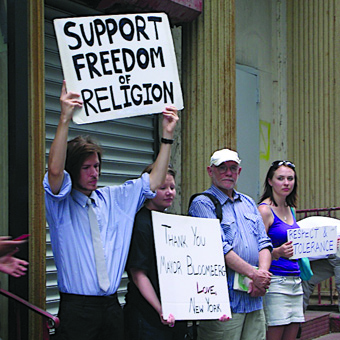
Fueling the Jones affair was the case of Park51, a Muslim community center in Lower Manhattan two blocks from the site of the 9/11 attacks. Dubbed the "Ground Zero Mosque" by some master of incendiary propaganda, this Muslim equivalent of a YMCA sparked outrage among some who found it disrespectful that a Muslim prayer room should be so close to the site of an attack by Muslim extremists (whose victims included Muslims). Though Imam Feisal Abdul Rauf proposed Park51 as a place of dialogue, the site instead became a venue for dueling protests warning of the "Islamization" of America or extolling religious freedom.
The trouble around Park51, though unique because of its location, is hardly rare. About half of Americans polled would not want a mosque in their neighborhood; two sites in Tennessee were even vandalized. The whisper campaign alleging that President Obama is a Muslim, now believed by 20 percent of Americans according to some polls, could only take root in a climate of fear and prejudice.

Catholic leaders were outspoken regarding Jones' plan. Bishop Joseph Latino of Jackson, Mississippi called the plan to burn the Qur'an "an affront to all people of faith, and to society as a whole." The response to the more complex Park51 case has been less straightforward, with New York Archbishop Timothy Dolan declining to stake out a position in the hope of mediating the dispute.
But Catholics must not leave it to their leaders alone to negotiate this most important interreligious relationship of our generation, and our own history as victims of similar prejudice is worth remembering. The 19th-century politics of the nativist movement warned of a Catholic immigrant menace that would claim America for the pope-hysteria that resulted in the 1834 burning of an Ursuline convent outside Boston. New York Gov. Al Smith's 1928 run for president was largely derailed by his Catholicism. The only Catholic to win that office, John F. Kennedy, had to distance his faith from his politics to such a degree that many would find him insufficiently Catholic nowadays.
But it is not only history that should be calling Catholics out of the shadows. "Perfect love casts out fear," proclaims Jesus in John's gospel, and there is a reason: Fear is the enemy of love. A fundamentalist pastor's willingness to burn the book that Muslims see as God's direct revelation is nothing less than a failure to love one's neighbor as oneself. Jones would have been outraged by the desecration of the Bible, yet he was ready to inflict the same pain on Muslims the world over.
Catholics thankfully already have a decades-long record of positive engagement with Islam, beginning with the Second Vatican Council's Nostra Aetate, which speaks of the "esteem" with which the church holds Muslims, who "adore the one God, living and subsisting in himself; merciful and all-powerful, the Creator of heaven and earth." Catholics would do well to steep themselves in that tradition and seek Muslim partners with similar aspirations.
The fear of Islam that has now infected our culture is not likely to dissipate any time soon, though the Catholic experience indicates that it can indeed be overcome. In the meantime it is left to us as believers and Americans to decide which message we will hear, especially from those who seek to influence our votes. We must choose the kind of society we want to live in: one rooted in fear or one marked by love. The events of this past summer have uncovered once again the power of the former in our political culture. What we do with this knowledge remains to be seen.
This article appeared in the November 2010 issue of U.S. Catholic (Vol. 75, No. 11, page 8). Bryan Cones is the managing editor of U.S. Catholic.
re: "Islam is a political system disguised as a religion..."
By The Eminem Fan (not verified) on Wednesday, October 13, 2010-
(This is a reply to Maria's comment, not the article.)
No, I think you are wrong. Many/most of the followers of Islam, no doubt, are acting in good faith. Many of them, no doubt, sincerely love God and strive to serve Him. Untold thousands of them have nothing to do with political systems and everything to do with following the religion they've been taught since their birth.
Yes, it is true that there are political leaders and others who use Islam to their own advantage. Then again, the same has been done with Catholicism throughout history by various corrupt despots.
Muslims Persecute Christians
By Maria (not verified) on Wednesday, October 13, 2010Muslims persecute Christians in every country where they are the majority. Why would they behave any differently if they became the majority in this country?
This editorial writer needs to talk to Christians in Pakistan, in Egypt, in Turkey, or Indonesia, to name just a few, about how they are treated by the adherents of Islam.
Islam is a political system disguised as a religion. A political system in which Christians are third-class citizens. You need to learn more about it and what it teaches before you spout off on how we should "tolerate" it.
re: "Muslims persecute Christians"
By The Eminem Fan (not verified) on Wednesday, October 13, 2010-
Not all Muslim countries impose the harsh restrictions against Christianity that some do. (As States that embrace the Muslim religion as true, it is only natural that they would seek to foster Islam....but freedom to worship publicly does exist in some Islamic States.) I would say that at least some, if not most, Islamic States show a good degree of toleration, rather than fierce persecution.
Jordan: Islam is the State religion, but Catholics, Orthodox, and other groups are officially recognized by the State, and have freedom to worship publicly (provided they don't seek to convert Muslims).
Egypt: Some restrictions exist, but churches are allowed to exist and Christians can worship in them. No one is seeking to convert Christians by the sword, to my understanding. The constitution does provide for freedom of belief & religious rites.
Qatar: Private services of Christians are tolerated, behind closed doors. The government does provide traffic control for authorized Catholic services.
Iraq: Under Saddam, Tariq Aziz, a public government spokesman, was a Chaldean Catholic.
Yes Eminem, they persecute Christians.
By Jerry D (not verified) on Wednesday, October 13, 2010Any of the countries mentioned have far less religious freedom than any country that is primarily Christian.
It is virtually impossible for a church to get permission to build a new church. Even permission to get repairs is hard to obtain. Identity cards of religion are given people in Eygpt. Conversion from Islam to Christianity is a crime (and the risk of being killed for doing so is great.) Christians are sometimes given cards identifying them as Muslims and trying to get them corrected is extremely difficult with potential risk of being prosecuted as an apostate.
This BBC article provides a partial view of perscution of Christians in Egypt.
re: Yes Eminem, they do persecute Christians
By The Eminem Fan (not verified) on Wednesday, October 13, 2010-
Yes, Christians in Egypt do in reality face persecution, especially in recent years.
But what about UAE, Bahrain, Qatar, Kuwait, Jordan, even Syria?
I am not an expert on any of these countries, nor do I claim that any of them grant total, completely unrestricted religious freedom.
But: My main point is that many/most Islamic States do not utilize the oppressive, harsh quashing of non-Muslim religious communities. There are a few States that do not tolerate Christian practice (e.g. Saudi Arabia). But it seems like in the collective Western psyche, all Muslim countries are like this- my point is: this is not an accurate picture.
More countries
By The Eminem Fan (not verified) on Wednesday, October 13, 2010-
Bahrain: Basically, total freedom of religion is granted to Catholics and others... even Bibles can be sold publicly... the only thing basically not allowed is trying to convert Muslims to Christianity.
Syria: Here again, an official Islamic State, with almost total freedom of religion.
UAE: Again, basically freedom of religion for non-Muslims, within due limits. A Catholic Church has been built there.
Kuwait: A great degree of tolerance is shown.
persecution
By Jerry D (not verified) on Wednesday, October 13, 2010No one makes the charge that persecution of Christians is as bad in every Muslim country as it is in Saudi Arabia. However religious freedom is less in these countries than in any primarily Christian country. Therefore, the whole thesis of Bryan's article that concern about Islam is irrational is rest on a shaky foundation.
Even in the less harsh countries you mention at the very least Christians are discriminated against and don't have the same opportunities. Since conversion from Islam is punishable by death and there are many economic benefits to converting away from Christianity, you will have shrinking populations and set up a system for potential greater persecutions at other times.
Google up Christian persecution Syria.
re: Persecution/ religious liberty
By The Eminem Fan (not verified) on Wednesday, October 13, 2010Hello Jerry D
Islamic countires are often only doing-- in relation to Islam-- what (once-) Catholic countries once did in relation to Catholicism:
1- They officially embraced Catholicism as the State religion
2- The State gave preference to the Catholic religion as the true religion
3- In some cases, the State forbade the public worship of other religions. Also, the State might forbid radio programs, public speeches, books, etc which were in conflict with Catholicism or which encouraged the public to join other religions.
Religious Liberty, as envisaged by most "primarily Christian" countries that you refer to today, was explicitly condemned by numerous popes, including Pope Leo XIII and Pope Pius XI. Even Vatican II (which may have contradicted these pope's teachings) did not go as far as condoning the kind of religious liberty that we take for granted today. (Vatican II might oppose # 3 above, but still would not oppose # 1 and # 2 above.)
Well said
By Anonymous (not verified) on Monday, October 18, 2010The Republic of Ireland was as you state until recently. The Catholic Church had a special relationship with the state established in its constitution and operated as an unofficial branch of the government with power over all. The National "public" schools in Ireland were and mostly still are Catholic schools. The bishops dictated the laws of the country according to Catholic teaching ignoring the differing beliefs of non-Catholics. There was no persecution of Protestants as there was of Catholics in pre-independence Ireland or Northern Ireland but they were obliged to live in a Catholic country run by the Catholic Church. This and the unique Irish brand of clericalism lead directly to the worst child abuse yet seen in the Church. Ireland has removed its state ties with the Church and become a modern country to the disapproval of the bishops. The same is happening in Brazil, the Philippines and other countries where the bishops staunchly stand with Pope Leo XIII and Pope Pius XI that Catholicism should be the law of the land. Many American bishops would agree. If abortion, embryonic stem cell research and other pro life targets were outlawed how long would it be before they called for the outlawing of invitro fertilization, divorce and contraception? I'm not equating them but if the bishops answered honestly how many would say that other practices condemned by the Church should remain legal if there was a practical way to outlaw them?
Religious law
By Anonymous (not verified) on Monday, October 18, 2010People talk about Sharia law in America, something that will never happen, Muslims will not be a majority in the United States, but there are still modern examples of Catholic law in Catholic countries. If they had their way many American bishops would see it here. Their allegiance is to the Magisterium of the Catholic Church not the Constitution of the United States. It's good that we have religious freedom guaranteed by our federal government. No church including our own or any religious authority would do it. The United States would never have been established by a Catholic majority. If they tried Pope Pius VI, who said monarchy was "the best of all governments", would have excommunicated them.
U.S. Catholic insists on a civil and respectful dialogue on our website, following our Comment policy. Comments should be charitable, on topic, and brief. U.S. Catholic reserves the right to delete comments deemed inappropriate. Links are not allowed and comments with them will be moderated or deleted. We encourage you to choose your words wisely.