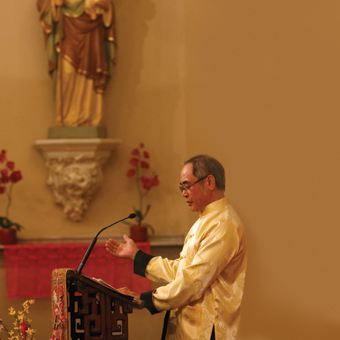
The Second Vatican Council unleashed a wave of lay participation in the church—and there’s no turning back.
Joan Higgins remembers when things began to change at her San Francisco parish. “It was 1968,” she says. “We had a new young pastor who was very forward-looking. He turned around the altar, moved the tabernacle to one side, and instituted a moment of collective silence for reflection after communion.” The young priest also introduced another innovation: a parish council.
“Then he left to get married,” says Higgins with a laugh. “We got a new pastor who was very conservative. He moved the tabernacle back behind the altar, got rid of the moment of silence, and abolished the parish council.”
A few decades earlier, the changes instituted by either of the new pastors might have been met by a collective shrug of the parish’s shoulders. In those days, Catholics–mostly second- and third-generation immigrants–were more concerned with putting bread on the table for their families than debating the placement of the tabernacle. In the heady years after the Second Vatican Council, however, Catholic laypeople were more inclined to give voice to their desires for and disappointments with the church.
“My husband, Bob, who served on the parish council, was very upset about it being abolished,” says Higgins. “He held a meeting at our house with a lot of men from the parish, and they had a long conversation about what to do.” Higgins, for her part, was at least as concerned about the elimination of the moment of silence after communion. “I thought it was very important for us to reflect on what had just happened at the Mass,” she says. “So I wrote the pastor a letter to complain. He actually called me up to talk about it, and we had a good conversation.”
A growing ferment
It is an exaggeration–but not much of one–to say that the role of the laity in the Catholic Church has changed more in the last 75 years than the last 750. Seventy-five years ago, when this magazine was first published, the Mass was in Latin, and laypeople did not read from scripture or distribute communion. “Religious education” consisted of classes in Catholic schools taught primarily by sisters wearing habits.
Nevertheless, to suggest that laypeople had no role in the life of the church of that time would be mistaken. Catholic parishes had a rich network of lay associations–confraternities, sodalities, service organizations–that played an important role for a church of immigrants seeking a foothold in American society.
“These associations served a useful purpose,” says Jay Dolan, author of The American Catholic Experience (University of Notre Dame Press) and professor emeritus of history at Notre Dame. “Catholics weren’t necessarily well regarded by the broader culture. They were able to develop a sense of confidence by joining and participating in these organizations,” says Dolan.
By the mid-20th century, however, it became clear that many lay Catholics were seeking a broader role in the life of the church. After the Great Depression and World War II, church leaders encouraged laypeople to help rebuild their societies. Catholics were obtaining college degrees and entering the ranks of the professions. They were reading and talking about their faith.
“The theology of the mystical body was enormously important,” says Dolan. It stressed that every Catholic was a member of the Body of Christ and was called to make Christ present in the world. In 1943 Pope Pius XII embraced this theology in an encyclical, Mystici Corporis (The Mystical Body), where he wrote that laypeople “ought to have an ever-clearer consciousness not only of belonging to the church, but of being the church.”
The most significant lay movement of this period was the Christian Family Movement (CFM), founded in 1949 by Patricia and Patrick Crowley. While the name might suggest a support group for married couples, the CFM’s actual focus was on Christian social action in the world. CFM encouraged the formation of small groups of married couples who would use a three-part method: observe, judge, act.
“The people involved in CFM believed that they had to make it easier for people to have good family lives,” says historian Jeff Burns, the author of Disturbing the Peace: A History of the Christian Family Movement (University of Notre Dame Press). “They understood that economic and social conditions in the broader society had a large impact on family life.”
By the early 1960s, notes Burns, more than 50,000 couples were involved in the Christian Family Movement. Because couples tended to cycle in and out of the group, the actual impact was much larger. CFM eventually went international, becoming particularly strong in Latin America.
More than three lines
Shortly after his election in 1958, Pope John XXIII announced his intention to call an ecumenical council, a gathering of the world’s bishops that quickly became known as Vatican II. In a 1962 letter to the pope, Cardinal Léon-Josef Suenens of Belgium called “for a major statement on the position of laypeople in the church. The Code of Canon Law devotes a mere three lines to them!”
As it turned out, the laity received far more than three lines at Vatican II. “Almost every document deals with the laity in some way,” says Dolores Leckey, author of The Laity and Christian Education (Paulist Press). Sancrosanctum Concilium (Constitution on the Sacred Liturgy), for instance, called for reform of the liturgy in order to promote the “full and active participation” by the entire assembly. The council also adopted Apostolicam Actuositatem (Decree on the Apostolate of the Laity), which called the laity to discern the gifts given to them in baptism and to use them in service of the church’s mission.
The council members tried to balance their desire for greater engagement by the laity with preserving the church’s hierarchical structure. The council’s principal document on the church, Lumen Gentium, speaks of the whole church as the “People of God” before it discusses the roles of clergy, laypeople, and religious orders, each of whom received a separate chapter. At the same time, Lumen Gentium reaffirmed the hierarchical structure of the church and enjoined the laity to accept the decisions of their pastors and bishops with “Christian obedience.”
The issue that most clearly dramatized these tensions was contraception. Pope Paul VI had removed the issue from consideration at Vatican II and had established a separate commission to review it. Among the lay members of the commission were Patricia and Patrick Crowley of CFM. Their survey of CFM members suggested strong support for a change in the teaching.
The Crowleys were not inclined to defer to clerical members of the commission. When Father Marcellino Zalba asked what would happen to “the millions we have sent to hell” if the teaching was abandoned, Patricia Crowley responded, “Father, do you really believe God has carried out all your orders?”
Pope Paul VI hoped his 1968 encyclical Humanae Vitae would put an end to the debate. Instead, it sparked a backlash that led some Catholics to leave the church and others to reassess their respect for church teaching. As the church moved into the 1970s, it was clear the Catholic laity had come a long way from “pray, pay, and obey.”
New roles, struggles
The bishops who gathered at Vatican II ultimately returned to their dioceses, eager to use the council as a means of renewing their local churches. Many were interested in harnessing the talents of a newly energized laity.
The liturgy was one of the first areas where the laity took on new roles. In 1972 Paul VI issued the document Ministeria Quaedam, which allowed laypeople to serve as lectors, assist the priest within the sanctuary during Mass, and distribute communion.
Al Cattalini, a retired Coast Guard captain, remembers his experiences as a lay eucharistic minister–now called extraordinary ministers of communion–at a military chapel in Hawaii in the mid-1970s. “There was a Saturday evening folk Mass conducted by our chaplains. It was rich with Hawaiian pageantry and music and attracted a lot of tourists, some of them with their beach clothes still on. I still raise eyebrows when I tell people I distributed communion to gals in bikinis!”
The American bishops struggled to keep up with the changes happening at the grassroots. In 1977 they established the Secretariat for the Laity and installed a lay woman, Dolores Leckey, as its first director.
“At the beginning we didn’t have a paper clip,” says Leckey. She spent her first year working with New Ulm, Minnesota Bishop Raymond Lucker to put together a committee of bishops interested in the topic. “There was a lot of enthusiasm, though,” says Leckey. “None of them ever missed a meeting.”
The secretariat’s work eventually produced the U.S. bishops’ first major document on the laity, Called and Gifted, which was issued in 1980. The document called the laity to a faith that expressed itself in service to the church and to the world. In particular, the bishops spoke positively of lay men and women who were preparing themselves professionally to work in the church, a phenomenon they termed “lay ecclesial ministry.”
Church of the world
Even before Called and Gifted was issued, however, there were critics asking whether the focus on lay ministry was leading to a neglect of the “lay apostolate,” the specific vocation of the laity to live out their faith, in the realms of family, work, politics, and culture. In 1977 a group of laypeople, priests, and religious based in Chicago issued A Chicago Declaration of Christian Concern. The declaration argued that “while many in the church exhaust their energies arguing internal issues . . . the laity who spend most of their time and energy in the professional and occupational world appear to have been deserted.”
The signers of the declaration formed the nucleus of a new organization, the National Center on the Laity (NCL), whose mission was to encourage lay Catholics to bring their faith into the places where they lived and worked. “There had been so much attention paid to lay ministry and the renewal of parish life,” says Bill Droel, current editor of NCL’s newsletter. “There was a concern that the idea at the heart of Vatican II–the church as the People of God in service to the world-was being lost.”
Russell Shaw, a longtime spokesperson for the U.S. bishops and the author of Catholic Laity in the Mission of the Church (Requiem Press), agrees with Droel. “Most parishes have ‘ministry fairs’ where they strongly encourage parishioners to sign up to do something in the parish. There’s nothing comparable in terms of the lay apostolate in the world.”
The election of Pope John Paul II in 1979 brought into office a pope who shared some of these concerns. In 1988 the pope issued a document, Christifideles Laici (On the Lay Christian Faithful), that expressed concern about the “clericalization” of the laity and stressed that the primary mission of the laity is to evangelize the secular realms of culture, politics, and economics. That concern has found its way into a number of more recent Vatican documents, such as liturgical directives that strongly suggest that lay Eucharistic ministers be used only when there are an insufficient number of priests and deacons available.
Leckey believes there is no evidence that the expansion of lay ministry has come at the expense of the lay apostolate. “It’s a spurious argument,” she says. “What I’ve seen time and again is that people who become lectors or lay Eucharistic ministers begin to deepen their faith and start asking questions about how to apply it in the world.”
Power to the people
The historical role of the bishop in the Catholic Church has been to “teach, sanctify, and govern.” With laypeople moving into teaching the faith and playing a more active role in the celebration of the sacraments, it wasn’t long before laypeople were wondering about their role in church governance.
In the 1970s many parishes began to introduce parish councils, and a few bishops established diocesan councils. At the time, the canonical status of the councils was unclear, as was their scope of influence. “In too many cases, the people on the parish councils were just friends of the pastor who rubber-stamped his decisions,” says Shaw.
A number of Catholics had a more expansive vision for a lay role in church governance. To mark the American bicentennial in 1976, the U.S. bishops convened the Call to Action conference in Detroit. The conference brought together 2,500 priests, religious, and laypeople to inaugurate what Cardinal John Dearden, archbishop of Detroit, called “a new way of doing the work of the church in America.”
The conference delegates quickly ran ahead of the bishops, approving resolutions calling for re-evaluations of the church’s teaching on birth control, clerical celibacy, homosexuality, and women’s ordination. Even some relatively sympathetic observers, such as the sociologist Father Andrew Greeley, thought the conference went too far.
Many of the attendees, though, were not deterred and went on to found a new organization, dubbed Call to Action (CTA), to advocate for reform within the church. Since that time CTA has become more liberal while the church’s hierarchy has become more conservative, making any effort to find common ground increasingly difficult. The CTA’s current priorities focus on supporting gay and lesbian Catholics and defending employees of the church who have been fired because of their personal views on church teaching.
Jim Fitzgerald, CTA’s executive director, seems resigned to the group’s limited influence with the bishops. “Historically, change rarely comes from people at the top,” says Fitzgerald. “We have to be the church we wish to see rather than waiting for those in power to bring it about.”
Some Catholic reformers take a different view, arguing there are many things the church could do to reform its governance without overturning traditional doctrines. The clerical sexual abuse crisis that roiled the church in 2002 led to the formation of a new organization, Voice of the Faithful (VOTF), whose motto is “Keep the faith, change the church.”
Dan Bartley, president of VOTF, believes he is fairly typical of the organization’s members. The CFO of an electronics manufacturer in Long Island, Bartley and his wife are involved in marriage preparation for couples at their parish and are graduates of a diocesan school for pastoral ministry. Angered by the clerical sexual abuse crisis, they became active in the Long Island VOTF chapter. “I joined VOTF to help our church become a community that our children and grandchildren will still want to belong to,” he says.
In addition to supporting victims of clerical sexual abuse, VOTF has also made proposals for structural reforms that would not require any changes in church teaching. The organization has urged bishops to consider ordaining women to the diaconate and recently proposed a set of reforms for increasing lay input in the selection of bishops.
Despite what would appear to be a moderate agenda, VOTF has struggled to overcome both the opposition of many bishops and the apathy of many laypeople who otherwise agree with its positions. While VOTF experienced a surge of membership during the worst months of the sexual abuse crisis, membership leveled off soon after, and the organization recently went through a financial crisis. While Bartley and his team have stabilized the group, it remains an open question whether VOTF can recapture its earlier momentum.
“The issue of governance is going to take a long time,” says Leckey. “Catholic ecclesiology sees bishops as very central. We are organized hierarchically.” She suggests focusing on the grassroots, where a lot can be done to increase the sense of shared responsibility for the governance of the local church. “Catholic schools are a good example, because you have the precedent of the bishop delegating responsibility for Catholic education to laypeople and religious.”
Baptized for mission
Over the past 75 years, the role of the laity in the Catholic Church has undergone a dramatic transformation, thanks in large part to Vatican II. Yet challenges and conflicts remain. Some Catholics perceive that church leaders are retreating from Vatican II’s commitment to empowering the laity.
Theologian Richard Gaillardetz, co-author of Ordering the Baptismal Priesthood (Liturgical Press), believes that the problem is in thinking of the realms of “church” and “world” as somehow mutually exclusive, with the ordained focused on the former and the laity focused on the latter.
“All the baptized, lay and ordained, are called to share in their baptismal vocation to be disciples to the world,” says Gaillardetz. “It’s a mistake to think of liturgical ministries as ‘churchy’ ministries distinct from the church’s mission in the world. It’s better to think of the liturgy as the action of the church by which, nourished by the word and sacrament, we are all sent forth into the world in service of God’s reign.”
Gaillardetz suggests that we have much to learn from the growing churches in Africa and Asia. “I think it’s significant that the churches of the global South would not even raise the issue of the laity as central to their concerns,” he says. Many of these churches are more engaged with pressing social questions, such as the spread of HIV/AIDS, genocide, and abject poverty, notes Gaillardetz. “They see these issues as concerns of the church entire, and they call for a response from the whole church, lay and ordained.”
This article appeared in the August 2010 issue of U.S. Catholic (Vol. 75, No. 8, pages 12-17).
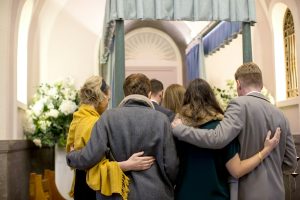
Image: Photo by Karen Callaway/Catholic New World