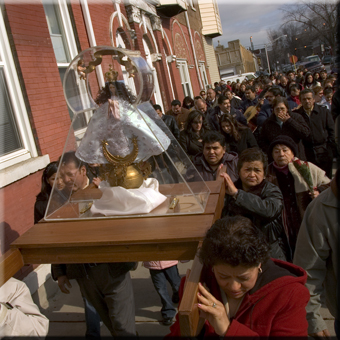
Dispatches from the history of Hispanic Catholics in the United States.
From colonial times until recently, Hispanic Catholics in lands now in the United States have been on the margins of their church. During the Spanish and Mexican periods, Catholics lived too far from the seats of their dioceses. At one time in New Mexico, a whole 70 years passed between bishop’s visits.
After the U.S. conquest of the Southwest in 1846 and of Puerto Rico in 1898, these regions remained far removed from the chief concerns of the “mainstream” U.S. church.
As a result, the 500-year history of Catholic Hispanics in what is today the United States has been one of moving from the periphery to the center of the church-to the table where decisions are made, pastoral priorities are set, human and financial resources are allocated. Their voices can finally be heard.
The Hispanics who achieved that feat and others who helped them are the heroes of the Hispanic church.
Obstacle course to a priestly vocation
One major roadblock Hispanics in the United States have had to overcome on their path to the church’s center has been the way fellow Catholics frequently dismissed or judged them as weak in faith, lacking in formation, or generally incapable of leadership.
They have risen to such challenges by persevering in a long struggle-first to receive adequate ministry, then to minister to their own people, and more recently to serve the church as a whole.
Patricio Flores, the sixth of nine children in a Texas family of illiterate migrant farmworkers, was a 10th-grade dropout in the 1940s when the desire stirred in him to become a priest. He spoke to his pastor, who told him to go home and pray for six months.
When Flores came back and was told to pray for another six months, he realized he had to seek help elsewhere. A religious order priest discouraged him, but a diminutive middle-aged Sister of Divine Providence, Mary Benetia Vermeersch, showed no hesitation. Asking Flores if he could drive, she borrowed a Model-T and said, “Drive me to see the bishop.”
Bishop Christopher Byrne of Galveston, Texas paid Flores’ tuition, books, and other expenses so he could attend a Christian Brothers high school. The young Mexican American graduated as valedictorian, went on to the seminary (where he had to shine the shoes of his classmates to earn money for incidentals), and was ordained in 1956.
In 1969 San Antonio’s Archbishop Francis Furey decided he needed a Mexican American auxiliary–an option no bishop had dared propose. Furey submitted Flores’ name as his only nominee.
When the apostolic delegate to the United States, Archbishop Luigi Raimundi, returned the paperwork asking for two more names, Furey simply wrote Flores’ name two more times. “I had to do a lot of pushing,” Furey later remembered. “A breakthrough in the Catholic Church is not easy.”
Flores was summoned to Washington, where Raimundi interrogated him for a whole day. Finally, according to Flores, the apostolic delegate said, “Father Flores, I understand you have been seen dancing in public.” Flores, who sometimes performed special dances with his sister, replied, “Yes, your Excellency, but don’t you think that is better than dancing in private?”
Raimundi made him promise he would never dance again.
In 1970, 95 years after the ordination of the nation’s first black bishop, Flores became the first U.S. Hispanic to be ordained a Catholic bishop. The ordination Mass at the San Antonio convention center drew 8,000 people, demonstrating how happy Hispanics were to finally have their own religious leader. Nine years later Flores became the archbishop of San Antonio. He retired in 2004.
As the nation’s first Hispanic bishop, Flores pastored a flock far beyond the confines of his archdiocese. In that role he sometimes encountered strong criticism, such as when he visited César Chávez, the founder of the United Farm Workers, in a California jail; met with leaders of a demonstration protesting the high Latino casualties in the Vietnam war; or supported an organization of the poor that worked for better schools and municipal services.
Flores helped bring others into the center of the church’s life.
Reclaiming a Latino identity
By the 1970s, Hispanic clergy and religious women and men had become aware that their training, whether by design or not, had caused them to reject their own culture. Like Flores, they began to reclaim their cultural identity and to demand the opportunity to serve their own people. It was a hard struggle.
“In my first parish in Los Angeles, I was not permitted to celebrate Mass or preach in Spanish in spite of the fact that 80 percent of the Confessions I heard each week were in Spanish,” recalls Los Angeles priest Father Juan Romero.
Jerry Barnes, a Mexican American, was denied ordination by a religious superior because he wanted to work in Hispanic ministry. Archbishop Flores gave him the chance to begin again in San Antonio, and today he is the bishop of San Bernardino, California.
Victory Noll Sister Gregoria Ortega single-handedly worked to improve the education and working conditions of Hispanics in the Texas Diocese of Abilene. Alone, with no title or support from the clergy, she faced down police officers, judges, school principals, and school boards. Some priests attacked her from the pulpit, and eventually the bishop asked her to leave the diocese.
After years of working in the barrios of San Antonio beside people struggling to maintain hope amidst chronic unemployment, health problems, and malnutrition, Sister Gloria Gallardo, S.H.G. not only dedicated herself to serving her own people but also to helping other religious women do the same.
In their lonely struggles Ortega and Gallardo discovered the need to organize their own support group. In 1971 they were among 50 nuns who founded Las Hermanas, committing themselves to “more effective and active service of the Hispanic people.” A year and a half earlier, 50 Mexican American priests had founded PADRES, an organization of priests that worked to transmit “the cry of our people to the decision makers of the Catholic Church in America.”
Aided by these groups and others, Hispanics created pastoral centers; provided lay leadership for diocesan, regional, and national Hispanic ministry offices; introduced and encouraged the Cursillo movement; organized gatherings of Catholic Hispanics, and established an association for Hispanic theologians. Together these initiatives have offered a ministry to the church as a whole that has flowed from the wellsprings of Hispanic culture and history.
In a quieter way, and over a longer period, Mexican Americans have spread the devotion to Our Lady of Guadalupe and Cubans have shared their devotion to Our Lady of Charity.
¡Sí, se puede!
In the 1960s César Chávez organized the first successful union of farmworkers. Though he had only a seventh-grade education, he was able to plant the moral issues of his cause in the center of the nation’s conscience.
When the union went on strike in 1965, members of the National Council of Churches’ Migrant Ministry stood with them on the picket lines. Chávez pointedly asked, “Why do the Protestants come out here . . . demanding nothing, while our own priests stay in their churches?” Soon priests and nuns, major superiors and bishops, and Catholic laymen and women answered the call and stood alongside the workers.
The key to Chávez’ success was his exemplary faith, his embrace of voluntary poverty, and an unwavering commitment to nonviolence. He held long fasts to call attention to the workers’ plight. The banner of Our Lady of Guadalupe led the workers’ marches. He evangelized by persuasion and example.
Chávez cultivated the nonviolence of Jesus and the spirit of St. Francis of Assisi, believing the poor could be more powerful than the wealthy because there was nothing anyone could take from them.
Chávez’ movement is perhaps the best-known example of the enduring commitment of Hispanic Catholics to live out the gospel call to serve the least of our brothers and sisters. That commitment continues today in Hispanic parishes’ strong advocacy for and service to the immigrant community.
In 1968, ending a 25-day fast almost too weak to walk and talk, the union leader said, “It is my deepest belief that only by giving our lives do we find life. I am convinced that the truest test of courage, the strongest act of manliness is to sacrifice ourselves for others in a totally nonviolent struggle for justice. To be a man is to suffer for others. God help us to be men.”
When Chávez, after testifying all day in court, died in his sleep in 1993, 50,000 people attended his funeral.
Penitential spirit
The spirit of Chávez, with its disposition to do penance and sacrifice, runs through the centuries-long history of Hispanic American Catholicism. All the way back in 1598, explorer Juan de Oñate, according to his chronicler, “scourged himself” as he led the first colonists to New Mexico.
One group that has particularly embraced this spirit is the Fraternidad Piadosa de Nuestro Padre Jesus Nazareno, commonly known as the Penitentes. It was founded in the early 19th century and flourished in New Mexico.
Though bishops tried to suppress it, in part because of its rigorous penitential rituals, its members served as lay ministers when there were no priests available. They led congregations in praying the rosary and reciting the Stations of the Cross, presided over funerals, and mediated disputes among families.
“It would not be an exaggeration to say that the Penitentes assured the survival of the Catholic faith in New Mexico during the Mexican period and beyond,” wrote their priest chaplain in 1988. In the rural community where I grew up, Penitentes led the liturgy of the Three Hours’ Agony on Good Friday, re-enacting the Crucifixion.
I experienced firsthand their penitential religiosity in the 1980s, when I twice participated in a five-day, 100-mile pilgrimage to the Shrine of Chimayó. The Penitentes and their families assisted the pilgrims by directing traffic and providing hospitality, medical attention, and meals.
At a chapel in a village named Ocate, several pilgrims spent the night sleeping on the hard wooden floor. After the first day’s march of 28 miles, the feet of many were raw with blisters. But even though a 70-mile walk over the Sangre de Cristo Mountains lay ahead, not one of the scores of pilgrims, ranging in age from 10 to 70, dropped out.
A long way from home
Pilgrimages, common in Hispanic culture, are an echo of the many larger journeys that have played a role in the history of Hispanic Catholics.
Félix Varela, a Cuban priest and patriot, was elected to the Spanish parliament in 1821. Two years later, when he introduced legislation calling for the abolition of slavery and independence for Cuba, he was forced to flee Spain.
Never able to return to Cuba, he settled in New York, where he spent many years serving poor Irish immigrants. He started a Spanish newspaper that became an effective voice for Cuban independence. Varela also earned a doctorate in theology, becoming the first Hispanic theologian in the United States. He served as vicar general of the Archdiocese of New York.
Today Varela’s cause for canonization is being pursued by Catholics in both the United States and in Cuba.
Varela was a harbinger of the millions of Hispanics who in the 20th century would come from the Caribbean, Mexico, and Central and South America seeking freedom from oppression.
But the mentality of the immigrant, of being from another place, has long been engraved in Hispanic culture, beginning with Oñate’s expedition at the end of the 16th century, during which for the first time women and children accompanied the soldiers.
Nearly a century later, in 1693, my own family came in another expedition that followed the reconquest of New Mexico by Diego de Vargas after the Indian revolt of 1680. Many more came in the aftermath of wars and revolutions, from Mexico, Cuba, Puerto Rico, Chile, and Central America. And they still come.
Theologian Fernando Segovia, reflecting on the historical journeys of U.S. Hispanics wrote, “We are a people living in two worlds, away from our traditional home, creating and establishing a new home.”
That applies not only to the immigrants but also to citizens with roots in the Southwest and Puerto Rico who now live all over the country. That new home is in the center of the church, not on its margins.
The future is mestizo
While Varela, the scion of a wealthy family, was welcomed as a priest, many of the laity who followed at first had to worship in church basements, to “file through the alley to get there,” as a prominent Puerto Rican woman put it.
At a conference I once heard a man recount that in the 1950s, when he came to New Jersey as a farmworker, he and his fellow Puerto Ricans were not allowed to worship in parish churches. For them Mass was celebrated in a chicken house. But while others might have left the Catholic Church and joined another faith, he persevered and eventually became a permanent deacon. “Today,” he said proudly, “we worship in the cathedral.” The outsiders have become insiders-all over the nation.
Because the overwhelming majority of Hispanics do not give up on their church, they will soon be the majority of Catholics in the United States.
Between 2000 and 2008 the number of U.S. Hispanics increased from 35 million to 46.9 million, a 34 percent jump. Their numbers will continue to increase at least until 2050, when the Census Bureau projects a count of 102.6 million. At that time, the bishops’ Subcommittee on Hispanic Affairs has estimated, 85 percent of U.S. Catholics will be Hispanic.
In a few years, if not already, thinking about the Hispanic church as a subgroup of the larger U.S. Catholic Church will no longer be possible. If the church can then be divided into parts, the largest one will be Hispanic.
As Mexican American theologian Father Virgil Elizondo has predicted, “the future is mestizo,” referring to the diverse mix of nationalities and races found in Hispanics in the United States.
The ministry of this soon-to-be majority was modeled 10 years ago in a large Catholic gathering in Los Angeles called Encuentro 2000. Its theme was “Many Faces in God’s House,” and it brought together all the cultures in the church to begin building a multicultural communion.
The process reflected the wisdom expressed by Mexican novelist Carlos Fuentes: “When we exclude, we betray ourselves. When we include, we find ourselves.”
This article appeared in the March 2010 issue of U.S. Catholic (Vol. 75, No. 3, pages 27-31).
Image: Claretian Photo/Carlos Ortiz