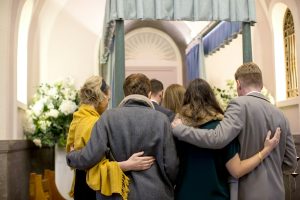
The most vibrant parishes focus as much on ministry to the poor as they do on ministry in the liturgy, says the founder of JustFaith Ministries.
In 1988 Jack Jezreel reluctantly became a parish social minister as a means to an end: to earn enough money to start a farm. “I realize that peace-and-justice work will always be done by only a handful of parishioners, it will most likely remain on the periphery of parish life, and it will be eyed suspiciously by most parishioners,” he wrote in his job application for Church of the Epiphany in Louisville, Kentucky.
To his surprise, however, JustFaith, the social justice program that he developed for the parish, took off. “People get very excited about their faith when they connect it with mission and serving the poor,” Jezreel says about his program’s success.
JustFaith Ministries is now a national organization that has transformed the faith of thousands through its parish-based programs. Jezreel’s goal is to change Catholics’ perception of parish life. “How do parishes move from only gathering, to gathering and sending forth?” he asks.
Jezreel knows that justice work never ends. JustFaith continues to develop new programs to reach more people and parishes. “Sometimes with 20,000 graduates, there’s a temptation to think ‘This is just fabulous,’ until you realize that the church in the United States has 70 million people, and 20,000 is only a drop in the bucket,” Jezreel says.
As for farming? It is still Jezreel’s passion. “There’s something holy about sticking one’s hands in the dirt and knowing it came from a God who loves us,” he says.
Why should social ministry be central to parish life?
Fundamentally the gospel seems to suggest a pattern of gathering and sending. Jesus gathers disciples and then sends them. Then his disciples gather and send.
If you look at church history, I think the church at its best has been doing this. Communities of women and men religious, for example, are places of personal and spiritual development as well as of mission.
What does “gathering and sending” look like in a parish?
In terms of gathering, I’m talking about things that are very familiar to the parish: sacramental celebrations, the RCIA, religious education, social celebrations, fish fries, and potlucks.
It’s all about preparation. But all of that nurturing, community building, education, and celebration leads to a sending forth. In the gospels Jesus speaks of the reign of God, and in the tradition we speak of Catholic social teaching.
The problem is that when churches don’t have a mission-this reign-of-God-related vision about what we’re to commit our lives to-then they become static. The parish becomes preoccupied with itself.
The second problem is that when that sending component gets lost, then the gathering loses its moorings. We don’t know what we’re gathering for. We don’t know what we’re preparing for and being educated for. We don’t even believe what we’re celebrating in the liturgy.
The gospel and the Second Vatican Council both suggest that parishes should be very deliberate not only about gathering, which they currently do very well, but also about the sending, which is in some way still rather undeveloped, especially in terms of Catholic social teaching.
How is your vision different from what we have now?
Traditionally the gathering has happened in parishes, and the sending has happened in agencies. We have these tremendous organizations-Catholic Charities, Catholic Relief Services, and the Catholic Campaign for Human Development-and the interesting thing is they all work outside of parishes.
I think the future of social ministry in the church is a collapse of these divisions. Parishes will still depend upon the remarkable work of organizations such as Catholic Charities and the St. Vincent de Paul Society, but we’ll see parishes that are characterized by a significant investment in that work.
Have you come across Catholic parishes that are accomplishing that?
The parishes that are energizing and life-giving have recognized this intrinsic link between the inner journey and the outer journey, between spirituality and active engagement in the world. These parishes will light the way for the rest of the church, but I don’t know but a handful of parishes around the country that have been so deliberate about this that they integrate it into everything.
How do you make social ministry central to the identity of the entire parish?
If we turn this into practical terms, seeing gathering and sending forth as equal elements means that half the parish budget is for gathering and half the parish budget is for sending. Half the parish staff is for gathering; half the parish staff is for sending. Half of the parish’s activity is gathering; half of the parish’s activity is sending.
That’s the vision. You have to claim what you want to see a parish become before it can become that. In the meantime what do we do? What if a parish divided itself up into groups of 12-that seems like a nice number-and each group becomes a mission-based community or mission team?
For example, there is a non-Catholic church called Church of the Savior in Washington. When you join it, they ask for the usual information, and then they ask you what mission team you want to be a part of. And if you say, “I don’t really think I’m that interested, I just really like the music and liturgy, and I enjoy everybody here,” they’ll tell you, “I’m sorry, but you can’t join the church.”
The point is not that they’re elitist. It’s just the way they understand the gospel. Yes, the community gathers and prays as a church normally does on a Sunday morning, but the church is also called to be about something more.
At the end of our Catholic liturgy, the presider says, “Go in peace to love and serve the Lord.” That’s not “Go in peace and feel holy this week.”
When you hear it in the context of the gospel, it means sharing Good News with the poor and vulnerable. It means somehow our task is to honor the reconciling, healing, transforming work of God in the world.
So having an active peace and justice committee is not enough?
Absolutely not-unless everybody’s a member of the committee.
This gospel component is for everybody. Jesus suggests in Matthew 25 and in many other places that this engagement with our brothers and sisters in harm’s way is one of the terms of our salvation. In other words we discover God’s life to the fullest exactly in the embrace of suffering and care for our brothers and sisters. It’s a necessary dimension of what it means to be a disciple of Jesus Christ.
How does the JustFaith program affect participants’ faith?
People tell us all the time that the program has deepened their faith and made it compelling in new ways. A man once said halfway through the process, “I’m 58 years old. I’ve been going to Mass every Sunday of my life. How come I’ve never heard this before?”
JustFaith asks a lot-but more than 20,000 people have been through the program, so it’s not impossible. There are a lot of books to read, videos to watch. You’re going to have some immersion experiences, retreats, and substantial prayer week after week. You mix all those things together with building community, and you end up with a pretty compelling experience.
The program was crafted originally to sort of mimic the RCIA process. My experience with RCIA was that because it allowed a nice stretch of time and it challenged people to make a pretty substantial commitment, you simply allow enough space for the Holy Spirit to work. By asking people to invest a lot of themselves in it, they get a lot more out of it.
How do you get from a small group of committed leaders to a parish-wide mentality?
In some cases it’s the ripple effect. Somebody gets fired up, whether by the Jesuit Volunteer Corps or a mission trip or JustFaith, and starts to create a structure for social ministry in the parish, as described in the U.S. bishops’ 1996 document Communities of Salt and Light: Reflections on the Social Mission of the Parish.
Does starting such a structure just mean increasing volunteer opportunities for parishioners?
In some cases it means creating the structure in which commitments can be made.
For example, when I first started JustFaith at Church of the Epiphany in Louisville, Kentucky, a dozen people came out fired up, and a couple of them started new committees. One was about environmental concerns, and as soon as that committee was offered, 12 people from the parish joined it. Now you have 12 people involved who previously had no expression for their commitment to social ministry.
Out of that first year of JustFaith, we also had two sharing-parish projects evolve that engaged 100 to 200 people. It’s all about creating opportunities so that people in the parish can get involved in deliberate ways.
At JustFaith, however, we have moved from thinking that “committee” is the primary expression. We think this work is best expressed by communities, not committees.
It’s all about taking or forming a small faith community, which is very familiar language to most Catholics, and focusing not only on education or prayer or community-building, but on all of these-plus engagement.
At the end of the day, there are a lot of things that I can’t and won’t do by myself, not because I’m not interested but because it’s just not something that I would presume to do on my own. But if there are people who are my brothers and sisters who are willing to go with me, I’ll do it. I don’t think I’d go to Haiti by myself, for example, but I’d go with 10 other people.
Do you have to go outside the parish to do social ministry work?
We try to nurture relationships within that parish, and that nurture involves everything from getting together with friends to being attentive to the needs right within our community. In other words the gospel doesn’t start outside the parish. But the critical piece is that it doesn’t stop within the parish.
One of the things that’s clear in Catholic social teaching is that when we ask the question, “Who is my brother and my sister?” the answer is “everyone.” Who are we responsible for and who do we care about? Everyone-everyone in our parish and everyone outside of our parish.
What are the main challenges to justice work in parishes?
My experience is that most resistance to the social mission of the church is simply unfamiliarity. A book first published in 1985 makes the claim that Catholic social teaching is our best-kept secret. That’s still true today.
In many ways it’s just a matter of education. People don’t know what the popes have written. They don’t know about the remarkable work of Catholic agencies serving the poor.
I think that one of the exciting pieces about the tragic news of the earthquake in Haiti is that some Catholics are recognizing for the first time what a remarkable organization Catholic Relief Services is. Even though Catholic Relief Services has been around for a long time, a lot of Catholics don’t know what they do or even that they exist.
In fact five years ago the estimates were that only 5 percent of the Catholic population knew what CRS was. Today it’s 22 percent. Still, fewer than one in four Catholics even know that CRS exists, and that needs to change. When you learn about such organizations, you can’t help but be inspired and proud.
Isn’t there a sense that Catholic social teaching is just a liberal thing?
Most people come to church with some kind of political inclination. Our faith challenges us to look at the world through the lens of the gospel and then make political choices based upon our faith instead of trying to make our faith fit our politics.
The Catholic Church is working on issues of poverty, such as housing and nutrition, and at the same time it is speaking on behalf of the rights of the unborn. Does that make the church liberal or conservative?
The church’s commitment is to life. Sometimes it may look liberal. Sometimes it may look conservative. Sometimes perhaps it looks green. That’s not the point. The point is what is faithful.
The two biggest outreach committees in most parishes are right to life and peace and justice, and they don’t seem to mix. Should there be more overlap?
It’s a big church, and there are a thousand things to get engaged in. I don’t have any aspiration of trying to turn everybody who’s interested in environmental concerns to also be primarily interested in poverty issues.
What I would aspire to in a parish is that everybody who works on issues related to the gospel respect what everybody else is doing. People can’t do everything. But in the church, we say we are one body. The foot is not the eye, and the eye is not the arm, and all the parts of the body have a place. We don’t all have to be doing everything.
For my part I’m not terribly engaged in what’s going on in the Congo, but I’m glad that there are people in our parish who are because it’s a critical need. At the end of the day, I just have to realize I’m one guy and I can’t do it all. I take pleasure and joy in working in a community where lots of people are doing lots of different things.
Do I need to make sure that everybody’s doing the thing that I’m doing? I think in some ways that speaks to a lack of humility and a disrespect for the charism and the gifts of other people in my community.
That sounds ideal, but what about when there’s more tension between the various groups in a parish?
This is where pastoral leaders need to draw people together in conversation. The critical piece is dialogue. As soon as we separate ourselves, then no doubt we have problems.
One of my worries is about what’s going on in American society now, where we only associate with people who think like us. The tremendous cost of that is that you have huge divisions in society.
These same divisions can then begin to express themselves in parishes. People presume that if you don’t think like me or you’re not as committed to a particular issue as I am, somehow you are the enemy, and that’s terribly unfortunate.
Ministers in the church have to be very deliberate these days about engaging a wider conversation that doesn’t allow that to happen, but there’s no magic bullet to solve this challenge.
How do you connect the justice work to spirituality?
How do you disconnect justice from spirituality? They cannot be talked about apart from each other in Christianity. When we talk about spirituality, we often mean the inner journey, the experience of communion with God. And the gospels make it clear that this is necessarily linked to our sense of communion with each other.
To the extent that I refuse to be attentive to my brothers and sisters, I have turned a blind eye to God, even while I might be using God language. To the extent that I say I will not love my brothers and sisters, it is really another way of saying I will not love the God who made me.
But it’s difficult to be engaged in the world unless one has also developed a rich spiritual life. Two characteristics of the saints jump out at me: One is they always seem to be connected to the poor and vulnerable, and two, they always seem to have a disciplined prayer life. That’s not an accident.
None of us is probably up for canonization in the JustFaith office, but our experience tells us that we do our best work when we’re grounded in prayer and when we’re connected with our brothers and sisters in harm’s way. When we get disconnected, our prayer becomes shallow, and when we don’t pray, our work becomes cynical and crabby. When you look at human suffering too long without a rich prayer life, there’s the prospect of becoming burned out and losing hope.
By grounding ourselves in a prayer experience in which there can be some sense of quiet and presence and openness to God, we are refreshed and restored.
This article appeard in the June 2010 issue of U.S. Catholic (Vol. 75, No. 6, pages 22-26).