

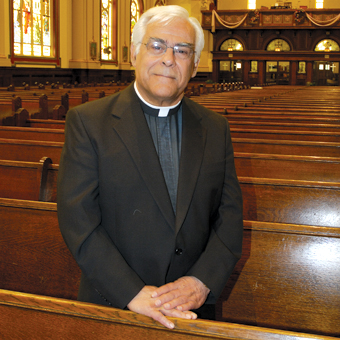
Robert Silva, a pastor and spiritual director who has taught at the University of the Pacific and the Catholic University of America, talks about how his journey to priesthood changed his life.
"We should not deny that we are struggling with the fallout from the sex-abuse scandal," Father Robert Suva told the 2006 convention of the National Federation of Priests' Councils (NFPC). "We are convinced and convicted of our priesthood. But we are struggling."
Silva, a pastor and spiritual director who has taught at the University of the Pacific and the Catholic University of America, has been president of the NFPC through some of the most challenging years for priests in its existence. Founded in the late 1960s in the tumultuous days after the second Vatican Council, the NFPC began as a national forum for priests to answer Vatican ll's call to become a more collegial church.
In the midst of their struggles, Suva called on his fellow priests to "paste across our foreheads" the words of Pope Benedict XVI, "Christ has risen because God loves us."
"What we must be," he said, "is a ministry of love."

How has the journey to the priesthood changed since you made the decision to become a priest?
My story might be unusual in that I never even saw a priest or went into a church until I made my First Communion. We never went to church because we lived hours from town, on a ranch in the hills outside of Monterey, California. We had no running water, no electricity, but we were very Catholic. God was a part of the fabric of our lives, God was the air we breathed. During Lent, way out in the hills, our family gathered, my folks pulled out the little pamphlets, and we did the Stations of the Cross every Friday. This was what I lived as a small boy. I think families today are usually not as Catholic in that sense.
We also don't have nuns telling boys anymore, "You're going to go take the test for the high school seminary," as I was told when I went to a Catholic school later on. The nuns were very key in many priests' vocation journeys; they would always be saying, "Don't you think you want to be a priest?"
A priest's life journey began in high school, and there simply weren't as many life choices as there are today. When I was in high school, the choices for Catholics were pretty much the military, the seminary, or college. Today, with so many options before them and without a vision of life where the air you breathe is God-filled, priesthood doesn't occur to a lot of young people.
So when does it occur to them, if ever?
It's not until people are in their middle to late 20s that they begin saying, "I don't know what my life means. I'm bored being an accountant. I want to do something more."
One of my students at the University of the Pacific graduated and made big bucks. After about a year, he came back and stayed with me and said, "I can't do this anymore. I might as well die now. I'm waiting to die, and I'm making lots of money doing it."
I asked him, "What do you want to do?" He said, "You know, I think I want to do medicine." He went to med school and is now serving in the poorest parts of West Virginia, and his life has meaning.
If it's true that there are many young people in their 20s looking for meaning in their work, why are they not choosing the priesthood?
There are some difficulties with the priesthood today. One of them is that the priest represents the institution, and the institutional church today is somewhat suspect, to say the least. Its leadership is perceived as being corrupt, not only in the Catholic community but with churches in general.
Because young people also grow up today with completely different understandings of homosexuality, for example, or of the place of women, some of the teachings of the church are incomprehensible to them. Denominations across the board are asking, "Why aren't our young people coming?" They believe in God and they are longing for meaning and purpose, but they're not going to invest in the institutional church until things change.
What might bring young people in?
The church has to begin to understand itself differently. For one thing, I think we've got to be very careful that we don't let ourselves get co-opted by political agendas, regardless of what political party you may be in. I fear we saw some of that among our bishops in the last election.
second, we have to start talking and using language that young people understand. The young process reality very differently; they perceive and understand differently. The evangelization process has to be different. We can no longer say, "We're the church-come to us." We have to reach out to people where they're at.
What does it mean to be a priest today?
Let's move beyond the Christian perspective for a moment. Look at our history as a human community. We have always had priests because priests bridge the world here and the world beyond. They're symbols, signs of somebody, some reality, beyond us. The human community needs that kind of hope so it doesn't fold in upon itself.
In the Christian context Jesus the priest not only holds out hope of the beyond, but makes the beyond present, so it's not about death, it's about life. Everyone who's baptized is baptized into Christ the priest, so the purpose of their whole life is to take up that mission of being a life-giver. We are to be signs that there is a beyond and to work to bring life to others, whether it's feeding or teaching or writing or whatever. The ordained are to lead that process, which is to go through death on the cross into the life of resurrection. So we become people of hope. Our job is not to put up fences, from my perspective. Our job as priests is to be dynamic in the process of being life-giving and encouraging people to be life-giving.
Isn't there a clash of cultures in the priesthood today, especially between older and younger priests?
It reminds me of what happens when two rivers meet: There's a tremendous amount of turbulence. That's where we are. We're being tossed and thrown in the turbulence of the coming together of two different ways of understanding the priesthood. I think the next 10 years are going to be tough.
You've got newly ordained who would say that we've gone beyond the boundaries of the church and we need to get everyone back in. I agree there is some need for a correction since the second Vatican Council. But you have to notice that the average age of guys coming into the priesthood today is about 36. What are those men looking for? They may have had some pretty rocky life experiences and are looking for a solid piece of granite to stand on, the certitude of a faith that's got solid parameters.
The newly ordained tend to emphasize personal holiness, to see it as their job to be as holy as they can be and to tell people what the boundaries are so they can be personally holy as well. They may sponsor a food bank because in charity we need to feed the hungry, but the real focus will be the 24-hour eucharistie adoration chapel.
The priests who came through Vatican II do not focus on boundaries. Their image would be of the church as leaven in the world. We're in the world to engage it, and you engage it with the gospel at a level that is concrete and real. Sometimes it's not all that clear where the church leaves off and the world begins.
As you see, those are two different strategies. In one, the energy is going out, and the other the energy is going inward. I think you're not going to engage young people in the life of the church if the role of the priest is maintenance and personal sanctity. The only thing that will engage the young is a tremendous vision of what life can bring to the world and how we can transform our institutions and each other's lives. It's relational, not institutional. We need the institution, but somehow it has to house the process of building relationships.
For example, I see younger priests coming up against postmodern people who aren't, for example, motivated by talk of missing Mass on Sunday being a mortal sin. People say, "I just don't need that."
I don't believe that you have to give up personal holiness to be engaged in the mission in the world. Nor do I think that being engaged in the mission is any less an adoration of God than kneeling before the Blessed Sacrament. When I kneel in adoration, what's happening is that I'm being drawn more and more into the dynamic of Jesus, the priest, giving life, bringing people out of death, and calling me more deeply into that life of mission.
How does the priesthood hold together with these two different visions?
It's difficult. For example, many younger priests refuse to meet and get to know older priests. Often when there's a priest gathering, the younger priests tend to stay away. I had one younger priest say to me not long ago, "It's you old guys, you old liberals, who have ruined our church, and we want to put it back together."
The older priests, on the other hand, can be just as ornery in a different way. "Those young guys, all they want is to undo everything we've accomplished in the last 50 years. I don't want to have anything to do with them."
But you can't grow old with dignity if you're not being generative. And how can a celibate be generative? By mentoring younger priests over the years-but many younger priests are not allowing themselves to be mentored. I think if an older priest is not able to mentor younger priests, something in him dies, and he's not able to enter into old age with generosity and happiness. He can become bitter and angry and isolated. That's a real danger.
At the National Federation of Priests' Councils we try to point out to priests that the heart of pastoral leadership is community, and community means compromising. You can't have priests putting each other into categories of good guys and bad guys.
Where do priests with different visions find common ground?
They are deeply committed in faith, for one thing. Of course they struggle with it, but they do focus on their life of faith and love for God.
Second, hands down, I don't know a priest who doesn't have a deep love for the church. They may yell and scream about Bishop So-and-so, but when push comes to shove,they love the church. They're committed to the mission.
And priests love priesthood. Some 90 percent of priests say they like being a priest. Would they ever do anything else? No. Many of them have problems with the institution, but they love the priesthood.
What about priests who have trouble with the institution?
A priest has to understand that he embodies the institution. He has to learn to deal with it, not in a hostile or cynical way, but in a constructive way.
I find it dangerous today that a lot of priests are saying, "I don't trust the bishop or the diocese or the larger church. I'm going to stay in my parish, and we're going to become the best little parish church we can be." That is simply not Catholic, and it is a denial of an aspect of priesthood-a priest can't just throw the larger church away.
When I talk about this on priest retreats, some priests squirm because they don't want to identify with the diocese or the institution. But they have to understand that by the fact of their orders they embody the institutional church.
You have to trust the process of the church unfolding and realize that it's bigger than any of us. If you are mature in the faith, you are going to be able to live with the ambiguities of the church as it is. Can you work to influence things? Yes, but the church has a wisdom that I don't have. It may take a year, it may take 10 years, and in the process I may discover that the truth was not at all where I had been looking for it.
What has been the effect of the abuse scandal on the priesthood?
I recently gave a retreat in a large diocese, and two months later I got a phone call asking me to come back. One of their priests, in his early 40s, had been arrested and charged with trafficking in child pornography on the Internet.
This priest was one of their bright lights: smart, good-looking, talented. Young people loved him; old people thought the world of him. Now here he is heading for five years in prison. I walked into this meeting of priests, and they were in tears. They said, "Whom do we trust? How do we even know we can trust you?"
The abuse crisis has created a whole level of mistrust. When one of your best friends is hauled off to jail and you didn't know a thing about it, you begin to think, whom on earth can I trust?
Second, on a personal level the whole thing can be very hurtful. When you see a headline in a major newspaper about a "perv priest," your heart sinks. I wear the Roman collar in my office building in downtown Chicago, and ever since the scandal when I go to lunch it's like the parting of the Red Sea. People see me coming and make a point to walk around me. In the past it would have been, "Hey Father, good to see you." Come Ash Wednesday, most of these people have ashes on their foreheads, so you know they're Catholics.
Sometimes priests, myself included, will say, "I've been a priest for 41 years now, to think it has come to this. What's happened to everything we've given ourselves to?" Then you simply lift your head up and realize, this what it means to live at the heart of the cross.
What about priests' relationship with people in the parishes?
I think people in individual parishes really do love and respect their priests. They'll hang onto their kids more, and they're a little more cautious and careful than they used to be, but in general most priests get a lot of affirmation from parishioners, and that's very important.
I think priests and people have come together on this issue. We all know evil is in the world, and we're not surprised when it raises its ugly head. But when it begins to permeate at the institutional level in our church, that's a whole different question.
The terrible disillusionment with our bishops on this issue has been overwhelming because it wasn't just one person, it was the whole system. That's when you get shaken, and rightly so. We need to continue challenging our leadership. There has to be some accountability for the lack of appropriate leadership and oversight among the bishops.
It often appears that the U.S. bishops have tried to move beyond the scandal, saying, "We've weathered the storm; now let's move on."
As I said before, the church is struggling with two images, one being the kingdom with the moat, where the church is inside and the world is out there, and we'll take care of our own. With that mindset, we won't generally hold people to account.
But if you see the church as leaven, in the world and very much part of it, doing its work slowly and carefully, then you believe that the individual who commits this kind of failure needs to be taken to account, as we would do in any community of integrity. If that were to happen, I think our church would be able to move forward on the issue.
Do you sense that some people have begun pitying priests, especially since the abuse crisis?
I think that's right. In California I was great friends with this couple who had a 5-year-old boy. One day after church, he said to his mom, "When I grow up, I'm going to be a priest like Father Suva." I was at their house for dinner the next week, and the mom says to me, "You know, when he said that, my heart sank."
I asked her why. She said, "I would never want him to be a priest. It's such a difficult life." I said, "Do I look like I'm suffering?" No, she said. "Do you think I'm lonely?" No. "Well," I said, "Where are you getting this from?"
She says, "On Holy Thursday, for example, when the priests are up there, they're all so old." The image is of a group of men who are 65 and older. It's hard to help young people see that this is a fruitful, wonderful life. People in their 30s, 40s, and 50s probably do see us as "poor Father."
People also see overworked priests serving more than one parish. They can't be seen in their priest garb without being suspected of being a child molester. People are conscious that priests are under a lot of stress.
But how is that different from being married? In homilies I've said I can think of nothing worse than to be lying in bed next to the person I used to love and being so resentful that I lie with my back to her and I don't talk to her and we don't touch each other for two weeks. How do you live with that?
I see people in church nodding their heads when I say that. What's so new about having to live with a little suffering?
But people still think priests are special and shouldn't have to suffer like the rest of us.
That's why we need to change the seminary. I don't think teaching priests that they are people of privilege is a good thing. I'd like to see them all spend time in the Third World or the inner city so that when they start their ministry, they have some sense of life as it really is for most of the people in the world.
Where do you find hope?
Being a priest is a ministry of presence more than anything. It's a presence that helps people to be hopeful about themselves, about their own meaning and their own purposes. It's a presence that then says, "Now that you know who you are, go and share that."
The priestly vision is doing things that bring life. Maintaining an old brick building that's going to cost us $3.5 million to repair and repaint-I'm not so sure that's what we should be doing. We need to discover God together.
How we want to structure that is something we have to figure out from here. I'm not sure that the priest has to be the administrator. I know he has to be the brother and father. That's the way I've tried to live. It's the way I've stayed hopeful.
This article appeared in the July 2006 issue of U.S. Catholic (Vol. 71, No. 7, pages 18-23).



Add comment