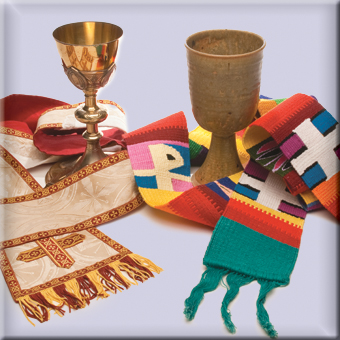
As wing tips and clerical collars replace sandals and golf shirts, parishes react to a new style of priest.
When the alarm clock rings, Father James Moore, 33, pops out of bed. He brews coffee, makes his bed, and launches into prayer.
Down the hall, Father Bart Hutcherson, 48, likes to set two alarms half an hour apart to ease into the morning. He doesn’t bother making his bed.
Their days, their desks, and their general approaches to priesthood differ widely. Yet they are both Dominican priests serving the same parish, St. Thomas More Catholic Newman Center in Tucson, Arizona.
When they are standing side by side on Sunday, the contrast is clear. Father Bart wears a simple white habit, a green chasuble, and sandals. Father James wears the same habit and chasuble, along with an alb, an amice, and black shoes. He looks fancier, yet he is the associate to Father Bart, who considers his junior’s dress “overkill.”

The amice “is truly a pre-Vatican II vestment, not required in any circumstances,” he says. “Here in the desert, it makes little sense to put on an extra layer of clothes.”
So it is no surprise, with clothing differences that translate into liturgical ones, that parishioners wondered what would ensue when Father James—fresh out of seminary—was assigned to assist their more casual pastor.
“Father James led such a sheltered life, growing up in a traditional Catholic family in the country, so he shows up at the Newman Center and he’s all set and ready to fight the good fight,” says parishioner Cliff Bowman, 45, a pilot instructor and father of four. “I was a little concerned how they were going to work out.”
The two priests had the same questions. Father Bart had just attended Father James’ ordination, “a very high-church liturgy at a big Gothic church”—a far cry from the informal Newman Center where, alas, the avid organist would have no organ. “That was my first impression: How is he going to survive here without an organ? And is he going to push us to try to get an organ?” Father Bart recalls. “I knew his liturgical style is much more high church than mine, so I worried, how is that going to affect our ministry here? Is that going to be something that’s a sadness for him? Or is it going to be something where he comes in and tries to change the dynamic here?”
Father James had no plans for a takeover, but he did bring a penchant for Gregorian chant, a knowledge of Latin, and a “curiosity as to how it would play out.”
How is it playing out two years later? “Pretty well,” Bowman says, which is remarkable when you line the two men up and break down their differences. The short list is the stuff they have in common: the Dominican formation, the Newman mission, the commitment to priesthood and service.
The list of differences is virtually everything else, beginning with where they preach, how they preach, and what they preach on. Father James uses a prepared text and stands at the lectern; Father Bart leaves the lectern and the script. Father James addresses morality, church teaching, and church history, while Father Bart applies scripture to everyday challenges and temptations.
Even the way they position their hands at Mass reflects broader discrepancies: Father Bart folds one hand over the other, palms facing his chest, while Father James presses his hands together, fingers pointing up.
Changing of the guard
As a younger generation of priests joins and replaces an older generation, parishes across the country are feeling the change. City by city, diocese by diocese, it is a changing of guards that is neither swift nor soundless and comes with no choreography to guide the steps.
Many young priests arrive with an unabated zeal for the church, a solid grasp of liturgical rubrics, and a preference, if not insistence, for traditions of the past. They call themselves “JPII priests” because their formative years were shaped by Pope John Paul II’s pontificate. They are unafraid to preach on touchier moral teachings and eager to share rituals they consider timeless—ones their gray-haired peers often interpret as a step backward from the hard-won changes of the Second Vatican Council.
For these older priests, zeal for the church has softened into an abiding love, tinged by an awareness of its shortcomings. They’ve seen many messy relationships, and they’ve mastered the fine art of meeting people where they are and gently drawing them in.
At best, the change can puzzle parishioners, surprised at how different the same vocation can look. It can result in awkward moments—a parishioner sitting between a pastor and an associate pastor engaged in a tense debate at a council meeting, or seeing the older priest roll his eyes and reference “the young buck.”
At worst, it can induce an exodus of parishioners. When the old priest and the new priest are diametrically opposed, Catholics say it can feel as if the axis of a familiar home church is tilting, the ground moving beneath their feet.
It’s “jarring,” says Mary Deeley, the pastoral associate at the Sheil Catholic Center in Evanston, Illinois. “Whenever you have a change in leadership, there are going to be people who say, ‘I just can’t do this. I’m out because he’s out.’ ”
On a personal level, that can result in a crisis of faith—someone who stops going to Mass or someone who never comes back.
That major decision can be prompted by minor liturgical changes, which parishioners quickly pick up on and often read into, says Karon Latham, who has worked as a pastoral associate and now serves as director of faith formation for a cluster of three parishes in rural Central Michigan. “The liturgy is the heart of who we are and what holds us together as Catholics,” she says. “Any time there is an abrupt change in the way [liturgy] is done, it can really interfere with the way people are encountering God.”
Identity crisis
Latham speaks from experience. She was dismayed that fellow parishioners who had been strong in their faith stopped showing up on Sundays during a difficult transition to a new pastor, which coincided with the mandated implementation of the General Instruction of the Roman Missal.
To try to ease their struggles, Latham met with parishioners at church, at coffee shops, and in homes. “You could see how they were grieving the loss of something that had been so meaningful to them,” she says. “And for parishioners who happened to be experiencing personal loss—whether it was illness or struggling with relationships—it was almost too much for them to come to a liturgy that was unfamiliar.”
In the face of these changes, priests experience plenty of pain, too. At question, ultimately, is their very identity: Are they defined by baptism or by ordination?
Older priests tend to say the former, emphasizing what they share with parishioners and offering their first name. “Theologically, my primary identity should be that of a baptized disciple who is called to live out his discipleship as an ordained minister of the church,” says Father Donald Cozzens, 70, a professor at John Carroll University in Cleveland.
Forgetting that primary identity can lead to a dangerous attitude, he adds. “I heard of a woman who came into the sacristy after the Mass and tried to make a point to the priest about his homily. ‘Well, Father, after all, we’re all disciples,’ she said. And he responded, ‘I am not a disciple. I’m a priest. The laity are disciples.’ ”
On the other hand, younger priests say, just as parents should not be too chummy with their children, neither should priests try to be on the same level as their parishioners.
“All Catholics are priests, prophets, and kings,” says Father Randal Kasel, 37, who serves at St. Charles in Bayport, Minnesota . “The priest in a particular way is meant to be a priest at a parish, and he has all those roles. That’s why there needs to be a sense of closeness but also just a little bit of distance. It’s hard for priests to do, because I want people to like me. But I can’t be true to myself and reject my role. What happens when you’re too close to people who you also have to govern? What happens when you have to say something a little difficult or you need to correct someone?”
As a priest settles into a new parish, he is left to watch the departure of some parishioners and the eventual arrival of new ones, a process that can take several years to shake out. The trial period a congregation gives a new pastor can be awfully brief—and is often marred by secondhand accounts and closed minds.
Molly Martin, a member of St. Benedict in Duluth, Minnesota, once let rumors about a forthcoming pastor cause her anxiety, only to discover many lacked merit. So when her church experienced another leadership change three years ago, “I was not so worried,” she says. “I had learned to wait and form my own impression.”
The number of parishioners who leave because of a priest change is usually cancelled out by the number who come, says Anne Merritt, the secretary at St. Benedict. She credits their new pastor for implementing change slowly, with clear and thorough communication.
Before he began presiding with his back to the parishioners, a position older Catholics will remember from their early years, he explained for months the reason for the practice and issued five bulletin inserts, Merritt says. Advent 2009 was the introductory period, and once ordinary time began this year and the pastor had heard enough complaints, he decided to revert to the most common custom, facing parishioners, for the 8 a.m. Mass, one of three weekend services at St. Benedict.
“I thought that was being fair,” Merritt says.
Growing pains
Liturgical changes often reflect the way a priest views his relationship with the parish. Cozzens’ understanding of that relationship comes from French Dominican Father Yves Congar, whom he paraphrases: “There are two ways of looking at ministry in the church: One is that Christ chose ministers who form a people; the other is Christ forms a people from whom come ministers.”
When you believe the latter is true, as Cozzens does, you understand a priest can be influenced by his parishioners just as surely as he may try to influence them. It can take years of pastoral service to really appreciate this, though. “Parish priests often are humbled at the faith and courage of their parishioners. The more insecure a priest is,” he adds, “the less likely he is to be shaped by his parishioners.”
Being willing to be shaped by parishioners does not mean abandoning church teaching, Cozzens says. “I hope I am faithful and pastoral—neither severe nor lax in my care of souls, preaching, and teaching.”
Kasel looks at his relationship with his parish through a different lens. “I love being a priest,” he says. “But it’s not easy. It’s a lot about being willing to suffer with people and for people. The priesthood is an intense life of grace with Jesus, to lead others to him and to face the same things he did—the opposition as well as the blessings, the miracles and the great disappointments. At my parish I’m trying to do what the church wants, and I’m doing it as generously, charitably, and patiently as I can.”
That can result in policies that ruffle feathers, such as Kasel’s emphasis on boy altar servers—without rejecting the girls who had been on board. “If they wanted to stay on, I’ve told them they could,” he says. A few have.
Kasel explains: “Only men can be priests, and the church sees serving at the altar as the first step toward being a priest. Is it really fair to the girl to have her at the altar if she can’t become a priest?”
But it can be hard to swallow if your daughter wants to be an altar server, as was the case for Bridgann Overmann, 68, of Marion, Iowa, when her daughter was young and their priest did not allow her to serve.
“I was not happy about it at all,” recalls Overmann, who didn’t want any obstacles to her daughter’s engagement in the church.
Overmann also resists the use of Latin in Mass. “I don’t think that’s moving forward,” she says. “Latin is a beautiful language, but we don’t understand it.”
Kasel suspects a few families left St. Charles because of his emphasis on male altar servers. His unflinching objection to contraception, a point he’s raised at the pulpit, hasn’t won him many popularity points either. He thinks it’s difficult for parishioners who are used to hearing thoughtful but palatable proverbs to adjust to sermons on the pill and natural law.
“I wasn’t picking a fight,” Kasel says, “but I was saying, ‘This is what the church teaches,’ and I was doing it in a gentle way, a loving but forthright way. There’s not a lot of wiggle room to it.”
Though about 20 families have left St. Charles, he says even more have joined. He’s not dwelling on the past, but he hasn’t forgotten the push-back he experienced from some parishioners.
It was an eye-opening experience for the priest of five years. “What happens in parish life is you get a few people excited, they can do a lot of rabble-rousing,” Kasel says. “When people get upset, they try to ferment it.”
On the other hand Overmann believes parishioners are entitled to speak up if a new pastor implements change they find upsetting. “They owe that to the priest,” she says. “You need to tell him in a gentle way. They need to grow. We need to grow as a church. We need to be stretched, we need to try new things.”
Room for both
Older and young priests could learn a great deal from each other, experts say. “There’s room for both models,” says pastoral associate Mary Deeley. “I’ve had experiences of priests who grow in their priesthood and begin to see the real value in both styles. The danger is in demonizing the other side.”
Or even calling them “the other side,” she adds.
Father Robin Ryan, 53, who teaches at the Catholic Theological Union in Chicago and directs the young-adult discernment program Catholics on Call , points to the origin of this issue. “I think one of the greatest challenges facing the U.S. church—and I don’t want to be alarmist about this—is that many diocesan seminarians and many religious order seminarians are being formed in very different ways about priestly ministry and, to an extent, about theology,” he says. “My fear is that that’s going to make it harder down the line for priests from different backgrounds and orders to work together. I don’t think we’ve really grappled with that.”
He believes each generation has wisdom for the other.
“Older priests,” he says, “sometimes could miss out on the fact that a priest is called to reflect holiness. And we’re not just one of the guys.”
As for the younger men, “It’s very important that priests treat people who are adults like adults. Sometimes that emphasis on a priest as a person set apart and the spiritual father can lead to a kind of paternalistic approach to ministry that’s just not going to work and is not helpful and forgets that we’re all part of the Body of Christ.”
As for Father Bart and Father James, the Dominicans serving side-by-side, sandal to shoe, they attribute their accord to open communication, deep-seated respect, and good-natured teasing.
Last Christmas, for instance, Father James asked Father Bart, who wore an Obama T-shirt on Election Day, for Sarah Palin’s memoir Going Rogue.
They pray for each other. They edit each other’s homilies. And occasionally they just bite their tongues. Their common ground may be narrow, but it is deep. Just take a peek at the profile picture on Father James’ Facebook account: It is a picture of him with Father Bart, above the caption “brothers.”
This article appeared in the May 2010 issue of U.S. Catholic (Vol. 75, No. 5, pages 12-17).
Image: Tom Wright