What's your sign: The cross or the tomb?
Though the cross reigns over Good Friday, Easter's mystery needs a symbol of its own.
I don't usually think of Jesus' crucifixion when passing the sweets table, but there it was: A big rich dark chocolate cake adorned with white sugary latticework in the shape of-you guessed it-a cross.
It wasn't completely out of place, since I was at an ordination. But it brought to mind the perennial question of why, if you want to make something, anything, "Christian," all you have to do is slap a cross on it, and voila! I wonder if the Romans had any idea that their preferred instrument of torture would someday be imitated in cake frosting.
Actually, the early Christians might be a little surprised themselves. It took centuries for crosses to appear in places of worship, perhaps because the ancient church still had firsthand experience of their brutal purpose. Once the memory of a fellow Christian nailed to a cross faded, believers felt more comfortable bringing one to church. Since then Christian churches of almost every stripe have a cross. Catholic schoolchildren of a certain generation were even taught to draw one at the top of every sheet of paper.
Unfortunately the ubiquity of the cross, for all its importance, focuses our faith almost exclusively on Jesus' torture and execution. His resurrection, which is the end point of the Good News, gets lost in the shadow of the cross-though death's defeat admittedly lacks an easily identified instrument as its apparent victory. Easter's transformation is a bit hard to illustrate, much less draw at the top of an essay.

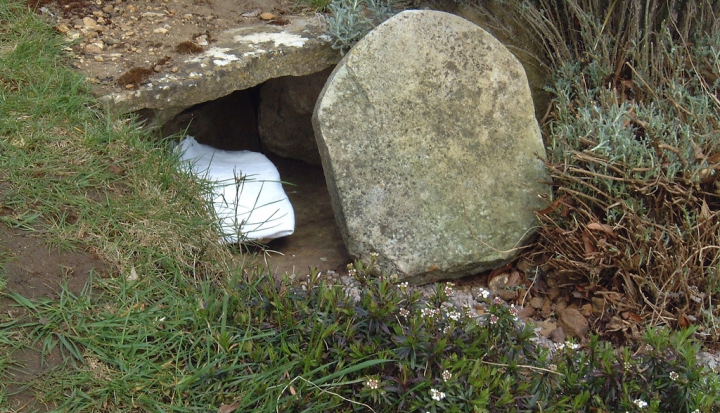
But it does lead one to wonder why we haven't sought an image that captures our Easter faith more fully. Scripture provides a captivating yet ambiguous one: an open, empty tomb. In fact, the oldest story of Easter, from the gospel of Mark, lacks the angelic figures of Matthew and Luke and the mysterious gardener of John. All Mark gives us is an empty hole in the ground, from which the women who came to anoint Jesus flee in terror.
Perhaps that's one reason why the empty tomb never caught on. Unlike the cross, concrete in its shape and purpose and cruelty, the empty tomb is ambiguous, open to interpretation. Depending on your point of view, it is either a curiosity to be explored-who isn't tempted to enter a cave?-or a macabre reminder of our own inevitable death.
That is, after all, the truth of the grave, one that can be more personal than the cross. It's easy to let the cross be all about Jesus' death; none of us expect to die on one. And Jesus' death in the minds of many Christians is a one-time event, a special case with cosmic purpose, however understood.
But while the cross allows us to recall Jesus' historical passion and consider its saving purpose, we can easily remain safely in denial about our own mortality, and questions about the purpose of our own death can go unasked.
Even if we're unlikely to be tortured to death on a cross, we're all going to end up in a grave some day. Christian faith promises that we'll come back out eventually, but not until we follow Jesus down into the depths of the earth in our own "saving" death, regardless of the manner by which we go.
That is the mystery we celebrate in baptism, and why baptism in the ancient church was a lot more like a ritual drowning than an unthreatening trickle of water. St. Paul says it best: "Do you not know that all of us who have been baptized into Christ Jesus were baptized into his death?" (Rom. 6:3). Beyond scripture and sacrament, we experience that truth of faith more immediately and intensely when we place a loved one in the open ground and water the earth with our tears.
Considered in this light, an empty tomb on Easter Sunday might not merit the joy of even a single alleluia. But between the cross and a hole in the ground, I'll take the tomb. For me it better captures the pattern of our Christian lives-life, death, resurrection-acknowledging the inevitability of death as well as its inability to hold us forever. The life that awaits us is beyond our grasp, inspiring at least uncertainty if not apprehension, but also open to hopeful possibility.
"What no eye has seen, nor ear heard, nor the human heart conceived," says Paul, is "what God has prepared for those who love him" (1 Cor. 2:9). Easter's empty tomb points the way to the God who is making all things new.
This article appeared in the April 2010 issue of U.S. Catholic (Vol. 75 no. 4, page 8).
The Cross or the Tomb
By Eileen Quin Gould (not verified) on Tuesday, April 26, 2011I am a born again Catholic. My life is filled with joy and grace. Christ is first and foremost to me. However I relate to his dying on the Cross for my sins, I relate more to Resurrection and His Holy Spirit that He left each and every one of us. My greatest joy is Pentecost. I have angered a dear friend, a Carmelite, because I did not put the Cross above all else. But we are allowed to choose our Way and this is my Way.
How about this as a much more
By Jim McCrea (not verified) on Friday, April 22, 2011How about this as a much more real respresentation of what Christ did for us:
http://www.galileecatholicgifts.com/index.php?l=product_list&c=162
I prefer a much more
By Anonymous (not verified) on Friday, April 22, 2011I prefer a much more realistic depiction of the crucifixion. Mine may be cleaned up a bit--not enough blood and gore, but at least it has Christ suffering, as he did for our sins.
I have no problem with the
By Anonymous (not verified) on Thursday, April 21, 2011I have no problem with the use of crosses as jewelry and decoration, and devotions. It is on the cross that Jesus performed his saving act.
However, I think a cross without Christ, in other words a simple cross, not a crucifix, is inadequate and incomplete.
I know that many do not want to be reminded of death, but, as we saying the Mass, "Dying he destroyed our death, rising he restored our life."
AT this point in my life the destruction of death is more relevant than the restoration of life.
Symbol of Easter
By Milka Stanojevich (not verified) on Wednesday, April 20, 2011For years, I have thought about the message we send when we wear a cross, or use it as a symbol of Easter. To many Christians, the cross is a symbol of the instrument of execution, and does not evoke feelings of joy, only sorrow. We have used many pagan symbols as well, and even used the Paschal Lamb. You would be surprised how many people do not know, or understand, why this is used as a symbol. I think we should stop using the name EASTER, since its roots are pagan as well, and use Resurrection Sunday as the Eastern Orthodox Christians have used for years, it makes more sense on every level. Again, a tomb is about death, even an empty one. Resurrection Hospital in Chicago uses a butterfly as their symbol, and I think that is a far more appropriate sign of joy, not entirely accurate, but a symbol of new life nonetheless. A more direct symbol would be of the Risen Christ, ascending without the cross, a true symbol of joy and victory. Maybe an Aramaic character that means resurrection, much like the Chai means life in Judaism?
Death and the Cross
By Anonymous (not verified) on Thursday, April 29, 2010Hello. I get the tomb imagery for death. But from another perspective: that as a Hospice nurse...for many, dying is a cross experience of suffering, pain, grief, anguish, etc. The cross is alive with these very real emotions of letting go of hopes, dreams, a lifetime of being someone etc, and knowing that you are alone with God when there is nothing pretty about dying, no matter how many in community are standing at the foot of the cross, in this journey to the unknown. The cross speaks volumes about the real process of dying...the empty tomb is more about the grief after death...My preferred symbol? The Circle of Life. Peace.
God is PERFECT LOVE that endures forever!
By Letha Christina Chamberlain (not verified) on Sunday, April 18, 2010I'm sorry--to the above commenter... The Revelation of St. John is a "vision"--a "vision" is symbolic--we will not know what it actually portends at this time... (sometimes guessing is fun!) We DO know it is a message of victory and hope! God's LOVE is for everyone--Jesus died on the cross for everyone... Since God's mercy endures forever--it is the person/spirit's choice at the end that matters. The rejection of His LOVE by anyone/spirit, we do not know. So I'll take the better part of valor, praying for mercy for humankind's and Satan's conversion of heart. In the process of my life, Satan's handiwork has been turned into goodness by God, bringing me valuable lessons and increased strength. It's the least I can do for my God, sorrowing as He is for the lost sheep who have wasted so much time... losing out on the bounty of His LOVE right now!
Sorry, Satan cannot be
By wsxyz (not verified) on Wednesday, May 12, 2010Sorry, Satan cannot be converted, and Jesus did not redeem the fallen angels.
Furthermore, although it is true that God's LOVE is for everyone, so is his JUSTICE, and many souls are in now in Hell. Pray and do penance for those still living, that they may avoid this end.
Remember Dear Christian, you have but one soul to save, One God to love and serve, One eternity to expect. Death will come soon, judgement will follow, and then, Heaven or Hell forever.
How did you come to know the
By Milka Stanojevich (not verified) on Wednesday, April 20, 2011How did you come to know the mind of God? God is boundless and unknown, so how do you presume to know the unknowable? God is limitless, boundless and eternal, therefore, all things are possible through God, even if we, as egotistical amd finite beings do not comprehend that fact. Our egos get in the way of the simple, irrevocable fact that no religion defines God, and God is all-powerful and the Ultimate Source of Life. The meager intelligence we possess cannot begin to phantom the nature of God, so I could and would, never make a statement that presumes to know what is, and is not possible. We need to acknowledge that our lives are inscrutable, our existence unexplainable (by anyone) and anyone that claims to know is either delusional, or mendacious. God is non-denominational, and not a religious entity, but a source of all life, even beyond our imagination or intellect. We need to revere God and accept that we are all a part of that life source, regardless of what religious name you choose to give yourself.
True Dat wsxyz
By Eminem Recovery June 22 in stores (not verified) on Wednesday, May 12, 2010The commenter (who thinks Satan can have a conversion of heart) certainly has compassionate intentions, but wsxyz is correct.
Satan was a marvelous angel created by God. But Satan's choice was an eternal one. He has no chance of repenting, nor would he do so if given the chance, due to his absolute hatred and rejection of God.
He and the angels who followed him will never be converted or saved. Luckily, we humans have the chance to repent and to be forgiven. We have a great Redeemer and, through God's Mercy, the possibility of being saved, no matter what sins we have committed.