Parishes are finding that reducing their carbon footprint is not only an environmental issue but a spiritual one, too.
Parishioners at Mary Immaculate Church in East Los Angeles meet monthly in convivencias, or town hall meetings, to discuss parish initiatives. Last autumn, when they learned that 38 million water bottles annually are sent to U.S. landfills, their vote on what the parish should do wasn’t even close. Plastic water bottles are now banned from the campus.
In Chicago third-grade “garbologists” are keeping track of how well their school, St. Monica Environmental Academy, is recycling.
In Annapolis, Maryland a retired state senator has helped his parish divert its parking lot’s polluted runoff away from a nearby stream and into rain gardens, where it will percolate through the soil, nourishing thirsty plants.
Parish by parish, Catholics are building a new commitment to creation care. Add all these actions together and the result is hope.

The movement isn’t limited to Catholic faith communities. Interfaith Power & Light helps churches, mosques, and synagogues green their facilities, conserve energy, educate about climate and energy, and advocate for climate and energy policies both at the federal and state levels. In 2000 the group counted just 100 member congregations. Now there are 10,000 member congregations in 29 states.
At the same time secular environmentalists are realizing that technology alone can’t solve the environmental crisis. “No other group of institutions can wield the particular moral authority of the religions. . . . The potential of the faith communities is simply enormous,” former presidential adviser Gus Speth told a group of religious leaders and environmentalists at a 2008 Yale Divinity School conference on religion and the environment.
Because of the Catholic Church’s tradition of social teaching and Pope Benedict XVI’s powerful call for sustainability, Catholic parishes are uniquely situated to be co-creators in what the U.S. Catholic bishops call “renewing the earth.”
In the same way that the environment is both local and universal, so is the church, giving parishes an effective platform to address environmental challenges. “I’m optimistic,” says Walter Grazer, former director of the environmental justice program for the U.S. Conference of Catholic Bishops. “We’ve come a long way. It helps that Pope Benedict has been focused on this issue, addressing it consistently and in a variety of venues.”
That said, no two parishes are going to be on the same greening timetable or track.
Ramon Posada, chair of the Creation Sustainability Committee for the Archdiocese of Los Angeles, notes that while one parish is installing solar panels, another may be worrying about that hole in the roof. Still, the cumulative effect of environmental action in parishes should not be underestimated.
The fact that, for instance, St. Bartholomew Catholic Faith Community in Wayzata, Minnesota has instituted a successful recycling program and is now looking to reduce its energy bills is not just a morale booster or a way to attract a new generation of parishioners-although going green may also do those things. Its actions are part of a greater, crucial whole.
According to Energy Star, a government-based program that labels energy-efficient appliances, if all of the nation’s 307,000 congregations cut their energy consumption by 25 to 30 percent, they would save nearly half a trillion dollars and 13.5 billion kilowatt hours of electricity. That’s a lot of coal, oil, and gas saved for the future. Best of all, Energy Star says most congregations can cut their energy use simply by investing in efficient equipment, facility upgrades, and maintenance. The choice is whether to pay for wasted energy or for upgrades.
Start small
Sandra Bowen, a parishioner at St. Gertrude in Chicago and a member of the parish’s fledgling green team, observes that parishes often start with recycling, but each parish’s leadership determines how the program will develop. Some begin with in-depth study-say, of the pope’s new encyclical. Others jump into immediate action. “You go with where the people are,” she says.
At St. Bartholomew in Minnesota, the green team began with just eight or nine parishioners who, with help from the local utility, set up an information display and gave away compact fluorescent lightbulbs after Mass a couple years ago. “We just kept asking, ‘What can we do to make this greener?’ ” says Jennifer Shaltz, the chair of the team, which included a sixth-grader from the parish school.
They decided that recycling was the perfect starter project after the school’s fifth-grade teacher joined the team and said she wanted recycling to be part of her class’ science curriculum.
Recycling started in the parish offices, then later in the school. Knowledgeable fifth-graders staff the trash containers during lunch hours-but kids catch on quickly. It’s recycling at coffee and doughnuts after Mass that has provided the best teaching moments. “People can get nervous about even minimal change,” says Shaltz. “But we showed how easy it was. People tell us, ‘This is so wonderful that you’re doing this.’ ”
“This is not hard,” says Shaltz. “It’s not a tough thing when there are enough people caring.”
Resource renewal
At St. Mary’s Parish in Annapolis, Maryland, longtime parishioner Gerald Winegrad has for years spoken out about connecting faith to responsibility as stewards to God’s creation. “This is important-did you see the bishops’ message?” he would ask other parishioners or the pastor.
Few were surprised, therefore, when Winegrad, a former state senator, set about greening St. Mary’s. In 2007 he sat down with St. Mary’s pastor, John Kingsbury, C.Ss.R., armed with a list of environmental actions he’d like to see at the parish.
“If you form a broad-based committee, I’ll give it my blessing,” Winegrad recalls Father Kingsbury telling him.
Just a month later, Kingsbury received much the same to-do list from the newly formed St. Mary’s Environmental Stewardship Committee. The list could be a guide for action at almost any parish across the country. It included:
• Doing a complete buildings and grounds assessment to find energy- and water-saving potentials;
• Taking advantage of the local utility’s energy audits and any credits they might provide;
• Taking an inventory of cleaning chemicals at the church and schools, and switching to green substitutes where appropriate;
• Ensuring compliance with a parish-wide recycling program, including during the summer months; and
• Looking for ways to improve storm water management and habitat creation.
The Stewardship Committee is looking into green roofs, which can reduce runoff by as much as 75 percent and also reduce energy costs. Other future storm water projects include increasing the number of rain barrels to catch rainfall and allow for slower dispersal.
Without leaders like Winegrad, Shaltz, Bowen, and thousands of others, successful environmental stewardship at parishes wouldn’t happen.
“There are elements of terror,” says Bowen about predicting environmental problems. “You look at all this and it seems pretty dire. But you’re not going to save the world on your own, and it’s a hopeful thing to take action.”
Bowen advises those wanting to green their parishes to begin with small steps. “It doesn’t have to be perfect,” she says. “It can grow.”
A little help
Whether it’s diocesan, ecumenical, or secular, outside support builds confidence and is an impetus and a source for ideas.
In Chicago, ecumenical environmentalists urged Bowen and others in St. Gertrude’s green team to reach out to other Chicago parishes. “You Catholics have your own spin on things,” they said. Catholics United for the Environment (CUE) now meets intermittently. Members from a number of parishes encourage one another, share resources, and hear from expert guest speakers.
A few miles away, the pastor of St. Monica Parish, Father Ted Schmitt, went to the Chicago Botanical Garden for advice on how St. Monica’s school could become an environmental academy. The botanical garden ended up partnering with the school, providing invaluable assistance in creating and refining the curriculum.
In Los Angeles one of the sustainability commission’s goals is to get parishes talking with one another, sharing ideas and encouragement.
Father John Lasseigne and his parishioners at Mary Immaculate will be a good source for leadership. When the parish, which is 95 percent Spanish-speaking, banned plastic water bottles, they also eliminated the vending machine that dispensed water bottles and installed more water fountains. The parish bought a thousand stainless steel water bottles wholesale with the church’s logo on them and sold the bottles for about a nickel over cost. The bottles sold out quickly.
Mary Immaculate also hired a company to perform a professional audit of its buildings in order to learn how to strategically green its campus. High on its to-do list is insulating the parish hall, which currently has no insulation whatsoever.
Education and actions like these follow parishioners home. During Lent last year Mary Immaculate held a poster competition for “How can my family prevent global climate change?” After Easter posters were exhibited. Parishioners were also urged to sign the St. Francis Pledge to Protect Creation and the Poor .
Let your LED light shine
Parish leaders shouldn’t be shy about going green.
Church of the Presentation in Stockton, California held a free electronics waste recycling event for both parishioners and their neighbors. The event reminded the community that electronics shouldn’t go into the landfill but rather be recycled, and the parish gave people a way to do the right thing.
They found themselves with tons of electronics in just a few hours. “It’s been part of my faith journey to realize that Catholics are called to be involved in their community,” says Deacon Scott Johnson.
In Annapolis, St. Mary’s won local awards for diverting its parking lot runoff-and they inspired other businesses and nearby congregations to follow suit.
A study of nearby Spa Creek had identified runoff from St. Mary’s 2-acre parking lot as a top priority for remediation. The parking lot, formerly school fields, now accommodates the parish’s 12 weekend Masses on its 7-acre campus. Rain fouled by motor oil, sediments, and pollution flushed from the asphalt toward the battered Chesapeake Bay via Spa Creek.
The Stewardship Committee formed a partnership with the Spa Creek Conservancy and received a $105,000 state grant to divert the runoff. The water is now channeled to nine rain gardens, also known as bio-retention facilities. The gardens’ thirsty, hardy plants can process the polluted runoff, which seeps into the ground rather than racing to the already overburdened bay.
Publicizing good news like this gives people hope, a necessary ingredient for change. As Gus Speth says, “We are carried forward by hope, by a radical hope, that a better world is possible, and that we can build it.”
Taking a stand
Action within a parish-such as recycling and runoff mitigation-is vital. But how about when activism is necessary? Sometimes it takes an act of Congress or the county commissioners-as Catholics in Grand Junction, Colorado discovered-to make a necessary change.
Life on Colorado’s dry and isolated Western Slope is complicated by the uranium, coal, and natural gas beneath the land’s thin surface. In the past hundred years, those resources have brought about a half dozen booms and busts, often leaving homelessness and poverty in the wake of short-lived high wages.
The hundred or so Catholics belonging to the Grand Valley Peace and Justice Commission (under the auspices of the Pueblo, Colorado diocese) work not only on environmental issues but also on homelessness, child protection, and immigration. “We all know good people who lost their jobs with oil and gas. It pulls us in two different directions,” says Karen Sjoberg, director of the commission.
In decades past, secular environmentalists have been accused of caring more about wildlife than people. That has never been true with creation care, which has always been intimately linked with human dignity. Pope John Paul II wrote in 1991, “Our tradition calls us to protect the life and dignity of the human person, and it is increasingly clear that this task cannot be separated from the care and defense of all creation.”
This connection led the commission to take part in the shutting down of a leaky, clay-lined toxic evaporation pit in 2007. The pit was 24 miles east of Grand Junction near the town of De Beque, in a narrow canyon of sagebrush, sand, and rock. It held wastewater from the oil and gas industry, and for years tests had shown it was leaking benzene, a cancer-causing compound, and that there was groundwater contamination.
De Beque is within the parish boundaries of Immaculate Heart of Mary Catholic Church, which is one of the four parishes in the commission. Immaculate Heart’s pastor agreed to attend a hearing on the pit. Father John Farley is a shepherd, not an activist. But what he heard moved him to action.
His parishioners still remember the Sunday in 2007 when he spoke from the pulpit about the toxic mess their neighbors were facing. After Mass people lined up to sign petitions urging their county commissioners to stop the dumping, clean up a six-year-old spill, and force the owners to comply with state regulations. The parishioners had just needed to learn about the issue from someone they trusted and be given the opportunity to act.
The commission, Farley, and other activists succeeded. The county commissioners closed the operation in 2008. “It was tremendously important to the people in De Beque that they were supported by the church,” says commission member Fran Didier.
It’s not easy being green
The Grand Valley Peace and Justice Commission knows all about controversy. For pastors like Farley it can be difficult to take up a cause and preach about something that some parishioners don’t want to hear about. Responding to naysayers comes with the territory.
Glenmary Father John Rausch, a self-proclaimed “rent-a-priest,” speaks freely about environmental issues. He sympathizes with parish priests, who he says aren’t as free to speak out.
“When you’re a pastor it’s difficult to take sides,” he says. When he fills in for vacationing or ill parish priests, he often talks about mountaintop removal mining. He’s familiar with the sight of a disgruntled parishioner walking out during his homily.
Another barrier to change is paying for environmental fixes. Making them happen takes creativity and a deal-maker’s instincts. At St. Mary’s in Annapolis, greening committee members knew from the start that they’d need to find an outside grant in order to solve their problem of dirty runoff from the parking lot.
Then the parish notified them that the fix could not result in the loss of a single parking space. The plan had called for three fewer spaces. They improvised, channeling water to nine rain gardens located elsewhere on the campus.
Compromise was also necessary at St. Bartholomew in Minnesota. The pastor gave the green team’s recycling program a go-ahead with the provision that it should neither cost the parish nor add to the staff’s workload. The group worked within that constraint.
When faced with doubts about the cost of energy-efficient improvements, energy audits can help make the case. At Mary Immaculate in Los Angeles, they are mapping out how money spent now will help the parish budget in the long run.
Learning curve
The more that’s learned about the environment, the more people feel a part of a web of relationships. Scientists now understand that mountaintop removal mining in Appalachia doesn’t just scar the land locally, it has negative consequences for the entire East Coast’s drinking water.
Adding more greenhouse gases to the atmosphere causes climate chaos that affects not only us but our grandchildren and beyond. The U.S. Conference of Catholic Bishops wrote in 2001 that at its core, global climate change is about “our human stewardship of God’s creation and our responsibility to those who come after us.”
The Vatican’s “Ten Environmental Commandments,” released on Earth Day 2008, say that “our responsibility toward ecology extends to future generations.”
That principle drives Johnson of Presentation Parish in Stockton. “We’re trying to leave something for the future,” he says. “I try to get people thinking in terms of intergenerational solidarity.”
Presentation has a vigorous social justice program that includes environmental stewardship, something Johnson says older parishioners sometimes struggle with, but students and young people immediately understand. In fact, he believes the environmental initiatives at Presentation Parish have brought a number of 20-somethings back to church.
Perhaps because they are the future, most youth do “get it” regarding environmental stewardship. Catholic schools are a natural place for parishes to begin their greening projects.
In the Archdiocese of Chicago, St. Monica Environmental Academy offers a green curriculum with environmental education integrated into every class. The school installed solar panels and composting bins; there are field trips to the landfill; and older students are now surveying, using what they’re learning in geometry, to create terraced gardens.
Schmitt, the pastor, also hopes to tear up the current asphalt parking lot and replace it with permeable or pervious concrete, which allows water to percolate down into the earth below instead of becoming polluted runoff.
You gotta have faith
In the end, creation care means renewing a parish’s call to the mindfulness of the Catholic tradition, something that begins with practical actions: reduce, reuse, and recycle. It means changing the parish culture from always opting for the cheapest items to bringing a green component to every event.
“We’re the leaven,” says St. Gertrude green committee member Sister Terri MacKenzie, S.H.J.C.
They’ve been cheered on by their pastor, who is enthusiastic about including the church’s environmental teaching into liturgies. “We model and we invite people to join us,” says Bowen, her attitude reflecting St. Francis’ advice to “Preach always. When necessary, use words.”
Bowen and Sister MacKenzie both say that while a practical to-do list is important, bringing the church’s teachings into everyday conversation at the parish has been transformative. “I saw interconnections before; now I see that they’re even deeper than I’d thought,” says Bowen. “We share a finite planet, but there’s abundance if we share. It makes you more grateful for creation.”
This article appeared in the April 2010 issue of U.S. Catholic (Vol. 75, No. 4, pages 12-17).
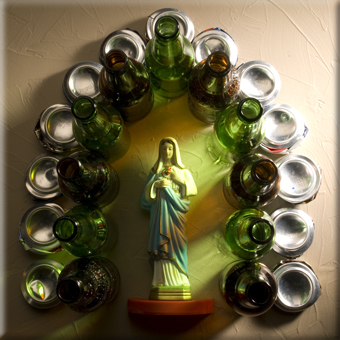
Image: Tom Wright