
Logo

Season's Greetings: Let's welcome Catholics home

Friday, November 6, 2009
Season's Greetings: Let's welcome Catholics home
ShareThis
If we're going to invite disaffected Catholics to come on home, let's also warm up the welcome they're likely to receive.

There's no shortage of programs to draw missing Catholics back to church, but few can boast of their efforts in a single diocese as "an increase of 92,000 souls who came home!" Such is the claim of Catholics Come Home, a new evangelization effort first tested in the Diocese of Phoenix and now expanding to 16 others, including my own Archdiocese of Chicago, which hired Catholics Come Home for a holiday TV ad campaign designed to bring back the lapsed.

The local response to the new initiative has been mixed. "What's changed?" a couple of priests of my acquaintance asked. If people have left because of bad preaching, lackluster liturgies, or the church's position on X, Y, or Z, they're not likely to find anything different. At the same time a friend who is a pastor pointed out, there's no harm in trying.

We Catholics can't deny we have a retention problem. Recent research shows that 10 percent of the U.S. population is made up of former Catholics, and Catholics Come Home gets credit for seizing the opportunity. But I'm not sure a Fifth Avenue-style media campaign with its accompanying price tag is the way to go, though the package includes training for "first-responder" parish workers such as office staff.

To borrow from my old theology teacher, who borrowed from the late U.S. House Speaker Tip O'Neill: "All church is local." Research on non-practicers shows that most didn't leave because of big-picture issues such as the teachings on birth control or sexuality or women's issues; they just drifted away.

Maybe they had a single bad experience in the confessional, or a local chapter of the clergy sex abuse scandal ushered them out. Or perhaps Mass just didn't offer any good reasons for the drama of dragging the kids out of bed on Sunday morning. But whatever the problem was, it was on the parish level, and it's on the parish level that change needs to happen.

Let's face it: One of the chilliest places in town on Sunday morning can be the local Catholic church. You can go to the same 10 a.m. parish Mass for a month and not have anyone speak to you, while the members of the local Protestant congregation will be competing with each other to hand you a donut. I visited a local Episcopal church one Sunday, and the priest actually offered to meet me for coffee later in the week if I had any questions. I kid you not.

That kind of welcome is rarely on our Catholic radar. But while we may not be able to do anything about the church teachings or policies that make some feel unwanted, we can certainly make sure that anyone who walks through the door knows we're glad to see them.

Such a welcome of course must include those who feel pushed to the margins by Catholicism, but it also requires a generous attitude toward those pierced and spiky-haired teenagers whose looks of mystical derision perfectly accessorize their non-Sunday best. It means avoiding even the hint of a frown when the storm of toys and breakfast cereal spills over from the young family next to you. And it demands the extra effort of reaching across the boundaries created by skin color, native country, and language.

While we're at it, five minutes of conversation with the elderly (and lonely) parish gossip can't hurt, nor can a smile to the self-important parishioner who is about to pounce on you to help with the annual rummage sale. "Welcoming" even those we know sets a tone that visitors catch.

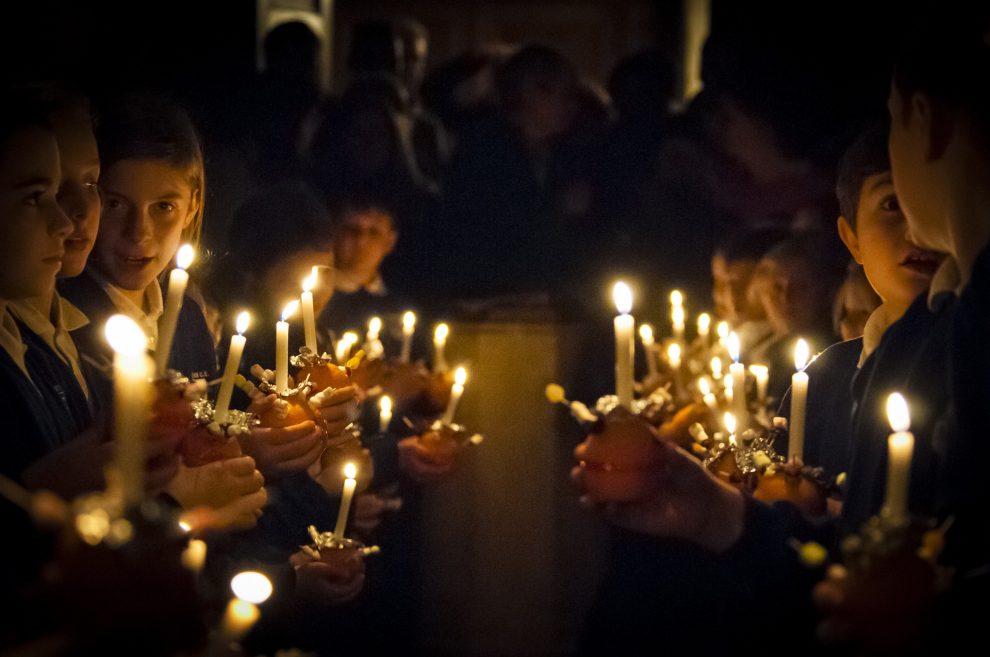
Christmas is just the time to practice that kind of welcome, whether for perfect strangers or less-than-perfect regulars. This is the season we remember the welcome God got from his earthly hosts, both bad (King Herod) and good (shepherds, angels, and astrologers). Grown-up Jesus got the same mix, though his own shockingly broad invitation included women and children, the disabled and deranged, the maimed and chronically ill, prostitutes and condemned criminals. He encouraged his disciples to keep similar company.

With that kind of example, going out of our way to welcome the Christmas Eve crowds shouldn't be too difficult. Maybe if we got just that part right, our "retention problem" might solve itself.

Bryan Cones is managing editor of U.S. Catholic. This article appeared in the December 2009 issue (Vol. 74, No. 12, pg. 8) of U.S. Catholic magazine.

Comment viewing options

Select your preferred way to display the comments and click "Save settings" to activate your changes.

You just have to wait. They'll all be back. (Yeah,Right)

Look at it as a problem in marketing. The people left in the pews, still very satisfied with the program, share many of the same qualities with each other and are quite a cohesive group. There are others who aren't very satisfied but stay around out of loyalty and in the hope that things may still change. Those are the ones coming less and less often and will probably disappear after the next major life event, such as the death of a last living parent or the last dependent child leaving home. Those that have left also share many of the same qualities with each other, more similar to the frequent attendees just hanging around than those still very satisfied with the church.

If you don't make some changes in the church, all you will ever attract are those similar to the ones still satisfied in the pews. How many more of those are out there.

One of the main selling points of the church has always been that it doesn't change, so you have to make changes that will attract the fallen away without appearing to do so. Big problem, if you're serious. Fortunately, given the present hierarchical leadership, no changes are in the works or likely to be, any time soon. They are set on rolling back Vatican II and making the church more authoritarian and inflexible than it already is. Well, depending on how you look at it, I guess that's a change. Good luck with that!

"One of the reasons I think

"One of the reasons I think is the difference in philosophy/theology between the Catholic Church and protestant ones for example. They are more people oriented and we are more atuned to the sacrifice of the Mass." I copied and pasted this part of a response as an example of the typical lack of understanding of what the Celebration of The Eucharist is supposed to be. In too many places, too many of the clergy have been so absorbed in raising money for parish projects they NEVER had time to educate themselves about liturgy as it was expressed by the fathers of the Church in Vatican II. In too many places the people were never formed in the spirit of the reformed liturgy. In too many places priests and people are gathered in one place as individuals shopping for the commodity of the Eucharist. Until that changes, folks who've had a euchristic experience in another church will have little interest in coming back. The liturgical parodies performed by the thinly disguised Lefebverite newly ordained just make the sense of an individualized, privatized spirituality stronger.

[ I deleted comment ]

[ I deleted comment ]  


Season's Greetings: Let's welcome Catholics home

Season's Greeting? How about Merry Christmas? It is true that the church on Sunday is hardly a great social meeting and that many, especially visiting or new parishioners, are not drawn into the community. I used to love Youth Fellowship at the methodist church when I was young even though I was(and am) a practising Catholic. One of the reasons I think is the difference in philosophy/theology between the Catholic Church and protestant ones for example. They are more people oriented and we are more atuned to the sacrifice of the Mass. It takes a good organization within the parish to help this. One parish I attended had a group of volunteer parishioners that were assigned 10 fellow members each to call each week - to inform, see how they are doing etc. Our parish has a program for returning and divorced Catholics to attend.

Catholics Come Home

There is a tired quality in the tone in your article about Catholics Come Home. My experience, with Catholics who have seen the ads used by Catholics Come Home, is enthusiasm and a desire to do some bragging about the good done by the Church. Let's do the analysis after the adds have run and let's just wait and see what happens for now.

A welcoming community.

As I have talked to many who have left the church, there is one reason that stands out more than all the others viz. that I did not feel welcome in the Catholic Church. This is from people who had been raised as Catholics from little on.
The first step in welcoming--is not at the door by the 'official greeter' of the day. The welcome becomes real in the pew, when those who are already there take the time to warmly greet each person that sits next to them--front and back included.
Some will complain that if we do this, it will be too noisy in church. There is truth to that. But we also need to remind ourselves that Jesus comes to us first of all in our very gathering as a community. We can't be or form community if we don't speak to each other. So we need to find a heathly balance between the noise of forming community and the quiet desired for personal prayer time.

Suggestion

As a traditional Catholic, I've always been turned off by the fact that in many cases, Catholics are traditionally not very welcoming.  They seem to care less if you're there or you aren't there in church.  Sometimes, they won't even speak to you outside in the parking lot if you say hello.  A first-time stranger would feel like they're in another (unfriendly) country, if not another planet.  Add to this the self-righteous, arrogant, and holier-than-thou types of church-goers, and you have a recipe for alienating many, many people.

I've always wondered... Why can't, before Mass, **all** attendees- clergy and laity- gather in a room outside of the church- e.g. in the social hall.   This would be a great place to talk, laugh, greet one another, welcome new people, and even share the sign of peace. 

Then, everyone could process reverently into the church.  In the church- before, during, and after Liturgy, a reverent silence should always be maintained to show respect for the Blessed Sacrament.   

If all parishes started doing this, we'd find the balance between community and quiet prayer. 


Megan Sweas's picture

Interesting idea

I'm intrigued by this idea, David. I've been to many churches here in Chicago that do the "greet your neighbor" thing. Sometimes I'm tempted to arrive at Mass a few minutes late to make sure I miss the "greet your neighbor" part.

It just feels so forced and awkward--maybe because you're in a pew. People shake hands and say "hi." That's not welcoming. Who are you? Do you care what my name is? I'm a shy person. I should probably reach out to somebody else too--they may feel the same way--but it's difficult to do so.

Bryan writes, "You can go to the same 10 a.m. parish Mass for a month and not have anyone speak to you." I've gone to a particular Mass for much longer than that and never spoken a word to others, besides "hi" and "peace be with you."

Truthfully, the only time I really feel "welcome" at church is when I go back to the gym Mass that I grew up in. It can be a bit too social, but I find that at regular Masses, some can forget that this is a communal experience. I'm glad to hear that this isn't just a lib/traditional liturgy issue!

Push to get Catholics back in the pews

"Research on non-practicers shows that most didn't leave because of big-picture issues such as the teachings on birth control or sexuality or women's issues.."

And what of those of us who left precisely for those reasons - because of deeply held convictions that not only are some Catholic teachings dead wrong, they are, at times, harmful.

Leaving not because of the conservatives who kept urging us to leave (a common phenomenon, as John David notes in his comment) - but because of feeling that by remaining in the pews one becomes an enabler of a dysfunctional church. But, in good conscience, some cannot support the church by either their presence in the pews nor with money. There are serious and deep problems in the very nature of the structure of the church, and in many of its teachings, that must be addressed if the church is to be viable in the long run. However, the people of God who ARE the church have no voice, and have no hope of reforming the church. That must come from those in power, and it is clear that this is not going to happen. Vatican II has been systematically undone by the current and late pope.

All year one finds signs that say “The Episcopal church welcomes you” - a church that remembers that females are made in the image of God, a church that admits that it cannot literally read God's mind, a church that, like the early Christian church, is governed with the input of all those in the church, rather than by an appointed aristocracy.

Returning Catholics

One of the problems that many Catholics who would like to return have are the many conservatives who are telling them to leave.

Comment viewing options

Select your preferred way to display the comments and click "Save settings" to activate your changes.
U.S. Catholic insists on a civil and respectful dialogue on our website, following our Comment policy. Comments should be charitable, on topic, and brief. U.S. Catholic reserves the right to delete comments deemed inappropriate. We encourage you to choose your words wisely.