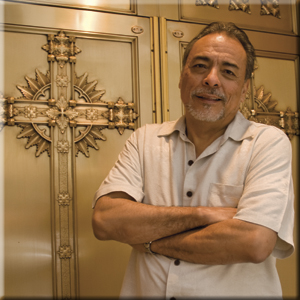
The key to a thriving parish is not so much what goes on inside, says this longtime pastor, but what its members are doing beyond its walls.
In his book Excellent Catholic Parishes (Paulist), Paul Wilkes singled out St. Pius X Parish in El Paso, Texas as "not only one of the most outstanding Hispanic parishes in America, but one of the best [parishes], period. With hundreds of members solidly trained as lay leaders, new ministries springing up virtually weekly, and liturgies that appeal to everyone . . . , this parish indeed serves as a ray of hope for Hispanics and for the church at large."
Ministries at the parish include not only standards such as the St. Vincent De Paul Society and a thriving Catholic grade school, but also outreach to those with HIV, a ministry caring for children detained by the U.S. government for crossing the U.S.-Mexico border without papers, and many others.
The parish took on this character after Msgr. Arturo Bañuelas arrived in 1988. By treating parishioners "like adults instead of children," Banuelas encouraged them to take responsibility for their parish. "The needs are there and the gifts surface," he says. Each person in parish ministry is trained, so that parishioners can speak confidently about their faith. As well as founding the Tepeyac Institute, El Paso's diocesan formation center, Banuelas is also nationally known for his work on border issues.
And can you think of any other pastor you know who allowed himself to be overruled by his parish council?
If I were a newcomer to your parish, what would I notice?
One of the things most people notice right away is a very strong sense of community. They notice how many people are involved in a creative, vibrant liturgy; they notice in the announcements the tons of activities that are going on. They would notice a very strong sense of mission: a lot of involvement in the community of Juárez across the border in Mexico as well as in El Paso, and a strong focus on social justice.
They would notice how welcoming and how comfortable everybody is with both English and Spanish-that there's no tension in the community over that, even though we have people who speak no English at all, people who speak no Spanish at all, and people who are comfortable in both.
They might also notice that our facility architecturally highlights the beauty and spirituality of a border community. It's not a church that you would build in Boston; it's a church that reflects and lifts up the spirituality and the history of our Hispanic culture and heritage.
How has the parish changed in the time you've been there?
When I got there, we noticed that we had to encourage some significant shifts in how parishioners saw themselves as laypeople, the way they saw the priest, and their idea about the mission of the church. This shift, I think, is at the core of why we've grown.
Before I arrived, parishioners saw the parish as a place you went and got your obligations fulfilled so you could go to heaven. Half of the church would leave after Communion. They didn't own their parish, and they had no identity as a community. Some people didn't even give the sign of peace because they didn't know the folks around them.
What changed?
The major theological shift came when they started seeing that because of their Baptism they had a role in the life and the mission of the church. We had to work at shifting that mentality-that it is not the priest's church or the pope's church only. It is their church.
Building relationships was really important, but I think the major shift came when the people started to see that they were not volunteers but that they were called to a ministry. They don't "come and help Father"; it's their church and they have a role. What shifted in me, and I think in them, was realizing that they're not children. We started treating them like adults instead of children. My job is to keep calling them to be mature adult Catholics.
People start recognizing that they have gifts, and they have to use them to serve others. When that mentality started to bear fruit in the community, my job became to get them training. We have 2,200 people trained in some form of ministry in the parish. Everyone who ministers is required to go to the Tepeyac Institute in El Paso, which trains people in lay ministry.
We also require every minister to have a community experience of Christ together, which we call an evangelization retreat. After a certain period of ministry, you have to attend another retreat and get more ongoing training. That's changed the character of our parish tremendously because the laity started seeing themselves as ministers in their own right with their own gifts. The Spirit is working, and you can see that the church comes alive.
Other parishes often ask us to send over our evangelization team or other parish teams. They see that we have trained people, and they use our people to get their own parish started.
We've heard of parishes that were told, "If you think you own this parish, you're operating out of a congregational model that is not Roman Catholic." How do you answer that kind of criticism?
The answer is that Vatican II works. I wouldn't call it congregational, I would call it collegial. Collegiality does work, you know. In our parish the ministry council makes decisions for the parish. They're not a consultative group to the pastor. They make decisions and they can outvote me, and they have. They can't sell the property, and they can't change canon law, but in the actual running of the parish the ministry council, made up of the heads of each ministry in the parish, meets monthly to have supper and to make the decisions for the parish.
Have you ever been overruled?
Yes. The parish ministry council wanted to build a community center and more offices. I was not in favor of this because we had just finished paying off our debt. The people said, "We need it." I said, "Give me a chance to explain why we shouldn't be building," and they gave me a chance.
I explained and tried to persuade them. When they voted, it was unanimous to build the center. They said, "Father, it's our community; we need to do this." Then I had to work with them and own it myself.
If its members "own" the parish, how does that affect your vote?
When I first arrived, we had identified some priorities for long-term planning, and the ministry council met to talk about them. I wanted to show them that ministry had to be part of who we were, that each of us makes Christ present in our own ministry.
I wrote a fake letter, and I told the council that it was from the bishop. The letter said, "In six months you will not have a resident pastor. A priest might come every so often, but you won't have a resident priest. So work out a pastoral plan, and then I'll come back and talk with you."
The president read the letter, and everybody was real silent, wondering what to do next. But right away-and this was, for me, a blessing and a great lesson-the president said, "OK, let's see. Sally you're in charge of liturgy, so you're going to do the Sunday services. So-and-so, you're going to have to take care of the youth." And so on.
They had no problem, because of the gifts that were there. They were taking deeper ownership.
Then it dawned on me, What are they going to do when the priest comes? I wrote a note with that question and passed it to one of the council members, who read it out loud. There was silence.
That made me think, what is my role then? I realized the reason we can't have that beautiful church that they had been planning is because they have a priest, and that hit me hard. I thought, maybe my role is to get all these gifts here to do their work, even though we're limited, in some sense, because of the hierarchical structure and tradition that we have.
The ministry council answered the question by saying, the priest can make sure that we're on the right path, that we're following the tradition.
Do you see a push-back against that model of parish?
When you're in our parish, it doesn't sound fearful, but I could see some priests feeling threatened. I had a conversation with a priest who said, "What you're promoting is that we're no longer going to need priests in the future. You're telling everyone that they're all priests." That's not really what we're promoting, and I could see why that would be a threat. I said, "Well, the people are priestly, but I don't think that I'm promoting that we're not going to need priests."
I can see how some priests might feel threatened in terms of relating to adult Catholics. If you're clerical, you just do what Father says. But if you have a lot of strong laypeople who are leaders, then you have to sit down and listen to them and perhaps be told what's best for the parish. Who wins? The church wins, the parish is better. I would rather have that model of priest, because it strengthens the community.
I'll give you one example that shows the shift in the parish. When I first got there, the Confessions were all about the typical sins. Today I hear people say, "Father, I haven't been involved in ministry." When somebody comes to Confession and says, "I feel bad because I haven't been doing anything to help the poor," that signals a whole different way to see church. I can see some people being threatened by it, but it's going to happen and we can't push it back.
How did you end up with so many ministries?
We didn't make a list of what ministries we wanted in the parish. For example, we realized that there was nothing in the city for immigrant children. More than 100,000 children are caught by the border patrol each year as they try to cross the U.S.-Mexico border, some of them as young as 4 years old. We minister in two of the detention centers. We got 40 people signed up for training so we could do that ministry.
People come up and say, "You don't have anything for cancer patients here, and we happen to be nurses who are trained in grief work." Vamonos, let's go. The needs are there and the gifts surface.
We have the usual ministries like St. Vincent De Paul Society, but we also minister to the colonias, residential areas along the border that lack some of the most basic necessities like water and electricity. We have missionaries that go to West Texas and to Chihuahua, Mexico.
People see that it's not just about charity but also about-as difficult and complex as this is-trying to change the things that cause people to suffer. Both justice and charity are important.
Our parish has evolved a lot on immigration issues. We have banners outside, one of which reads, "Justice has no borders."
Obama's border czar, Alan Bersin, came to our parish for a border conference. I am happy that finally Washington is listening to voices from the border.
Is there room in your parish for people who don't agree politically with the views of the majority?
When we took a stand against the border fence and spoke against the Minutemen along the border, I had one parishioner say to me, "But Father, they're the best patriots we have." He comes to church every Sunday. We're very clear that we disagree, but we can disagree and still be a community.
We're next to a military base, which we have a very good relationship with because many of its families send their children to our Catholic school. Having a lot of military people in our community made it a challenge to talk about the Iraq War. Every Sunday we'd have blessings of young men and women going off to serve. We would repeat each time what the church teaches about these wars in particular and at the same time ask God to protect the soldiers.
Some people have left, of course, but we have standing room only every Sunday. The people who want a 25-minute Mass, they're not coming to St. Pius.
At some point you have to have a parish for people who want a way to be adult Christians. People who are looking for a deeper sense of church feel very comfortable at our parish.
Does this change in the parish show up in the liturgy, or did it come from the liturgy?
Whether you do service with the poor has a lot to do with how you understand Eucharist. When you have parishioners visiting the poor who have no water and who can't pay the bills, sitting with people in hospitals who are dealing with life and death questions, caring for people who have HIV, working with people with disabilities-when you're experiencing Christ in those moments, your predisposition for the liturgy is going to be much greater.
The more you're involved, especially with the poor, the greater your hunger for spirituality grows. The more you're involved with hopeless situations, the deeper you look for meaning in your life. Somehow the liturgy makes more sense-the washing of the feet, the cross of unconditional love, the hope of the Resurrection.
Why?
I think solidarity with those who struggle daily to survive is the call of the gospel in our day. Solidarity with the poor is not for a small group of social justice activists-it is the very identity of what a parish stands for. When a parish journeys with those who struggle to survive and those who are poor, it will inform their vision of their spiritual life and inform their identity as Catholics.
I've seen more and more in our parish that convinces me that we are all missionaries. Not that we all go to Latin America or Africa, although some of us do. But being a missionary is being sent out to make a credible presence of Christ. The poor are the ones who teach us how to do that. They don't have a lot to give us in terms of money or gifts, but they have a way of living that calls us to look more deeply at values that are important to us as Christians.
The poor aren't all good or saintly people, but the very fact that they live in hopeless situations calls us to ask whether our own lifestyle is gospel-based or materialistic. It makes us hungry for a deeper spirituality and makes us wonder if we're living shallow, artificial lives. The poor are saying: yes, you are. They're not saying that in words, they're saying that because we got out of our comfort zones and visited people in areas where there's no water and no electricity, where you have to shower with a bucket.
That call of solidarity transforms you and gives you a desire to grow spiritually as nothing else does. You cannot find that at Wal-Mart. The poor teach you that. I think that journey has been what gives character to our parish community.
The mission is what enriches our sacramental life. I don't think I've found anything more powerful in my own priesthood.
Do you have any concerns that the next priest who comes into your parish will be unlikely to act like that in a similar situation?
Yes, I do. However, the bishop has a keen sense of the pastoral needs of the diocese and our parish, and I believe that he will act accordingly.
I also think our laity, over the years, have become mature enough that they would somehow sit with the new priest and say, "You know what, Father, we tried that."
This article appeared in the November 2009 issue of U.S. Catholic magazine (Vol. 74, No. 11, page 28).
Read more from Msgr. Arturo Banuelas on going beyond a Euro-centric church.