

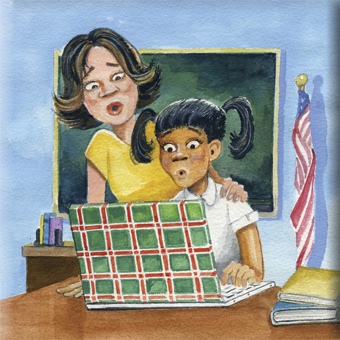
How would education expert Father Joseph O'Keefe, S.J. reboot Catholic schools if he could start from scratch? In a time and place not so far away, O'Keefe has imagined a Catholic school utopia where everyone is plugged into the same mission.
For many years, Nearfutureville was a just small desert town with very few Catholics. Today, it is emblematic of the Catholic Church in the United States, with migrants from the Northeast and Midwest and immigrants from every part of the globe. Its Catholic population includes a few extremely wealthy entrepreneurs, a significant number of middle-class professionals, and many lower-income people who mostly work in the service industry.
Three years ago, the bishop of the newly established Diocese of Nearfutureville, convinced that Catholic education is the best way to foster faith, established an innovative network of schools. When diocesan leaders reflected on how well their Catholic education had prepared them for leadership today, they realized that they had to prepare young people for leadership in 2050. "What will the world be like then?" they wondered. "How can we prepare young people today for what they will face tomorrow?"
Diocesan leaders knew that they had a golden opportunity to be visionary pioneers; they wanted to complement the best of the past with cutting-edge innovations to prepare for the future. They identified three distinctive elements of their educational enterprise: fostering 21st-century thinking skills, sustaining vibrant faith communities, and being anchored in and anchoring the greater community.
Yesterday's schools cannot provide the knowledge and skills that will be needed by those who will be society's leaders in the mid-21st century. In the past, schools transmitted knowledge in routine and often fragmented pieces through courses and written materials five days per week for 180 days in an academic calendar created to accommodate an agricultural society.

Over the past decade, discoveries in neuroscience and cognitive psychology reveal that traditional ways of organizing curriculum and instruction fail to provide optimal learning experiences. Schools today need to foster creativity over rote memorization, differentiated learning rather than one-size-fits-all, problem solving over quick right-and-wrong answers.
Along with advances in our understanding of the way the brain processes knowledge are dramatic changes in the way knowledge is passed on. Information about anything is just a Google search away, and heavy encyclopedias and newspapers are being replaced by Wikipedia, news websites, and blogs. School libraries are not so much physical places that own books and journals; they are virtual sites that provide access to e-books and e-journals.
More than transmitting knowledge, schools must give students the ability to sort, to evaluate, and to synthesize the knowledge that is constantly at their fingertips.
Schools must be nimble and creative if they are to meet the needs of the 21st-century workplace. Sadly, public school systems-with teachers' unions, highly politicized school boards, and centralized bureaucracies-too often stifle creativity. The stagnancy of public education has given rise to charter schools, which are more responsive to contemporary needs. But they too are often straitjacketed by high-stakes tests based on state-mandated curriculum frameworks.

Catholic schools certainly have challenges but they are relatively free from bureaucracy, and unlike charter schools they have a long track record of academic integrity. In other words, Catholic schools are uniquely poised to meet the needs of 21st-century learners.
Catholic schools today must be more than a building. Through government grants, corporate contributions, and private donors, Nearfutureville Catholic Schools expand the "walls" of the school by providing every student a laptop, and they ensure that every home has wireless capabilities. Courses for all students, from kindergarten through grade 12, are a blend of in-class and online activities, and the divide between schoolwork and homework gradually has disappeared. Home is as much of a learning space as the school building but, paradoxically, the need for the school building has never been as great.
Public schools and charter schools can well afford to buy the infrastructure and human resources required to build such 21st-century educational institutions, but they lack the faith-based grounding to teach young people to discern what is worth knowing in a vast ocean of information and unlimited virtual possibilities.
While reading the signs of the times, educational leaders must remain faithful to the primary goal of a Catholic school: passing on the joy of a Catholic way of life to the next generation, Catholic and non-Catholic alike. At the heart of the Catholic way of life is community, and while much relationship-building can happen online, there is no substitute for being physically present to each other.
The Catholic leaders of Nearfutureville are pleased that they have focused most of their attention on the spiritual development of the adults who work in the schools. They were careful to hire for mission. Even though they hired some non-Catholics, every person, from principal to custodian, is enthusiastic about the religious character of the schools.
The schools promote a Catholicism that brings the tradition to life in a joyful and vibrant way. The religious art depicts heroes of the tradition, contemporary and ancient, and intentionally reflects the multicultural reality of the Catholic Church. The atmosphere echoes the rhythms of Catholic life, its stories and seasons.
Laypeople have a central ministerial role, having been prepared to lead public prayer, reflect publicly on scripture, and offer spiritual counsel to peers, parents, and pupils. Local clergy, freed from management, have more time and energy to minister in frequent sacramental celebrations. High school students work on catechetical programs for younger children as well as acting as peer ministers.
All of the staff members do annual retreats to reflect on their own vocation and the collective vocation of the school community. Are they people of hope? Are they passionate about what they teach, and is that passion rooted in their experience of God? Do they respect and care for each other as adults in the school? Is their community marked by forgiveness, mutual concern, and tough love when needed? Do they love those who aren't very lovable? Do their priorities reflect solidarity with the poor, the oppressed, or anyone in need? Does their behavior witness to a belief in God?
Of course, no one on this side of heaven could give an unequivocal yes to any of these questions. But these are the building blocks for the kind of vibrant religious community that the next generation will find attractive and compelling.
It has often been said that knowledge without virtue is dangerous, and virtue without knowledge is ineffectual. Nearfutureville Catholic Schools endeavor to provide young people with a sophisticated understanding of scientific and technological developments that will have an impact on how we define human life. Those who will be leaders in 2050 will face a number of pivotal questions-about the beginning and end of life, genetic engineering, cloning, ecology, economics, and politics-that will demand both knowledge and virtue.
In seeking to provide a strong moral compass, the educational leaders take as their guiding principle the dictum often attributed to St. Francis of Assisi, "Preach the gospel always; use words when necessary." In the Nearfutureville Catholic Schools, teachers and staff don't just talk the talk; they walk the walk.
It takes an entire village to educate a child. Catholic schools have an incomparable strength in their ability to build and sustain a strong multifaceted community. Sociologist James Coleman found that students do well in Catholic schools because they experience a sense of belonging, cohesiveness, and connection. This is the legacy of the traditional parish school. Catholic schools still excel at building community.
Children bring to school an array of issues that can impede intellectual growth and faith formation. At times, these issues are medical, and those from low-income families may go without the services. The administrators of Nearfutureville Catholic Schools have formed strong working relationships with hospitals and clinics not only to provide medical attention to individuals, but also to devise curricula and activities to promote healthy living for families.
Sometimes children bring emotional or psychological challenges to school. Nearfutureville Catholic Schools work with social service and mental health providers to offer individual and group therapy and also to help teachers and families create wholesome environments in school and at home.
And while all children in these schools are immersed in Catholic culture, not all of them are Catholic. Nearfutureville Catholic Schools have strong, cordial relationships with local clergy from other faiths and provide opportunities for students of all traditions to find common ground.
Educators in Nearfutureville espouse the idea, "Think globally, act locally." They recognize that they are members of a family of Catholic schools, 120,000 strong, that encircle the globe. Each school has a twin Catholic school in a developing country. There are occasional exchanges and study trips, and via videoconferencing and other technologies, there are cyberspace "pen pals," classes taught collaboratively, and teleconferenced worship.
The schools are preparing students for a world where economic and political forces will require them to be not only good citizens of the United States but good global citizens. The Roman Catholic Church is the most expansive and richly multicultural organization in the world. Nearfutureville Catholic Schools take full advantage of this invaluable niche.
Most Catholic schools traditionally function as islands unto themselves. In Nearfutureville they knew that, unless they partnered with an array of institutions, they could never face the daunting challenges of educating in faith for the 21st century. Wisely, they anchored the schools in the community. They also knew that partnerships are, by their very nature, reciprocal; if these schools were to be anchored in the community, they must be anchors for the community.
Each campus is open from early morning to late evening, all year round. Intergenerational educational initiatives abound, including classes to learn English, parenting, and life skills; GED classes; educational programming for the elderly; and ongoing theological education. A variety of groups meet in the schools-12-step programs, parish councils, youth groups, and civic organizations. Diocesan leaders ensure that their schools are exemplary neighbors committed to the betterment of all of the citizens of Nearfutureville.
This enterprise, of course, is very expensive. How do the schools of Nearfutureville avoid the financial disaster that so many Catholic schools-900 of which have closed since the year 2000-have experienced?
Before founding their schools, Nearfutureville's diocesan leaders scoured the country to find best practices in other dioceses for sustaining good fiscal health. They knew that they had to take a multifaceted approach to school financing.
One diocese had success at tithing because of a long and compelling campaign to change the way Catholics think about the weekly collection. But that would not be enough.
Though the U.S. Constitution prohibits the direct funding of faith-based schools, government funds are available. U.S. Department of Education grants are often left untapped by Catholic educators, but they learned that in successful dioceses, skillful administrators were able to identify government funding opportunities and negotiate the complexities of the proposal process.
Nearfutureville administrators did the political groundwork to minimize competition with the public sector. Politicians are advocates of children in all schools. Collaboration provides other resources that help to sustain Nearfutureville schools: transportation, textbooks, and nurses for children both in public and Catholic schools.
The leaders of the Nearfutureville diocese knew that the days of bingo and bake sales were in the past. When they launched their schools, they invested heavily in development activities. Each school has an annual fund that attracts local philanthropists, Catholic and non-Catholic alike. Without an alumni base, Nearfutureville schools tapped into a donor base of people who had attended parochial schools elsewhere.
While high participation rates in annual funds are very important, it is major gifts that make a real difference. Leaders of the Nearfutureville diocese learned that Catholic schools cannot survive without strong and active boards. Board members will not invest significant resources into the schools if there is a "pray, pay, and obey" mentality or if the commitment of the clergy and administrators is one of "contrived collegiality." They must be true partners with clergy and administrators in forming vibrant institutions. In Nearfutureville, the board members make the schools their most significant charitable cause. The schools have begun to build endowments because of these major gifts.
Leaders of the Nearfutureville diocese also know that successful development is a long-range effort. They launched a successful estate planning venture which will have a major impact for generations to come.
Philanthropy comes in services as well as dollars. Entrepreneurial school leaders leverage local businesses for a range of services at reduced price and they exercise economies of scale through common purchasing. They counterbalance lower teacher salaries creatively with subsidized housing, opportunities for reduced-rate or pro bono services from Catholic physicians, attorneys, and other professionals, and guaranteed tuition discount at Catholic colleges that want visibility among the growing population of 18-year-olds in Nearfutureville.
The creative and entrepreneurial leaders of Nearfutureville Catholic Schools are able to sell a compelling vision of what a Catholic school can be. Parents and grandparents, Catholics without children, corporations, foundations, and local businesses provide high levels of support because they believe that something unique and tremendously important is happening in these schools. These philanthropists care deeply about the future of Nearfutureville and they know that education is the only way to prepare today for a bright future tomorrow.
The emblem of Nearfutureville Catholic Schools is fitting: a tree with strong, deep roots and with broad branches, old and new, that flower afresh each year. Without deep and strong roots in the tradition, Catholic schools could not exist. But without branches that reach into new places and buds that flower afresh with every generation, they will not be able to accomplish their noble mission.





Add comment