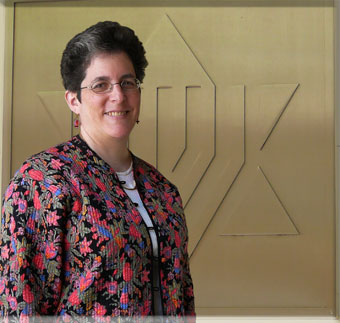
In one of her Boston College courses, Rabbi Ruth Langer traces anti-Judaism through Christian texts. “My students are shocked to hear the kind of language that appears in earlier texts,” says Langer, associate professor of Jewish studies and the associate director of Boston College’s Center for Christian-Jewish Learning. “They don’t know these traditions of pre-Vatican II thinking.”
Her students’ shock demonstrates the two sides of Catholic-Jewish relations today. On one hand, “there’s been a seismic shift in the Christian world” in the attitude toward Judaism since the Second Vatican Council, Langer says.
On the other hand, many aren’t aware of the legacy of anti-Semitism. History can help Catholics understand the recent controversies between Catholics and Jews, such as the outcry after Pope Benedict XVI lifted the excommunication of a Holocaust-denying bishop from the Society of St. Pius X.
Between such missteps and a lack of progress at the theological level, it could be easy to be pessimistic about Jewish-Catholic relations. Still, Langer says it’s her service as a rabbi to teach Boston College students about Judaism.
Langer, who spoke with U.S. Catholic soon after Benedict’s trip to the Holy Land in May, likes to see Judaism and Catholicism as siblings who don’t always get along. “They like each other more and more, hopefully, as they get older, and there’s a sense of shared roots and parallel growth.”
Coming off Pope Benedict XVI’s trip to the Holy Land in May, what’s the status of Jewish-Catholic relations?
You have to look at the broader scene of the last two or three years. There’s been a series of miscommunications and misunderstandings. First Pope Benedict extended permission to use the pre-Vatican II Latin Mass, which includes a Good Friday prayer for the conversion of Jews. This year he lifted the excommunication of four bishops of the Society of St. Pius X, including Bishop Richard Williamson, who denies that 6 million Jews were killed in the Shoah (Holocaust).
Then the pope goes to Israel as part of a very complex pilgrimage. During that week he obviously visited Catholic sites. He visited Jordan. He visited Israel proper, which is not insignificant at all, and he visited a refugee camp in the West Bank as well as the separation barrier that runs through it.
In the context of all of this there was a bit of suspicion built up: Does Pope Benedict really stand behind Nostra Aetate, the Second Vatican Council’s declaration on the church’s relationship with non-Christian religions, and the subsequent documents? Is he willing to go beyond superficial reconciliation between Catholics and Jews?
What do you mean by superficial reconciliation?
To give an example from a few years back, while discussing Mel Gibson’s The Passion of the Christ (Icon Productions) with Boston College students, the term anti-Semitic was used. I had students who said, “I resent this conversation. You are accusing me of being anti-Semitic. I know that anti-Semitism is a sin. I am not an anti-Semite.”
It became clear in the course of the conversation that the students didn’t know what anti-Semitism is. The superficial reconciliation is “I know that I’m not supposed to say nasty things about Jews.”
In the Middle Ages, Passion plays were often performed on Good Friday and were accompanied by rioting against the local Jews. There was a history of seeing this kind of play and then taking action based on it. Gibson’s movie was, in effect, a big-screen Passion play.
The students might not know that much about theology, and they can’t begin to assess when something could lead to anti-Semitism, let alone is anti-Semitism within the heritage of almost 2,000 years of Christian anti-Judaism. The serious theological problem of anti-Semitism gets blurred over with, “I know so-and-so who’s a Jew, so Jews are okay.”
What is anti-Semitism and how is it different from anti-Judaism?
Anti-Semitism is a racial prejudice against Jews, and it was only named in the 19th century. Preceding that we tend to talk about anti-Judaism, which is prejudice against Jews because they made “wrong” religious choices.
That idea led to the early church’s accusations against Jews, such as: Jews are blind to the truth of Christ; Jews are eternally guilty for killing Christ based on the passage that says, “His blood be upon us and our children” (Matt. 27:25).
Then you get into popular suspicions of Jews in the Middle Ages desecrating the consecrated host. Jews were accused of kidnapping and killing Christian children because they needed their blood in order to make the Passover matzah. Jews were blamed for poisoning the wells and causing the bubonic plague. All of these were libels that were patently false, but this was part of the medieval imagination.
This way of thinking about Jews and Judaism stretched into the 20th century. There were blood libels in the 19th century, including an accusation against Jews in Atlanta in the 1920s. It’s not just deep, dark history.
How did this relationship change?
The Second Vatican Council was a point of revolution. It changed the way Catholics and other Christians understood Judaism, and it has spun off a series of additional documents since then. You have the basic understanding that comes in a rather inexplicit way in Nostra Aetate that the Jewish covenant with God is valid. Pope John Paul II later said that quite explicitly in a speech, so it can be quoted with authority.
One also looks to Pope John Paul II’s series of symbolic gestures. He went to the synagogue in Rome as a brother. He went to Auschwitz as a pilgrim, and most significant in my mind was his visit to the Western Wall in Jerusalem.
When Jerusalem became Christian in the fourth century, there was a transference of its center of holiness to the Church of the Holy Sepulchre from the Temple Mount, which Christians used as a garbage dump. By worshiping at the Western Wall in Jewish form-putting a note in the wall-Pope John Paul II acknowledged the holiness of the site in a way that was immensely powerful.
Now Benedict did every single one of these things, too, but he’s following. These are the positive steps, but then there have been bumps, including during the papacy of John Paul II.
What’s an example of a bump during the previous papacy?
One example is that Pope John Paul II canonized Edith Stein, a Jewish woman who converted to Catholicism and was killed in the Shoah, in many ways as a Jewish saint. This was extremely uncomfortable because Jews aren’t neutral about people converting out of Judaism.
That’s a subtext here. It was part of the church’s evangelizing mission that Jews don’t really have a right to exist as Jews within Christian society. Jews were formally put under conversionary pressure by the church from the 13th century on. I have a relative who was probably kidnapped into a convent in the early 20th century in Poland and only found her family 50 years later.
The Jewish community is small and has never recovered its numbers since the Shoah. There are about 12 million Jews in the world now. That’s about what Hitler left. People who convert out of Judaism have traditionally been considered real traitors to the community.
Did the Shoah make the issue of conversion all the more significant?
On this point, the Shoah made a larger impact on Christians than Jews. Jews have always been threatened by these really energetic attempts at conversion.
Our two traditions view the ideal community differently. Judaism is the religion of the people of Israel, defined not by ritual or belief but by birth. But Jesus says to go out and baptize people from all nations and make them Christian. The ideal community is universal. In the wake of the Shoah, though, many Christians saw a reason to step back from evangelizing Jews.
Why shouldn’t Catholics want Jews to convert if Jesus is the savior?
The question is, “Is Judaism itself something good, something that God intends?” If so, there is no need for Jews to become Christians to be saved, as implied by the teaching that God’s covenant with Israel is valid. On the other hand, in Christian theology salvation comes only and universally through Christ.
Catholic scholars are working to propose theological solutions to this contradiction with participation from Cardinal Walter Kasper of the Pontifical Commission for Religious Relations with the Jews.
A 2002 statement emerging from a dialogue between U.S. bishops and American Jews, “Reflections on Covenant and Mission,” expressed deep sympathy for both sides of this conundrum. But the U.S. bishops released a statement this summer saying that a theology that disavows mission to the Jews is erroneous, and that Jesus fulfilled the old covenant and thus salvation is found only through Christ.
Speaking personally and frankly, such a stance is destructive to dialogue. If I know that my partner does not respect who and what I am-and, even more, is seeking to change me-I’m not going to enter into that conversation. If there are not two equal parties at the table, it is not dialogue.
How does this play out in the controversy surrounding the Good Friday prayer for the Jews?
In 2008 Pope Benedict XVI released a revision of the 1962 Latin prayer from the pre-Vatican II liturgy, but it still prays that God illuminate the hearts of the Jews “so that they may recognize Jesus Christ, the savior of all men.” It continues, “Almighty and everlasting God, you who want all men to be saved and to gain knowledge of the truth, graciously grant that, as the fullness of peoples enter into your church, all Israel may be saved.”
The revision got rid of the language from the 1962 prayer about removing the veil from the hearts of Jews and the blindness of Jewish people, but it’s still a prayer for the conversion of the Jews. From a Jewish perspective, a prayer for our conversion is a prayer for our annihilation, not for our salvation.
Kasper published an article in the Vatican newspaper that said that the intent of this prayer is eschatological, meaning it points to the end times and should have no impact on immediate evangelization of Jews. There’s a joke in Jewish-Christian dialogue circles that when the Messiah comes we’ll ask him whether he’s been here before or not, and then we’ll know.
To push the question off to the end times is not a bad solution, but the problem is that nobody says during the Good Friday liturgy, “If you understood what we said in Latin, you really aren’t supposed to act on it or take it as a basis for your attitude.”
What does it do for a Catholic to hear this on Good Friday?
If you subscribe to lex orandi, lex credendi (what you pray is what you believe), there’s a problem with that prayer. The ultimate goal of a liturgy is to form people’s faith.
When you rewrite and revise prayers as Benedict did, you have an obligation to revise them in a way that is theologically acceptable. The 1970 prayer in Latin, from the liturgy after Vatican II, is theologically beautiful. It’s a prayer that Jews be better Jews. I’m not sure why they didn’t use it.
Do you think it could have to do with mollifying the Society of St. Pius X?
The basis for extending the permission to recite the Latin Mass more broadly was Pope Benedict’s desire to heal the schism between the Society of St. Pius X and the Catholic Church.
In 1988 Archbishop Lefebvre ordained four bishops without getting permission from Pope John Paul II, and that was grounds for excommunication. The society opposes some of the teachings of the Second Vatican Council and sees itself as the true Catholic voice of tradition.
That’s been an issue for Pope Benedict, and he’s been trying to reach out to this community to heal this schism, which is why he lifted the excommunication of the four bishops.
What was the Jewish reaction to Benedict’s move?
It was soon discovered that one of the bishops, Richard Williamson, denied the extent of the Shoah. Those who checked the group’s website immediately after the story broke found a lot of disturbing anti-Semitic statements and rejections of Nostra Aetate and the Second Vatican Council.
I don’t think the Jewish community really understood the motivations for healing the schism. The Jewish community also did not understand what lifting of excommunication means. The popular perception was that bringing someone back into communion means blanket forgiveness-you’re back on good terms and considered a good person.
It was actually a technical step. It brought them back into communion with the church but did not give these men permission to act as priests or bishops.
As Pope Benedict eventually made very clear, these four bishops are going to have to accept not only the teachings of the Second Vatican Council but also the teachings of the church since the Second Vatican Council-particularly in terms of Catholic-Jewish relations.
It’s also become increasingly clear since then, particularly during his visit to Israel, that Holocaust denial, although itself not grounds for excommunication, is unacceptable.
Is Holocaust denial a bigger issue?
Holocaust denial is very dangerous, especially when it’s in the hands of somebody like Mahmoud Ahmadinejad, president of Iran. He’s not only denying the Holocaust, he’s threatening another one. He doesn’t seem to care that a nuclear assault on Israel would devastate the Palestinian community as well. The international Jewish community very much sees Holocaust denial as a threat.
How prevalent is Holocaust denial?
I don’t know that Holocaust denial is prevalent in America. In Europe it’s a crime. But a study conducted by the University of Haifa found that 40 percent of Israeli Arabs deny the Holocaust. It has become tied up with anti-Zionism and denial of the right of Israel to exist as a Jewish state.
How do you untangle all of the political issues around Israel when it comes to Catholic-Jewish dialogue?
To exclude Israel from the Catholic-Jewish dialogue is to dialogue only with part of Judaism. Israel as a manifestation of healthy Jewish life in the Holy Land is an integral part of Jewish theology and Judaism as a religion.
There is no idea of having separate religious and secular realms in Judaism or Islam, as there is in Christian thinking. We have to deal with the tangled mess, and we do have a tangled mess. There’s no question about that.
How did Pope Benedict deal with the political situation on his trip to the Holy Land?
I think the pope did a pretty good job addressing this in his parting speech at Ben Gurion Airport. He said, “Let it be universally recognized that the State of Israel has the right to exist and to enjoy peace and security within internationally agreed borders.”
That was a critically important statement. Internationally agreed borders don’t exist right now. We have ceasefire lines, and peace and security means no rockets being lobbed over those borders.
The pope followed with, “Let it be likewise acknowledged that the Palestinian people have a right to a sovereign independent homeland, to live with dignity and to travel freely.” That was a balanced statement.
I don’t have answers to this particular problem. I’m not personally even optimistic that others can find the answers; I hope they can. If you start off with a commitment to the rights of these two peoples to live in peace and security as neighbors, we have a beginning. The majority of Israelis would like to move in that direction. It’s not a huge majority, but it’s a majority.
How did the Jewish community react to the pope’s criticism of the separation barrier and the condition of the Palestinian refugees?
I haven’t seen much reaction to it. In a sense it was inevitable that he went there. He could not have omitted paying attention to Palestinian concerns.
We know people are living in a tragic situation, but solving that is not trivial. It takes an effort that goes well beyond what Israel itself can do. At the moment the only thing Israel could do to solve that situation is to cease to exist, and I’m not sure that would solve it either. The harsh way of saying it is the people in the refugee camps have been held hostage for 61 years.
Will there always need to be a separation wall?
Sometimes borders need to have walls, especially when there are people crossing them who are looking to kill other people. I was in Israel in 2001 and 2002 during the Intifada. We missed being killed by 24 hours twice. You can’t live like that.
The question of where the wall is going to be is quite different from there being a wall or at least a marked border that people don’t cross without identification. We don’t cross between here and Canada without our passports.
Do you think Pope Benedict could help bring peace to the Holy Land?
The theme of Pope Benedict’s trip was his call for peace. The text of the prayer that he put in the Western Wall was a prayer for peace, and if you look through his speeches from the trip, it was a recurring theme. Probably the most quoted line of his parting message was, “No more bloodshed. No more fighting. No more terrorism. No more war.” That’s a prayer for peace.
Still, he didn’t successfully bring together all sides. At best his meeting with faith leaders in Nazareth offered a symbolic gesture of unity. The superficial has to come first, but how do you go deeper?
Are Jews confident in Pope Benedict as a Jewish-friendly pope?
Not entirely. I think it’s been very hard to read him. The Jewish community puts a lot more faith in actions than in sort of vague theological statements. Were the pope to mandate that there be teaching about Judaism in every seminary curriculum, that would be a concrete action. Whereas to say “we absolutely affirm the teachings of Nostra Aetate,” what does it mean?
The Yiddish word is tachlis-something that’s really there. Since there have been on the one hand some good abstract statements but on the other hand some real, concrete missteps, I think that the jury is still out.