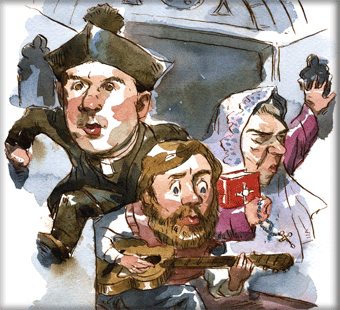
We are one church and we need just one Mass, this Catholic argues-even if that one Mass is celebrated in any number of languages.
At one end of the archdiocese where I live, a Mass is held in a gymnasium every Sunday, and a group of lively folk musicians accompany the assembly through a relaxed and informal liturgy. The mood reflects the music. Because it’s a gym, children seem to act less restrained, feeling free to roam a bit. Folding chairs are set up in a semi-circle around a portable altar that this group has used for many years.
There are no kneelers, of course, reflecting to some extent the impracticality of portable kneelers, but reflecting to a greater extent the theology of those gathered: These are “looking up to God in trust, not bowing down to God in fear” Catholics, nurturing a view of church and theology that was born at the Second Vatican Council.
I know many of these Catholics and consider them to be very good people. Their liturgy is, I believe, a scandal.
At the other end of the archdiocese, a priest adorned in shimmering vestments murmurs prayers in Latin, facing the tabernacle, his voice barely audible to the assembly of worshipers kneeling behind him. Many of these are silently and privately praying the rosary. At certain moments there is an exchange of words between the priest and the assembly. These words are in Latin.
The atmosphere is reverent, reflecting to some extent the mood naturally created by silence, candles, and Latin, but reflecting to a greater extent the theology of those gathered: These are “kneeling before God in awe, not back-slapping brother Jesus” Catholics, preserving a view of church and theology set aside at the Second Vatican Council.
I know one of the people in the assembly to be one of the finest human beings alive-my father-but his liturgy is, I believe, a scandal.
An outsider observing the two rituals Would never guess they belonged to the same church. And in fact, many of the participants at the respective assemblies might admit that they don’t really share a faith with the participants in the “other” group.
This is what makes these liturgies scandalous. They represent such polarized expressions of worship that they drift from the central purpose of liturgy as stated in the introduction of Sacrosanctum Concilium, the Second Vatican Council’s Constitution on the Sacred Liturgy: “to be a sign lifted up among the nations, to those who are outside, a sign under which the scattered children of God may be gathered together until there is one fold and one shepherd.” A church practicing such divergent forms of worship will hardly unite the scattered children of God.
Currently we are many folds under a shepherd who last year stirred the pot with his apostolic letter Summorum Pontificum (Of the Supreme Pontiffs), sanctioning wider use of the old Latin or Tridentine Mass. Besides allowing individual parishes to conduct Latin Masses at the pastor’s discretion, secondhand reports suggest that Pope Benedict XVI would like to see a Latin Mass offered at every parish. Upon hearing this, I felt a rumbling that I’m certain was Pope John XXIII, who opened the Second Vatican Council, rolling in his grave.
The problem with the gym mass is not the gym, or the folk music, or even the lack of kneelers. The gym liturgies I’ve participated in mostly adhere to the rite promulgated by the Second Vatican Council. The scandal is the fact that 100 yards from the gym, a splendid church sits where liturgy is celebrated by the other 90 percent of the parish every Sunday.
Once, when gym repairs required the gym Mass to move back into the regular church for a while, there was some talk that the gym altar should be moved in to replace the regular church altar. Two altars at one parish screams division to me: “Our church is not your church; our worship is not your worship; we are not you.” Such practices divide the Body of Christ-not the sort of thing those who led the council had in mind when they promulgated changes.
In the zeal that followed the council, many well-intentioned but liturgically ill-informed experiments cropped up in parish liturgies. Some progressive liturgies went too far and abused the intent of the council’s changes.
Many of these alternative practices have fueled the reaction of extremists who now want to rewind church history and drop us all back into a Bells of St. Mary’s world, as black and white as the cassock and surplice of a 10-year-old altar boy. At one end of our church, progressives dance to the beat of their very own drummer, while at the other end nostalgic traditionalists turn back the hands of time.
In my judgment, the progressive, alternative Masses are much less troubling than the return of the Tridentine Mass. As mentioned, gym liturgies are mostly faithful to the changes promulgated in the council. While they may cross the line at times, at least they seem to be reaching in the direction the council members were pointing us toward.
And let’s face it, my generation, the flower-power gang, is, well, beginning to push up daisies. Progressive liturgies are fading away as the jingle-jangle of our tambourines increasingly exits stage left.
But prancing in stage right are the Tridentine Troubadours, flipping the altar around and turning their backs to the monumental progress of the Second Vatican Council.
What is scandalous about this practice is not the Latin. After discussing the issue with theologians and liturgists Keith Pecklers, S.J. and Mark Francis, C.S.V., both independently made the distinction between the Tridentine Mass, celebrated by Catholics between 1570 and approximately 1965, and the post-conciliar rite practiced in the Latin language.
Pecklers explains that the church has, since the council, always allowed the use of Latin in the reformed liturgy. Saying the Mass in Latin is no different than saying it in Spanish or Polish or English.
The reformed liturgy is flexible enough to allow the use of Latin at times. Many parishes replace the “Lamb of God” and the “Holy, Holy, Holy” with the Agnus Dei and the Sanctus during the season of Lent. Besides being in complete conformity with the changes promulgated by the council, this appropriate use of the Latin can often deepen the spiritual tone of the liturgy and underline the gravity of the season.
But limited use such as this is far different from a complete 180-degree nostalgic return to an outdated rite.
The Tridentine Mass is not simply the current Mass (the one promulgated by Pope Paul VI in 1970) spoken in Latin. The Tridentine Mass, which dates from 1570, reflects a very different-and incomplete-understanding of the early church. Francis argues that “the 16th-century framers [of the Tridentine Missal] lacked adequate historical resources, as they were unable to refer to manuscripts dating earlier than the pontificate of Innocent III, around 1216.”
A church digging in its defensive heels at the peak of the Reformation developed the Tridentine Mass, taking shots at pagans, heretics, schismatics, and “perfidious” Jews. The rich revelation of the Old Testament is mostly absent, and the participation of the laity barely exists.
The Second Vatican Council had some very good reasons to call for an end to the Tridentine Mass and to promulgate a new rite. More sophisticated research uncovered a fuller understanding of how liturgy was celebrated in the early church. Improved scripture scholarship developed into a new lectionary with a wider selection of readings. Better historical research removed fictional saints from the liturgical calendar.
Perhaps most important for the average Catholic, the Mass was celebrated in the language of the people. Interestingly, while the Tridentine Mass began to be used in 1570, Masses were celebrated in Latin as early as A.D. 350. Originally, the Latin replaced Greek because people understood Latin, and using Latin allowed more people to understand what was going on. In 1965 the church once again came to the seemingly obvious conclusion that people should understand what is being said in Mass.
The Mass that emerged from the reform of Vatican II is wonderful, divine, human, and sublime. It works, and it is enormously superior to the Tridentine rite. We do not need to celebrate an old rite. We need to get more people to celebrate the existing rite well.
The stakes are high. We participate in the liturgy to praise God and to be transformed so that we can transform the world. We need to do this together. We cannot gather the scattered children of God together if we ourselves are scattered.
Feedback
All names and locations of contributors were withheld for their privacy.
The reason I’m for the wider use of the Tridentine Mass is . . .
I see its resurgence as a backlash against our popular culture, and I think those who like it should be able to attend.
All Masses are beautiful, and they all worship the same Lord.
We are all at different stages of our faith development and therefore have different needs.
I believe in having the choice. The Tridentine Mass should be available to Catholics who are interested.
It brings me closer to our Lord than the Vatican II Mass. I actually left the church for many years after the Mass was changed but have since returned with the “Catholics Returning Home” program.
The reason I’m against wider use of the Tridentine Mass is . . .
The ecclesiology is not right. It doesn’t seem to include the laity as part of the church. And let’s face it: Lots of the priests who celebrated the Tridentine Mass didn’t understand the Latin very well, either. Why celebrate in a language neither the celebrant nor the assembly understands?
We have fewer and fewer priests, and they already have such a heavy burden. We shouldn’t add learning a new rite and language to their responsibilities.
It’s like watching TV on mute-people are watching “the show” but can’t understand what is really going on. And when they do respond, they are using answers learned by rote without knowing the meaning of what they are saying.
It marginalizes the assembly, promotes an unduly exalted view of the ordained, and emphasizes the transcendence of God almost to the exclusion of his immanence.
It denies the spirit and vision of Vatican II.
It truly is a priest “saying Mass” while those in the congregation pray their own private devotions in the background.
We are already losing our young people-with the Tridentine Mass we would really be running them off.
I like the Mass I attend because . . .
It gives me a powerful reassurance that despite the total inadequacy of my efforts, they will somehow play a role in bringing the reign of God to the world.
I can understand what it is all about spiritually and intellectually, and I get more exposure to scripture and new homilies every time.
I always come away feeling much better.
I am a part of the prayer and praise to the Lord. I am a child of God, part of the family, not an outsider.
The priest is a great homilist, and the congregation is small but welcoming.
It is vibrant, inspiring, reverent, and involves the laity in many roles.
I have no excuse not to participate.
The biggest effect of increasing celebrations of the Tridentine Mass will be . . .
A return to old ideas and beliefs. I am concerned about this, as the seminarians and young priests seem to be returning to these more conservative ways.
I don’t think there will be a major resurgence of the Tridentine Mass. The vast majority of Catholics prefer the “regular” Mass in the vernacular.
We would be taking a step back to “the good old days” which were not, in fact, all that good.
It provides another option, and we like options for everything.
Creating an alienation between the celebrants and those in the congregation. The reason we celebrate Mass as a group is to promote our unity as a community. If we could celebrate Mass individually, why have a church at all?
Confusion. I was an altar server in the late ’40s and early ’50s, and even then I was the only one participating.
Division-creating two communities using the same building.
It will give those who already don’t attend Mass regularly another excuse to stay home, and it will be more difficult for inquirers and recent converts to feel welcomed and included.
Those who will give it a try may discover its beauty and find God’s presence in it.
If I were pope and faced with appeals to allow wider use of the Tridentine Mass, I would . . .
Discourage its use and encourage those requesting it to prayerfully study the work of Vatican II.
Deny those appeals with an explanation of why I insist on the Vatican II Mass.
See that there are other, bigger problems that need to be addressed than “style preference” and allow it to encourage worship that brings meaning to these people’s prayer lives.
Say that the decisions of Popes John XXIII and Paul VI were very good and that I had no intention of going back.
Remind people that silence, kneeling, and private prayer are not synonomous with reverence and that a foreign language does not foster active participation.
Ask every pastor to spend a month of homilies explaining the correct theology of the sacrament of the Eucharist.
Try my best to promulgate a better understanding of how the liturgy was originally celebrated in the early church and promote education in parishes about the liturgy in general. I think the average Catholic has very little understanding of exactly why we do what we do.
Listen to those requesting it and help them clarify for themselves what they are really needing spiritually.
Allow each bishop and priest to decide what is best for his diocese and parish. The goal is to make all people comfortable at a Mass.
General Comments
The new Roman Missal addresses many of the translation issues that those who prefer the Tridentine Mass have with the Vatican II Mass. Perhaps this would be the way to unite us all back into one Mass.
In general, I believe the Tridentine Mass is an expression of something very inauthentic in our tradition. It is excessively ritualistic. It denies the active role of the laity as members of the priesthood of believers. But if we have to have it, let’s be sure that those who prefer it are integrated into and fully participating in parish life, to help increase mutual understanding.
I remember attending the Tridentine Mass as a child in grade school. We memorized the songs and prayers without having a clue what they meant. Some say the return of this Mass would bring reverence back to the liturgy-I don’t think so. I think people will disengage.
We can honor the past without becoming slaves to it.
I am a cradle Catholic. I grew up attending the Tridentine Mass, and I danced away from it when it was changed!
At this point it seems more like a tool of church politics than a form of worship.
The Tridentine Mass was in place for nearly 400 years. We need to give the Vatican II rite a chance to evolve.
Even the early Christian communities celebrated in the vernacular.