Get ready for changes to your Sunday Mass.
When Father Jeff Keyes arrived at St. Edward's Parish in the summer of 2004, he found a thriving, multiethnic parish of 5,400 families on the eastern side of the San Francisco Bay. Keyes' religious order, the Missionaries of the Precious Blood, had sent him to become pastor of one of the order's two remaining parishes in California.
While pleased with many aspects of his new assignment, there were certain things that bothered him. Passionate about the liturgy, Keyes felt that the parish's approach to the celebration of the Eucharist conveyed a somewhat casual attitude toward this central mystery of the Christian faith.
It was an accumulation of small things, notes Keyes, who recalls, for example, that the parish was using a loose-leaf lectionary rather than a bound copy. Keyes was troubled by the idea of having a "throwaway Word of God," as he puts it.
A trained musician with a number of published compositions to his credit, Keyes was particularly disturbed by the parish's musical repertoire. At his first Mass, for example, the choir sang "Gather Us In," whose third verse begins, "Not in the dark of buildings confining, not in some heaven light years away." Keyes was frustrated that a Catholic hymn would appear to dismiss our desire for heaven. "I said to people at the parish, ‘That's not what we believe!' " says Keyes.
In the months after he became pastor, Keyes set about making changes. Many were small, such as the decision to purchase real candles for Advent rather than the plastic oil lamp candles that had been used previously. "The point of an Advent wreath is to mark the passage of time," says Keyes. "You need real candles to do that." Keyes also found craftsmen within the parish who refurbished the ambo, baptismal font, and tabernacle.
It was Keyes' decision to radically reshape the parish's music program, however, that generated the most controversy. Keyes essentially banned the use of a number of popular contemporary hymns, particularly "praise and worship" songs with lyrics that sometimes reflect a Protestant theology. "They are not appropriate for a Catholic Mass," says Keyes.
His most striking innovation was to transform the parish's 10 a.m. service into a "sung Mass," with many parts being sung in Latin using Gregorian chant. Keyes favors using the chants from the Graduale Romanum and the Graduale Simplex-the two official chant books for the Mass-even though few parishes make use of them because of the complexity of the music.
The first few months were difficult. The original choir of almost 30 voices dwindled to a small handful. A number of families left the parish. Some parishioners accused him of wanting to return to a pre-Vatican II liturgy. The charge is ironic, says Keyes, because the Second Vatican Council's Sancrosanctum Concilium (Constitution on the Sacred Liturgy) specifically envisioned Catholics learning to sing the key parts of the Mass in Latin.
Not everyone was displeased with the new direction, however. After his first Christmas Mass at St. Edward's, one older parishioner came up and said, "Thank you for giving us our church back." A woman who now drives 20 miles to attend the 10 a.m. Mass every Sunday wrote Keyes a three-page letter thanking him for providing a "dignified, prayerful, and truly artistic celebration" of the Mass.
A visitor to St. Edward's 10 a.m. Mass finds an intriguing mix of old and new. Much of the "ordinary" of the Mass-the parts that recur from week to week, including the Kyrie, Gloria, Sanctus, and Agnus Dei-is chanted in Latin, as are the "propers," that is, the antiphons that are used for a particular Mass at the entrance, offertory, and Communion processions. The readings and homily and most (but not all) of the congregational responses are in English, as is the Eucharistic Prayer, which Keyes chants from beginning to end. Although Keyes has worked to teach parishioners the basics of chant, the congregation still tends to drop out on some of the more complex pieces.
Donalyn Deeds has been a parishioner at St. Edward's for more than 30 years and currently serves as the parish's director of religious education. She considers Keyes a friend as well as a boss and has not hesitated to challenge him on some of his changes. "I think we moved too abruptly," she says. "This parish had been doing contemporary music for such a long time. It's what people were used to."
Deeds concedes, though, that Keyes may have brought a much-needed sense of reverence back into the liturgy. "There is a lack of formality that is pervasive throughout our entire culture. People show up for Mass late and they leave early. They come in T-shirts and jeans. I think Father Jeff may have brought some needed discipline."
Although some of his parishioners see him as a conservative, Keyes resists the label. "When I preach about immigration, people think I'm a liberal. When I seek to do what the church asks when we celebrate the liturgy, people think I'm a conservative. All I seek to be is Roman Catholic," he says.
A reform of the reform?
While few parishes have gone as far as St. Edward's, the movement to recover a more traditional approach to liturgy appears to be gaining ground. Some advocates of this approach are radicals who reject the liturgical reforms of the Second Vatican Council and prefer to celebrate the Mass according to the pre-reform liturgical books. Others accept the reforms of the council but criticize the way they have been implemented.
One of the most prominent advocates of a "reform of the reform" is Pope Benedict XVI. Prior to his election, his book The Spirit of the Liturgy (Ignatius) compared the liturgy prior to Vatican II to a beautiful fresco that had been whitewashed. The council had removed the whitewash and allowed the colors to be seen. Since then, however, "the fresco has been endangered by climatic conditions as well as by various restorations and reconstructions. In fact, it is threatened with destruction."
There are also those at the grassroots of the church who share Benedict's concerns. One organization that embraces the pope's views is Adoremus, which has raised concerns about contemporary liturgical texts, music, and architecture.
"Our aim is to rediscover and restore the beauty of the liturgy," says Helen Hull Hitchcock, a member of the group's executive committee and editor of its newsletter, the Adoremus Bulletin. "We've lost a sense of sacredness and solemnity," says Hitchcock, who believes that modern liturgical language and music are often not elevated enough to inspire feelings of worship.
John Baldovin, a Jesuit priest and professor of liturgy at Boston College, questions whether those seeking a "reform of the reform" are representative of the majority of Catholics. "I don't think there are a large number of people who are dissatisfied with the reform. I think it's a small minority."
Whether their numbers are large or small, though, Baldovin believes that defenders of the reformed liturgy need to take the "reform of the reform" movement seriously. Baldovin recently published Reforming the Liturgy: A Response to the Critics (Liturgical Press), in which he evaluates a number of critics of the post-Vatican II liturgy, including Pope Benedict, the liturgical historian Klaus Gamber, and the philosopher Catherine Pickstock.
Many of these thinkers would like to see significant changes made to the way the Eucharist is currently celebrated, including more use of Latin (including Gregorian chant), greater or even exclusive use of Eucharistic Prayer I (the Roman Canon), and a return to the practice of kneeling while receiving Communion. They also argue that the priest and the people should face the same direction during prayer rather than having the priest face the assembly.
While Baldovin agrees that more reverence in the celebration of the liturgy is needed, he thinks that implementing these changes would be a mistake. "I call it ‘Amish Catholicism.' It's nice, quaint, traditional, and even commendable in some ways. But it's not real," he says. "The world that supported that understanding of the liturgy has passed away."
Sister Joyce Ann Zimmerman, a former seminary professor and director of the Institute for Liturgical Ministry in Dayton, Ohio, worries that these changes would make it harder for the assembly to participate actively in the liturgy. "There is a risk of returning to a very privatized religion with a large rift between the ordained minister and the people, where the priest is celebrating for us rather than with us. That's not what Vatican II was about."
Some liturgists, though, question whether the concept of "active participation" in the liturgy is adequately understood. "It is sometimes treated as a slogan," says Father Douglas Martis, who directs the Liturgical Institute at Mundelein Seminary near Chicago. "We tend to say people are ‘participating actively' if they sing and say the responses. But participation is more complex than that."
The key issue, suggests Martis, is not the degree of external participation but whether the faithful have a deep understanding of what is going on in the liturgy. "Participation flows," says Martis, "from what is happening inside a person."
"And with your spirit."
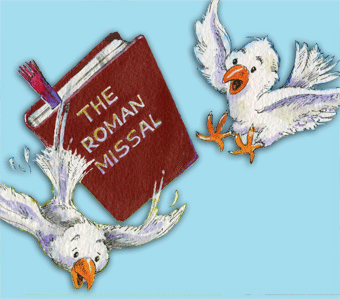
One area where a "reform of the reform" will likely be noticed is in the prayers used during the celebration of the Eucharist. The United States Catholic bishops plan to roll out a new translation of the Roman Missal-the official prayer book of the Mass-in late 2011.
The new translation is the fruit of a long and sometimes bitter debate over the proper way to translate Latin prayers into English. The translation currently in use in the United States was first issued in 1973 by the International Commission on English in the Liturgy (ICEL), an international body established by the English-language bishops conferences.
Following the 1969 translation guidelines issued by the Vatican in the document Comme le prévoit, the ICEL translators tried to render the key ideas of the prayers in simple, straightforward English rather than trying to translate the Latin word for word.
Critics of the ICEL charged that the organization's approach to translation rendered the prayers banal. ICEL tried to address these concerns when it began a revision of its missal translation in the late 1980s. By that time, though, ICEL's opponents had identified other issues of concern, such as ICEL's efforts to use inclusive language (using human beings rather than men).
Hitchcock's organization played an important role in organizing opposition to ICEL's translation among the U.S. bishops. "We would attend the conference meetings, talk to bishops, and send them dossiers on certain issues," says Hitchcock.
Despite their efforts, however, ICEL's translations continued to receive the support of a large majority of bishops, albeit by progressively narrower margins.
ICEL's critics had also gained the ear of the Vatican. In 2001 the Congregation for Divine Worship issued Liturgiam Authenticam, which requires that translations adhere much more closely to the Latin text. Based on these new norms, the Congregation rejected ICEL's revised translation of the Roman Missal, despite the fact that it had been approved by a two-thirds majority of every English-language bishops' conference in the world.
The ensuing crisis led to a restructuring of ICEL and the replacement of its senior staff. ICEL's new leaders immediately began work on yet another translation of the missal, which is currently in the process of being approved by the national bishops' conferences.
The new translation takes a more literal approach to translating the Latin text. Instead of responding "And also with you" when the priest says "The Lord be with you," the congregation will now respond, "And with your spirit."
Prior to Communion, the congregation will pray, "Lord, I am not worthy that you should enter under my roof" rather than "Lord, I am not worthy to receive you." Some of the words of the Gloria and the Nicene Creed have also been changed.
In addition to striving for greater fidelity to the Latin, the translators also sought a more elevated tone, one less like ordinary speech. The Opening Prayer for the 11th Sunday in Ordinary Time, for example, currently reads:
Almighty God, our hope and our strength, without you we falter. Help us to follow Christ and live according to your will.
The prayer in the new translation, by contrast, has a more traditional sound:
O God, the strength of those who hope in you, graciously hear our pleas, and since without you mortal frailty can do nothing, grant us always the help of your grace, that in following your commands we may please you in purpose and action.
"I think the ordinary person in the pew will hardly notice the change," says Hitchcock, who believes the new translations are both more accurate and more reverent.
Martis believes the reception of the new texts will depend greatly on how they are presented by priests and liturgists. "To say ‘here's what we have to do,' " he notes, "is a very different approach than ‘look what this new translation opens up for us.' "
Recent experience suggests that Hitchcock and Martis may be too hopeful. In South Africa the recent decision of the nation's Catholic bishops to implement the new English translation has produced a significant backlash. The letters page of the Southern Cross-South Africa's national Catholic newspaper-is regularly filled with letters complaining that the new texts are difficult to say and understand. One correspondent went so far as to write, "I hate you, hierarchy."
Father Russell Pollitt, pastor of Holy Trinity Church in downtown Johannesburg, is frustrated at both the new translation and the way it has been implemented. "The whole thing is a mess," he says.
Amanda Jones, a parishioner at Holy Trinity for more than two decades, has similar feelings. "I think our bishops approved this without taking into consideration the feelings of the laity." Jones is particularly frustrated that the new translation does not reflect the widespread use of inclusive language in contemporary culture.
With respect to the Creed, for example, Jones asks, "Do I serve God better by saying ‘for us men and for our salvation,' or ‘for all of us' or ‘for all people?' "
Sing an old song
New prayer texts aren't the only area where advocates of a "reform of the reform" are trying to make an impact on Catholic worship. As the experience of St. Edward's parish shows, music is another area where traditionalists hope to have an influence.
Few people are as passionate about recovering the church's musical heritage as Jeff Tucker, the managing editor of Sacred Music, the quarterly publication of the Church Music Association of America. Tucker, the author of Sing Like a Catholic (CMAA), also directs a chant choir at his parish in Alabama and regularly travels around the country giving workshops on Gregorian chant.
"There can be no reform of the liturgy without addressing the stagnation of liturgical music," says Tucker. "We're missing the best of the Catholic musical tradition."
Like many of those involved in the "reform of the reform" movement, Tucker is critical of contemporary Catholic hymnody, which he feels is too tied to popular musical forms. "You can hear this same kind of music outside the church," he says. "As a result, the music ties you to the earth rather than lifting your mind and heart to God."
Tucker, though, does not believe that the answer is replacing contemporary hymns with traditional ones. Parishes, he says, should move beyond the "four-hymn sandwich" approach to choosing music for the Mass. Tucker laments that hymns have come to replace the entrance, offertory, and communion antiphons for every Mass that are specified in the church's liturgical books.
"These texts are part of the Mass in a way that hymns are not," says Tucker, who believes that chanting the parts of the Mass should be an ideal toward which parishes should always strive.
Zimmerman of the Institute for Liturgical Ministry believes Tucker's vision is unrealistic. "It reflects the spirituality of a monastery rather than a parish. The average congregation is not going to learn new antiphons and psalms every single week. You'd end up with only the choir singing. If people don't participate, what have you gained?"
Zimmerman also questions the criticisms aimed at contemporary hymns. "Some of those hymns from the '70s were truly god-awful, and I have no problem saying that," she says. "But we also have some truly excellent hymns. I think ‘Gift of Finest Wheat,' for example, will stand the test of time as well as any of John Wesley's hymns."
The Catholic bishops of the United States appear to be taking a middle path on these questions. In a 2007 revision of their national guidelines on liturgical music, the bishops significantly strengthened the language encouraging the use of Gregorian chant while retaining the option of vernacular hymns.
Back to the future?
The wider use of traditional prayers and music may lead some to wonder whether the liturgical reforms of Vatican II are at risk. Could the church ever return to the "old" Mass?
The answer is almost certainly no. It's true that in 2007 Pope Benedict liberalized the rules governing the celebration of the older rite-now dubbed the "extraordinary form" of the Roman Rite-and encouraged its wider use.
While the pope was partially motivated by a desire to achieve reconciliation with schismatic groups attached to the older Mass, he also expressed a hope that its wider celebration would encourage those praying the reformed rite to do so with greater reverence.
"If that is his objective, then he's going about it the wrong way," says Baldovin of Boston College, who believes that efforts to improve the church's celebration of the liturgy should look forward rather than backward. "The problem with the reformed liturgy is not that it has been tried and found wanting, but that it has not been tried," he says.
Many of those who disagree with Baldovin on specific issues share his conviction that the focus of the discussion should be the rites as they were reformed by Vatican II.
"The post-conciliar liturgy is the one that we have received," says Martis of Mundelein Seminary. "Our responsibility is not to wish we had another but to celebrate it as authentically as we are able. My desire is that people understand it better and recognize how it can be a genuine expression of our deep faith in God."
St. Edwards' Keyes does not plan to offer the extraordinary form at his parish anytime soon, citing both scheduling challenges-his parish already offers six crowded Masses every weekend-and a lack of time to learn the prayers and rubrics of the old rite. More fundamentally, Keyes continues to hold the liturgical reforms of Vatican II in high regard. "People who don't think that the reform was necessary are misinformed," he says.
It may be too much to expect that a consensus on this point might lead to a truce in the church's "liturgy wars." Nevertheless advocates on both sides of the current debate may agree on more than they realize.
Hitchcock concedes that the time before Vatican II was hardly a golden age. "Prior to the council, seminaries didn't really teach liturgy. They taught rubrics, how to work your way through the books," she says.
Baldovin, for his part, agrees that those seeking a "reform of the reform" are on to something when they complain about a loss of reverence. "We've said that liturgy is the ‘work of the people,' which is true. But it's God's work first."