

Catholics around the world can inspire us with the many ways — both personal and political — through which they build peace.
Mary Mukanaho is a Tutsi in Rwanda. Her seven children and husband were killed in the 1994 genocide-by neighbors whom she had lived next to for 40 years. She survived because she happened to be out of the country at the time. She felt she was going mad and turned to alcohol to dull the pain. She was enraged to see her neighbors receive Communion with the very hands that had murdered her family.
It was not until 1998, when she took part in an intensive process of reconciliation established by the Catholic Church in Rwanda, that Mukanaho slowly began to deal with her trauma. She realized that she could never get her family back, but, she says, "at least you will live in peace if you forgive."
Eventually she was able to offer forgiveness to two of her neighbors, Athanase Niyombonye and Innocent Bucyana, when they finally came and asked for her pardon.
The Rwandan genocide was so shocking, in part, because such massive inhumanity is relatively rare. But Mukanaho's story, recounted by author Jeffry Korgen, is far from unique. Mukanaho's faith called her to build peace through a wrenching process of personal healing, but peacebuilding is also frequently an urgent political task.
Just as Mukanaho could not find peace without forgiveness, whole communities and nations torn apart by war cannot find peace without undergoing a very difficult process of forgiveness and reconciliation.
While the role of religion in today's conflicts and wars often makes headlines in places like Gaza, Afghanistan, Pakistan, or Iraq, religiously inspired peacebuilding receives comparatively little attention.
But the same kind of unwavering, absolute commitment to one's faith that can make religion a source of division also makes it a powerful force for freedom, justice, and liberation.
In northern Uganda, for example, an extremist group called the Lord's Resistance Army has terrorized the population for years. In 1997 Gulu Archbishop John Baptist Odama joined with his Anglican, Muslim, and Orthodox counterparts to form the Acholi Religious Leaders' Peace Initiative.
These religious leaders not only helped bring international attention to this widely ignored campaign of terror, they also had the courage to seek out Joseph Kony, the brutal LRA leader (and former altar boy), to urge him to enter peace negotiations with the Ugandan government.
When Kony's LRA finally agreed to formal peace talks, Odama and the other religious leaders were asked to be the official facilitators. In Colombia, the Philippines, Congo, and Northern Ireland, Catholic leaders have played similar roles.
In the Democratic Republic of Congo, wars over the past 15 years have left an estimated 4 million dead. As in many poor countries, the church there is one of the only functioning institutions in society, providing a large part of the education, health care, and social services in the country.
Congolese church leaders have spoken out against oppressive regimes, foreign aggressors, and warlords. In the Archdiocese of Bukavu alone, Archbishop Christopher Munzihirwa was killed by rebel groups in 1996; his successor, Archbishop Emmanuel Kataliko, died under mysterious circumstances after returning from being exiled by rebel groups.
In 2006 Congo held its first democratic elections since it gained independence in 1960, and the church played a leading role. A Catholic priest, Father Appolinaire Malu-Malu, chaired the Independent Electoral Commission, which was responsible for ensuring that the elections were free and fair.
The Philippines is one of the world's most Catholic countries, one of the United States' strongest allies, and one of the fronts in the "war on terror." The Philippines' southern islands, the largest of which is Mindanao, face terrorist attacks by Abu Sayyaf, a small extremist group with ties to Al Qaeda, as well as a long-running insurgency by the Moro Islamic Liberation Front, which is fighting for self-determination after centuries of Christianization of their lands by Spanish and U.S. colonial governments.
The church's peacebuilding role in the Philippines is complex. It recognizes that the government must defend the country against terrorist attacks, while it criticizes the government's corruption and human rights abuses. The church has also been working to overcome the deep historical divide between Christians, Muslims, and the indigenous peoples through interreligious dialogue; to address the economic, social, and political marginalization of Muslims; and to cultivate a culture of peace in a region that has known little but war for generations.
With the assistance of Catholic Relief Services (CRS) and the University of Notre Dame's Kroc Institute for International Peace Studies, Catholic groups have developed training programs in conflict mediation and peacebuilding. The Mindanao Peacebuilding Institute, for example, has provided intensive training for more than 1,000 leaders from 40 countries.
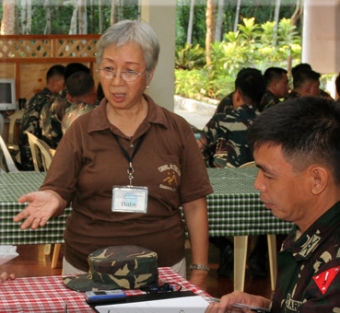
In recent years the training was expanded to include the Philippine military. Maj. Gen. Raymundo Ferrer and other senior officers only reluctantly agreed to attend peacebuilding training in 2005. But their skepticism about such "soft," nonmilitary approaches to dealing with terrorists and insurgents has gradually evolved into wholehearted support.
Peacebuilding methods deepened their understanding of the complexity of the conflicts they faced, improved the military's relationships with local communities, and proved the value of mediation and dialogue, rather than force, in handling potentially explosive situations.
In cooperation with church-affiliated peace organizations, some military units in Mindanao now run their own peacebuilding training. In January, when Ferrer became chief of the Eastern Mindanao Command, he singled out the Mindanao Peacebuilding Institute and CRS trainers for helping him integrate peacebuilding into his military leadership.
Other notable Catholic peacebuilding activities around the world include mediating or facilitating peace processes in Colombia, Mozambique, and Northern Ireland; playing a prominent role in post-conflict truth and reconciliation processes in Guatemala, Chile, and Peru; peacebuilding training integrated into programs of Catholic relief agencies; interreligious peace education programs in Catholic schools in Bosnia; and trauma healing programs in Burundi.
The breadth of the church's peacebuilding activities helps explain why former Secretary of State Madeleine Albright, in her book The Mighty and the Almighty (Harper Perennial), has written that faith-based organizations "have more resources, more skilled personnel, a longer attention span, more experience, more dedication, and more success in fostering reconciliation than any government."
The church can be effective in peacebuilding because it is deeply rooted in local communities suffering from violence, and is often the most important civil institution in poor, conflicted countries.
At the same time its global reach can surpass that of governments, international institutions such as the United Nations, and multinational corporations, giving it an unusual capacity to build bridges between the zones of peace and prosperity and the zones of conflict and deprivation that divide our world.
But what matters most in making religion more successful at fostering peace and reconciliation than any government are the struggles of individuals and groups to live out even the hardest demands of their faith.
Mukanaho, the Tutsi Catholic in Rwanda, after a long process of healing, eventually came to a point where she no longer saw her neighbor as a Hutu murderer but as a "brother in Christ" to whom she could extend the forgiveness she promised when she said the Lord's Prayer.
For Odama, the Ugandan archbishop, "Blessed are the peacemakers" became not just a pious hope but a moral imperative that compelled him to risk his life for even a slim chance at peace.
Malu-Malu, the Congolese priest, recognized that the ballot box could be both an alternative to the bullet and a means to protect basic human dignity and to build a just society.
And General Ferrer came to understand that peacebuilding training for his troops could help "to redefine the role of the military" and lead to a broader understanding of peace that includes "full human development."
What makes peacebuilding authentically "Catholic" then is that it is deeply rooted in faith.
But what does that have to do with our faith as Catholics in the United States, far removed from the genocide in Rwanda or the jihadists in the southern Philippines?
First, Catholic peacebuilders half a world away challenge us to come to terms with our own faith. It is said that "war is hell." If it is, hell is occupied by a lot of saints. War brings out the worst-but also the best-in people in ways that ordinary life rarely does. Today's saints are found in abundance in places such as Uganda, Sudan, Rwanda, Colombia, Iraq, and Mindanao. These contemporary saints can help challenge us in the relatively comfortable, risk-free Christianity that we live.
They are models, not because we face the kinds of conflicts they face, but because they help us see how real people today, in even the most difficult circumstances, actually live out the beliefs we say we profess but rarely have to practice.
If forgiveness is possible for a mother whose whole family was murdered, how much easier should it be to forgive the far less egregious wrongs that we suffer? If others risk their lives trying to stop the violence around them, how much easier should it be for us to take seriously the closing words at Mass-"Go in peace to love and serve the Lord"-and try to resolve minor conflicts in our everyday lives?
Peacebuilders half a world away also challenge us to live the virtue of solidarity. It is tempting to think that the "Body of Christ" is our local parish, that the neighbors we are called to love are only those who live in our neighborhood. How could we make a difference for those struggling in faraway countries?
But people from countries torn by war often say how important it is to know that others around the world care and are paying attention. "The moral and other kinds of support from Catholics around the world," says Myla Leguro, who developed many CRS peacebuilding training programs in Mindanao, "provides us a deep sense of hope, which is so essential when faced with seemingly endless war."
Finally, we cannot escape the fact that we are Catholics living in the United States. In virtually every country torn by conflict, our government or our corporations are directly or indirectly involved.
Mindanao is a front in the "war on terror." Congo is a source of critical natural resources necessary for many of the consumer goods we take for granted. Northern Uganda is typical of the many conflicts where active engagement by the United States can help resolve long-standing conflicts. As citizens we have a responsibility and an opportunity to ensure that our government-and our corporations-use their tremendous capacity to promote peace in these areas.
Perhaps more importantly, our country remains very much mired in conflict in Iraq and Afghanistan. Much of the world does not experience or perceive the United States as a peaceful nation. By understanding how Catholics in other countries are trying to promote peace and reconciliation amidst conflict, we might renew our commitment to do more to ensure that our nation becomes a force for peace and reconciliation around the world.
Regrettably, the CRS peacebuilding programs in Mindanao, Rwanda, Congo, and other areas are now at risk because of the economic crisis. There is an urgent need for Catholics in the United States to support Catholic peacebuilding programs both financially and through prayer.
The Catholic Church, like many other religious bodies, has a long, proud, and mostly unheralded tradition of peacebuilding. More foreign policy experts need to appreciate, as Madeleine Albright now does, the importance of faith-based peacebuilding for world peace. But the Catholic community itself also needs to do much more to tap the full potential of this essential part of the church's mission: peacebuilding.
This article appeared in the June 2009 issue of U.S. Catholic (Vol. 74, No. 7, page 29).




Add comment