

Lord knows these organizations need some help serving their communities.
OK, children, gather around. I'll tell you what life was like before parish councils, back when my hair was brown and my dreams were green.
The pastor pretty much ran things, and that was fine with most of us. First of all, we didn't have to go to a lot of boring meetings. Second, we were free to complain to one another (and sometimes to him) about what was wrong with the parish without feeling one iota of guilt or responsibility. Finally, we didn't have to go to a lot of boring meetings.
Then along came Vatican II and we realized that:
- The church is "the people of God."
- We laypeople have a lot of talent and knowledge parishes desperately need.
- Priests and other parish staff people aren't especially trained or sometimes even very good at a lot of the things that go into running a parish.
- If we laypeople were more involved in decisions about the parish, we would be more likely to accept them.
So God said, "Let there be parish councils," and there were parish councils. And God saw that it was good.

Well, actually, as far as we know God has not expressed a definitive position one way or another on parish councils, but the Pope thinks they're a good idea, and that should be enough for most of us.
Now, I come to praise parish councils, not bury them, though I'm not a big fan of them as presently constituted. It seems to me that most fall into one of three categories:
- Rubber stamps for the pastor and staff.
- A soapbox for complainers and obfuscators of all things parish.
- A particularly cruel and unusual form of punishment for certain well-intentioned parishioners.
In all of the above cases, serving on a parish council seems like a waste of a good layperson's precious time. But that doesn't mean we should bury them. It means we should figure out how to make them operate better-that is, more in our interests.
This is not just a matter of changing the structure. At one parish I know, for example, the parish council was clearly not working, so the staff and lay leaders spent a year discerning what was wrong and how to fix it.
After considerable study and consultation they decided that since the parish council wasn't working, what was needed was to get the key people on every single one of the 70 or so parish ministries involved in the working of the council. The parish developed four "commissions," made up of representatives of all of the ministries, which were each to meet four times a year and report their activities to the council.
This meant that all the busiest people in the parish (including the parish staff, who were to attend each of the commission meetings) would now be required to go to at least four additional meetings per year.
Sure enough, after a couple of years the quarterly commission meetings have pretty much turned into poorly attended times for exchanging information and working out scheduling conflicts between and among ministries-nothing more. And the parish council still doesn't work.
As a businessman and former community organizer, I've tried to convince various parish councils that one of the problems they have is that they waste people's time. As in most good businesses and organizations:
- Meetings should start on time.
- A printed agenda should be sent out ahead of time.
- People should be prepared to present and speak to the issues on the agenda.
- Issues should be discussed and decided by majority vote.
- The meeting should end on time or early-never late.
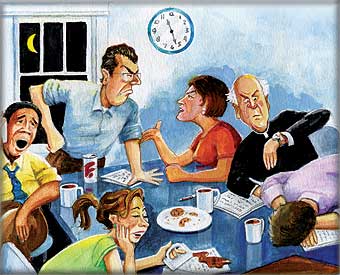
Everyone thinks these are good ideas-in theory. In practice, however, parish council meetings usually start late, waiting for stragglers to arrive, and then continue on until all hours of the night, trying to come to something called "consensus" on every issue.
This makes it difficult for members to explain to their spouses why they are home so late or to their bosses why they are sleepy the next day at work. It also makes it difficult to recruit people to serve on the council.
So why do I say that I have come to praise parish councils? I have come to praise the idea of parish councils-that is, a group of laypeople who can advise the pastor and parish staff on the key mission and function of the church.
You know what that mission is, don't you? It is the mission on which all Catholics are sent at the end of every Mass. It is the mission on which Jesus of Nazareth sent his disciples and by extension all of us. It is the mission to help bring about the Kingdom of God "on earth as it is in heaven."
It is a mission worthy of all of our lives-and certainly one worthy of our spending a few hours a month sitting on a parish council if it can help us and our fellow parishioners better accomplish it.
Here is what we laypeople need to ask of the parish:
- Are the various ministries, spiritual practices, and religious education programs offered by our parish helping prepare us to live out our faith in our daily lives?
- Do the homilies we hear help us connect scriptures with our mission to the world?
- Does the Mass send us forth with a sense of urgency and empowerment to "love and serve the Lord" and transform the world?
On these questions our pastors and parish staff can certainly use our feedback, and the parish council can be the place where we laypeople can give it.
Likewise with the functioning of the parish itself. A parish council can advise the pastor and staff on parish programs, finances, fundraising, facility management, personnel, and so forth. Not that we are going to do these things for them. They are still in charge, and we are merely advising. That's just the way it is, and we really shouldn't want it any other way. Otherwise our work on the parish council could distract us from our work on our jobs, with our families, and in civic affairs.
This is what the parish council should be all about: making sure that the parish is functioning efficiently and effectively in support of the Christian mission to the world. Almost by definition, then, it will not be a rubber stamp for the pastor and staff, nor a place where naysayers come together to complain about internal parish issues, nor a waste of time for those who serve on it. Why? Because it will be dealing with what we laypeople really care about: our lives outside church, not what happens inside church.
The purpose of the parish council is to help the parish better prepare us and send us forth into the world. Why would we ever think it was for anything else?
This article appeared in the June 2009 of U.S. Catholic (Vol. 74, No. 6, pages 35-36).






Add comment