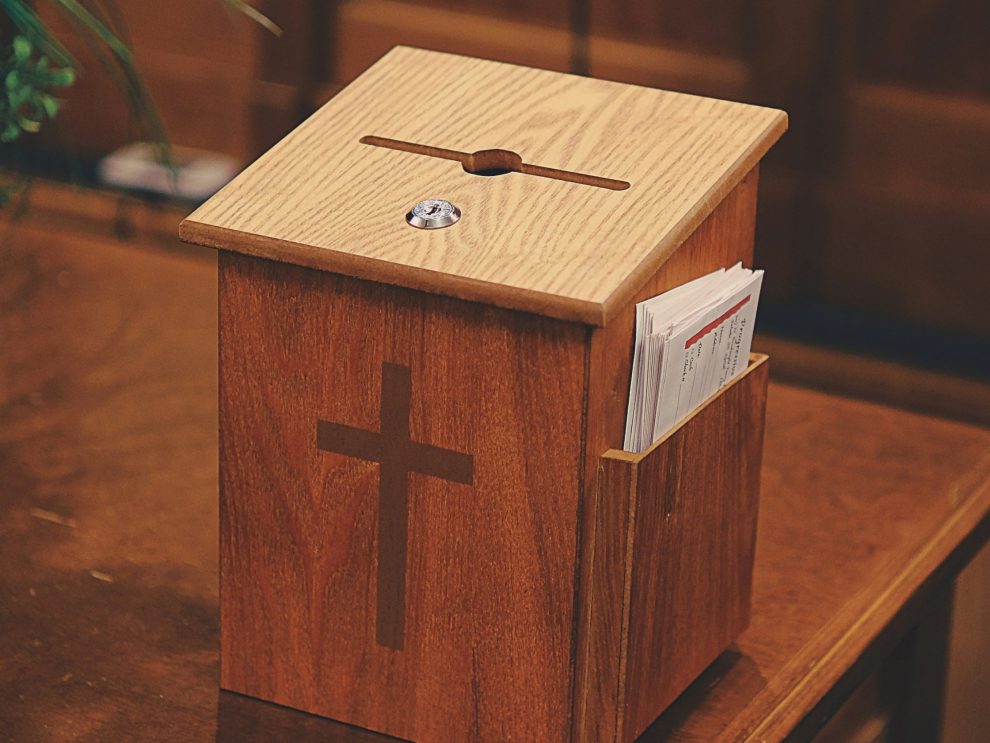
If the pastor had not stepped down, the church embezzlement might have continued indefinitely. But when Father Brian Lisowski, pastor of St. Bede the Venerable, a large parish on Chicago’s Southwest Side, resigned in 2004, the Sunday Mass collection suddenly ballooned by more than $2,500 a week. A police investigation indicated Lisowski had stolen about $1.1 million during his five-year tenure. “No one suspected a thing,” says Father William Stenzel, who replaced Lisowski as pastor at St. Bede’s.
The collection had been kept Sunday nights in a large basket in the rectory where Lisowski had helped himself to cash (never checks), squirreling his spoils away in a secret safe in his bedroom. On Monday mornings the remaining contents in the basket were carefully counted and dutifully recorded by parish volunteers and then picked up by an armored car.
Why didn’t anyone notice the cash shortage? “There was a lot of rehabbing and deferred maintenance of buildings going on,” says Stenzel, “so they had all these fund campaigns and special collections. Overall, the Sunday collections were up during those years.”
Lisowski, who had signed himself into a treatment center for alcoholism, readily admitted guilt and produced all the missing money. He served two years in prison and is now free. Stenzel says St. Bede parishioners understand his actions were alcohol-related and are inclined to forgive. The parish council unanimously recommended that, if his treatment proves successful, Lisowski be returned to active ministry—though not necessarily to St. Bede.
You might consider this sad affair an anomaly, a rare deviation from the norm in Catholic institutions. But it is not as rare as you might think. A random scan of newspaper stories dealing with Catholic Church embezzlement during the month of July 2008 alone produced a dozen cases. Here are some examples:
A priest in Richmond, Virginia appeared in county court on charges of misappropriating as much as $1 million from two parishes he pastored, while supporting a secret wife and three daughters in a city 50 miles away.
A 73-year-old Omaha, Nebraska nun was sentenced to three to five years in prison for embezzling as much as $800,000 from the archdiocese. She had been the director of the Catholic Family Life Office in Omaha and was coauthor of one of the church’s most widely used marriage preparation programs.
The bookkeeper of a parish in Longboat Key, Florida was arrested and charged with stealing some $330,000 from the church for personal use. Parishioners described her as “your stereotypical sweet church lady.” Her lawyer said she had been dealing with mental issues.
Prosecutors in Delray Beach, Florida were in the final stages of preparing for the trial of two former pastors of a local church accused of grand theft over a 42-year period. A diocesan audit claimed the two misappropriated as much as $8.9 million from parishioners. Time magazine called the scandal “the worst known case of embezzlement in U.S. Catholicism,” when reports first broke in 2006.
The former chief financial officer of the Cleveland diocese was found guilty in federal court of netting $750,000 in diocesan money through an elaborate kickback scheme in which he illegally steered $17.5 million in accounting and computer business to an associate. The diocese’s legal counsel and the bishop denied having any idea of the scheme.
Prosecutors in Kaua’i, Hawaii were preparing opening statements for the trial of a parish volunteer charged with misappropriating more than $85,000. Instead of depositing counted and stamped checks from Sunday Masses in the parish bank account—one of her duties—she allegedly deposited them in the account of a Catholic social club, of which she was treasurer.
Also in July it was revealed that the rector of the Marian shrine in Lourdes, France was under investigation for fraud in diverting some $700,000 in donations to the shrine to his personal account. Defense lawyers requested that the investigation be delayed until after Pope Benedict XVI’s scheduled visit to the shrine in September, marking its 150th anniversary.
“The next tsunami”?
There was nothing unique about last July. A scan of press reports almost any month will unearth similar accounts, many as strange and seemingly surreal as these. Three questions immediately present themselves: How big is this problem? Why is it happening? And what is being done about it?
Clearly, the Catholic Church is not the only victim; news stories regularly report misappropriation at Protestant, Jewish, Muslim, and other institutions. Nor are religious organizations alone affected. Almost all nonprofit institutions appear to be taking heavy hits.
A recent report by the Association of Certified Fraud Examiners estimated that in 2006 some 13 percent of the $300 billion given to U.S. charitable institutions, including churches, was lost through embezzlement—a colossal sum of $40 billion. If that 13 percent loss figure is applied to the Catholic Church, it would mean that of the $6.5 billion contributed by Catholics to their parishes in 2006, a staggering $845 million was lost to embezzlers. Catholic leaders declined to verify that figure or any other estimate.
Some experts, including Diana Aviv, president of Independent Sector, which represents nonprofits, are suspicious of the association’s estimates and recommend further research. Nevertheless, there is broad, general agreement that the situation is serious.
“We have a huge problem,” says Frank Butler, president of Foundations and Donors Interested in Catholic Activities. “Some think it’s the next tsunami to hit the church, but we really don’t know. And it’s not just here. Elsewhere in the world, especially in developing countries, there are even more serious situations.”
“No one knows the amount lost because so much isn’t even reported,” says Chuck Zech, director of the Center for the Study of Church Management at Villanova University. In any case, he says, church embezzlement loss is not comparable in financial loss to the church’s loss due to the priest abuse scandal. “But coming on the heels of that scandal,” he adds, “it further damages the credibility and moral authority of church leadership. At the very least, it casts doubts in the minds of contributors about how their money is being used.”
Zech and Robert West, an accountancy professor at Villanova, wrote the report “Internal Financial Controls in the Catholic Church” that sounded an alarm in late 2006, creating concern and heated discussion in the church. The report concerned a survey questionnaire they had sent to the chief financial officers of all 174 U.S. dioceses.
Only 78 dioceses (45 percent) responded, but 85 percent of the respondents acknowledged serious problems in the five previous years. While 27 percent of respondents reported less than $50,000 in church embezzlements, 11 percent claimed church embezzlements totaling more than $500,000, and the rest were somewhere in between.
On the basis of these limited returns, one cannot conclude that 85 percent of all 174 dioceses had similar experiences. Still, Zech says, he wonders about the situation in the 55 percent of dioceses that didn’t bother to take part in the survey. Among the responding dioceses, only 3 percent conducted annual audits of their parishes, 14 percent reported occasional audits, and 21 percent said they seldom or never audit parishes.
Lambs to the slaughter
Why does church embezzlement happen? “Churches are too trusting,” says Zech. “They’re more like families. People can’t imagine their fellow parishioners would be stealing.”
As one expert cited in the survey report stated, “Since churches rely on sacred belief systems, internal controls might be viewed as a secular concern and either inherently evil or . . . unnecessary, even insulting to church workers and volunteers.” Others echoed similar sentiments, though some observers argue that implementing strict controls should be seen as “a manifestation of holistic stewardship.”
Church embezzlement also happens because the church leadership is unable to demand the kind of accountability and transparency that secular businesses can require. “From an administrative perspective the church is quite decentralized,” says the survey report, “with each diocese and each parish within the diocese having a fair amount of autonomy. Dioceses have virtually no external or regulatory oversight of their financial statements.”
What is the church doing about the problem? Since the 1980s the U.S. Conference of Catholic Bishops has endorsed resolutions about the need for internal financial controls, produced position papers supporting professional fiscal management, presented detailed regulations governing diocesan finance councils (which are mandated by canon law), and produced a 213-page guide on the best way to prepare accurate financial statements.
In 2007 the bishops, through their Diocesan Fiscal Management Conference, recommended in the strongest language that all dioceses require yearly internal audits of their parishes—with the pastor, key employees, and finance council members signing the document and attesting (among other things) that they “have not received any report that has not been reported to the diocesan bishop . . . of fraud, abuse, or misappropriation, and that the signers have not engaged in any activity with the parish from which they or their family could personally benefit.”
Since the 2006 report, says Zech, there has been no serious research on how or whether the situation has improved nationally. A soon-to-be released survey of 500 parish finance councils, sponsored by Villanova and Georgetown Universities, indicates some controls are being put into place, he notes. But in many cases serious lapses remain. For example, in 40 percent of the parishes studied, “one person has sole authority to approve routine disbursements [of funds] and reconcile bank statements,” the survey said.
Many critics claim stronger measures are needed if the hemorrhaging of money is to be halted. Jack Siegel, a tax lawyer and expert on nonprofit management, says, “The guidelines the bishops have put on paper are excellent, but they don’t work if they aren’t used.”
Since, according to church law, their recommendations are advisory only, Siegel says, “You lose the monitoring factor.” In an informal study of church embezzlements he did several years ago, Siegel expressed surprise at how many involved Catholic institutions. He wondered if the church’s hierarchical structure makes parishioners, including members of finance councils, overly deferential to pastors and hesitant to criticize or even to make suggestions.
It would be extremely helpful, notes Siegel, if dioceses would voluntarily agree to public disclosure through use of IRS Form 990, which provides a clear, capsulized picture of an organization’s finances. Most nonprofits must file such forms, but religious institutions are presently exempt.
Another critic, Michael Ryan, a retired security official with the U.S. Postal Service who calls church embezzlement “the church’s second-greatest scandal,” says the recommendations of the bishops conference are too vague and theoretical, leaving “19th-century security methods firmly in place” and “allowing thieves to continue beating the system.”
Ryan is particularly concerned about the security of Sunday Mass collections, and he has produced detailed, multi-step proposals about the consolidation, transport, storage, opening, counting, documenting, and bank depositing of collections. If there is vulnerability at even one of these steps, says Ryan, the entire process is compromised. But he says he fears church authorities lack the will to “correct this morally, fiscally, and ethically intolerable situation.”
Attempting to improve the way the church handles money, Geoffrey Boisi, former vice chairman of JPMorgan Chase, has put together a team of high-powered Catholic executives called the National Leadership Roundtable on Church Management. It has issued guidelines for financial audits of U.S. dioceses, created best practice recommendations for church leaders, published DVDs and workbooks, and created a website (ChurchEpedia.org) where church leaders can discuss problems and solutions. Some dioceses have welcomed this good-faith assistance, but other bishops are reportedly hesitant to take advice from a strictly lay-led group.
A truly radical solution was proposed recently to a lay-led group, the Connecticut legislature. Sparked by a highly publicized church embezzlement involving a local priest, a bill under consideration would take money matters out of the hands of pastors and bishops and give full financial authority to individual parishes; it would also allow parishes to keep present controls in place, if they prefer.
An explosive reaction came from the state hierarchy. Bridgeport Bishop William Lori said the proposal “directly attacks the Roman Catholic Church” and “our faith” and is “a thinly-disguised attempt to silence the church on important issues of the day, such as same-sex marriage.” The bill was quickly withdrawn for further study.
Who’s counting?
In fact many U.S. dioceses, learning from experience, are now issuing their own no-nonsense security measures for parishes, covering every step of Sunday collections procedures and regulating the incoming and outgoing of finances from other sources as well.
The Archdiocese of Chicago, for example, has a 26-page “Business Administration—Best Practices” website, with rules regarding parish and school finances, real estate dealings, and insurance. Parish credit cards are restricted for use with established vendors and have preset spending limits. A special phone number is available for anyone who is suspicious of fraud or mismanagement.
Among the rules for Sunday and holy day collections:
• The ushers must consolidate collections to pre-numbered tamper-evident bags and initialize them after sealing.
• At least three people should be present when collections are counted.
• There should be multiple count teams, which are rotated periodically.
• During counting, checks are restrictively endorsed and the cash collection report must be signed by the count team members.
• All cash deposits should be deposited daily or locked in a safe, in a pre-numbered tamper-evident bag, with entry to the safe only to those people designated to have access.
• Ideally, different individuals complete the receiving, processing, recording, and bank reconciliation functions.
The new Chicago rules were published in February 2005, just six months after Lisowski of St. Bede the Venerable Parish was indicted for stealing from collections. Parishes were required to implement the rules immediately. But everyone quickly learned that even the most minor breach could disrupt the whole system.
At St. Margaret Mary Parish in the city’s West Rogers Park neighborhood, the high-spending pastor for eight years, Father Mark Sorvillo, quickly found a way to continue his practice of church embezzlement despite the safeguards. As was revealed later in a police investigation, Sorvillo opened the sacristy safe after hours Sunday nights, tore open the tamper evident bags, seized some of the collection, then put what was left in new bags, sealed them, forged the initials of the ushers, and put them in the safe.
If staff or collection counters had been alert, they would have noticed that the numbers on the bags were out of sequence with those on the old pre-numbered bags, and his scheme would have backfired. But they didn’t notice, and the larceny went unchecked for almost another year.
Finally parishioners became suspicious because the pastor kept insisting that funds were lacking to keep the parochial school going, and careful notice was finally given to the out-of-sequence bag numbers. A parish audit detected the crime. Eventually, Sorvillo was sentenced to four years in prison on charges of embezzling $190,000, though the real amount was believed to be closer to $1 million.
Elsewhere parishes are learning, some the hard way, to tighten security measure. In Louisa County, Virginia the pastor of two small parishes, Immaculate Conception and St. Jude, Father Michael Duffy, has hired a bookkeeper and a secretary, and he requires a team of counters for Sunday collections. He does not get to open the mail himself or take the weekend proceeds to the bank. Two keys, his and the head of the finance council’s, are required to open the safe. “We will have no one alone with money,” says Duffy, “not an usher, not a counter, not a priest.”
His predecessor, Father Rodney Rodis, was just the opposite—a one-man whirlwind. He personally picked up and opened the mail, took the collection from church to rectory, and did not require a secretary or an active finance council. “Everything was loose here,” says Duffy, “very lackadaisical.”
In fact, Rodis, who was pastor for 11 years, had been taking parishioners for a ride, helping himself to large chunks of the collection for his other life—a wife and children in another city where he reportedly told neighbors he was in the import-export business.
His deception was uncovered when he retired due to illness. Duffy became suspicious when a man who had donated a $1,000 check to the parish asked for a copy for income tax purposes. In fact, the check had never been recorded or deposited with the church. It was found in a secret account in Rodis’ name, and an investigation revealed the theft of more than $600,000 in donations over the previous four years, some of which went to Rodis’ family and friends in the Philippines. Sentenced to five years in federal prison, he still faces separate state charges.
Fleecing the flock
In Milwaukee parishioners at the Gesu Parish have learned that a lack of internal financial controls can lead to the loss of money and years of headaches. The Jesuit pastor, Father Peter Eitzel, is reluctant to talk about details but acknowledges that the aftermath of a serious church embezzlement is “very unpleasant.” He arrived as pastor in July 2002 and discovered eight months later that a misappropriation of funds had been going for at least four years. Charged was the bookkeeper, Rebecca Piekarski, who had, according to news reports, taken some $850,000 through an imaginative variety of schemes including forgery and manipulation of the parish books.
Eitzel says most of the money was stolen in an eight-month period in 2001 and 2002 when the director of administrative services resigned and an interim pastor was serving temporarily. “We noticed that contributions were sinking,” he says. “We attributed it at first to the pastor turnover, the lack of access to parking due to construction in the area near the church, the lag in the economy, disillusion from the child abuse scandal.”
When an examination of bank statements showed the facts, Eitzel says, “We gathered the trustees and the parish council and shared the news at all the Masses.” Then began an ongoing tightening up of the financial system, “a lot of oversight, double-checking everything, keeping track of who does what.” Finally a four-year period of arbitration and mediation with the insurance company came, says Eitzel, “and it was exhausting.” Piekarski served time in prison and is now free.
“There’s a family atmosphere here, a tendency to trust everyone,” Eitzel says, “so you can have all the control in the world, and if someone wants to [embezzle], they’ll do it.”
At St. Vincent Ferrer Parish in Delray Beach, Florida, everything involving money is “squeaky clean,” says the pastor, Msgr. Thomas Skindeleski. “Our mantra is accountability and transparency.” The finance council, chaired by a parishioner who happens to be the financial controller for the Diocese of Palm Beach, is extremely active, he says, and has the teeth to challenge Skindeleski’s or anyone else’s directives.
Ushers are trained in the secure handling of collections, collection counters operate in rotating teams, and all who work for the parish, whether as employees or volunteers, know their duties and limits. The vault that holds the collection can only be opened by the use of two keys simultaneously—one in the possession of the business manager and one carried by the parish bookkeeper, says Skindeleski.
It didn’t use to be that way. For 40 years the pastor, Father John Skehan, apparently ran St. Vincent Ferrer as if it were his personal fiefdom. When he retired, his friend and successor, Father Francis Guinan, allegedly followed suit for another two years until an anonymous letter to the district attorney triggered a diocesan audit.
It indicated that as much as $8.6 million had been misappropriated by the two pastors, but due to the statute of limitations, prosecutors could claim only about $1 million had been skimmed. Skehan, now 81 and highly regarded by parishioners during his years at the old, wealthy parish, allegedly used huge sums from parish collections and donations to purchase a condominium as well as a cottage in Ireland and spent freely on friends, family, and himself, as did Guinan.
Although Skindeleski has introduced professional controls, about 500 parishioners have left the parish since the scandal, he says—about half out of outrage at the church for tolerating larceny for so long and the other half out of outrage at the church for “persecuting” their beloved pastor, Skehan, who has recently been sentenced to 14 months in prison.
This article appeared in the May 2009 issue of U.S. Catholic (Vol. 74, No. 5, pages 12-17).
Photo by Leiada Krözjhen on Unsplash