Who are the Lefebvrites, and are they Catholic?
The Society of St. Pius X (SSPX), whose members are commonly known as “Lefebvrites” after their founder, Archbishop Marcel Lefebvre, is a group of about 150,000 former Roman Catholics who disagree with elements of the Second Vatican Council, beginning with its reform of the liturgy. The SSPX also rejects Vatican II’s declaration Dignitatis Humanae, which defines religious freedom as a human right, and teachings found in the Constitution on the Church (Lumen Gentium) and the Declaration on the Relationship of the Church with Non-Christian Religions (Nostra Aetate), which affirm God’s covenant with the Jewish people and reject the belief that the Jews as a people bear guilt for Jesus’ death.
In 1988 Lefebvre ordained four bishops without the permission of Pope John Paul II. As a result Lefebvre, the bishops, and the clergy of the SSPX were automatically excommunicated in accord with canon law, and the SSPX became a schismatic church. For this reason the SSPX does not share the full communion of the Catholic Church.
Though Lefebvre was excommunicated only after he ordained new bishops, the SSPX’s refusal to accept the teaching of the highest authority in the church—an ecumenical council convened by the pope—had progressively eroded its relationship with Catholicism. The rejection of the particular teachings themselves is only part of what is at issue; the more profound matter is the SSPX’s denial of the church’s authority to reformulate and change Catholic teaching and worship.
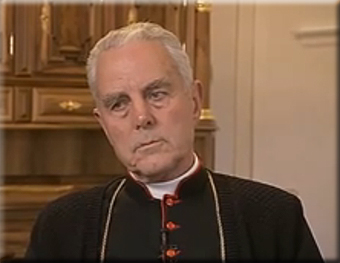
The relationship between the Catholic Church and the SSPX became unclear in January when Pope Benedict XVI lifted the excommunications of the four bishops ordained by Lefebvre, who died in 1991. The action caused controversy because SSPX Bishop Richard Williamson disputes the extent of the Holocaust and the existence of the Nazi gas chambers. Williamson’s rehabilitation drew protests from Jewish communities around the world, with World Jewish Congress President Ronald Lauder asserting that by “accommodating anti-Semites like Williamson, the achievements of four decades of Catholic-Jewish dialogue [are] put into doubt.” Catholic bishops in Europe also protested because the SSPX had taken no steps to accept the teachings of Vatican II.
In response to both concerns, the Vatican made clear that the lifting of excommunication does not mean that the bishops of SSPX can function as Catholic bishops, likening Pope Benedict’s action to Pope Paul VI’s withdrawal of excommunication from the Orthodox Patriarch of Constantinople in 1965. The pope further insisted that the teachings of the Second Vatican Council were not optional and reaffirmed the council’s condemnation of anti-Semitism.
As of this writing, the leader of the SSPX, Bishop Bernard Fellay, has said that his group will not accept the conciliar teachings its members find objectionable. Therefore, while no longer excommunicated, the group still cannot be considered to be in full communion with the Catholic Church.
Bryan Cones is the managing editor of U.S. Catholic. This article appeared in the April 2009 issue of U.S. Catholic (Vol. 74, num. 4: page 41)
SSPX UNABLE TO PROCLAIM THAT ALL NON CATHOLIC PARTICIPANTS AT AS
By Lionel Andrades (not verified) on Friday, July 22, 2011Friday, July 22, 2011
SSPX UNABLE TO PROCLAIM THAT ALL NON CATHOLIC PARTICIPANTS AT ASSISI 2011 ARE ON THE PATH TO HELL
The Society of St. Pius X (SSPX) is unable to say that all the non Catholics participating at the inter religious meeting at Assisi this October are on the path to Hell. The SSPX cannot affirm Cantate Domino, Council of Florence 1441 since they believe that those who are saved in invincible ignorance or with the baptism of desire are not implicit cases, instead, they are explicitly known to us and so contradict Cantate Domino on extra ecclesiam nulla salus.
They are so confused that Bishop Bernard Fellay is not expected to answer the previous post on this blog just as he has never answered other SSPX-related posts e-mailed to him.
The problem is that the SSPX interprets Archbishop Marcel Lefebvre as referring to de facto baptism of desire which is knowable to us in the present times. Yet the baptism of desire is known only to God. It can only be known to us in principle, as a concept. It is de facto only for God. So how can they interpret Archbishop Lefebvre as referring to a de facto known to us baptism of desire and invincible ignorance ? However this is being done.
So the baptism of desire and invincible ignorance can never ever be an exception to the dogma Cantate Domino on extra ecclesiam nulla salus.
Cantate Domino suggests all the non Catholic participants at Assisi 2011 are oriented to the fires of Hell, unless before death, they convert into the Catholic Church. There are no baptism of desire or invincible cases among them that we can know of. The dogma says that they are all, with no exceptions, going to Hell.
-Lionel Andrades
CONTINUED
http://eucharistandmission.blogspot.com/2011/07/sspx-unable-to-proclaim-...
SSPX UNABLE TO PROCLAIM THAT ALL NON CATHOLIC PARTICIPANTS AT AS
By Lionel Andrades (not verified) on Friday, July 22, 2011This simple truth however cannot be proclaimed by Bishop Fellay, and the SSPX bishops since they deny an ex cathedra dogma with an alleged de facto, explicit-to-us baptism of desire. All implicit salvation is explicit for the SSPX writers and members !
Otherwise, vaguely they oppose syncretism and indifferentism and proclaim the Catholic Church as the one, true Faith, the only religion of God and that non Catholics need to convert into the Catholic Church except for…
As for Fr. Leonard Feeney, nowhere in the Letter of the Holy Office 1949 is it stated that he was excommunicated for heresy. Venerable Pope Pius XII in the Letter of the Holy Office published in the Denzinger referred to ‘the dogma’ the ‘infallible teaching’. The dogma like Fr. Feeney affirms the ‘rigorist interpretation’ of outside the church no salvation.So the Letter supports Fr.Feeney on the dogma.
It was the Archbishop of Boston Cardinal Richard Cushing who indicated that there were de facto known cases of persons saved in invincible ignorance or the baptism of desire and so this contradicted Fr. Leonard Feeney and the dogma. The SSPX is repeating the same heresy.
It’s time the SSPX organizes a conference on the dogma outside the Church no salvation, alongwith the communities of Fr. Leonard Feeney, who have been granted canonical status, to understand who believes in what.
Extra ecclesiam nulla salus shows that a Catholic can accept Vatican Council II according to Tradition, in accord with the dogma, and not according to the liberals, as a break with the dogma and Tradition.
-Lionel Andrades
SSPX UNABLE TO PROCLAIM THAT ALL NON CATHOLIC PARTICIPANTS AT AS
By Lionel Andrades (not verified) on Friday, July 22, 2011CONTINUED
VATICAN COUNCIL II AFFIRMS CANTATE DOMINO, COUNCIL OF FLORENCE ON EXTRA ECCLESIAM NULLA SALUS- Fr. Davide Carbonaro
http://eucharistandmission.blogspot.com/2011/07/vatican-council-ii-affir...
Its a mortal sin to deny the dogma extra ecclesiam nulla salus. It is a sacrilege to receive the Eucharist in this condition- Fr. Gabrielle, priest of the Franciscan Friars of the Immaculate
http://eucharistandmission.blogspot.com/2011/07/its-mortal-sin-to-deny-d...
THERE IS NO BAPTISM OF DESIRE THAT WE CAN KNOW OF- Fr.George Puthoor
http://eucharistandmission.blogspot.com/2011/06/there-is-no-baptism-of-d...
THERE IS NO DE FACTO BAPTISM OF DESIRE THAT WE KNOW OF-Fr. Masimilliano dei Gaspari F. I
http://eucharistandmission.blogspot.com/2010/05/there-is-no-de-facto-bap...
EVERYBODY NEEDS THE EUCHARIST TO GO TO HEAVEN - Fr.Marcos Renacia, Augustinian Recollect priest
http://eucharistandmission.blogspot.com/2011/06/everybody-needs-eucharis...
MONS.IGNACIO BARREIRO CARAMBULA, INTERIM PRESIDENT,HUMAN LIFE INTERNATIONAL,USA SAYS "We don't know any case of the baptism of desire or invincible ignorance.Only Jesus can judge"
http://eucharistandmission.blogspot.com/2010/10/monsignacio-barreiro-car...
-Lionel Andrades
Catholic or Christian
By Dana Monroe (not verified) on Wednesday, March 25, 2009I have always been quite taken over St. Michael. Often he is seen by himself, devil under foot and not in the company of the other archangels. I came across some written info sponsored by St. Joseph's Mail order, written by Little Flower Press Educational materials that referred to the book of Apocalypse when referring to the angels. In looking for the book of Apocalypse I discovered from The Family Rosary Commemorative Edition of the Caholic bible, written in rememberance of The Marian Year that the Douay bible deemed Catholic is the one with the written book of Apocalypse. It also talked about the other bibles actually being Protestant. Why aren't we sent to the written work as it was translated for the Catholic church by English Catholics in 1578? If the other bibles are deemed Protestant then why do we learn from that which "protests" the Catholic church? I was sent to the book of Revelation in place of the Book of Apocalypse and the literature is varying.
First, I'm not sure what
By Lisa Marcelletti (not verified) on Wednesday, April 1, 2009First, I'm not sure what Michael the Archangel has to do with the Douay-Rheims translation of the Bible - I have a devotion to Michael myself but I don't get your connection.
But, there are several much better translations endorsed by the Magisterium of the Church than Douay-Rheims, and here's one important explanation for that. Jerome translated the Old Testament (from the original Hebrew and Aramaic) and the New Testament (from the original Greek) into Latin between 382 and 405 CE. At the Council of Trent (1545-1563 CE), it was decreed that this Latin translation, commonly referred to as "The Vulgate", was the officially approved Catholic Bible - Latin was the only language that the Church endorsed for Bible reproduction. The D-R English translation was done using the Vulgate and completed between 1582 and 1610 - to counter the Reformation in England. But until Vatican II (1962-1965 CE), there was no approved English Bible for Catholics.
Since 1947, there have been so many archeological and cultural discoveries of even older Bible texts than Jerome used and Catholic scholars have been able to make much more accurate translations by returning to the original languages that scripture was written in.
The Magisterium has approved both the New Jerusalem Bible and the New American Bible for liturgical proclamation in North America. Both of these translations are far better at communicating the original languages into modern English than does the D-R.
You can call the final book of the Christian scripture "Apocolypse" or "Revelation" - the title doesn't change the contents of the text. What does change, though, is the accuracy and competency of the translation - you will more clearly approach understanding what the words of the redactor are by using New Jerusalem or New American than reading D-R.
Pope Benedict speaks
By Timohty+ (not verified) on Wednesday, March 11, 2009Dear brothers in episcopal service!
The lifting of the excommunications for the four bishops consecrated by Archbishop Lefebvre in the year 1988 without the mandate of the Holy See caused an uproar led with a ferocity which we haven’t seen for a long time, both within and outside of the Catholic Church for a multiplicity of reasons. Many bishops felt helpless faced with an event that came unexpectedly and that could barely fit positively into the questions and duties of the Church of today. Even though many shepherds and faithful were willing to gauge the Pope’s desire for reconciliation as fundamentally positive, the question of the appropriateness of such a gesture in the face of the real priorities of faithful life in our time stood against it.
A variety of groups on the other hand openly accused the Pope of wanting to reverse the Council; an avalanche of protests set itself into motion, the bitterness of which has made wounds visible which reached far further than the instance. So I feel pushed, dear confreres, to direct a clarifying word towards you, that should help to understand the intentions which led me and the respective organs of the Holy See in this step. In this way I hope to help to bring peace to the Church.
One of the for me not foreseeable glitch/breakdown existed therein that the lifting of the excommunication was overshadowed by the Williamson Case. The quiet gesture of mercy towards four validly but not licitly ordained bishops appeared suddenly to be something completely different: as a rejection of the Christian-Jewish reconciliation, as a retraction of that on which matter the Council declared it to be the direction/path of the Church.
From an invitation to reconciliation for an ecclesiastical group that was separating itself from the Church, it became in this way the opposite, a seeming backtracking behind all the steps to the reconciliation between Christians and Jews which have been made since the Council—with which I have made it the goal of my theological work from the beginning to walk along with and move ahead.
I can only deeply lament the fact that this superimposition of two conflicting processes entered and for a moment disrupted the peace between Christians and Jews as well as the peace of the Church. I understand/hear, that careful following of the news available/accessible from the internet might have allowed one to become aware of the problem in time. I have learned from it that we at the Holy See shall have to be more watch this source of news more attentively in the future. I was saddened that also Catholics, who really should have known better, felt the need to lash out at me with jump-ready enmity. All the more do I thank the Jewish friends who helped to quickly rid the world of the misunderstanding and to re-establish the atmosphere of friendship and trust which—as in days of Pope John Paul II—also continued to exist through the whole period of my Pontificate and God be praised, will continue to exist.
A further mishap that I honestly regret exists therein that the border and the extent of the measure of January 21, 2009 which were not clearly enough explained with the publication of the process. The excommunications concern the persons, not the institutions. The concecration of bishops without a Papal mandate signals the danger of a schism because it calls into question the unity of the College of bishops with the Pope. Therefore the Church has to react with the severest punishment, excommunication, in order to to call back those that were thus punished to penitence and so to unity. Twenty years after the consecrations this goal has sadly still not been achieved. The lifting of the excommunications serves the same goal as the punishment itself; to once again invite the four bishops to return. This gesture was possible after the involved parties expressed their fundamental acknowledgement of the Pope and his power as shepherd, even though with the exception of that which deals with obedience to his teaching authority and against that of the Council. With that I return to distinction between person and institution. The dissolution of the excommunication was a measure in the area of Church Discipline: The persons were freed from the weight on their conscience of the heaviest Church punishment. This disciplinary field should be distinguished from the doctrinal area. That the Society of St Pius X has no canonical status in the Church does not actually rest on a disciplinary but on a doctrinal foundation. As long as the Society has no canonical status in the church, their holders of office do not hold legal offices in the Church.
One must also differentiate between the persons as persons disciplinary level and the doctrinal level, with which both office and institution are in question. To repeat: so long as the doctrinal questions are not clarified, the society has no canonical status in the Church and therefore for that time its office holders, even if they are freed from the punishment of the Church, hold/practice no legal offices in the Church.
In the face of the situation, I intend to combine the Papal Commission Ecclesia Dei which has, since 1988, been responsible for those communities and persons, who have come from the Society of St Pius X or similar groups and would like to return to full communion with the Pope, with the Congregation of the Doctrine of the Faith. This should make clear that the problems that are now to be dealt with are of a doctrinal nature, especially that which deals with acceptance of the Second Vatican Council and the post-Concilliar teaching of the Pope. The collegial organs, with which the Congregation deals with the incidental questions (especially the regular meeting of the Cardinals on Wednesdays and the one to two yearly full meeting) guaranty that the prefects of the different Roman Congregations and the world wide episcopate will be brought into any decisions that will be made. One cannot freeze the teaching authority of the Church in the year 1962—the society has to be clear about that. But some of those who play the great defenders of the Council, need to be reminded that the Second Vatican Council carries with it the whole teaching history of the Church. Whoever wants to be obedient to it, must accept the faith of centuries and may not cut the roots from which the tree lives.
I hope, dear brothers, that the positive meaning as well as the the boundaries of the measures of January 21, 2009 have been clarified.But now the question remains: Was it necessary? Was it really a priority? Are there not more important things? Naturally there are more important and urgent things. I think that I have made the priorities of this pontificate clear in my speeches at its beginning. What I said then remains my unchanged guidelines.
The Lord unmistakably fixed the first priority for the successor of Peter at the Last Supper. “You however strengthen your brothers” (Lk 222, 32) Peter himself formulated this priority in his first letter anew: “Be constantly ready, to give everyone a speech and answer, who asks for the Hope that is in you.” 1 Peter 3,15) In our days, in which our faith threatens in broad stretches of the world to be extinguished like a flame which no longer finds food, it is the highest priority to make God present in this world and to open the access to God. Not just to any God, but to the God who spoke on the Sinai, to the God whose face in the love to the end (John 13,1) is recognized in the crucified and resurrected Jesus Christ. The actual problem of our point in history is that God is disappearing out of humankind’s horizon and with the extinguishing of the from God-coming-light the lack/inability to of direction breaks into humanity, the distructive effects of which we are seeing ever more of.
Pope Benedict
The Pope's letter explaining his actions
By Svato Schutzner (not verified) on Friday, March 13, 2009It's a pity that the English of the letter (at least as published in US Catholic) is in parts miserable (read, e.g., the first sentence of the third paragraph). I guess the original was in German? The Vatican needs a better translator. I think hundreds of English graduates here and in UK would gladly assist, free of charge.
New priests
By Anonymous (not verified) on Tuesday, March 10, 2009While the number of SSPX clergy isn't great, their influence has been greater than the numbers would suggest. Seminarians and recently ordained priests who are "in communion with Rome" and led by radically conservative bishops have learned the lesson well that they can play along with Rome until they can use their influence to completely set aside the teachings of Vatican II. They are dishonest and subversive.
A couple corrections on SSPX...
By David Phillips (not verified) on Wednesday, March 4, 2009Thank you, Bryan, for this article.
This is a friendly correction of a couple points:
- (Assuming they were truly excommunicated), it was the two consecrating *bishops* and the four consecrated *bishops* who were excommunicated- only those 6 individuals. The clergy (priests) of the SSPX were never excommunicated.
- Archbishop Lefebvre actually signed Nostra Aetate. I am not aware of SSPX ever rejecting that document thereafter. (Although, admittedly-and disturbingly- at least one, and possibly two, of the four SSPX bishops have made statements that could be considered truly anti-Semitic.) It was not Nostra Aetate that Lefebvre had a problem with- it was Dignitatis Humanae (which he claimed he did not sign) and also Gaudium et Spes (which he did sign).
I definitely do not agree with the SSPX in some respects, but I often come to their defense because I have a love for the Traditional Latin Mass, and I also feel the faithful who attend their chapels have been unfairly ostracized.
[As for me, I accept Vatican II (with reservations or questions about Dignitatis Humanae)- although I don't agree with some/much of what happened after Vatican II.]
SSPX clergy
By Bryan Cones on Friday, March 6, 2009Thanks for this. I'll look into the clergy question. The SSPX is technically a clerical association--the lay people who participate in their liturgies aren't really members--so the excommunication of their leadership would affect their standing as well. I don't think any clergy ordained by the four SSPX bishops at least could be considered in the full communion of the church, while they may not be technically excommunicated.
I admit that the desire of those who wanted to continue celebrating the old liturgy should have been accomodated more graciously, although Pope John Paul II did do so. I think if Lefebvre had said something like: "Listen, in conscience we just can't go along with this," instead of condemning Vatican II outright as he did later, there might have been a different resolution. I'm of the opinion that most Catholics were open to the liturgical reforms--and still are--and I don't think that making concessions to those who found the transition difficult would have prevented the reform from moving forward.
That said, I don't think the liturgy of the Council of Trent--which was a reform similar to Vatican II--holds any special claim on being THE Roman Catholic liturgy. After all, its framers didn't have access to any documents earlier than the 12th century. And I'd even argue that, in terms of the lectionary, lay participation, and basic structure, the Novus Ordo is a superior expression of Roman liturgical tradition, while granting that its execution sometimes leaves something to be desired.
Bryan Cones
U.S. Catholic insists on a civil and respectful dialogue on our website, following our Comment policy. Comments should be charitable, on topic, and brief. U.S. Catholic reserves the right to delete comments deemed inappropriate. Links are not allowed and comments with them will be moderated or deleted. We encourage you to choose your words wisely.