

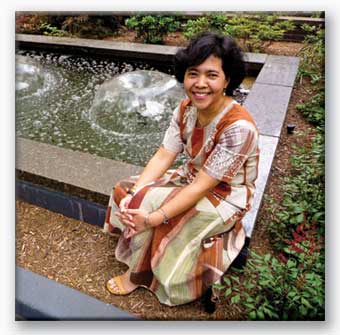
There’s much in Islam that favors women, says this scholar. As sisters in faith Muslim and Catholic women can seek out such traditions together.
Syafa Almirzanah, a professor of comparative religion at Islamic University Sunan Kalijaga in Yogyakarta, Indonesia, could have continued her studies anywhere in the Muslim world, but she chose Catholic Theological Union in Chicago. Last spring she became the first Muslim to earn a doctorate from the school.
“Dialogue is, for me, a must,” she says. “In my tradition it is the obligation of Muslims to learn from others, to get knowledge from everywhere.”
Almirzanah has been active in interreligious dialogue in both her home country of Indonesia and in the United States. She feels comfortable with Catholicism, she says, because of the many similarities between it and Islam.

One unfortunate similarity is the way scholars from both traditions have misused faith to repress women. Almirzanah hopes that by learning about the history and theology of Islam—and by participating in interreligious dialogue—Muslims will embrace more female-friendly interpretations of the religion.
“I think one of the most important things in dialogue is having the courage to criticize our own tradition. We must learn from others, then come back and look at our tradition with a new horizon,” Almirzanah says. “Learning from others enriches our traditions. We can be better Muslims and better Christians.”
What does the Qur’an have to say about women?
The Qur’an is very positive about women. In the story of Creation, women and men are created from the same cells, so usually scholars say that means that men and women are the same before God.
The problem is that different Muslims understand the Qur’an in different ways. Islam is not the monolithic religion people think it is, just as Christianity is not monolithic.
If you read the Bible, you cannot ignore the context. When God revealed himself, it was not in a vacuum. People who receive the revelation of God have different backgrounds, experiences, and contexts, so they respond to it differently.
The same is true in Islamic tradition. Some more traditional Muslims only focus on what’s written in the text and don’t pay attention to the context of the verses; other more modern Muslims look at why God revealed a particular verse and how the community at that time understood it.
The verse on polygamy, for example, says that you can marry one or two or three or four women. More fundamentalist or traditional Muslims use this verse to justify having more than one wife, but actually the verse does not stop there. It continues: “If you cannot do justice, just marry one.” They ignore that crucial part of the verse. This verse was revealed after a war, and there were a lot of widows and orphans, so men were allowed to marry multiple women in order to take care of them.
You also must look at verses in relation to other verses. The Qur’an says elsewhere that even if you wanted to, you could not do justice to more than one wife. So actually Islam and the Qur’an ban polygamy. It says if you cannot do justice, just marry one woman, but it also says you can never really do justice to more than one wife.
How were women treated during the seventh century in the Arabian Peninsula at the time of Muhammad?
This is also debatable. Scholars usually compare what it was like for women before Islam and after Islam.
Most scholars say that pre-Islamic times were worse for women. They say that before Islam men could marry more than four women. A Muslim scholar will argue that Muhammad limited polygamy and advocated the ideal marriage of one man and one woman. This is progress because some say that husbands could even sell women before Islam.
But there are also many scholars who write that before Islam women’s conditions were not really bad because they were free and had rights. One author says that before Islam a lot of women were involved in war and managed businesses. There is evidence of cultures where husbands came into their wives’ homes when they married, and the children would belong to the women’s tribe. Our Prophet’s first wife was a businesswoman, and she came from a very noble tribe, though she may be the exception.
I personally think it was almost like it is today. In certain communities where people are poor and have no access to education, of course women may not have the same opportunities as women who have rich families and live in an urban society. I can say that there were some good attitudes toward women before Islam, but Islam increased those good attitudes.
How did Muhammad treat his wives?
The first wife of the Prophet was a businesswoman. His youngest wife, Aisha, was a scholar and one of the interpreters of what the Prophet was saying. Because she was very close to the Prophet, a lot of people asked Aisha about what they should do in matters of love or matters of Sharia, or Muslim law. She also was involved in battle.
The Prophet didn’t teach that women should just stay at home. These rules were introduced by the Prophet’s companions after his death. The Qur’an gives women the right to pursue an education and be involved in worldly matters.
I think we need to get traditional Muslims to look at history, even at our Prophet’s wives, and see that they were very active. Why should we now have to stay at home?
There is a verse that says men are above women, but above here does not mean women are naturally inferior. It means men are responsible for family welfare because they work outside the home and earn money—as they were in Muhammad’s time.
Today, a woman can go outside of the home, work, and earn money, so she has the same status as a man. She also has responsibilities for her family, so for a more modern scholar, men are not above women.
How do more traditional Muslim scholars explain away the prominence of Muhammad’s wives?
They say that his wives were exceptions. Most of the interpreters of the Qur’an have been men, so there is a lot of submission of women in Muslim teachings. When I was doing my graduate studies, my adviser told me that some of the interpreters were men who really hated women.
A lot of the misogynistic hadiths— the sayings of the Prophet—do not come from trusted sources, though.
Hadiths tell scholars about the life of the Prophet and the context of the revelations but aren’t actually revelations themselves. They are passed on through generations of people from Muhammad’s contemporaries, so scholars have to make sure there is a common link back to the time of the Prophet. In order to evaluate whether the Prophet said something, we have to study the transmission of the tradition and who it came from.
We have very strict requirements to accept that a saying really came from the Prophet. Most of the misogynistic hadiths come only from one source. These cannot be used as a resource for an edict. But some people choose the one that matches their thinking rather than the one that has the best source.
Who are other notable female figures in Islam beyond Muhammad’s wives?
There are a lot. The ninth-century scholar Ibn Sa’d wrote biographies of important Islamic figures, and he had a whole book of women in Islamic history.
There are also women saints. Rabia al-Adawiyya is a very famous Sufi, or Muslim mystic. She was a pioneer for the idea of love for God in Islamic mysticism. She has a well-known prayer: “God, if I pray to you only so you do not put me in hell, just put me in hell, and if I pray to you only so I can go to paradise, don’t put me in paradise, but if I pray to you only because I love you, don’t hide your face from me.”
Rabia is said to be in the rank of men because she was close to or one with God. A lot of Muslim women look at her as an example—the ideal mystic woman. She didn’t marry, but there are a lot of women mystics who did marry. Some are the wives or daughters of male mystics. Sufi men had women teachers. A teacher of the famous Sufi Iban Arabi said, “I am his spiritual mother.”
As in Christian spirituality, there are a lot of Muslim women mystics who are highly regarded. Mystics go beyond the text into the essence of the story. When you do that, every religion can meet, and men and women can meet. It is very conducive to dialogue.
Christian women sometimes struggle with male images of God. Is God thought of as male in Islam?
God is often described as having both a feminine and masculine aspect. One scholar compared it to yin and yang. In the Islamic tradition we call it Jalal and Jamal. Jalal is the might of God, and Jamal is the beauty of God. God has both of these aspects, feminine and masculine.
Yin and yang always are together, so women and men should be together. Man is not better than woman, and woman is not better than man. In Islam women and men should cooperate. Even in the Muslim Creation story, Eve is not the cause of the fall.
Still, the pronoun for God is a male pronoun, and that is a problem that feminists discuss. There are also certain verses in the Qur’an that only use a male pronoun, so Muslim feminists say that the male pronoun refers to both genders. For example, verses such as “you have to pray every day” use the male pronoun, but this doesn’t mean that praying is only for males.
What does it mean to be a Muslim feminist?
Quite simply, I define it as someone who supports women’s rights. There are a lot of male feminists who support the equal status of women, especially in Indonesia and Egypt. Some governments also promote equal rights.
Generally, what is the status of women in the Muslim world today?
As I said, Islam isn’t a monolithic religion. The place of women depends a lot on the social, political, and cultural conditions of the community. Islam in Indonesia is very different from Islam in Saudi Arabia, for example.
In Indonesia it’s common for women to study and be in politics, but still there is resistance. We had a female president before our current president. When she was to be appointed president, fundamentalist groups opposed it because they said that Islam prohibited women from leading them. She became our president anyway. There are no verses that prohibit a woman from being president.
Still, many believe that women’s responsibilities are domestic tasks such as cooking and taking care of children. Even my in-laws still believe that. They wouldn’t let my husband cook.
When a woman’s husband comes home from his job, she is supposed to serve him. But both my husband and I work outside the home, so why should I serve him? I always say, “I am not his servant. I am his wife.” If I serve him on an occasion, it’s not because it’s my responsibility; it’s because I love him.
We also have to understand there are women themselves who really believe in the fundamentalist interpretation. They believe that they should be at home and that they might have to accept being a second wife because this is what Islam teaches.
How much of that is due to religion and how much is due to culture?
I think it has to do with both. Culture is there, but certain interpretations of religion are there, too. There is a certain interpretation of Islam that says women should stay at home, not go anywhere, and take care of the family.
This is why women have to study what Islam actually teaches about women and our position. Our Prophet cooked and even sewed his clothes himself. There is nothing to be ashamed of in that.
We have to improve Muslims’ understanding of the Qur’an. A lot of laypeople are Muslim because their family is Muslim, and they have never really studied their own tradition. They depend on their religious leader: Whatever he says, they will follow it. We cannot just do that; we have to know the sources of Islam ourselves.
There are a number of schools of thought for Islamic law. I was taught that you don’t have to follow one of them, but the most important thing is to know why they say what they do.
How can women’s positions in the Muslim world improve?
There are a lot of ways to improve our status, but I think the key, again, is education. Unfortunately, there are still a lot of people who do not have access to it. A lot of families in my country still pay only for boys and not girls to study if they have limited resources.
I have a brother, and my father let me go to school even to the highest levels, but that’s often not the case at the university level. As a professor in Indonesia, I do see a lot of female students studying theology, though.
Why do you think some resist alternative interpretations of Islam?
I think we need more research on that. Some scholars say fundamentalism is not a purely religious movement, but is political as well, and I agree. Patriarchal culture is weakened by the Muslim feminist movement. They are strict with women because they want power.
I also think it’s one way for the Muslim community to challenge modernity. When it comes to women’s issues specifically, for example, fundamentalists say that a Muslim feminist is strongly influenced by the Western perspective. They criticize the feminist movement because they don’t want it to be secular.
What do you as a modern Muslim make of Western feminism?
I think Muslims have to choose what is really appropriate for us and what can be applied in our tradition from Western feminism.
It does seem like Western feminists don’t really need men sometimes, and I don’t think Muslims should go in that direction. We have to work together. The Qur’an says that women are sustenance to their husbands, and husbands are sustenance to their wives.
Every tradition has good points and bad points. I always try to see the positive. Fundamentalists often refer to Sayyid Qutb, an Egyptian scholar who came to the United States in the late 1940s and only saw bad things—promiscuity, drugs, materialism, and so on. In his mind people in the United States were living in Jahiliyyah, the era before Islam, a state of ignorance.
Should we follow him? I think not. I came here and I saw myself what it is like in the United States. There is still much good here. We can choose to see what is good.
What issues do Christian and Muslim women share?
I think Muslim and Christian women have the same struggle to gain equal positions to men within our traditions. Most of the interpreters in the Catholic tradition are male, just as in Islam. That’s one of the reasons they underestimate women, and there are misinterpretations of both religions.
For example, Jesus had female followers, but the Catholic tradition doesn’t really consider them to be apostles. From my perspective, the women of those days were Jesus’ apostles. In Islam we also have women companions to the Prophet Muhammad. But for some reason, in both cases, these women have been forgotten.
Muslim and Christian women can work together. We need to interpret verses for ourselves and criticize the old male interpretations. We should study together and go deeper into the traditions to find out what our traditions are actually saying about the position of women.




Add comment