

The immigration debate comes home to Catholic parishes
She brought her children here from her country because she feared gangs would kill them.
“I left because of the delinquency of El Salvador. The situation there is very delicate. A mother has instincts toward her children, and, well, I saw a very dangerous future for them,” Maria Ayala says.
The Salvadoran civil war—which killed some 70,000 from 1980 to 1992, including San Salvador Archbishop Oscar Romero—spawned gang violence by groups like Mara Salvatrucha.
“I was afraid my children would become part of Mara,” Ayala says. She saw many other neighborhood children join the gang. They wound up dead or addicted to drugs.

The civil war also devastated the economy in El Salvador, especially the country’s agriculture. Violence and unemployment, coupled with deteriorating family and social structures, has led many El Salvadorans to flee to the United States.
“Just thinking about going back makes us tremble,” Ayala says. “I’m not going back.”
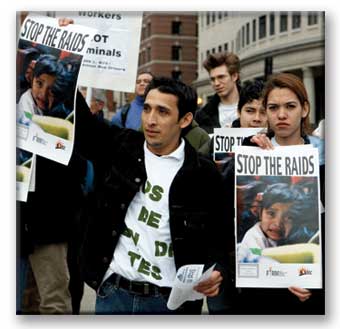
U.S. Immigration and Customs Enforcement seemed to have other plans for Ayala, who sewed military vests and backpacks for U.S. troops at the Michael Bianco plant in New Bedford, Massachusetts. On the crisp morning of March 6, 2007, when ICE officers stormed the plant and surrounded Ayala and her fellow workers.
“We turned off our machines, but we were already surrounded by immigration agents,” Ayala says of the raid. “They told us not to run but to sit down. We didn’t know what to do—run, sit, or hide.”

Ayala says she and her coworkers felt as if they were on a dead-end street, not knowing where to go or what was going to happen. The workers went most of the day without food or water, cuffed at the wrists and ankles.
“A worker doesn’t deserve that kind of treatment,” she says, choking up. ICE held Ayala and the others at nearby military barracks overnight. She says she went three days in detention without bathing.
Raids and anti-immigrant laws are spreading fear among the undocumented, says Holy Cross Father Daniel G. Groody, associate professor of theology at the University of Notre Dame and an immigration expert.
“It’s divided families. Fathers were sent back and their kids remained here,” he says. “People were living in the shadows before, but I think now people in some sense are moving into hiding.”
That’s the case with Ayala, who still lives in Massachusetts with her children. She picks up the odd job here and there to provide what she can for her family.
“We will never forget that day,” she says. “We cannot sleep, we get pains, headaches. Our world is uncertain because here we are in the United States, and we don’t know our future.
A parish opens its doors
Undocumented parishioners of St. Bridget Church in Postville, Iowa stayed in the parish hall for six days after the May 12, 2008 ICE raid in that city.
“They did not leave [the church] because of fear,” Father Paul Ouderkirk, the parish pastor, says of those affected by the invasion of the Agriprocessors meatpacking plant, in which 389 undocumented immigrants were detained. “They were so scared.” More than 400 immigrants found a safe place to sleep at St. Bridget.
“Our church doors were wide open. We housed parishioners and fed them for a whole week, three meals a day,” says Paul Rael, who works in Hispanic ministry at the parish. “And we continue to help them, especially people who are detained or who have detained loved ones.”
At one point the parish was feeding more than 1,000, “morning, noon, and night,” according to Ouderkirk, a tremendous effort sustained by the volunteerism of a few women at the parish. But the positive response was far from universal.
“A certain number are saying they’re criminals—they should be prosecuted,” Ouderkirk says. “My response to that is, ‘They lived here for 10 years, why all of a sudden are you bringing this up?’ Nobody answers that.”
Others have been raising similar questions since ICE increased its enforcement and deportation efforts, especially after the failure of immigration reform legislation in 2007. Over the last five years, the U.S. Catholic bishops have been pushing for a comprehensive immigration reform that would include abandoning the border “blockade” strategy and emphasizing family unity and a broad-based legalization of the undocumented. (See sidebar, page 15.)
An October Zogby poll commissioned by the bishops found that 69 percent of self-described Catholics supported a path to citizenship for undocumented immigrants. That’s up from 49 percent two years ago, but divisions among Catholics remain.
Steve Skojec, a parishioner at St. Mary Mother of God Parish in Washington, is one of the many Catholics who still doesn’t see it the bishops’ way. He believes the bishops’ position encourages unchecked immigration.
Skojec says some bishops “seek to undermine legislation that limits social services” to the undocumented. In particular he points to Phoenix Bishop Thomas J. Olmsted and Tucson Bishop Gerald F. Kicanas, who publicly opposed a ballot measure that would require individuals to produce proof of citizenship before applying for public benefits. The measure passed.
Skojec believes that “certain bishops” do not sufficiently recognize a nation’s right to control its borders. They “pay lip service to the sovereignty of the state, while placing an inordinately heavy weight on the right of the migrant,” he says.
Groody of Notre Dame has a reply to that: “The claim to sovereign rights must be addressed after the needs of distributive justice are met. That means we really can’t look at immigration as the problem—it’s a symptom of a deeper one.”
That deeper problem, Groody says, has to do with trade imbalances and the underdevelopment of countries—situations that push immigrants across the border.
“Unless we’re really going to address those problems, people are going to be migrating as they have since the beginning of time,” he says.
Faith over politics
Despite a few disgruntled parishioners, Our Lady of Guadalupe Parish at St. James Church also opened its doors to migrants in the wake of the 2007 New Bedford raids.
“There was a group after the raids, and it wasn’t just Anglo folks, who were saying that [the immigrants] knew what they were coming for, what they were getting into when they came into the country illegally,” says the pastor, Father Richard Wilson.
“At the same time, these were the people who were also helping with food and whatnot,” he says. “So a lot of people are able to separate their ideological positions with how they deal with the individual. You have parishioners who oppose illegal immigration but believe that this is a human being who needs food, so they’re going to help give it to them.”
Wilson recounts how parishioners called talk radio stations to defend their pastor’s actions, despite not agreeing with the church position on immigration. “Well, he’s doing what he’s supposed to be doing,” they would say.
The priest says parishioners’ disposition to the immigrant often has a lot to do with their faith. “If they have a deeper faith, they’re much more open to each other because they understand we’re all brothers and sisters. A lot of people did respond after the immigration raid to help out in many different ways. They came from all different ethnic groups, so a lot of good did come out of a bad situation.”
Holy Cross Father Marc Fallon, who works with Catholic Charities in New Bedford, says many Catholics and other community members are hesitant to interact with the migrants.
“These are very painful stories. Our parishioners are political refugees—they’re fleeing poverty and the presence of gangs and a completely disrupted social fabric,” he says. “The cheap exit is to listen to the cable news racists who want to target them and put a label on them and treat them as criminals.”
Fallon says the undocumented are often victims of racist and xenophobic language. Despite his efforts in community forums, the message doesn’t sink in.
“All people want to do is build a wall and still, somehow in good conscience, be able to go to Cancun for their vacation.”
Same and different
“Immigrants have always been scapegoats with these economic problems and national issues,” says Groody.
Groody notes the Irish in particular. “The ‘fighting Irish’ were immigrants fighting for human dignity,” he says. “So in some sense the stories of immigration are not new. But the numbers of immigrants are greater than we have ever seen before.”
The number of people living outside their country of birth has practically doubled since 1955, according to the United Nations Population Fund. The total number climbed to 191 million in 2005.
“The church has to critique some of the problems in the current policy as well as encourage development—which needs to happen so that people don’t have to migrate in the first place,” Groody says.
The message strikes a chord with Chris Fleischman, who attends All Saints Catholic Newman Center in Tempe, Arizona.
“This whole thing didn’t start with people wanting to invade our country,” he says. “It started because they were desperately poor, and our trade policies made their condition worse.”
Fleischman volunteers with No More Deaths, a humanitarian group that offers food and medical assistance to immigrants crossing the U.S. border illegally. He says the priests at the Newman Center have been supportive of the effort, announcing water drives and preaching about the church’s stance on immigration.
“It’s really great to hear them say that what we’re doing is the work that Jesus would want us to do,” Fleischman says, adding that many pastors in the area don’t address immigration.
“Being a pastor is kind of a political position, and I understand that,” he says. “I guess they have to prioritize and not upset the apple cart. But I think that’s what Jesus would do—reach out to the least among us.”
Julio and Elvira Vázquez, parishioners at St. Catherine of Siena in Phoenix, feel supported by the local church. The Vázquezes entered the country legally but overstayed their visa, which is common among the undocumented. Julio says they leave the house only when they need to or to go to Mass.
Arizona isn’t the friendliest place for undocumented immigrants. With tough immigration laws and a zealous county sheriff who has made national headlines by conducting sporadic sweeps for undocumented immigrants, many live in fear of deportation.
“The fear is always there, but the Virgin Mother protects us,” Julio says, adding with a chuckle, “If they do catch us, they’re going to send us back to Mexico, not just anywhere. They’re going to send us back home.”
A family crisis plan
In January 2008 the Legal Arizona Workers Act took effect. The legislation punishes employers for hiring undocumented immigrants. Parishes throughout the state have noticed migrants leaving to work in other states.
“People are preparing a crisis plan in case they get deported,” says Tommy Espinoza, a parishioner at St. Catherine of Siena who is the president of Raza Development Fund, Inc., the nation’s leading Latino development lending institution. “You’re sitting down and talking about this with an 8-, 9-, 10-year-old kid, who has no sense of the political situation. You’re instilling fear.”
“You don’t want to take a chance with the sheriff’s department,” Espinoza says. The sheriff’s deputies will routinely pull people over for minor traffic violations and ask for their proof of residence. If the person is undocumented, the deputies will hand him or her over to ICE.
Espinoza says that, as a result, the undocumented won’t call the police when a crime is happening in their neighborhood.
“It has to be really bad before they call,” he says. “Criminals are preying on communities that are predominantly immigrant.”
For Espinoza the church’s role is a bit ambiguous. While he acknowledged the bishops’ efforts, he says not everyone is happy with them.
“The Latino always wants more,” he says. The undocumented don’t expect their bishops to be political, he says, but to evangelize.
When reform does happen, Espinoza predicts the driving force won’t be human dignity but the economy.
Last year both the CATO Institute and the President’s Council of Economic Advisors found that on average immigrants pay $80,000 more in taxes than they receive in government services. The Pew Hispanic Center last year reported that the influx of foreign-born workers is not having a negative effect on native-born workers.
“Americans are asking themselves what the impact of immigrants is on the bottom line,” says Jill Gerschutz, migration outreach coordinator for the U.S. Jesuit Conference. “While [undocumented immigrants] do use schools and hospitals, they actually don’t have access to a lot of the welfare benefits that a lot of Americans think that they do—and they do pay taxes, especially sales taxes.”
Catholics also need to be reminded that the church in the United States is an immigrant church, says Kevin Appleby, director of the U.S. bishops’ Office of Migration and Refugee Policy.
“This country was built by immigrants from distant lands. A lot of opponents will say, ‘Well, my grandparents came legally.’ ”
Yet, he says, before 1923 there was no law governing immigration to the United States. So anyone who came before then simply had to present themselves and demonstrate they didn’t have any communicable diseases.
Forgotten roots
Father Gary Graf, pastor of Holy Family Parish in Waukegan, Illinois, says he often talks about “historical amnesia” with his parishioners.
“The Catholic Church was there for immigrants when no one else was,” says Graf. He tells parishioners who disagree with the church’s position that the church “was there for your parents and grandparents, why wouldn’t we do it for these people here?”
Graf also notes the drawbridge theory on immigration. Once you immigrate and are safely in the castle, so to speak, up comes the drawbridge. “The harshest critics are sometimes first-generation immigrants. They’ll say their parents suffered, so these immigrants have to suffer in the same way.”
A city council-approved petition inflamed tension at Graf’s parish last year. The council approved participation in Section 287(g) of the Immigration and Nationality Act, a controversial program that permits local law authorities to enforce immigration law.
Normally police officers send only undocumented immigrants guilty of violent crimes to ICE for deportation. The recently approved measure allows Waukegan police to start deportation proceedings for any reason.
The mayor of the city also established a towing ordinance requiring officers to impound vehicles of drivers driving without a valid license. To get their car back, individuals have to pay $500. For the last two years, when people have been pulled over, they’ve been asked about their documents.
“Few issues can so polarize a community,” Graf says, noting that a lot of his parishioners have been pulled over and a number have lost their vehicles.
In order to deal with this escalating tension, Graf has pro-immigrant and anti-immigrant groups meet on a regular basis. These meetings are important so that both sides understand each other. If reform is passed, one side will think it too harsh, and the other will find it too mild.
“A lot of people haven’t changed their minds, but they’re more sensitized,” he says. “We’re looking for integration, not assimilation. If we are truly a nation of immigrants, then everyone has to change. All of us become new people in the process.”
Change of heart
Passing immigration reform itself will not change attitudes.
“What we really need to do is look at attitudes and see how people are relating to each other and to newcomers,” Appleby says. “That’s where the church can make a big difference—in trying to educate to the reality of immigration and to the human side of the immigration story.”
In Waukegan, in Postville, in New Bedford, and in Phoenix, over and over, when Catholic citizens have come face to face with the undocumented, their hearts have been softened. It’s as if in the migrants’ suffering, they see them for who they are.
Raids and anti-immigrant laws force Catholic parishes to talk. It stops being politics and starts being life—more specifically, the life of our family, brother and sister, undocumented and anti-immigrant.
“As a church, as we work toward political and economic reform, the bigger issue we also need to work out is our spiritual reform,” Groody says. “And that’s going to be changing minds and hearts—and crossing those borders is going to be more difficult than crossing the walls that are constructed by government.”






Add comment